You’re in one of two spots right now.
Either you decided to pursue a commercial driving job and opened the Georgia CDL manual, only to realize it feels bigger than expected. Or you already know you need the permit first, but you’re not sure how to study without wasting time on the wrong material.
That is normal. Most new CDL applicants do not struggle because they are incapable. They struggle because the process looks crowded at first. There is the written test, the endorsements, the DDS appointment, the permit, the waiting period, and then the skills exam. If you do not have a clean plan, it all starts to blur together.
The good news is that the path is simpler than it looks when you break it into the right order. Study the right sections. Use a georgia cdl permit practice test the right way. Learn what DDS is asking. Then move into hands-on training once your permit is in hand.
Your Starting Line for a Commercial Driving Career
A lot of future commercial drivers start the same way. They hear about a job opening, talk to a friend already in trucking, or decide they want a more practical career path. Then the questions hit fast. What test do I take first? What do I study? Which practice tests are worth my time? What happens at DDS?
The first answer is straightforward. Your starting point is the Commercial Learner’s Permit, often called the CLP. Before anyone worries about backing, shifting, or road test routes, they have to pass the written knowledge exam.
Many people get overwhelmed at this point, because they treat the permit test like a mystery. It is not a mystery. It is a reading-and-application test based on the Georgia CDL manual and the vehicle type or endorsements you want.
A better mindset is this: do not try to learn everything at once. Learn the core rules first, then layer in the endorsements that match your goal. If you want a broader picture of the full training path, this overview of truck driving schools in Atlanta, Georgia can help you see how the permit fits into the larger licensing process.
The permit stage is not about being perfect. It is about proving you understand safety, inspection basics, and how commercial vehicles operate.
When students get stuck early, it is because they read passively. They flip pages, highlight lines, and hope the information sticks. A stronger approach is active study. Read a section, quiz yourself, and then take practice questions until you can explain the answer in plain language.
Decoding the Georgia CDL Knowledge Tests
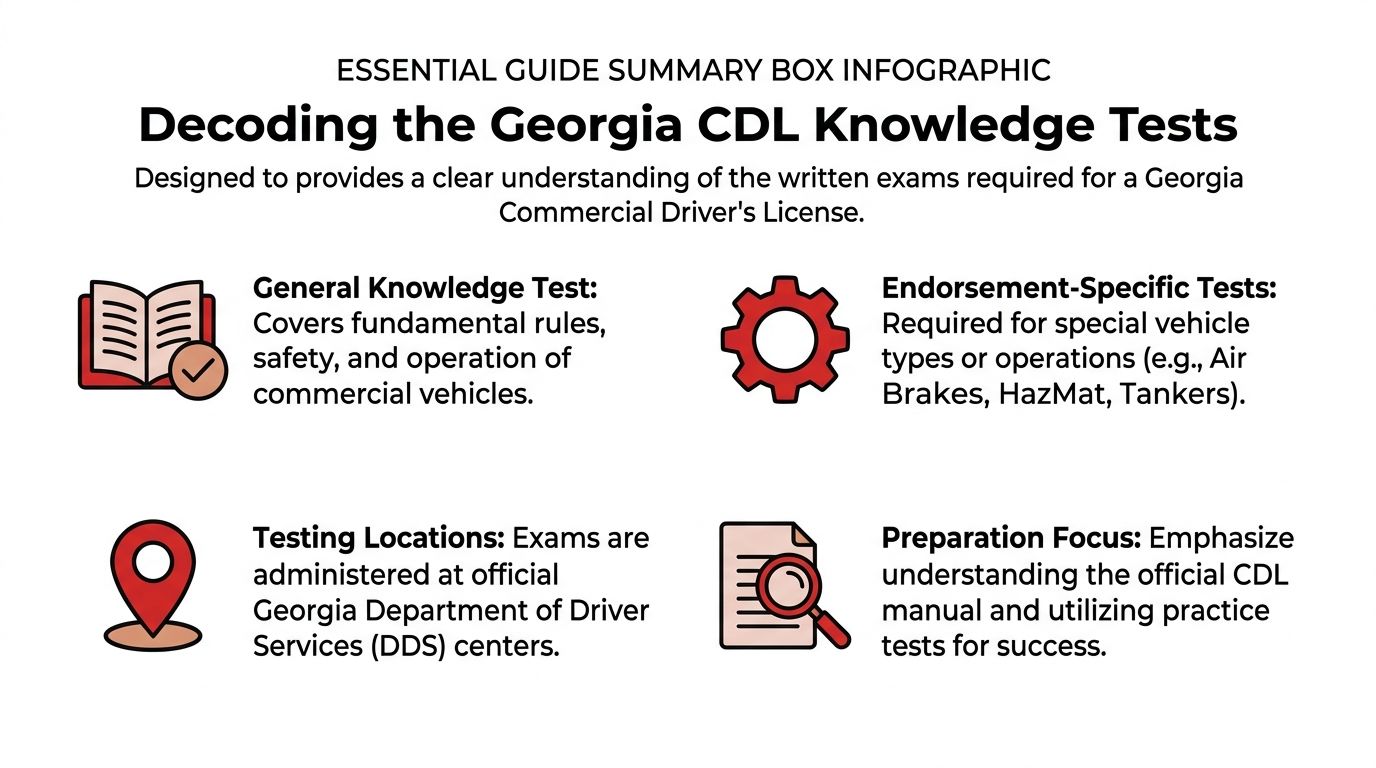
A lot of students hit this point and assume the written tests are one big wall of random rules. They are not. The Georgia CDL knowledge exams work more like a checklist. DDS is checking whether you understand the safety rules for the kind of commercial driving you plan to do.
For nearly every applicant, the first checkpoint is the General Knowledge test.
According to this Georgia CDL practice test guide, the Georgia CDL General Knowledge test has 50 questions, uses multiple-choice or true/false formats, requires 80% to pass, which means 40 correct answers, and is not timed.
What the General Knowledge test is really checking
This exam measures judgment as much as memory. A student can memorize a phrase from the manual and still miss the question if they do not understand how that rule works on the road.
A-1 instructors see this all the time. A student knows the name of a vehicle part but gets stuck when the question asks why a defect matters. That is why we teach the material in layers. First, learn the rule. Next, connect it to a real driving situation. Then answer practice questions.
Expect questions around these areas:
Vehicle inspection basics
Know what parts to check before a trip and what kinds of defects can make a vehicle unsafe.Safe driving habits
Study following distance, speed control, scanning ahead, and how to spot hazards early.Basic operating knowledge
Large commercial vehicles turn wider, stop slower, and need more planning than a passenger car.Emergency procedures
Be ready for questions about brake problems, roadside breakdowns, and other situations where a calm response matters.
Here is the key idea. The test rewards understanding. If you can explain a rule out loud in plain language, you are much more likely to choose the right answer when two options look similar.
The endorsement tests that may apply to you
After General Knowledge, some applicants need extra tests based on the vehicle or job they want. This part confuses a lot of new drivers, so keep it simple. You do not study every endorsement. You study the ones tied to your goal.
These are the test areas many Georgia CDL applicants consider:
| Test area | When it matters |
|---|---|
| General Knowledge | The starting point for most CDL applicants |
| Combination Vehicle | Common for tractor-trailer driving |
| Air Brakes | Needed if the vehicle uses an air brake system |
| Tank Vehicles | Needed for tank cargo operations |
| Passenger | Needed for buses or other passenger vehicles |
| School Bus | Needed for school bus driving |
| Doubles/Triples | Needed for certain multi-trailer combinations |
| Hazardous Materials | Needed for hazmat work and comes with extra screening requirements |
A simple way to organize this is to treat General Knowledge as your foundation. Endorsements are the add-on rooms. You build the foundation first, then add only the rooms you need.
How to avoid studying the wrong material
New CDL applicants often waste time by reading every endorsement chapter before they have picked a direction. That is like studying for every class before you know your schedule. It feels productive, but it scatters your attention.
Use this method instead:
- Study General Knowledge first until the core safety rules make sense.
- Choose the vehicle type or job you want.
- Add only the endorsement sections that match that path.
- Use practice questions to find weak spots, then go back to the manual for those topics.
If you want help choosing the right test sequence, this step-by-step guide on how to obtain CDL in GA lays out the licensing path clearly.
At A-1 Driving School, we coach students to study with a purpose. Do not just ask, “What is on the test?” Ask, “What kind of CDL job am I preparing for?” That one question usually tells you exactly what to study, and what you can skip for now.
Your Proven 4-Week Georgia CDL Study Plan
A georgia cdl permit practice test works best when it is part of a schedule, not a random activity you squeeze in when you feel motivated.
Many individuals do better with short, repeatable study blocks than with one long cram session. Read a section carefully. Test yourself. Review mistakes. Then come back the next day while the material is still fresh.

Week 1 build your foundation
Your first week is for orientation and core concepts.
Read the General Knowledge section of the Georgia CDL manual in manageable chunks. Do not rush. At the end of each study block, close the book and write down what you remember about the topic. If you cannot explain it, read that part again.
Focus on:
Inspection language
Learn the names of major parts and what you are checking for.Safety rules
Pay attention to following distance, seeing hazards, and basic defensive habits for large vehicles.Vehicle behavior
Commercial vehicles need more room, more planning, and smoother control than a passenger car.
Keep a notebook with two columns. In the left column, write the rule. In the right column, write why it matters. That second column helps the information stick.
Week 2 start using practice tests seriously
Many students improve fast during this period.
A Georgia CDL practice resource reports that 66% of candidates fail their first-try General Knowledge practice test, while people who use practice tests consistently achieve 20% to 30% higher first-attempt pass rates at official DDS centers by getting familiar with scenario-based questions (Georgia CDL practice test data).
Do not let that first low score discourage you. A weak first score is useful. It shows you where your blind spots are.
Use this method:
- Take a practice test without looking up answers.
- Mark every missed question by topic.
- Return to the manual only for those weak areas.
- Retake a different set of questions later that day or the next day.
The goal is not to memorize a question bank. The goal is to train your brain to recognize how DDS-style questions are framed.
Week 3 add endorsements and mixed review
By week three, your General Knowledge study should feel more organized. If you need endorsements such as Air Brakes or Combination Vehicle, begin focused study there.
A simple rotation works well:
- One day on General Knowledge review
- One day on endorsement material
- One day on mixed practice questions
- One day on your weakest topic
That mix keeps your core knowledge sharp while building the extra knowledge your specific CDL path requires.
Here is a good checkpoint question to ask yourself: when you miss a question, do you understand why the correct answer is right, or did you just recognize it? Recognition is weaker than understanding.
To break up your study session, watch a short walkthrough and then return to your notes with fresh eyes.
Week 4 simulate the test
Your final week is about control, not panic.
Take full-length practice tests in one sitting. Sit at a table. Put your phone away. Read carefully. Review every mistake after you finish.
Use this short checklist before your final practice rounds:
| Study check | What you should be able to do |
|---|---|
| Explain inspection items | Name the part and explain what you are checking |
| Handle scenario questions | Apply the rule, not just quote it |
| Spot weak sections | Identify patterns in your errors |
| Stay calm through a full test | Maintain pace without rushing |
A good final week does not feel dramatic. It feels steady. You should be cleaning up weak spots, not trying to learn the entire manual from scratch.
Full-Length Georgia CDL Permit Practice Tests and Answers
The best way to use a georgia cdl permit practice test is to answer first, then review the explanation slowly. Do not skip the explanation just because you got the question right. Sometimes students guess correctly for the wrong reason.
These two mini-tests are modeled in the spirit of General Knowledge study. Use them as a workshop. Write your answers down before checking the key.
Practice test one
1. Why is a pre-trip inspection important?
A. It gives you a chance to clean the vehicle
B. It helps you find safety problems before driving
C. It replaces regular maintenance
D. It shortens your route
2. When driving a large commercial vehicle, stopping distance is usually:
A. Shorter than a passenger car
B. The same as a passenger car
C. Longer than a passenger car
D. Irrelevant if traffic is light
3. If a question asks for the safest response to a hazard ahead, your first thought should be to:
A. Speed up and pass it
B. Ignore it unless it blocks your lane
C. Recognize it early and create space
D. Move suddenly without checking mirrors
4. Why do commercial drivers need to manage space carefully?
A. Large vehicles are less affected by traffic
B. Large vehicles need more room to stop and maneuver
C. Space management matters only on highways
D. Mirror use is enough by itself
5. If you do not understand a test question at DDS, the best move is to:
A. Guess immediately without rereading
B. Leave the building
C. Reread it slowly and look for the safest answer
D. Skip every difficult question forever
Answers and explanations for practice test one
1. B is correct.
A pre-trip inspection is about safety. You are checking the vehicle before operation so you can catch visible or obvious issues before they become road problems.
2. C is correct.
Commercial vehicles take more distance to stop. That is one of the core ideas behind spacing, speed control, and hazard recognition.
3. C is correct.
Hazard response starts with seeing the issue early. If you identify a problem soon enough, you can slow smoothly, adjust position, and make a safer decision.
4. B is correct.
This is one of the central differences between car driving and commercial driving. Large vehicles need more room, and the safest drivers plan ahead instead of reacting late.
5. C is correct.
DDS knowledge tests reward careful reading. Many wrong answers look tempting because they sound familiar or dramatic. The best answer is usually the one grounded in safe, controlled driving.
Practice test two
Try this second set without looking back at the first.
1. A good study habit for the permit test is to:
A. Read once and never quiz yourself
B. Use practice questions to find weak topics
C. Avoid the manual completely
D. Study only the night before
2. Why do scenario-based questions give many applicants trouble?
A. They ask you to apply a rule instead of just recite it
B. They contain no driving concepts
C. They are always trick questions with no right answer
D. They focus only on vehicle color and route names
3. During exam preparation, what should you do after missing a practice question?
A. Memorize the answer letter only
B. Review why the correct answer is safest
C. Ignore the result
D. Switch to unrelated material
4. Why is calm pacing helpful on test day?
A. It helps you read each question more carefully
B. It lowers the passing score
C. It changes the test format
D. It removes difficult questions
5. Which approach is strongest for long-term retention?
A. Passive rereading only
B. Guessing until patterns appear
C. Reading, self-testing, and reviewing mistakes
D. Highlighting every sentence in the manual
Answers and explanations for practice test two
1. B is correct.
Practice questions are useful because they show you where your understanding breaks down. That lets you study with purpose instead of reviewing everything equally.
2. A is correct.
Many applicants know the rule when they see it directly. They get tripped up when the question wraps the rule inside a driving situation. That is why applied practice matters.
3. B is correct.
If you miss a question and only memorize the letter, you are likely to miss a similar question later. Learn the reason behind the answer.
4. A is correct.
Fast mistakes are still mistakes. Careful pacing helps you catch small wording differences and avoid choosing an answer that is almost correct but less safe.
5. C is correct.
The strongest study pattern is active. Read the concept, test yourself on it, and then go back over your errors with the manual open.
How to use these questions the smart way
A mini-test like this is most useful when you review by topic.
If you missed questions tied to inspection, spend your next study block on inspection language. If you missed hazard and space-management questions, focus there next. This turns random practice into a system.
Use this simple tracking format in your notebook:
Topic missed
Write the subject, not just the question number.Why you missed it
Was it confusion, rushing, or weak understanding?Correct rule in plain language
Rewrite the idea as if you were explaining it to another student.Next action
Read the manual section again or do another question set on that topic.
Good practice does not just test memory. It exposes habits. If you rush, overthink, or rely on guessing, your practice scores will show it before DDS does.
Common mistakes that waste study time
Many students put in effort but not in the right order.
Watch for these problems:
| Mistake | Better approach |
|---|---|
| Reading without quizzing | Read, close the book, and recall key points |
| Memorizing answer letters | Learn the safety principle behind the answer |
| Studying every endorsement at once | Focus only on the tests you need |
| Ignoring wrong answers | Use mistakes as your study map |
A georgia cdl permit practice test should make your study more focused each week. If your practice is not changing what you review next, you are leaving value on the table.
Scheduling Your Test and Navigating the DDS
You have studied for weeks, your practice scores are steady, and you are ready to test. Then test morning hits, and the problem is not the questions. It is a missing document, a name mismatch, or an appointment detail you did not confirm.
That is why this step deserves the same attention as your study plan.
What to prepare before you leave home
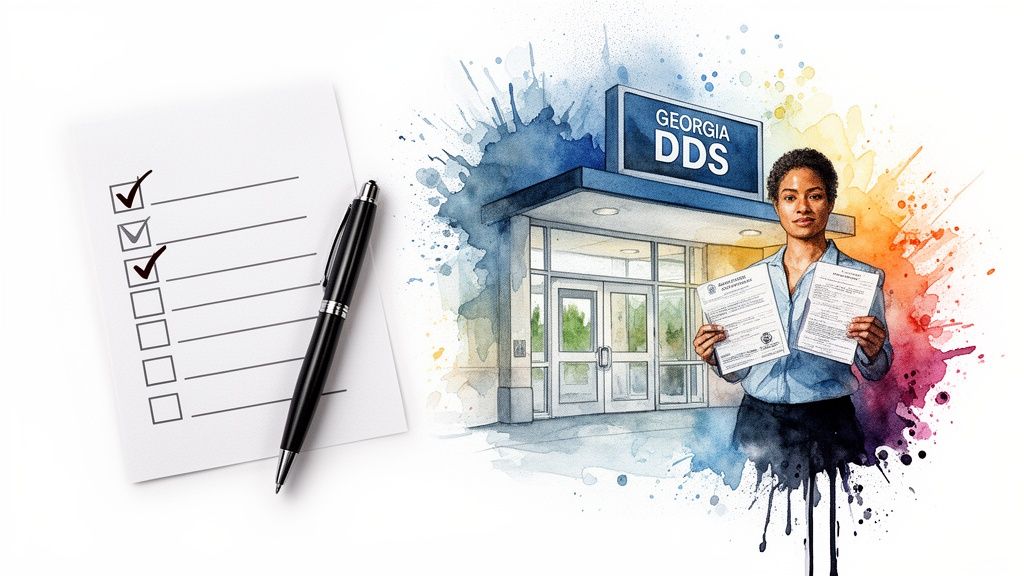
DDS paperwork works like a pre-trip inspection. If one required item is missing, the whole process can stop until you fix it.
Before your appointment, confirm the current DDS requirements for your situation and build a simple folder with everything in one place. Students who do this usually feel calmer because they are not hunting for papers in the parking lot.
Use this checklist:
Identity documents
Make sure your full legal name matches across documents.Proof of Georgia residency
Bring the type and number of residency documents DDS currently asks for.Social Security documentation
Check that the number and name match your other records.Any CDL-specific forms or medical paperwork you need
If your license class or driving type calls for extra paperwork, gather it early instead of trying to solve it the day before.
Money matters too. Georgia CDL applicants should expect separate state fees for the permit, application processing, the license itself, and the skills test. Check the current DDS fee schedule before you go so there are no surprises at the counter.
How to handle the appointment process
Treat the DDS appointment like the last mile of your study plan, not a small errand.
Pick a test date that gives you a little breathing room. If your scores are improving but still inconsistent, waiting a few extra days often helps more than rushing into an appointment just because a slot is open. A good target is to schedule when you can explain the rule behind the right answer, not just recognize it on a screen.
A-1 students do better with this step because we help turn the process into a sequence:
Confirm which knowledge tests you need
General Knowledge is common, but endorsements depend on your goal.Check DDS document requirements before booking
Rules can change, and personal situations can affect what you need.Choose a test day that fits your study rhythm
Morning works well for many students because focus is usually better.Put your documents together at least a day early
Last-minute packing creates preventable mistakes.Arrive with time to spare
A calm check-in helps you start the test with a clear head.
What the DDS visit is usually like
The written exam is given on a computer at DDS. That format sounds simple, but pressure changes how people read.
A student who does fine at home may miss easy questions at DDS because they read too fast, second-guess basic safety rules, or let one difficult item throw off the next five. The fix is simple. Slow down, read fully, and answer the question being asked.
These habits help:
Pause before you begin
Take one minute to settle your breathing and focus.Read each question all the way through
Small wording changes can change the correct answer.Watch for safety language
CDL questions often reward the safest action, not the fastest one.Do not carry one mistake into the next question
Miss one, reset, and keep working.
Many DDS setbacks come from paperwork problems, timing mistakes, or rushed reading. Handle those early, and test day gets much smoother.
If you want to see how the permit fits into the bigger training path, our guide to getting a Class A license in Georgia connects the written test, permit stage, and road training in one clear process.
From Permit to License The A-1 Driving School Advantage
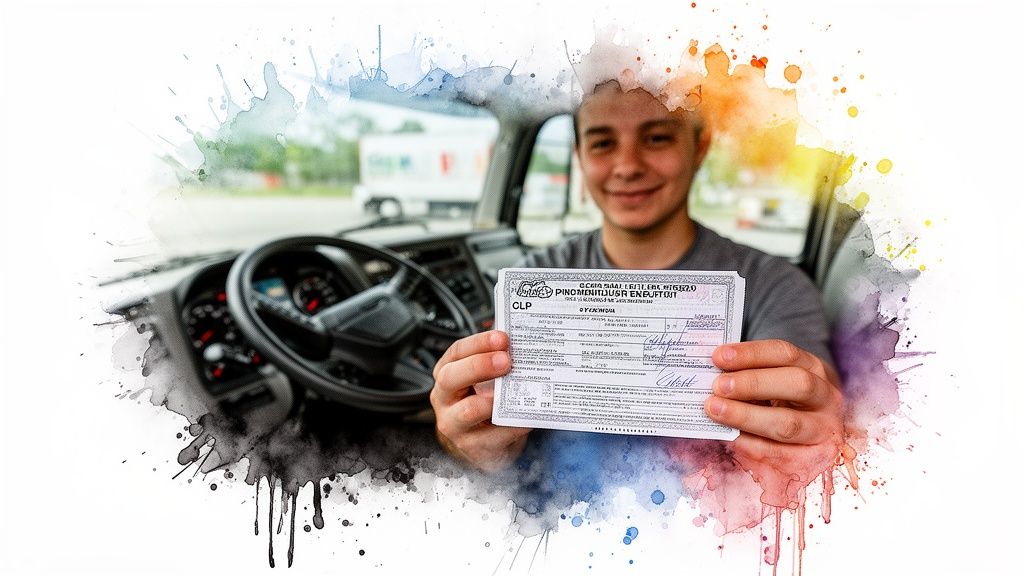
Passing the written test gives you permission to start the hands-on part of CDL training. That shift catches many students off guard because paper knowledge and truck performance are different skills.
Why many permit holders stall after the written test
Reading about a pre-trip is one skill. Saying it in order, under pressure, without skipping items, is another.
The same thing happens with backing and road driving. A student may understand the rule, then over-correct in the truck because no one has shown them how to slow the maneuver down and make smaller adjustments. That is a training gap, not a motivation problem.
The three skills areas that matter most
Here is the pattern instructors see most often:
| Skills area | Common trouble spot |
|---|---|
| Pre-Trip Inspection | Skipping parts, losing sequence, weak verbal explanation |
| Basic Vehicle Control | Over-correcting, poor setup, rushing maneuvers |
| Road Test | Late decisions, wide turns, weak space management |
Pre-trip becomes easier when you use a repeatable order every time. Basic control improves when you stop chasing the trailer and make smaller, calmer corrections. Road driving improves when mirror checks, lane position, and turn setup become routine instead of last-second decisions.
Why professional instruction changes the outcome
Students often practice exactly what they already do wrong. That is the hard truth.
An experienced instructor shortens the learning curve because they can spot patterns early, correct them on the spot, and give you a repeatable method. At A-1, that means helping students build a spoken pre-trip flow, cleaner backing habits, and steadier road test judgment.
Good training saves time because it gives your permit a purpose. You are not just holding it. You are using it to build the skills that lead to the full license.
The permit shows you understand the rules. Training shows you can apply them safely and consistently in the vehicle.
Start Your Engine with A-1 Driving School
A Georgia CDL path gets easier when you stop treating it like one giant task.
First, learn the written side clearly. Then use a georgia cdl permit practice test to sharpen weak areas. After that, handle the DDS appointment carefully, earn your permit, and move quickly into hands-on skill building.
That same step-by-step mindset works for every kind of driver training. Some students need CDL help. Others need driver’s education, Joshua’s Law, online course options, road test support, or lesson packages that fit a busy schedule. The best training programs make the process simpler, not more confusing.
A-1 Driving School stands out because it supports drivers at multiple stages. That includes behind-the-wheel instruction, road testing support, online learning options, and access to programs such as the Georgia Driver’s Education Scholarship Grant Program for eligible students. For families and adult learners alike, that kind of flexibility matters.
If your goal is not just to pass one test but to build real skill, structured lessons are the smartest investment. A good package gives you repetition, coaching, correction, and a clear path forward.
If you want help turning study time into real progress, A-1 Driving School offers driver education, online course options, road test support, and driving lesson packages designed to move students from confusion to confidence. Whether you are working toward a CDL, need road test preparation, or want a flexible training plan in Georgia, A-1 can help you take the next step.