Thinking about getting your Commercial Driver's License in Georgia? It's a fantastic career move, but let's be honest—the process can feel a bit overwhelming at first. The good news is that it’s a clear, step-by-step journey.
We’ve seen countless drivers start right where you are. At A-1 Driving School, with over 38 years of experience in driver's education, we’ve learned how to break it all down. The whole process really comes down to four key milestones: making sure you're eligible, getting your learner's permit, completing your training, and then passing the final skills test.
Before you dive in, it’s important to know which type of CDL you’re aiming for. The class of license determines what you can legally drive.
Georgia CDL Classes at a Glance
Understand the different types of Commercial Driver's Licenses available in Georgia and what they allow you to drive.
| CDL Class | Vehicle Type | Common Use |
|---|---|---|
| Class A | Combination vehicles (tractor-trailers) with a GCWR of 26,001+ lbs, towing over 10,000 lbs. | Long-haul trucking, flatbeds, livestock haulers. This is the most versatile license. |
| Class B | Single vehicles with a GVWR of 26,001+ lbs, or towing a vehicle under 10,000 lbs. | Dump trucks, city buses, large box trucks for local delivery. |
| Class C | Vehicles that don't fit A or B but are designed to transport 16+ passengers or carry hazardous materials. | Shuttle buses, large vans, and smaller HazMat vehicles. |
Choosing the right class is your first big decision. Most people going into trucking aim for a Class A, as it opens up the most job opportunities.
The Four Main Steps to Your Georgia CDL
The path to getting your CDL in Georgia is a structured one. This diagram lays out the four big steps you'll take to become a licensed commercial driver.
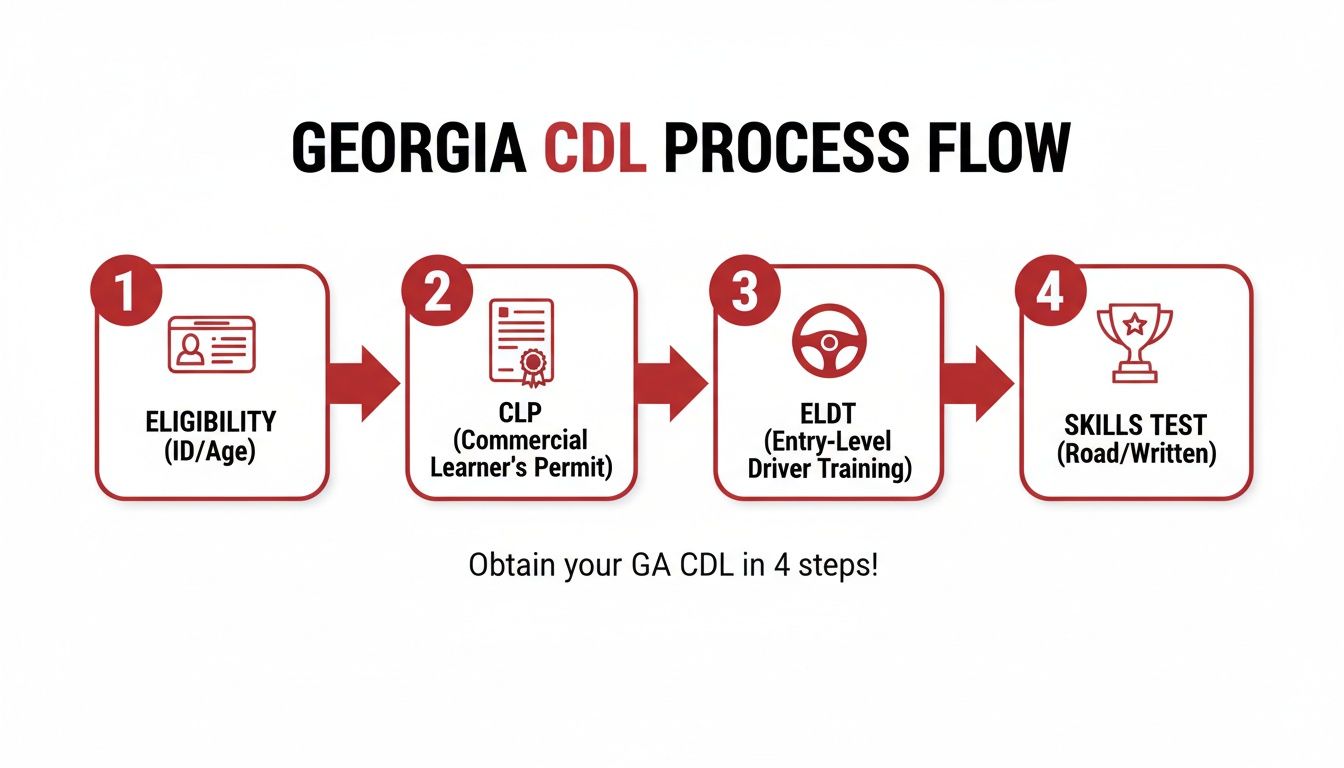
As you can see, each phase builds on the one before it. You start by proving you meet the basic requirements, and you finish by showing an examiner you have the skills to handle a commercial vehicle safely. It’s all designed to ensure every new driver is road-ready.
While Georgia has its own specific rules, it's helpful to understand the general commercial license requirements and application steps that form the basis for these regulations. Knowing the "why" behind each rule makes the process much clearer.
The journey might seem long, but with the right guidance and solid preparation, you can get there. Your new career is waiting.
Confirming Your Eligibility for a GA CDL
Before you can get serious about driving a commercial vehicle, the Georgia Department of Driver Services (DDS) has a few boxes you need to check. Think of it as laying the groundwork for your CDL. Getting these basics handled upfront will make the entire process much smoother down the road.
First, let's talk about age and your current license. To get a CDL in Georgia, you must:
- Be at least 18 years old to drive commercially within Georgia (intrastate).
- Be at least 21 years old to drive across state lines (interstate) or transport hazardous materials.
- Hold a valid, non-commercial Class C Georgia driver's license.
If you don't have a standard driver's license yet, that's your first mission. For younger drivers, this means taking a Joshua's Law course. A-1 Driving School has been a leader in driver's education for decades and offers a state-approved 30-hour online course to fulfill this requirement. Feel free to check out our guide on the requirements for a Georgia driver's license to get started.
The DOT Physical and Medical Certificate
One of the first major hurdles is passing the Department of Transportation (DOT) physical exam. This isn't your average check-up. It's a specific health screening to make sure you are medically qualified to safely operate a large truck for long hours.
Your exam has to be done by a certified medical professional on the FMCSA’s National Registry. During the physical, the examiner will test your:
- Vision and hearing to see if they meet strict federal standards.
- Blood pressure and pulse rate to check for any potential heart issues.
- Overall physical condition, screening for things like sleep apnea, diabetes, or any other disorder that could affect your driving.
Once you pass, you'll get a Medical Examiner's Certificate (MEC). You absolutely need this certificate when you apply for your Commercial Learner’s Permit (CLP), so it’s smart to get this done early on.
Key Takeaway: The DOT physical is not optional. It’s a federal rule put in place to protect you and everyone else on the road. Don't put off scheduling your exam—finding an appointment with a certified examiner can sometimes take a couple of weeks.
Your Driving Record and Legal Status
Your driving history matters. Georgia is serious about safety, so applicants should have a clean driving record. You’ll need to prove who you are and that you’re a legal U.S. resident. This means gathering a few specific documents.
Required Documentation Checklist:
- Proof of Identity: An unexpired U.S. Passport, original or certified U.S. Birth Certificate, or a Certificate of Naturalization.
- Social Security Number: Your original Social Security card or a W-2 form with your full name and number.
- Georgia Residency: Two documents showing your address, like a recent utility bill, bank statement, or rental contract.
Once you have these papers ready to go, along with your new Medical Examiner's Certificate, you’ll be all set for the next step: applying for your Commercial Learner's Permit.
Securing Your Commercial Learner’s Permit (CLP)
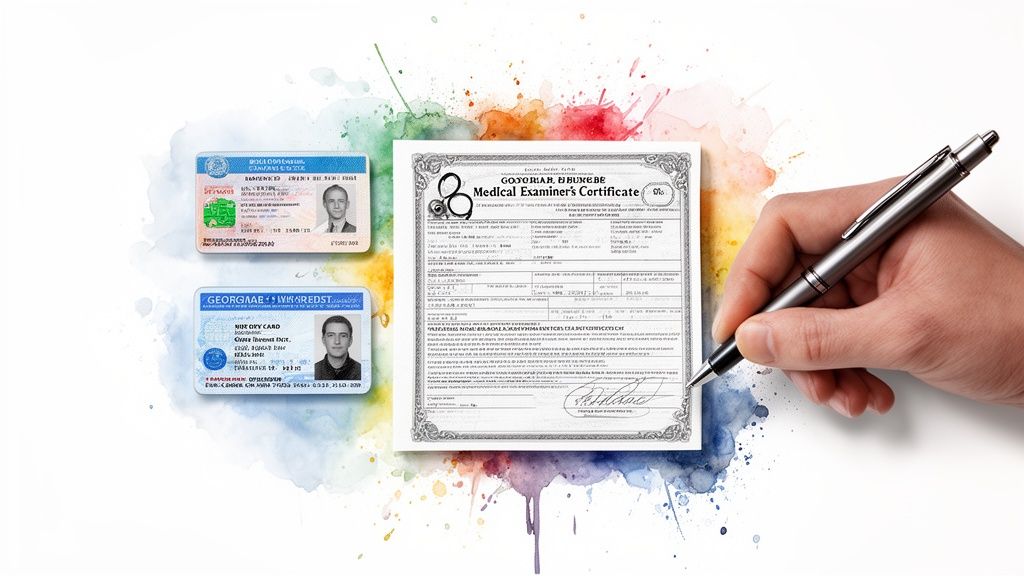
Alright, you've got your documents lined up and confirmed you’re eligible. The next big milestone is getting your Commercial Learner’s Permit, or CLP.
Think of the CLP as your key to start the engine. It’s the permit that lets you get behind the wheel of a commercial truck on public roads, as long as you have a licensed CDL holder riding shotgun. You have to be at least 18 to apply, but remember, you’ll need to be 21 if you plan on driving across state lines.
This isn't just a piece of paper; it’s a critical step, especially since the federal Entry-Level Driver Training (ELDT) rules took effect on February 7, 2022. With over 150,000 active CDL holders moving nearly 1.2 million tons of freight daily in Georgia, getting this permit right is the first step to joining a massive, essential industry.
Master the Georgia CDL Manual
Before you even think about heading to a Georgia Department of Driver Services (DDS) center, your first job is to live and breathe the official Georgia CDL Manual. Seriously. Every single question on your written tests comes directly from this book. Walking in unprepared is a recipe for failure.
Pay close attention to these sections, as they form the foundation of your knowledge:
- Driving Safely: This covers everything from basic vehicle control to managing your space on the road.
- Transporting Cargo Safely: Absolutely essential for any commercial driver, regardless of what you're hauling.
- Air Brakes: If you're going for a Class A or B license, this is a non-negotiable chapter. You have to know this system inside and out.
- Combination Vehicles: This is a must-read for anyone aiming to drive a tractor-trailer (Class A).
Don't just skim it. Take notes, make flashcards, and quiz yourself. The tests are designed to catch people who didn't sweat the details.
Passing the CLP Knowledge Tests
Once you're confident with the manual, it's time to visit a DDS Customer Service Center and prove what you know. You'll face a series of written tests on a computer.
Here are the main tests you’ll need to pass:
- General Knowledge Test: This is the big one, covering a wide range of topics from driving rules and safety to pre-trip inspections.
- Combination Vehicles Test: This is mandatory if you want a Class A CDL. It focuses on the specific skills needed for coupling, uncoupling, and maneuvering tractor-trailers.
- Air Brakes Test: Since most Class A and B trucks use air brakes, this is another common requirement. It tests your understanding of the entire air brake system and how to inspect it.
A Note on Preparation: Just reading the manual doesn't work for everyone. Professional instruction can make all the difference. At A-1 Driving School, we offer a range of programs, including state-approved driver's education and Joshua's Law courses, that build strong study habits and test-taking skills. That kind of foundation is a huge help when you’re prepping for your CDL tests.
Add Endorsements to Your CLP Now, Not Later
You might need to take extra tests for special endorsements, which let you drive specific vehicles or haul certain kinds of cargo. The smartest move you can make is to test for these endorsements at the same time you get your CLP. It saves you an extra trip to the DDS down the road.
Here are the most common endorsements you might need:
| Endorsement | What It Allows You to Do | Who Needs It? |
|---|---|---|
| T – Double/Triple Trailers | Operate a commercial vehicle pulling two or three trailers. | Long-haul drivers who need to maximize their cargo capacity. |
| P – Passenger | Drive a vehicle designed for 16 or more people (including you). | Anyone wanting to drive a city bus, school bus, or tour bus. |
| N – Tank Vehicle | Haul liquids or gases in a tank larger than 1,000 gallons. | Drivers transporting gasoline, milk, chemicals, and other bulk liquids. |
| H – Hazardous Materials (HazMat) | Transport materials that legally require placards. | Fuel tanker drivers, chemical haulers, and others in specialized transport. |
Once you pass these tests, you'll walk out with a CLP that has all the endorsements you need. This is where things really start moving, as you shift from book knowledge to hands-on driving. Next up: finding the right training program to turn that permit into a professional career.
Choosing the Right ELDT and Driving School
With your Commercial Learner’s Permit (CLP) in hand, you’re ready for the most important part of this journey: the training. As of February 2022, all new CDL applicants must complete mandatory Entry-Level Driver Training (ELDT). This federal rule makes sure every new driver starts with the same foundational knowledge and skills.
But here’s the thing—just meeting the minimum requirement isn't enough to make you a great driver. The quality of your training will make or break your confidence behind the wheel and your ability to pass that final skills test. Picking the right driving school is one of the most critical decisions you'll make for your career.
What Is Entry-Level Driver Training (ELDT)?
ELDT is broken down into two parts: theory (classroom-style learning) and behind-the-wheel (BTW) practice. You can do some of the theory work online, but the BTW training has to be hands-on with a qualified instructor.
The most important rule? Your training provider must be on the FMCSA’s official Training Provider Registry (TPR). Before you even think about signing up, you need to check that list. A-1 Driving School is a registered ELDT provider, so you can be confident your training will meet all federal standards for getting a CDL in Georgia.
The curriculum covers all the essentials you'd expect:
- Basic vehicle operation and controls
- Pre-trip and post-trip vehicle inspections
- Backing, parking, and docking maneuvers
- Managing your speed and space on different types of roads
- How to handle bad weather and emergencies
This is the baseline, but a truly great school will take you far beyond just checking these boxes.
Why Professional Driving Lessons Are Your Best Investment
You could technically get your ELDT certificate from any registered provider, but there’s no substitute for professional, one-on-one driving lessons. It’s one thing to read about a 90-degree alley dock in a manual; it's another thing entirely to nail it with an experienced instructor giving you real-time feedback.
At A-1 Driving School, we focus on customized driving lesson packages that fit your specific skill level. We know everyone learns at their own pace. Our instructors provide personal coaching to help you master tricky maneuvers and build the kind of confidence you can only get from real-world practice.
Our philosophy is simple: expert training is the key to creating safe, skilled commercial drivers. With a history rooted in driver's education, including pioneering Joshua's Law courses for teens, our commitment to safety is part of our DNA. We bring that same dedication to our CDL students.
This one-on-one approach helps you catch and fix mistakes before they become bad habits. It prepares you not just for the test, but for a long, successful career. And it's important to remember that some driving schools in Georgia do not have certified drivers, which makes your choice even more critical.
Finding the Right Training Program for You
So, how do you pick the right program? Start by thinking about your career goals. Many truck driving companies that train new drivers have their own programs, but independent schools often give you more flexibility and personalized attention.
Here’s what you should be looking for in a top-notch driving school:
1. Flexible Driving Lesson Packages: A one-size-fits-all program just doesn't work. Look for schools like A-1 that offer different packages, from the basic ELDT requirements to comprehensive options with extra practice hours. That way, you only pay for what you actually need.
2. Road Test Services: Taking your skills test in the same truck and on the same course you trained on is a huge advantage. It takes a lot of the stress out of test day. A-1 Driving School is a state-authorized testing center, so we offer a seamless transition from training to road testing.
3. Online Course Options: For the theory part of ELDT, online options give you the freedom to study whenever you want. A-1 combines convenient online learning for the "book smarts" with the essential in-person training for the "road smarts," giving you the best of both worlds.
4. Financial Assistance and Scholarship Info: Let's be honest, training costs money. A good school will point you toward resources like the Georgia Driver's Education Scholarship Grant Program, which can help cover costs if you qualify. We provide information on this grant to help our students.
Your choice of driving school is the biggest factor in your success. Think of it as an investment in your safety and your future. Don't just settle for the bare minimum.
Passing Your Georgia CDL Skills Test
Alright, you've put in the work. You’ve studied the manual, cleared the knowledge tests, and completed your Entry-Level Driver Training (ELDT). Now it’s time for the main event: the three-part CDL skills test. This is your chance to show the examiner you have the skills to handle a commercial vehicle safely on Georgia's roads.
Don't underestimate this final exam. It's a tough, thorough assessment you can take only after you’ve held your CLP for at least 14 days and finished your ELDT. While the national first-time pass rate hovers around 65%, Georgia’s DDS standards are notoriously strict, bringing that number closer to 60% for local applicants.
The good news? Since mandatory ELDT was introduced in 2022, quality training has made a huge difference. Good driving academies are seeing nearly a 20% jump in their students' first-time pass rates. It just goes to show that proper prep pays off.
The Three Parts of the Skills Test
Your Georgia CDL skills test is broken into three separate sections. You have to pass each part before you can move on to the next. Fail one, and the test is over for the day.
Part 1: Vehicle Pre-Trip Inspection
This is way more than just kicking the tires. You’ll have to walk the examiner through a complete and systematic inspection of your truck. They expect you to physically point to components, explain what you're checking for, and why it's important—covering everything from the engine and brakes to your lights and coupling system.
Part 2: Basic Control Skills
Next, you'll head to a closed course to prove you can handle the rig in tight quarters. This is where you'll perform a series of backing maneuvers that often include:
- Straight-line backing
- Offset backing (right or left)
- 90-degree alley docking
The examiner is watching to see if you have total command of your vehicle and trailer.
Part 3: On-Road Driving Test
For the final part, you’ll take the truck out onto public roads with the examiner. They’ll be grading your ability to navigate real-world driving scenarios. This includes everything from making safe turns and lane changes to managing intersections and merging onto highways.
Expert Insight: The pre-trip inspection is where so many applicants slip up. It’s not enough to just know the steps; you have to clearly and confidently tell the examiner what you’re doing. Practice your entire routine out loud until it’s automatic.
The A-1 Driving School Advantage
This is where getting professional instruction really clicks. You can read the CDL manual a hundred times, but nothing replaces an experienced instructor showing you how to perfect these maneuvers in a real truck.
At A-1 Driving School, our instructors know exactly what the DDS examiners are looking for. We focus our driving lesson packages on fixing the common mistakes that lead to test-day failures, offering the one-on-one coaching you need to build real confidence.
Plus, and this is a huge benefit, we are a certified third-party testing site. That means you can train on the exact same course and in the very same truck you'll use for your official road test. Taking the test in a familiar environment removes a massive amount of stress and helps you focus on what you know.
Booking Your Test and Final Prep
You can book your CDL skills test at a Georgia DDS Customer Service Center or a certified third-party site like A-1 Driving School. Just remember to bring your valid CLP and your Medical Examiner's Certificate on test day.
Investing in a few lessons is more than just buying practice time—it's an investment in starting your career on the right foot. With expert coaching and the ability to test where you train, you’ll show up to your exam prepared and confident.
Your Top Georgia CDL Questions, Answered
As you start down the path to getting your Georgia CDL, you're bound to have questions. It’s a big process! We hear from new students all the time, so we’ve put together answers to some of the most common questions we get.
How Long Does It Take to Get a CDL in Georgia?
Realistically, you should plan for the process to take anywhere from four to eight weeks.
This timeline gives you enough room to study the CDL manual, pass your written knowledge tests, complete the required Entry-Level Driver Training (ELDT), and get your final road test scheduled.
Keep in mind, you have to hold your Commercial Learner's Permit (CLP) for a minimum of 14 days before you can even take the skills test. Following a structured program, like our driving lesson packages, really helps keep you on track and moving forward efficiently.
How Much Does It Cost to Get a CDL in Georgia?
The total investment has a few different parts. First, there are the standard Georgia DDS fees for the permit and license, which will run you about $82. Then you’ll have the DOT medical exam, which usually costs between $80 and $150.
The biggest variable, by far, is your ELDT program. Tuition for truck driving school can be anywhere from a few thousand dollars to well over ten thousand, depending on the school you choose and how comprehensive the training is.
It's a smart move to see if you qualify for the Georgia Driver's Education Scholarship Grant Program. This state-funded program can help eligible Georgians cover training costs, making a high-quality education much more affordable.
At A-1 Driving School, we offer a range of driving lessons packages to fit different budgets. We want to make sure you get the exact training you need without breaking the bank.
Can I Use My Military Driving Experience for a Georgia CDL?
Absolutely. Georgia’s "Troops to Trucks" program was created specifically for this purpose. It’s a great way for service members to translate their military experience into a civilian career.
If you have at least two years of experience driving a military vehicle that’s similar to a commercial truck, you might be able to waive the hands-on skills test portion of the CDL exam. You'll still need to pass all the written knowledge tests to get your CLP, but it can definitely fast-track your journey into the trucking industry.
Is Online or In-Person CDL Training Better?
That’s a great question, and the honest answer is: you need both. The theory portion of your ELDT can be done through online course options, which is incredibly convenient for studying the rules of the road on your own time.
However, the behind-the-wheel (BTW) training is a mandatory, in-person requirement. There's just no substitute for getting hands-on practice in a real rig with a qualified instructor sitting next to you.
Our decades of experience in both online and in-person training—from Joshua's Law for teens to professional CDL instruction—have shown us that a hybrid approach works best. You get the book smarts from the online course and the road smarts from an expert instructor. That combination is what truly sets you up for success.
Ready to take the next step in your professional driving career? A-1 Driving School offers comprehensive ELDT programs, flexible driving lesson packages, and state-authorized road testing to guide you from permit to license. Enroll in a course today and start your journey with Georgia's most trusted driving school.