A lot of families land on this page at the same moment. The teen is counting the days until they can drive without a parent in the passenger seat. The parent is thinking about school pickup, sports, work schedules, and one bigger question: is this new driver ready?
That mix of excitement and concern is normal. A Georgia Class D provisional license is built for exactly that stage. It's not full independence yet, and it's not just a learner's permit anymore. It's the bridge between supervised practice and driving on your own under clear rules.
If you searched for provisional license ga, you probably don’t need a legal lecture. You need straight answers. What has to be finished first? What paperwork matters? What makes teens fail the road test? What helps them become calm, capable drivers instead of barely qualified ones?
The process is manageable when you treat it like a checklist and not a guessing game. That’s how instructors look at it. One step at a time, with less drama at the DDS counter and fewer surprises on test day.
Your Road to Freedom Starts with a Georgia Provisional License
Saturday morning usually makes the goal feel real. A teen is asking when they can start driving to school alone. A parent is already thinking about curfews, passengers, insurance, and whether every DDS requirement is finished.

A Georgia provisional license gives teens limited independence and gives parents a structure. It lets a new driver start handling short, real trips under rules that are meant to reduce risk while judgment is still developing.
From an instructor’s seat, the license itself is only one part of the job. Families also have to handle permit timing, Joshua’s Law, supervised driving records, DDS paperwork, and test scheduling without missing a detail. That is where a school with a concierge approach saves time and stress. A-1 helps families line up the training, understand what comes first, and avoid the common mistakes that turn a simple DDS visit into a wasted afternoon.
Some families start by making sure the permit stage is set up correctly with a Georgia permit test guide. Others compare another state’s early-driver structure to better understand how graduated licensing is supposed to build experience, like this overview of the learner's permit process. The point is the same. Strong preparation at the beginning makes every later step easier.
A provisional license is proof that a new driver has moved beyond basic instruction and can handle more responsibility under restrictions.
The trouble spots are predictable. Parents worry about lane checks, speed control, and left turns in traffic. Teens worry about parallel parking, test-day nerves, and getting turned away because one document is missing. Both are valid concerns, and both are easier to handle when someone walks the family through the process step by step.
Fulfilling Your Prerequsites Joshua's Law and Supervised Driving
A common stall point looks like this: the teen is excited, the parent has a calendar full of school and sports, and everyone assumes they can handle Joshua’s Law and practice hours later. Then the permit time is up, but the paperwork is not.
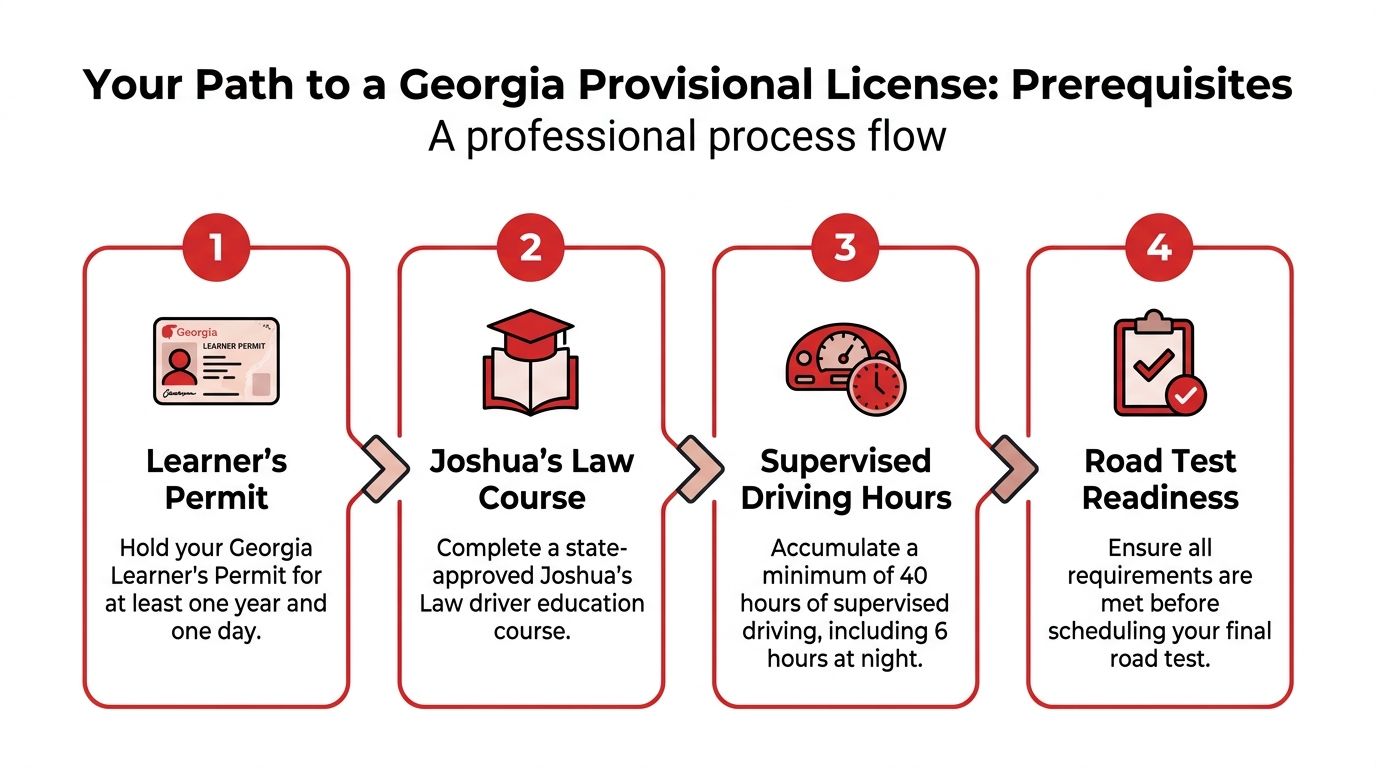
Before a teen can apply for a Georgia Class D license, two things have to line up. The permit must be held for one year and one day. The training requirements must also be finished.
Start with the one year and one day rule
Georgia gives families a built-in practice window. A teen must hold a Georgia Instructional Permit for one year and one day before moving to the Class D stage.
Good families use that time on purpose. They do not repeat the same short drive to school for twelve months and assume that counts as preparation. They add variety. Residential streets first, then heavier traffic, parking lots, left turns across traffic, lane changes, night driving, and wet-road judgment when conditions are safe.
If your teen is still early in the permit stage, it can help to compare how another state structures gradual progress. This overview of the learner's permit process shows the same core idea. New drivers build experience in stages before they get full driving freedom.
Joshua’s Law is often the part that delays families
For Georgia teens seeking a Class D license, Joshua’s Law includes a state-approved driver education course plus supervised driving, including 40 hours of practice with 6 hours at night.
I see two mistakes all the time. Families wait too long to start the course, or they treat the driving log like a box-checking exercise. Both create problems. The first causes scheduling stress near the finish line. The second produces teens who technically qualify but still struggle in real traffic.
A good course gives a teen structure and vocabulary. They learn how to scan intersections, judge following distance, read lane position, and decide when to wait instead of forcing a turn. That makes parent practice time more productive because everyone is working from the same set of habits.
What helps with the 40 supervised hours
Short, consistent drives work better than occasional marathon sessions.
A practical schedule usually includes one or two short weeknight drives, a weekend session focused on a specific skill, and regular night practice spread across the permit period. Leaving all six night hours for the end is one of the easiest ways to create avoidable stress.
Log each drive as soon as the car is parked. Families who wait until the end of the week usually forget where they went, what was practiced, or how long the drive lasted.
Use the hours to cover situations a road test cannot fully teach. Busy left turns. Parking beside other cars. Entering a multi-lane road without hesitation. Recovering calmly after a missed turn. Those are the moments that show whether a teen is developing judgment instead of just accumulating time.
Course format matters more than parents expect
Some teens do fine in a traditional classroom. Others need online flexibility because of athletics, jobs, or a packed school schedule. Parents usually know which setup their household can sustain. The right choice is the one your teen can complete on time without constant rescheduling.
For families still getting organized, A-1’s guide to the Georgia permit test process helps lay out the order of steps so nothing gets missed early.
A-1 also helps simplify the Joshua’s Law side for metro Atlanta families. Students in Fulton County schools can often complete requirements through A-1 in a way that fits more cleanly with school schedules, and families can ask about scholarship guidance at the same time. That concierge approach matters because parents are usually managing school calendars, practice logs, forms, and lesson scheduling all at once.
Don’t wait to ask about scholarship help
Some families assume driver education cost has only one answer. It does not.
The Georgia Driver’s Education Scholarship Grant Program can make the approved course more manageable for eligible students. Ask about eligibility early, along with class format and behind-the-wheel scheduling. Handling those decisions together saves time and usually prevents last-minute scrambling.
Here’s the practical way to choose:
| Situation | Better fit |
|---|---|
| Teen needs structure and live accountability | In-person class |
| Family schedule changes week to week | Online or virtual option |
| Teen is nervous behind the wheel | Add professional driving lessons early |
| Parent wants simpler logistics | Ask about school coordination and scholarship guidance |
The goal is simple. Finish the state requirements on time, keep the practice log accurate, and give the teen enough range behind the wheel that the DDS process feels organized instead of rushed.
Build Real-World Confidence with Professional Driving Lessons
A common pattern shows up a few weeks before the road test. The teen has the permit, the practice hours are mostly done, and everyone assumes they are ready. Then the first serious drive in traffic exposes the weak spots fast. Left turns taken too late, stops that roll, lane changes without a full head check, and braking that is either too early or too hard.

That is why professional lessons matter. The state minimum gets a teen eligible for the next step. It does not guarantee calm decisions in traffic, clean vehicle control, or test-ready habits under pressure.
Parents usually do a solid job teaching the basics in the family car. An instructor adds something different. We watch for patterns families often stop noticing over time because they feel normal in everyday driving. Coasting into a stop sign. Turning from the wrong lane position. Looking over the hood instead of scanning well ahead. Missing mirror checks before slowing or changing lanes.
The other benefit is practical, not personal. Teens often accept coaching better from someone who is not also handling grades, curfew, and chores. That usually makes lessons more productive, especially when a student is nervous or defensive.
Lessons should target the problems that show up on Georgia roads
Some students need only a few focused sessions. Others need a fuller plan because they have limited traffic experience, freeze in busy areas, or have practiced the same easy routes over and over.
Useful lessons usually work on:
- Merging and lane changes: judging gaps, matching speed, and checking blind spots without drifting
- Parking control: backing, parking lot awareness, and keeping speed under control in tight spaces
- Intersection decisions: left turns, four-way stops, yellow lights, and yielding without hesitation or guesswork
- Road test habits: full stops, stop line position, mirror use, hand placement, and smooth steering
A good package also removes a lot of uncertainty for parents. Instead of wondering what to practice next, the family gets a clear path. Skill gaps are identified early, weak areas get repeated, and test preparation stops feeling rushed. That concierge approach is what makes the process easier. A-1 helps turn scattered practice into a plan that prepares a teen for both everyday driving and the road test itself.
For a closer look at how outside coaching improves judgment, awareness, and consistency, read about the benefits of taking driving lessons from an instructor.
What good instruction feels like
Lessons should build in stages. A student starts with basic control, then moves into busier roads, more demanding turns, parking work, and test-style routes. Progress should be visible from one session to the next.
Some teens need encouragement. Others need repetition. The best lesson plans give both, without pushing so fast that the student starts guessing instead of driving.
This short video gives a practical sense of how road training and test prep are approached in Georgia.
If a teen is anxious, start lessons before that anxiety gets tied to the road test. If a teen seems overconfident, get objective coaching before small habits become point losses or safety problems. Professional instruction does more than build skill. It takes the guesswork out of getting ready to pass.
Assembling Your Documents and Scheduling Your Road Test
A lot of families get to this stage thinking the hard part is over. Then the delay comes from paperwork, not driving. A missing residency document, an expired DS-1, or a parent who planned to sign later can turn a test appointment into a wasted trip.
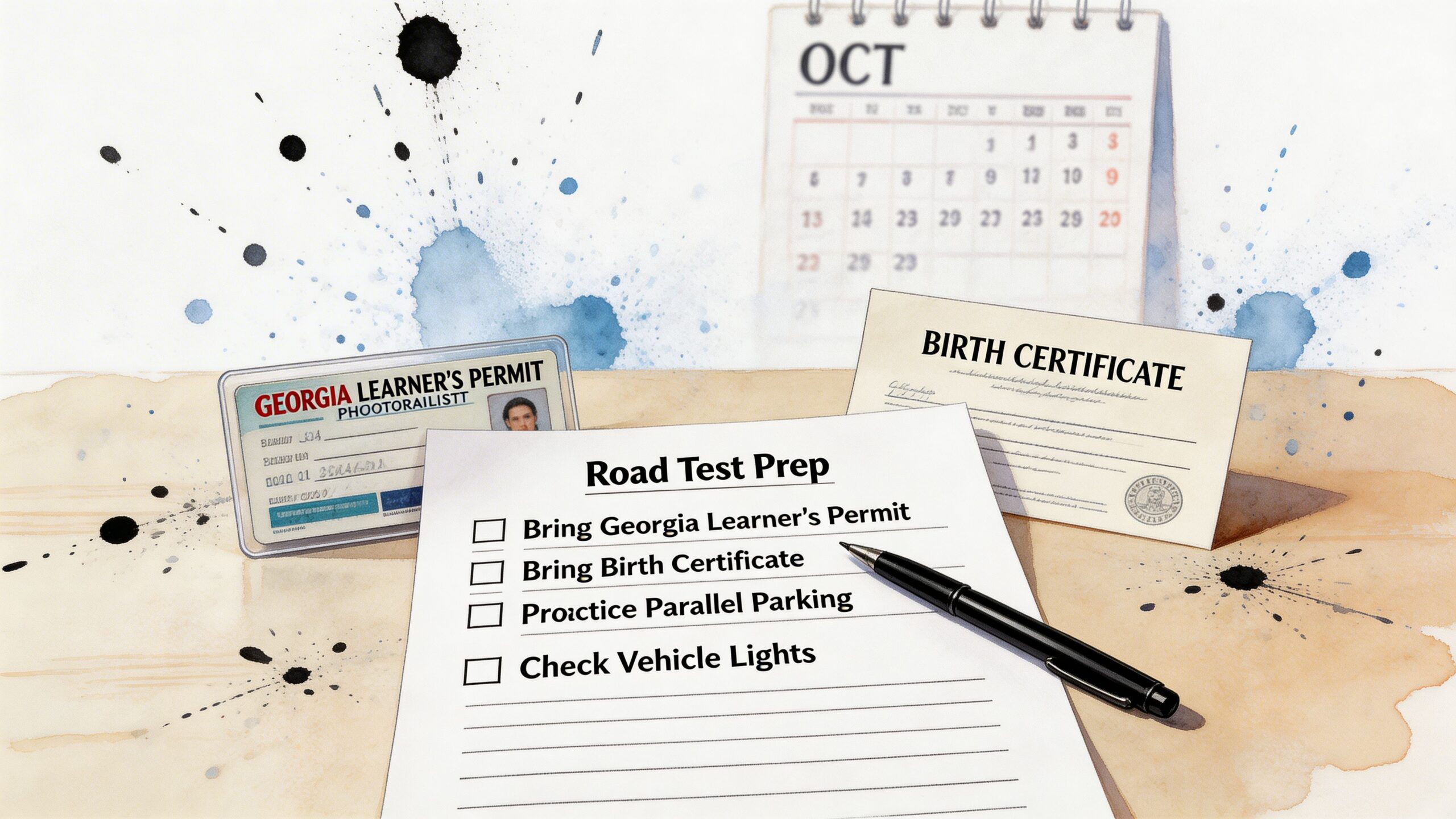
At A-1, this is one of the places families appreciate a concierge-style process. Before test day, it helps to treat the documents like part of the exam. Organized paperwork lowers stress, prevents last-minute rescheduling, and keeps the focus where it belongs, on the teen’s driving.
The document stack you need ready
Before the teen tests for a Class D license, gather every required item in one folder. That usually includes:
- Proof of identity: Birth certificate or passport.
- Social Security proof: Social Security card or another accepted document.
- Two proofs of Georgia residency: Mail or records that meet DDS standards.
- School enrollment proof: A notarized DS-1 School Enrollment Certificate that is still current.
- ADAP or eADAP certificate: Required before licensing.
- Parental consent documents: If the teen’s age or status calls for them.
- Completed online application form: Finish it before the appointment.
- Vehicle documents for test day: Current registration and insurance for the car used on the test.
Families who want to confirm what DDS accepts can review this Georgia ID requirements checklist before they schedule.
The forms that cause the most trouble
Two items cause repeat problems. The first is the DS-1 form. Parents often do not realize it has a limited validity period, so they bring one that was correct a few weeks ago and no longer works on test day. The second is the supervised driving record. If the log is incomplete, unclear, or left at home, the appointment can stop right there.
Bring the folder, not the memory.
I tell parents to do two checks. One check happens before the appointment is booked. The second happens the night before, with the teen, the documents, and the vehicle paperwork all in the same place. That small habit saves a lot of frustration.
DDS road test or third-party road test
Families usually have two paths for the final road test, and the better choice depends on schedule, comfort level, and how much support they want around the process.
| Option | What to think about |
|---|---|
| DDS Customer Service Center | State-run testing, with appointment timing and availability that may be less flexible |
| Certified third-party tester | Often easier to schedule, sometimes less intimidating, and often a better fit when the teen has already practiced at that location |
A nervous teen usually does better when the day feels familiar. If the student has trained in the same area, knows the check-in routine, and is using a car that has already been inspected for lessons, there are fewer avoidable surprises.
That is one reason many families choose to finish with A-1. We can help them line up the pieces in the right order, from checking readiness to scheduling the road test at one of our own locations. For parents, that means less guesswork. For teens, it means walking into test day knowing the setting, the expectations, and the small details that often trip people up.
How to Pass the Georgia Road Test on Your First Try
A lot of teens walk into the road test believing the hard part is over. Then they lose points on basic habits they have repeated for months without noticing. I see it every year. The student can steer well, park reasonably well, and still come up short because the stop was lazy, the lane change was rushed, or the eyes stayed too close to the hood.
The examiner is checking whether the driver can operate the car safely without prompts. That includes control, observation, judgment, and consistency under ordinary traffic conditions. The score usually reflects small mistakes adding up, not one dramatic error.
What the examiner is checking
Georgia road tests focus on the core skills a new driver uses every day:
- Stops: Full legal stops at the proper place, with the car settled before moving again
- Turns: Correct lane position, controlled speed, and finishing the turn in the proper lane
- Lane changes: Mirror check, signal, blind spot check, then a smooth move without drifting
- Intersections: Yielding correctly, recognizing right of way, and choosing a safe gap
- Backing and low-speed control: Keeping the vehicle straight and controlled without overcorrecting
- General awareness: Scanning ahead, managing following distance, and matching speed to conditions
Examiners also pay attention to how the drive feels from start to finish. Smooth inputs matter. A student who brakes late, turns the wheel in a hurry, or wanders in the lane usually has a preparation problem, not a test-day problem.
A professional instructor acts as the test-day concierge long before the appointment. At A-1, we correct those habits in lessons and practice tests so the student is not hearing about them for the first time from an examiner.
The mistakes that sink a score
The most common trouble spots are usually predictable:
Common failure points
- Rolling through stop signs
- Skipping the blind spot check before a lane change
- Turning too wide or cutting across the corner
- Driving far below the flow of traffic because of nerves
- Stopping past the line at intersections
- Backing with poor steering control
- Leaving the turn signal on after the move
- Looking too close to the front of the car instead of scanning ahead
Parents often assume the test is mostly about special maneuvers. It is not. The ordinary habits carry a lot of weight because they show whether the teen is ready to drive alone in real traffic.
That is why I push students to clean up the boring parts. A clean stop, an early mirror check, and proper lane position save more scores than fancy parking ever will.
What helps in the final week
The last week should look like sharpening, not cramming. Short, focused drives work better than one long, stressful session.
Use a practice drive to rehearse:
- Mirror setup before moving
- Smooth starts and smooth stops
- Every stop sign as a full legal stop
- Blind spot checks on every lane change
- Slow-speed turns without cutting corners
Run the drive like the actual test. Minimal chatter. Clear directions. No coaching once the maneuver starts. That approach shows the student where the weak spots still are.
Vehicle problems can also ruin a good test before the car leaves the parking lot. Check lights, signals, brakes, tires, registration, and insurance proof ahead of time. Families who finish the process with A-1 usually have an easier test day because the car, location, and routine are already familiar, and that cuts down on preventable stress.
The goal is simple. Make safe driving look ordinary. If a skill still feels shaky, fix it in practice and repeat it until it feels routine.
Driving with Your New License Restrictions and Upgrading
The first week with a Class D license often looks the same. A teen wants to drive a friend home after practice, a parent assumes it is probably fine, and nobody checks whether that ride fits the passenger rules. That is how good kids end up with preventable license trouble.
A Georgia provisional license gives real freedom, but it is still a supervised stage in practice. Families who handle it well treat the first year like an extension of training, with more independence and clear guardrails.
The restrictions that matter most
Georgia places a few limits on new Class D drivers, and these are the ones families need to know cold:
- No driving between midnight and 5 a.m.
- First 6 months: Only immediate family passengers
- Second 6 months: One non-family passenger under age 21
- After the first year: Up to three non-family passengers under age 21
The rule that gets broken most often is the passenger rule. It usually happens during ordinary plans, rides after school, team events, church, or a quick stop for food. One poor decision can create a suspension issue that follows the teen much longer than the ride itself.
How families avoid preventable violations
The cleanest approach is simple. Set the rules before the first solo trip.
I tell parents to make the expectations boring and specific. Write down who counts as immediate family. Decide whether the teen needs to text before any change in plans. Set a hard rule for late-night driving, and keep it consistent. Teens do better when the line is clear.
It also helps to keep licensing records in one place. Store course completion documents, school forms, and DDS paperwork together so nothing has to be hunted down later if the teen is ready to upgrade.
Upgrading to a full Class C license
The upgrade itself is not complicated. As noted earlier, Georgia allows a driver to move from a provisional Class D to a full Class C at age 18 if they have met the holding period and have no disqualifying major violations.
That makes the goal after the road test pretty straightforward. Keep the record clean. Follow the passenger limits. Do not let avoidable mistakes delay the upgrade.
Common problems families ask about
What if Joshua's Law or ADAP paperwork gets misplaced?
Get replacement documentation before going to DDS. The counter staff will want the record, not a promise that the course was completed.
What if the teen has a medical condition or disability?
Georgia DDS explains that an applicant whose condition may affect safe driving can be asked for a Medical Report Form DS-287 and may need review through the DDS Medical Liaison process. The DDS outlines that in its license FAQs.
What if the teen is legally eligible but still not ready to drive alone?
Wait and keep practicing. I have seen families save themselves a lot of stress by delaying solo driving for a few weeks and using that time for targeted lessons, parking lot work, and short traffic drives.
What if the DS-1 expires right before the appointment?
Replace it before the DDS visit. That is one of the easiest ways to lose an appointment slot.
A-1 helps families handle this stage with less confusion because the support does not stop at the road test. Some teens need one more lesson after licensing to work on night habits, highway merging, or parent concerns. Some families need help tracking course records, scholarship paperwork, or the next DDS step. That kind of step-by-step support is often what keeps a provisional license from turning into a preventable problem.
The Class D year is where safe habits either hold or slip. Treat it seriously, and the move to a full Class C is usually routine.