
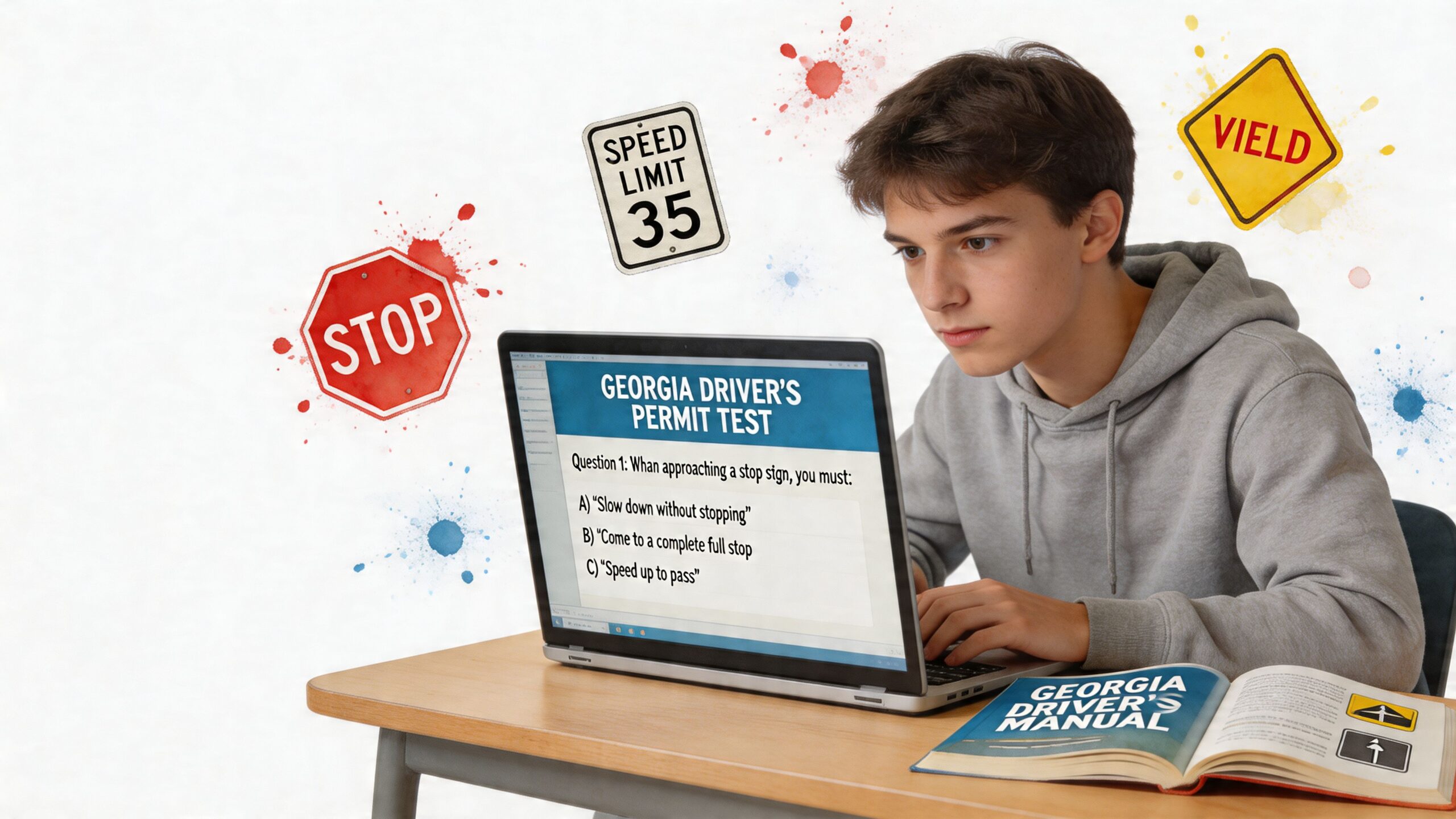
A lot of Georgia teens start in the same place. You're excited to get your permit, then you search online for what does a permit test look like, and suddenly you're buried in advice that doesn't seem to match what Georgia does.
One site talks about a 50-question Florida test. Another gives generic sample questions with no mention of Georgia DDS. Then you end up scrolling forum threads just trying to figure out the actual format, what documents to bring, and what happens once you get to the testing station.
That confusion is normal. The permit test feels bigger when the information around it is messy. The good news is that the Georgia version is much easier to understand once someone breaks it down in plain language.
Feeling Nervous About the Georgia Permit Test You Are Not Alone
A typical student I meet is usually doing three things at once. They're trying to study the Georgia Driver's Manual, asking friends what was on the test, and double-checking whether the advice they found online even applies to Georgia.
That last part causes the most stress.

Many search results for what does a permit test look like lean heavily toward Florida's format, even though Georgia teens face a different test setup. Online searches often surface Florida's 50-question exam, while Georgia students are looking for details on a different DDS experience, and forum threads show strong demand from Georgians asking about the exam format, required documents, and test-day logistics (123Driving).
Why that matters
If you're studying from the wrong state's advice, you can prepare for the wrong kind of test.
That doesn't just waste time. It makes test day feel more intimidating because you still don't know what you'll see on the screen, how the questions are divided, or what the DDS appointment will feel like.
What most teens are really worried about
Usually, it's not just the questions. It's things like:
- Will the test feel harder than the practice quizzes?
- Do I have to pass everything at once?
- What if I forget a sign I've seen a hundred times?
- What documents do I need so I don't get turned away?
Most permit-test nerves come from uncertainty, not ability.
Once you know the Georgia format, the process gets less mysterious. Instead of treating it like one giant unknown, you can break it into small, manageable parts and study for each one.
Decoding the Georgia DDS Permit Test Format
The Georgia permit test is simpler than many students expect, but one detail trips people up all the time. It is not one blended quiz where all questions are mixed together.
It has two separate 20-question sections. One section covers road signs. The other covers road rules.
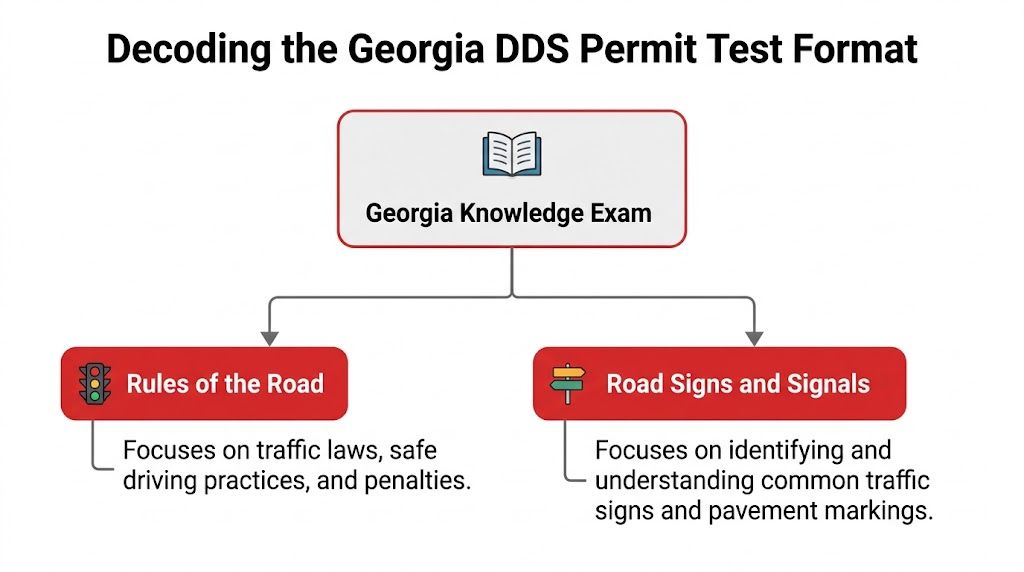
According to the Georgia permit test format summary, you must answer at least 15 questions correctly in each section, for a total of 30 out of 40, and that structure is designed to make sure drivers understand both signs and rules before getting a learner's permit (Driving-Tests.org).
The format at a glance
| Section | Number of questions | What you need to pass |
|---|---|---|
| Road Signs | 20 | 15 correct |
| Road Rules | 20 | 15 correct |
| Total | 40 | 30 correct overall, with 15 in each part |
What the two sections actually mean
The road signs part checks whether you can identify and understand common signs, signals, and markings.
That includes things like stop signs, yield signs, warning signs, lane-use signs, and pavement markings that tell you what you can and can't do.
The road rules part checks whether you understand how to behave in traffic.
That section usually involves right-of-way, following distance, turning, speed laws, school zones, sharing the road, and the everyday decisions drivers make.
The easiest way to think about it
Treat the exam like two mini-tests, not one big test.
If a student studies only laws and ignores signs, that's risky. If a student memorizes sign shapes and colors but never reviews right-of-way or lane position rules, that's risky too. Georgia wants both skills.
Practical rule: Study signs and rules separately, then combine them in mixed practice later.
Where students get confused
A lot of teens assume a 75% score overall is enough. That's not how this setup works.
You need to meet the passing mark in each section. So if you do great on road rules but fall short on road signs, that weak section can still hold you back.
That sounds strict, but it's helpful for studying. You know exactly what to prepare for:
- Learn the visual side.
- Learn the rule side.
- Practice switching between the two.
Once you understand that structure, the question "what does a permit test look like" becomes much less abstract. It looks like two focused knowledge checks, each testing a different skill you'll use behind the wheel.
Your Test Day Experience What to Expect at the DDS
The DDS visit feels easier when you know the order of events ahead of time. Most students calm down once they realize it isn't a dramatic, high-pressure scene. It's a routine office process.
What to bring
Before you leave home, gather your paperwork carefully. Missing documents can ruin an otherwise good test day.
A practical checklist includes:
- Proof of identity: Bring the official identification documents DDS requires.
- Social Security documentation: Make sure the name matches your other records.
- Georgia residency proofs: Bring the documents DDS accepts for address verification.
- School enrollment form if required: Teens under 18 often need the proper school enrollment paperwork.
- Parent or guardian consent if required: Don't assume this can be handled later.
If you're unsure whether your vision might be an issue, it helps to read a plain-language explanation like do I really need glasses with this prescription before your appointment. Students sometimes pass over the vision part when they study, then get nervous about it at the counter.
What happens inside
After check-in, a staff member usually reviews your documents and moves you through the basic intake steps.
Then you'll take the vision screening. If you already wear glasses or contacts for distance, bring them. Don't leave them in the car.
After that, you'll move to the testing area and sit at a computer station.
What the testing station feels like
The permit exam is typically taken on a computer with a simple multiple-choice setup. For most students, the technology itself isn't the hard part.
The harder part is staying calm enough to read each question fully.
A few things help:
- Sit down and settle in: Take a breath before answering the first question.
- Read every option: Don't click too fast just because an answer looks familiar.
- Watch for wording: Small words can change the meaning of the whole question.
If you know what the room, screen, and process look like, you spend less energy worrying and more energy thinking.
Sample Questions and Signs You Must Know
Students usually learn fastest when they can see examples. That's why the question what does a permit test look like is best answered with actual question styles, not vague advice.
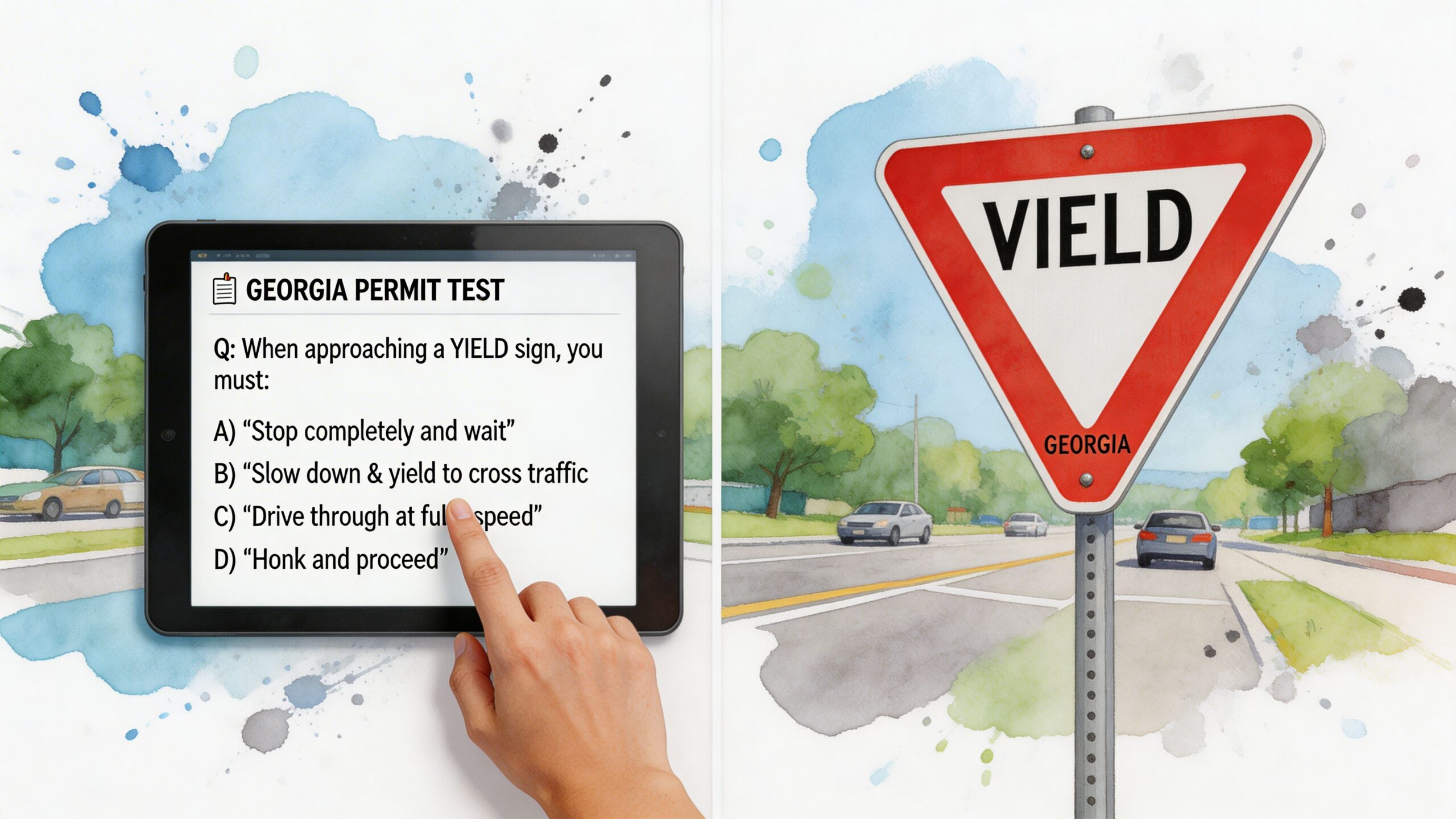
Sample road rules questions
Here are a few examples of the kind of thinking the test checks.
Question 1
You arrive at an intersection at the same time as another vehicle. Who should go first?
Best answer: The driver who has the right-of-way under the situation shown.
Why: These questions test whether you know who must yield, not just whether you know the vocabulary.
Question 2
When should you come to a complete stop at a stop sign?
Best answer: Every time you reach the stop line or crosswalk area.
Why: The DDS wants the full legal action, not a rolling slowdown.
Question 3
What should you do if you see a school bus stopped with its signal lights activated?
Best answer: Follow the law that applies to your direction of travel and roadway situation.
Why: Students often answer from memory too quickly and forget that roadway layout matters.
How to study these correctly
Don't just memorize the right letter choice.
Ask yourself, "What rule is this question really testing?" If you can explain the rule in your own words, you're much more likely to answer a slightly different version correctly on test day.
For extra sign review, this guide on what are road signs is useful because it helps students separate warning, regulatory, and guide signs instead of treating them all like one big flashcard set.
Signs that teens often mix up
These are the signs I see students confuse most often:
- Yield sign: Slow down, be ready to stop, and give the right-of-way when needed.
- Merge sign: Traffic streams are joining. It doesn't mean the same thing as yield.
- Do Not Enter sign: You are about to enter from the wrong direction.
- One Way sign: Traffic moves only in the direction shown.
- School crossing or school zone signs: Slow down and stay alert for children and crossing activity.
- Lane control signs and pavement arrows: These tell you where turns are permitted and where they aren't.
One of the biggest mistakes is treating every triangular or diamond-shaped sign as if it means the same thing. Shape and color matter, but meaning matters more.
This short video can help you visualize the kind of sign recognition and rule recall students practice before the exam.
A quick memory trick
Group signs by purpose, not by how scary they look.
| Type of sign | What it tells you |
|---|---|
| Regulatory | What you must or must not do |
| Warning | What hazard or change is ahead |
| Guide | Where you are going or what is nearby |
When students organize signs that way, the road-sign section starts to feel logical instead of random.
Common Mistakes That Cause Teens to Fail
The permit test isn't impossible, but it is a real hurdle. National permit test failure rates are estimated to be 35% to 55%, which tells you many first-time drivers struggle when they treat the exam as something they can just "wing" (Driving-Tests.org).
Mistake one: reading too fast
Students often miss questions they do know.
They spot a familiar topic, assume they know where it's going, and answer before reading the full sentence. That's especially common with right-of-way questions and sign wording.
Mistake two: mixing up similar signs
A yield sign, a merge sign, and a lane-ended warning sign can blur together if you only studied them casually.
The test punishes vague recognition. You need exact meaning.
Mistake three: second-guessing a good answer
Teens do this all the time. They choose the correct option, panic, then switch to something that sounds more complicated.
Your first answer isn't always right, but changing answers without a clear reason is one of the most common self-inflicted mistakes.
Mistake four: studying only one half of the exam
Some students spend nearly all their energy on rules because that feels more "academic." Others focus on signs because flashcards feel easier.
Georgia's split format doesn't reward one-sided prep.
Mistake five: memorizing practice questions without learning the rule
If a question changes its wording, that approach falls apart.
A stronger method is to review the rule, explain it aloud, and then answer a few variations. That's what builds flexibility instead of short-term memory.
A better test-day mindset
Try this sequence:
- Read the whole question
- Eliminate obvious wrong answers
- Choose the answer that matches the rule, not the one that sounds nicest
- Move on without replaying the question in your head
That approach doesn't guarantee perfection, but it cuts down on avoidable misses.
The A-1 Path From Preparation to Permit
Preparation matters. Some analytics indicate a 70% first-time pass rate for trained students versus 45% for untrained students, and repeated simulator or practice-test work can reduce real-test failure by as much as 40% (YouTube reference).
That gap makes sense. Students who prepare in a structured way aren't smarter. They usually just know what to expect and have practiced the exact skills the test measures.
What strong preparation looks like
A good prep plan usually has four parts.
- Manual study: Read the Georgia Driver's Manual with a pencil or notes app nearby.
- Question practice: Answer permit-style questions until the wording stops feeling unfamiliar.
- Sign review: Separate signs by category so you recognize meaning, not just shape.
- Driving context: Connect book knowledge to what you see on real roads as a passenger.
If you like using extra study tools, outside resources such as practice tests can help you rehearse multiple-choice decision-making. They work best when paired with the Georgia manual, not used as a replacement for it.
How coursework fits in
For Georgia teens working toward a Class D license, driver's education does more than help with permit prep. It gives structure to the whole licensing path.
That usually means looking at:
- Joshua's Law courses
- Online course options in Georgia
- Driving lessons and lesson packages
- Scholarship eligibility
- Road test planning
A practical place to start is this overview of getting a permit in Georgia, which connects the permit stage to the rest of the licensing process.
Why driving lessons matter early
A lot of families wait until after the permit to think about lessons. In reality, early planning helps.
When a student knows they'll move from permit study into real driving lessons, the written material starts to feel more concrete. Lane position, signs, mirror use, right-of-way, and scanning aren't just facts on a page anymore. They become skills you'll practice with an instructor.
That matters even more for nervous beginners. Some students don't need more information. They need a calmer, more guided learning sequence.
One local option many Georgia families consider
A-1 Driving School offers Joshua's Law courses, online and in-person learning formats, driving lessons, lesson packages, scholarship information, and road testing support for Georgia students. For families who want one provider to handle classroom learning, permit prep, behind-the-wheel instruction, and the next licensing steps, that kind of setup can make scheduling much simpler.
The students who feel most confident on permit day are usually the ones who followed a plan instead of collecting random advice from five different websites.
If you're helping a teen get ready, focus on consistency. A steady study routine, quality practice, and a clear next step after the permit usually produce better results than last-minute cramming.
Beyond the Permit Your Next Steps to a License
Passing the permit test is a milestone, but it isn't the finish line. It's the point where book knowledge turns into actual driving experience.
For Georgia teens under Joshua's Law, the next phase usually includes supervised practice, professional instruction, and eventually the road test. Families often discover that this is the stage where driving lessons packages become the most useful.
What comes after the permit
After a teen earns the permit, the focus shifts to real-world habits:
- Regular supervised driving: Practice in neighborhoods, larger roads, parking lots, and busier traffic situations.
- Night driving exposure: Don't leave night practice until the very end.
- Skill-building lessons: Work on turns, lane changes, parking, scanning, and decision-making with a trained instructor.
A strong lesson plan helps students build confidence gradually. That's especially important for teens who feel nervous in traffic or freeze when too many things happen at once.
Why road test prep matters
A lot of permit holders assume the road test will take care of itself later. That's rarely the smoothest approach.
Students do better when they learn early what examiners expect during basic maneuvers, observation checks, stops, turns, and parking. Reviewing Georgia road test what to expect can make the next step feel much more manageable.
Keep the sequence simple
The cleanest path usually looks like this:
- Pass the permit test.
- Start consistent driving practice.
- Add professional lessons where needed.
- Prepare specifically for the road test.
When families treat each phase as connected, teens usually feel less rushed and more capable.
Frequently Asked Questions About the Georgia Permit Test
What happens if I fail one or both parts?
Because Georgia uses a two-part knowledge exam, a weak area matters. If you struggle with signs or rules, your next move should be to study that area specifically instead of restarting your prep from scratch in a random way.
The smartest response is simple. Figure out whether the problem was knowledge, nerves, or rushing, then fix that exact issue.
Can I take the Georgia permit test online?
Many students ask this because online search results often describe other states. In Georgia, students should expect the permit testing process to be handled through DDS procedures rather than assume a generic online option they saw in another article applies here.
That's one reason Georgia-specific guidance matters so much.
Are there accommodations for students with ADHD or dyslexia?
Yes. Georgia DDS provides ADA accommodations that can include oral tests, extra time, or a quiet testing room, but students generally need to request those supports in advance and provide medical proof. This matters because ADHD and dyslexia affect up to 15% of U.S. teens, yet many generic practice sites skip over accommodations entirely (State of Florida practice test page).
What should I do if I get anxious during the test?
Slow down your pace on purpose.
Read the full question. Read every answer choice. If a question feels tricky, don't panic. Most of the time, the correct answer becomes clearer when you stop trying to answer from speed and answer from the rule.
Do I need driving lessons before I have my permit?
You don't need behind-the-wheel lessons before you earn the permit, but many families benefit from planning lessons early so the transition from permit to on-road training is smooth. It also helps to understand Joshua's Law requirements before you're trying to schedule everything at once.
If you're getting ready for your permit and want one place to handle Joshua's Law courses, online driver education, driving lessons, lesson packages, scholarship information, and road test support, take a look at A-1 Driving School.