The Georgia licensing process commonly begins this way. They open the DDS site, click through a few pages, realize there are different rules for teens and adults, then get stuck on one question that turns into five more.
That’s usually where stress kicks in. Do you need Joshua’s Law? When do you get the permit? What documents count? How much practice is enough before the road test? If you’re a parent, you’re trying to make sure nothing gets missed. If you’re the student, you just want a clean path from learner’s permit to license.
The good news is that how to get driver's license in Georgia is manageable when you handle it in the right order. The process only feels complicated when people try to piece it together from scattered pages, mixed advice, and last-minute DDS visits.
The Road to Your Georgia Driver's License Starts Here
A teen in Georgia usually reaches the same moment sooner or later. School is busy, a job or activity schedule is getting harder to manage, and depending on rides starts wearing thin. An adult learner often hits a different version of the same wall. Work, family, and daily life all get easier once you can drive yourself.
That demand isn’t small. The United States had over 235 million licensed drivers in 2023, and A-1 Driving School has trained over 100,000 drivers since 1987 within that larger system of structured licensing and safety requirements, as reflected in federal driver license data and the school’s long operating history (FHWA driver license dataset).
What matters on the ground is simpler. You need to move through the process in the right sequence and avoid the common mistakes that slow people down.
What the path usually looks like
For most Georgia teens, the path works like this:
- Get a learner’s permit
- Complete Joshua’s Law if you’re required to
- Practice enough to become consistent, not just comfortable
- Bring the right documents to DDS
- Pass the road test
- Start driving with judgment, not just permission
Adults may follow a shorter version, but the same principle applies. The easiest path is the one with fewer surprises.
Practical rule: The licensing process gets expensive in time long before it gets expensive in money. A missed document, weak lane change, or rushed test appointment can cost you weeks.
The biggest trade-off is speed versus preparation. People who rush to the road test because they “basically know how to drive” often create their own delay. People who practice with a plan usually move faster overall because they don’t have to repeat steps.
Georgia’s system rewards organized learners. If you treat each stage as a checkpoint instead of a hurdle, getting licensed becomes far more straightforward.
Your First Turn The Georgia Learner's Permit
For a Georgia teen, the learner’s permit is the first real checkpoint. It gives you legal access to supervised practice, and that practice is what turns traffic rules into driving habits.
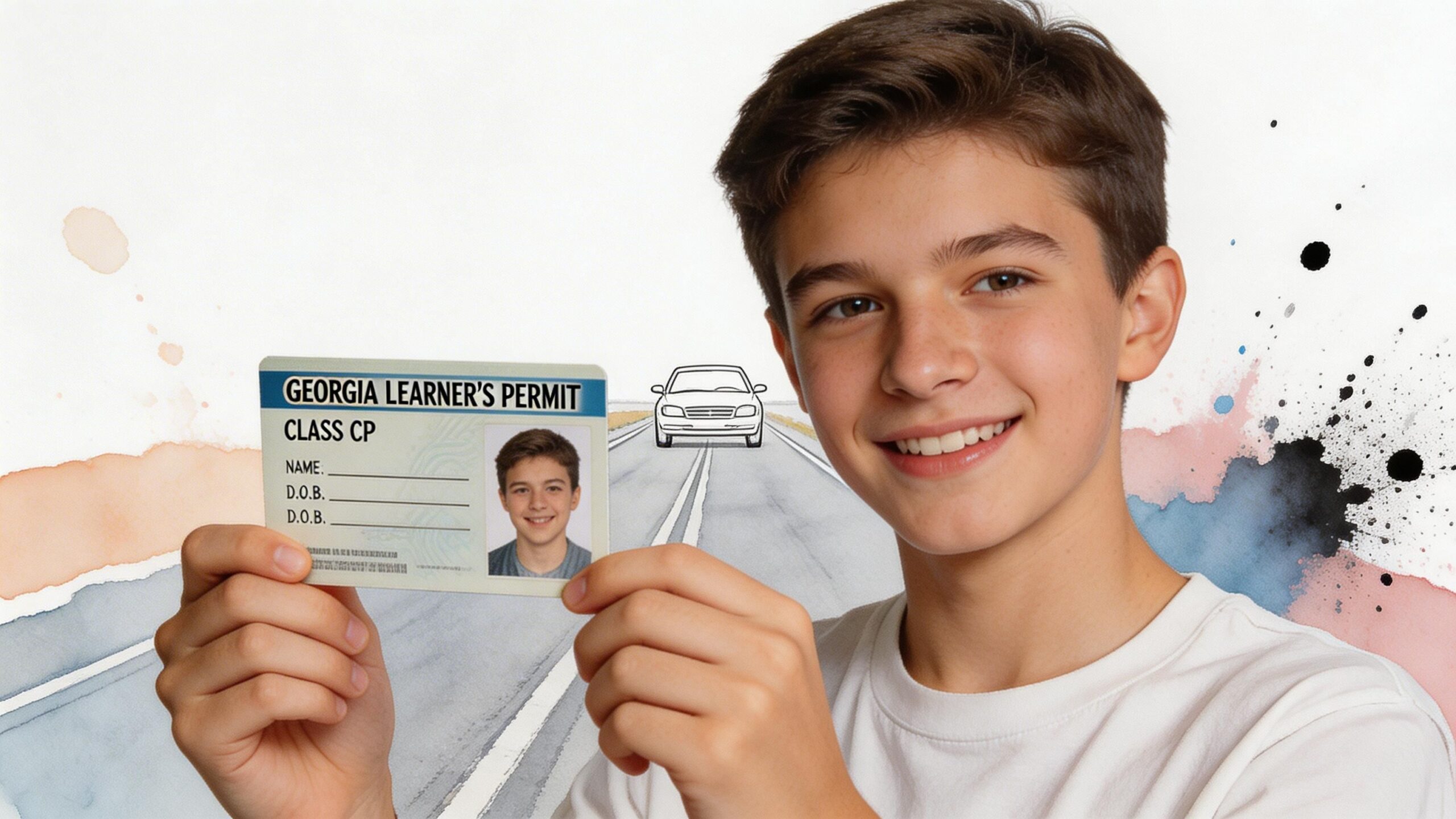
In Georgia, you can apply for a Class CP learner’s permit at age 15. The permit stage matters because it’s where weak study habits show up early. Students who treat the knowledge exam like a casual quiz often end up making an extra DDS trip they could have avoided.
What happens at the permit stage
You should expect three parts:
- A vision screening
- A knowledge exam
- A document review
The written portion is typically 50 questions with an 80% passing threshold, based on the traffic safety education guidance used in driver education contexts. The smartest way to prepare is to study the Georgia Driver’s Manual by topic, not by random page flipping.
What to study first
A lot of students waste time over-studying rare details and under-studying the basics. Start with the material that shows up in daily driving.
Focus on:
- Road signs: Regulatory signs, warnings, school zones, railroad crossings, lane-use signs
- Road rules: Right-of-way, speed management, turns, passing rules, stopping rules
- Safety habits: Mirror checks, following distance, yielding to emergency vehicles
- Georgia-specific details: Permit restrictions and teen driver rules
If you want a cleaner study path, the Georgia permit test prep page is a useful place to organize your preparation before your DDS visit.
What works and what doesn’t
A strong permit student usually does three things well:
| Approach | What it looks like |
|---|---|
| Studies in short sessions | Reviews road signs and rules consistently instead of cramming |
| Reads questions carefully | Slows down on wording, especially with right-of-way questions |
| Uses mistakes as practice | Fixes weak topics before test day |
What usually fails:
- Memorizing without understanding: Students remember an answer choice, then freeze when the question is phrased differently.
- Ignoring signs: Many learners think signs are the easy part until they miss several in a row.
- Rushing: A careless miss on a basic rule hurts just as much as a hard question.
Read each question twice before you answer. Most permit mistakes aren’t about knowledge. They’re about moving too fast.
Before you go
Make sure the name on your documents matches exactly. Small mismatches create big headaches at DDS.
Bring your focus, your study time, and patience. The permit isn’t the end goal. It’s the legal start of real training on the road.
Fulfilling Joshua’s Law The A-1 Way
Joshua’s Law is where many Georgia families either get organized or get frustrated. The rule itself is straightforward for teens under 18, but the scheduling around it can become messy if you wait too long or choose a format that doesn’t fit your week.
Georgia teens who are subject to Joshua’s Law need a 30-hour driver education course and 6 hours of professional behind-the-wheel instruction. That requirement exists for a reason. Georgia’s graduated licensing model is part of a national safety framework shown to reduce teen crash rates, and state-approved driver education programs also show completion rates above 97.5% in the ANSTSE data used for traffic safety education guidance (ANSTSE data collection guide).

Why families get stuck here
The problem usually isn’t the requirement. It’s the timing.
A student waits until the permit is already in hand, sports are in season, school projects are piling up, and everyone suddenly wants the whole requirement finished immediately. That’s when people start looking for the fastest option instead of the most workable one.
The better move is to choose a format that matches real life.
Online versus classroom
Both can work. The difference is how the student learns and how predictable the family schedule is.
Online course format fits well when:
- Schedules change often
- The student learns well independently
- Parents want less commuting
- You need flexibility around school and activities
Classroom format can be better when:
- The student benefits from live structure
- It helps to ask questions in real time
- Parents want a set weekly routine
- Screen fatigue is already an issue
That’s where A-1 Driving School fits naturally into the process. It offers Georgia-approved Joshua’s Law options online and in person, along with the required in-car lessons, so families can choose the setup that matches the student’s schedule rather than forcing everything into one format.
For students taking the online route, the Joshua’s Law student login is the practical entry point for accessing coursework.
The part parents often underestimate
The classroom hours matter. The in-car hours matter more.
A student can memorize signs and still struggle with basic execution once the car is moving. Turning too wide, braking late, drifting during lane position changes, and failing to scan intersections are all common early habits. Those aren’t fixed by more reading. They’re fixed by coached repetition.
What professional in-car training does better
A parent or guardian can supervise practice. That’s necessary. But supervised practice and professional instruction are not the same thing.
Professional instruction tends to be more useful for:
- Breaking habits early: Rolling stops and late mirror checks become harder to fix once they feel normal.
- Teaching commentary driving: Students learn to anticipate what could happen, not just react after it happens.
- Building consistency: One good drive doesn’t mean the student is ready. Repeated clean habits do.
- Preparing for evaluation: A road test looks for specific behaviors, not general confidence.
A calm student who scans well will usually outperform a bold student who guesses.
How to get more out of Joshua’s Law
The families who get the most value from this stage don’t treat it like paperwork. They use it to build a real foundation.
A practical rhythm looks like this:
- Complete the course on schedule
- Take the in-car sessions seriously
- Practice between lessons, not weeks later
- Keep a written driving log
- Add lessons if the student still has weak spots
Common mistakes at this stage
Here’s what tends to cause delays:
| Mistake | Why it creates problems |
|---|---|
| Waiting too long to enroll | It compresses the timeline and creates scheduling pressure |
| Finishing the course but not practicing | Knowledge fades fast if the student doesn’t drive regularly |
| Relying only on family feedback | Families often focus on comfort, not testable habits |
| Treating the 6 hours as enough for everyone | Some students need more seat time to become consistent |
One student may be test-ready with the minimum required training plus steady home practice. Another may need extra lessons because lane control, parking, or right-of-way decisions are still uneven. That’s normal.
For students who need a simpler path
If the goal is to remove friction, the strongest setup is usually a single provider that can handle the academic piece, the in-car requirement, and the next training step without sending the family in three directions.
That matters because teens don’t struggle most with one giant obstacle. They struggle with five small logistical ones stacked together.
A note for adult learners and families with language concerns
Adults aren’t usually dealing with Joshua’s Law in the same way teens are, but they often benefit from the same structure. Clear instruction, flexible scheduling, and guided practice still matter.
For families where English isn’t the first language, the process can feel more intimidating than it should. That’s one reason it helps to choose a school format and lesson plan that leaves room for repetition, questions, and patient instruction instead of forcing everything into one rushed timeline.
Joshua’s Law works best when it’s treated as training, not bureaucracy. The students who come out strongest are the ones who use it to build habits they can carry into the permit period, the road test, and their first year of driving on their own.
Your Pre-Flight Checklist Gathering Documents for the DDS
A surprising number of license delays happen before the test even starts. The student is ready, the ride to DDS is arranged, and then one document is missing, expired, mismatched, or unacceptable.
That’s avoidable.
Georgia DDS verifies identity and legal eligibility carefully, and the state uses the National Driver Register to check for suspensions or revocations in other states before issuing a license (NHTSA National Driver Register overview). If your paperwork doesn’t line up cleanly, DDS won’t just “work around it.”

What to bring
The exact document mix can vary by age and status, but most applicants should prepare for these categories:
- Proof of identity
- Proof of U.S. citizenship or lawful status
- Proof of Social Security number
- Two proofs of Georgia residency
- Current learner’s permit, if applicable
- Any required school or course certificates for teen applicants
A clean document packet beats a last-minute scramble every time.
A practical document check
Use this checklist before your appointment:
| Category | Examples to confirm |
|---|---|
| Identity | Valid passport or certified birth certificate |
| Residency | Utility bill, bank statement, or other accepted address proof |
| Social Security | Social Security card or other accepted proof |
| Permit status | Current Georgia learner’s permit if you already have one |
| Teen school items | School enrollment or attendance documents if required |
| Course proof | Required completion certificates for teen licensing steps |
The safest move is to review the accepted list directly before your visit. Georgia’s document standards can be strict, and the accepted combinations matter. This page on Georgia ID requirements is a useful checkpoint before you leave home.
Two problems that cause repeat trips
First, people bring documents that are real but not acceptable for that category.
Second, names don’t match exactly across documents. A middle name on one record, an initial on another, and a different suffix on a third can become a same-day problem.
Bring more supporting paperwork than you think you’ll need. DDS won’t reward minimalism.
For families with foreign-language documents
This comes up often with immigrant families, international records, or applicants whose supporting identity documents aren’t in English. If you need translated paperwork for DMV or legal use, a professional driver's license translation service can help you prepare documents in a format that’s easier to submit and review.
That doesn’t replace DDS requirements. It helps you avoid showing up with paperwork no one can process properly.
Final check before the appointment
Run through these questions the night before:
- Does every document match your legal name?
- Are your residency documents current and readable?
- Do you have originals or properly accepted copies where required?
- Did you pack your permit and course documents?
- If you booked ahead, do you have your appointment confirmation?
The road test gets most of the attention, but paperwork ruins just as many plans. Treat the DDS visit like a flight departure. If one item is missing, you may not board.
Master the Road Test with A-1 Driving Lessons
Most failures on the Georgia road test aren’t dramatic. They’re small mistakes repeated at the wrong moment.
A driver forgets the blind spot check. Stops softly but not fully. Turns with one hand and drifts wide. Accelerates correctly, then misses speed control in a school or neighborhood zone. These are ordinary errors, which is exactly why they cost people so often.
Around 35% of drivers fail the road test on the first try, often because of issues like missed blind spot checks or poor speed management, according to the traffic safety education guidance referenced earlier. That’s why targeted practice matters so much.

What the road test actually rewards
The examiner isn’t looking for a flashy driver. The examiner is looking for a controlled one.
That means:
- Clear observation habits
- Predictable braking
- Proper lane position
- Steady turns
- Correct responses at signs and intersections
- Good judgment without coaching
A lot of students think they need to feel fearless before testing. They don’t. They need to be repeatable.
Why driving lessons matter more than extra random practice
Practice helps only when it corrects something.
If a student keeps driving the same neighborhood loop with the same weak lane changes and the same rushed stops, more practice just reinforces the wrong pattern. That’s the trade-off many families don’t spot right away. Time in the car is valuable, but feedback is what turns that time into progress.
Where lesson packages help
A focused lesson package usually works better than unstructured family driving when the student needs to improve one or more of these areas:
| Skill area | What often goes wrong |
|---|---|
| Lane changes | No shoulder check, late signaling, drifting during movement |
| Intersections | Rolling stops, hesitation, poor right-of-way judgment |
| Turns | Wide right turns, cutting left turns, weak steering control |
| Parking and backing | Overcorrection, poor mirror use, rushed movements |
| Speed control | Driving too fast in lower-speed areas or too slowly in active traffic |
Some students need only a short refresher before test day. Others need a fuller package because the core habits still aren’t stable. There’s no shame in that. The better question is whether the driver is consistent enough to pass cleanly and then drive safely after the test.
Confidence that comes from repetition lasts longer than confidence that comes from reassurance.
What a useful lesson feels like
A productive road lesson shouldn’t feel like someone sitting in the passenger seat saying, “You’re doing fine.”
It should identify patterns quickly.
For example:
- You brake late when approaching a turn.
- You check mirrors but skip the shoulder on lane changes.
- You hesitate at four-way stops because you aren’t tracking arrival order.
- You steer well at low speed but tighten up in moderate traffic.
That kind of diagnosis is what improves test outcomes. Good instruction narrows the issue, drills it, and then retests it in a different setting.
Practice in the same type of conditions you’ll face
Students often prepare in quiet areas and then test in environments that demand more from them. A stronger lesson plan includes:
- Residential driving
- Busier turns and lane changes
- Parking and backing practice
- Stops, starts, and smooth control under evaluation conditions
Later in the process, this video is a useful visual refresher on the testing mindset and common on-road expectations:
What usually does not work
There are a few habits that regularly hurt otherwise capable students.
- Talking through every move with a parent on test week: Too much verbal correction right before the exam can make the driver second-guess basic actions.
- Cramming all practice into one weekend: Fatigue sets in, and quality drops.
- Ignoring one weak skill because everything else feels fine: One bad lane change or one uncontrolled intersection can undo a solid drive.
Familiar vehicle, familiar routine
Many new drivers do better when they test in a vehicle they already know. Familiar brakes, steering feel, and sight lines reduce unnecessary mental load. That’s one reason road test support and skill-specific lesson packages can make the final step feel much cleaner than a rushed DDS test day in an unfamiliar setup.
If your goal is simple, this is the practical approach. Build the permit foundation, complete the required training, then use targeted lessons to close the gap between “I can drive” and “I can pass the test without avoidable errors.”
License Fees and the A-1 Scholarship Advantage
Most families expect some DDS costs. What catches people off guard is that training, not the license card itself, is usually the part that needs planning.
That’s why the Georgia Driver’s Education Scholarship Grant Program matters. For teens who qualify, it can help cover the major training requirement tied to Joshua’s Law. That matters beyond convenience. Georgia’s graduated licensing framework is based on national models that have been shown to reduce teen crash rates by 10% to 30%, which is why state-funded driver education is more than an academic requirement. It’s a public safety tool.
Where to think about cost
There are usually two buckets:
- DDS-related fees
- Training-related costs
The DDS side is generally straightforward. The training side takes more coordination because timing, eligibility, and scheduling all affect what you pay and when.
Why the scholarship changes the equation
For many families, the scholarship turns driver education from “we need to budget for this later” into “we can move now.”
That’s especially useful when a teen needs:
- The required classroom or online course
- The required in-car instruction
- A smoother path into practice and test prep
What works best is handling scholarship questions early, before the family has already delayed enrollment.
A simple way to approach it
Use this order:
- Confirm whether the student is subject to Joshua’s Law
- Check scholarship eligibility
- Choose a training format that fits the family schedule
- Reserve in-car instruction before calendars fill up
- Plan extra lessons only if the student needs them
One provider can simplify the process. Families often prefer not to separate the course, behind-the-wheel sessions, and road test prep unless they have to. Keeping those pieces aligned usually cuts down on missed timing and duplicate scheduling.
A practical trade-off
The cheapest path on paper isn’t always the easiest path in real life.
If a family saves money up front but ends up juggling course access, lesson scheduling, and retesting delays, the process often becomes harder than it needed to be. Scholarship-backed training helps because it lowers one of the biggest barriers while keeping the student in a structured system.
The right question isn’t only “What does this cost?” It’s also “Does this setup help the student finish the process without stalls?”
You've Got Your License Now What
Getting the license feels like the finish line. It’s really the point where independent driving begins.
The first months matter most. That’s when habits settle in. A driver who keeps scanning intersections, managing speed carefully, and leaving enough space between cars will keep improving. A driver who gets casual too quickly usually starts collecting close calls.
New license holders should keep driving in a way that looks almost boring. Smooth stops, patient turns, full observation, and no rushed decisions. That’s what real skill looks like.
Parents can help by easing supervision instead of dropping it all at once. Adult beginners should do the same for themselves. Start with familiar routes, then build outward.
If you’ve made it this far, you already know the process is easier when each step is handled in order. Permit first. Required education next. Practice with purpose. Documents ready. Road test with habits that hold up under pressure.
If you're ready to start or finish the process, A-1 Driving School offers Georgia driver education, Joshua’s Law courses, driving lessons, lesson packages, and road test support so you can move from permit to license with a clearer plan.