
The ticket itself stings. What usually worries drivers more is what comes next.
A fine is one problem. A damaged driving record is another. If you're searching for how to reduce points on license issues in Georgia, you probably want a fix right now. That's fair. But after years working with new drivers, nervous adults, and families trying to keep insurance under control, one truth keeps showing up: the strongest point-reduction strategy starts before the next citation ever happens.
That Sinking Feeling The Truth About Traffic Tickets and Points
You see the lights in the mirror. Your stomach drops. You replay the last mile of driving and start guessing. Was it speed? Rolling through a turn? Following too closely?

Most drivers think first about the court date or the fine. The smarter question is what that stop can do to your record, your insurance, and your stress level over the next few years.
Two paths after a ticket
Some drivers go straight into cleanup mode. They want points off as fast as possible. Others take the longer view and ask why the ticket happened in the first place.
Both paths matter:
- Reactive path: Deal with existing points and try to limit the damage.
- Proactive path: Build habits and skills that make future tickets less likely.
- Practical path: Use both when needed. Fix today's problem, then train so it doesn't repeat.
A clean record rarely comes from luck. It usually comes from drivers who spot hazards early, manage speed well, and stay calm under pressure.
Other states show the same pattern. In New York, an approved defensive driving course can reduce up to four points, and New Jersey allows a two-point deduction for a qualified class, according to the AAA overview of how states reduce license points. States keep leaning on education because skill matters.
What works
Quick fixes help, but they have limits. A course can reduce points. It can't undo years of poor scanning, bad lane discipline, or weak judgment in traffic.
That's why drivers who stay out of trouble usually have something in common. They didn't just memorize rules. They practiced them until safe choices became automatic.
Understanding the Georgia Driver's License Point System
If you don't know your current record, you're driving blind. Georgia's point system rewards drivers who pay attention early and punishes drivers who wait too long.
Know the threshold
For Georgia drivers, accumulating a certain number of points within a specific timeframe can trigger a suspension under the Georgia framework described in the verified Georgia guidance. Points also remain active for a set period before they expire naturally, based on the same Georgia source discussed later in this article.
That means timing matters. An old ticket may be close to aging out, or a new one may push you into a much more serious problem.
Check your record before you guess
Start with the Georgia DDS record tools. Don't rely on memory. Don't rely on what you think the court sent over.
Use this quick routine:
- Pull your driving record: Check your DDS profile through the online system or MyDDS.
- Look for recent convictions: A ticket doesn't affect your points the same way until it hits your record.
- Count the timeline: Georgia looks at a rolling window, so dates matter.
- Watch for admin mistakes: If something doesn't look right, address it fast.
For a plain-language breakdown, A-1's guide on what you need to know about driver's license points is a useful starting point.
What drivers often get wrong
Many individuals misunderstand point problems in three ways.
| Common belief | What matters |
|---|---|
| Paying the ticket ends the issue | The record impact may last longer than the moment you pay |
| One class fixes everything | Point reduction tools have eligibility limits |
| If the license isn't suspended, there's no real problem | Insurance, future court outcomes, and employer concerns can still follow |
Practical rule: Check your record after every citation outcome. Drivers get into trouble when they assume instead of verify.
Why this matters beyond the DDS
Points affect more than your legal standing. They change how insurers see you. They also shrink your margin for error. One more citation feels very different when your record is already carrying prior violations.
Drivers who stay ahead of the system don't just react to bad news. They monitor it, understand it, and make training decisions before the next stop happens.
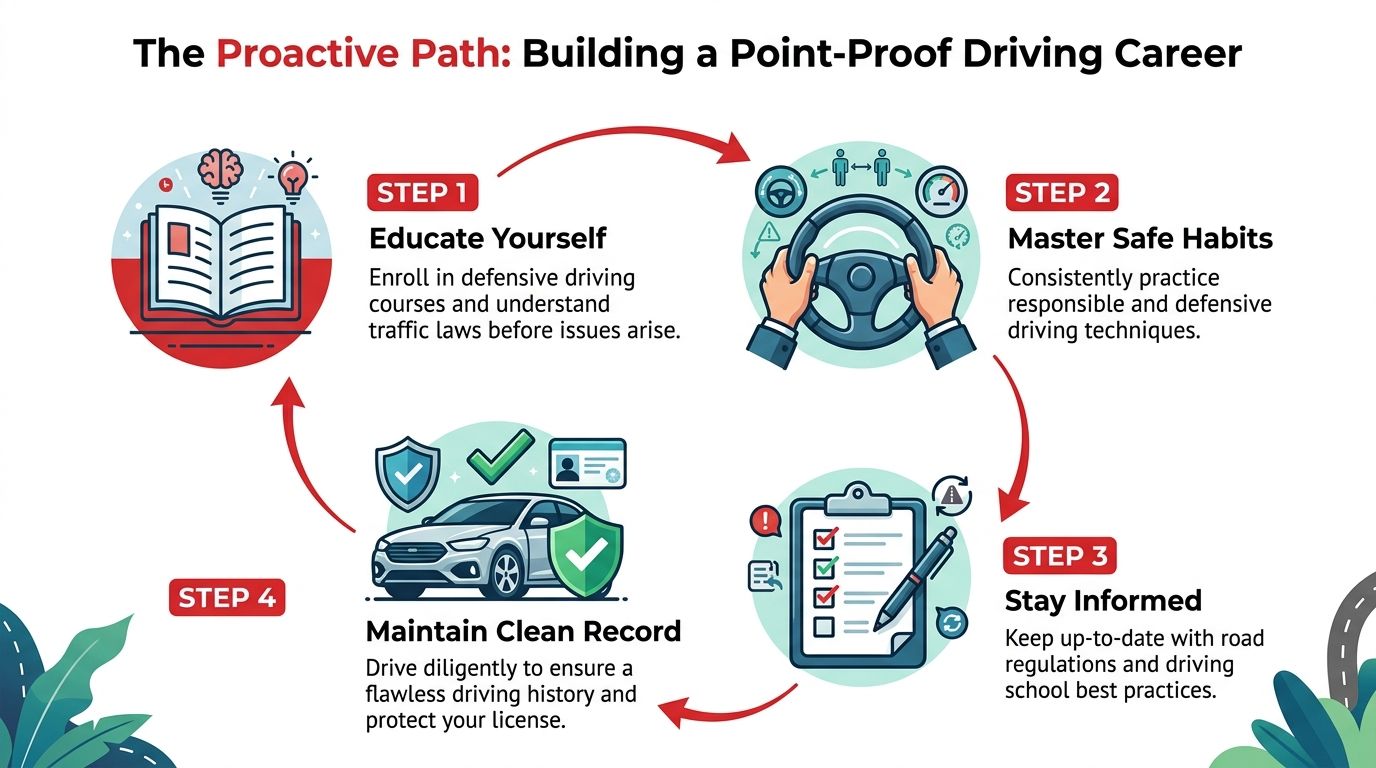
The Proactive Path Building a Point-Proof Driving Career
The best answer to how to reduce points on license problems is to stop creating them in the first place.
That sounds obvious, but many individuals don't train that way. They wait until a ticket, a failed road test, a nervous teen driver, or an insurance headache forces action. By then, the lesson costs more.
Driver education beats damage control
A point reduction course is useful after a mistake. Real driver education builds the habits that keep mistakes from stacking up.
That difference matters. One teaches recovery. The other teaches judgment.
Good training improves the exact areas that lead to common traffic trouble:
- Speed management: Not just knowing the posted limit, but learning how traffic flow, road design, and distractions affect your choices.
- Space control: Following distance, lane positioning, and timing around merges.
- Intersection discipline: Turns, stops, yield decisions, and late-light errors.
- Observation habits: Mirror use, scanning patterns, and hazard recognition.
- Calm decision-making: Especially for teens, new drivers, and adults who get tense in heavy traffic.
A lot of tickets start before the officer ever pulls a driver over. They start with weak habits.
Why Joshua's Law matters
For teens in Georgia, Joshua's Law isn't just a requirement to get through. It's one of the few structured chances to build safe driving fundamentals before bad habits settle in.
The strongest programs don't stop at the classroom portion. They connect the rules to actual driving situations:
- neighborhood turns
- lane changes in real traffic
- parking lot control
- highway entry and exit
- decision-making under pressure
That combination is what helps a teen become a driver who sees trouble early instead of reacting late.
Online courses work best when paired with real coaching
Online learning helps with scheduling. It gives families flexibility and makes it easier to complete required coursework. That's useful, especially for busy students and working adults.
But online instruction has a clear limitation. It can't watch your hands at the wheel. It can't correct your speed selection in traffic. It can't tell you that you keep braking late into right turns or drifting wide on left turns.
That's where behind-the-wheel instruction changes outcomes. Personalized lessons expose the small habits that create bigger consequences later.
Driving lessons: The Key Differentiator
Many drivers save themselves future points through this approach.
A generic class teaches broad rules. A one-on-one lesson teaches your problem. That's a major difference.
One student may know every sign in the handbook but panic on the highway. Another may drive confidently but roll through stops. Another may be an adult who hasn't driven in years and needs structured rebuilding, not a lecture.
Targeted lessons work because they isolate the risk.
Where lessons often make the biggest difference
- Parallel parking and low-speed control: These don't usually cause points directly, but they reveal steering discipline and awareness.
- Highway merging: Poor merge timing leads to abrupt lane changes, speed problems, and panic decisions.
- Left turns across traffic: One of the most common places drivers misjudge space.
- School zones and neighborhood speed control: Drivers often know the rule but don't manage pace consistently.
- Lane changes in congestion: Mirrors, blind spots, and timing need repetition, not guesswork.
The safest drivers aren't the ones who "feel comfortable." They're the ones who can perform the basics correctly when traffic gets busy, fast, or unpredictable.
Lesson packages create consistency
Single lessons help. Packages usually help more because driving skill improves through repetition.
That matters for three groups in particular:
- Teen drivers: They need progression, not one burst of practice.
- Adult learners: They often need confidence rebuilt in stages.
- Drivers returning after a bad experience: They benefit from structure and clear wins.
A package also lets instruction build logically. Early sessions can focus on control and observation. Later sessions can push into tougher traffic, test preparation, and weak spots that show up only after a driver settles in.
Road testing should be the finish line, not the starting point
A lot of families treat the road test like the goal. It isn't. It's the checkpoint.
Drivers who cram only for the test may pass and still be unprepared for daily driving. That's where tickets begin. They technically hold a license, but they haven't built durable road judgment.
Road test preparation should answer questions like:
- Can the driver make safe lane changes without prompting?
- Can they keep a steady, legal speed without wandering?
- Can they handle intersections cleanly?
- Can they recover calmly after a mistake?
If the answer is shaky, more training is cheaper than a record problem later.
Access matters too
Many families delay training because they assume it will be too hard to schedule or too expensive to start. Georgia's Driver's Education Scholarship Grant Program can make training more accessible for qualifying students. That's worth checking before putting off lessons that could shape years of driving habits.
Scheduling flexibility matters too. Teens have school. Parents have work. Adults returning to driving often need very specific appointment windows. Programs that offer online options, road test support, and different lesson formats make it easier to stay consistent.
One practical next step
For Georgia drivers who want prevention, not just repair, it makes sense to start with instruction that matches your stage: Joshua's Law coursework for teens, refresher lessons for adults, and targeted packages for drivers who need help with highway driving, parking, confidence, or test readiness. You can compare options through A-1 Driving School's defensive driving overview and then focus on the training format that fits your weakness.
Reactive Measures When You Already Have Points
If points are already on your record, deal with the record first. Then fix the driving habits behind it.
Georgia gives drivers one clear state-approved option. Completing a certified 6-hour Driver Improvement course can remove up to 7 points from your record once every 5 years, and you must submit the original physical certificate because electronic copies aren't accepted, according to this Georgia point reduction guide.
The short version of the process
This is the practical sequence:
- Confirm eligibility: Make sure you haven't already used the reduction window too recently and that you're not expecting it to undo a suspension.
- Take a certified course: Use a Georgia-approved provider.
- Get the original certificate: Keep the physical copy safe.
- Submit it correctly: Send or deliver it to DDS as required.
- Check your record again: Don't assume processing happened. Verify it.
What this method does well
It can reduce pressure on your record. It can also help drivers who are getting too close to a suspension threshold.
What it doesn't do is erase the underlying driving behavior. If the ticket came from speed control, following too closely, poor lane judgment, or distracted habits, the course doesn't automatically retrain those weaknesses.
Other realistic options
Some drivers also talk with a traffic attorney before resolving a citation. In some situations, a negotiated outcome may reduce the chance of assessable points. That's case-specific, and it depends on the facts, the court, and timing.
If your record has already pushed you into a tougher insurance category, it helps to review options built for drivers with prior violations. This guide to insurance for high-risk drivers gives a practical overview of what to expect when standard pricing gets harder to find.
If you're using a point reduction course as your only strategy, you're solving the paperwork and ignoring the pattern.
How License Points Directly Impact Your Insurance Premiums
Drivers often focus on the DDS because that's the official system they can see. Insurance companies create the money side of the problem.
One ticket may not feel catastrophic in the moment. Over time, though, a record with violations can change your rates, your carrier options, and how long you stay in a more expensive category.

Why insurers care about points
Insurance companies don't care about points for the same reason the DDS does. The DDS is focused on driving privilege and enforcement. Insurers are pricing risk.
A driver with recent violations often looks more likely to file future claims. That's why the financial pain can outlast the original court headache.
Pennsylvania's system makes the safe-driving logic plain. Drivers get three points removed for every 12 consecutive months of violation-free driving, according to the Pennsylvania Driver's Manual point system page. The idea is simple. Clean driving earns relief. Bad habits cost money.
The hidden cost of waiting too long
A lot of people shop for help only after insurance has already become a problem. That's backward.
A better sequence looks like this:
| Stage | Typical driver response | Better response |
|---|---|---|
| After first ticket | Pay and move on | Review record and fix the habit |
| After repeat violation | Look for point reduction only | Add skill training and insurance planning |
| After rates jump | Start scrambling for options | Maintain a clean record before renewal pressure hits |
If you're already dealing with increased premiums, A-1 also has a practical page on insurance for high-risk drivers that explains why record problems can keep following you even after the immediate ticket stress fades.
Serious charges raise the stakes further
Routine traffic tickets and impaired-driving charges aren't the same issue, and they shouldn't be treated like they are. If someone is facing a more serious alcohol-related charge in another jurisdiction, legal strategy becomes much more important than a standard driving class. For context on how that question can play out, this article on whether a DWI charge can be reduced shows why drivers should get legal guidance when the charge goes beyond ordinary point management.
A clean record does more than protect your license. It protects your future insurance bill from becoming a monthly penalty.
Your Long-Term Strategy with A-1 Driving School
Point reduction is useful. Skill building lasts longer.
That distinction should shape how you handle every stage of driving life. A teen getting started needs structured education and coached practice. An adult who moved to Georgia may need road rules, confidence rebuilding, and targeted lessons. A licensed driver with a recent ticket may need both corrective training and a smarter plan for the future.
A practical way to think about it
Use the right tool for the right problem.
- For new teen drivers: Start with Joshua's Law education, then reinforce it with behind-the-wheel training.
- For adults who need confidence: Take focused lessons on the exact situations that create stress.
- For test readiness: Treat road test prep as proof of skill, not a shortcut.
- For drivers with mistakes already on the record: Handle the immediate issue, then train the weakness that caused it.
This approach keeps you from overusing one solution for every problem. A classroom course won't fix highway panic. A single lesson won't replace a full education program for a new teen driver. The right mix matters.
Why long-term drivers stay cleaner
Drivers who keep a cleaner record over time usually do four things well:
- They don't wait for a crisis before getting help.
- They practice in the environments that challenge them.
- They refresh old skills when confidence slips.
- They treat driving as a skill that needs maintenance.
That's the mindset that keeps point problems from becoming a cycle.
The better question to ask
Don't ask only, "How do I get points off my license?"
Ask, "What kind of driver do I need to become so this stops happening?"
That question leads to better choices. It points families toward real driver's education, guided practice, flexible online coursework when needed, road test support, and lesson packages that build consistency instead of panic.
If you want a cleaner record and more confidence behind the wheel, start with training that fits your situation. Explore teen driver's education, Joshua's Law options, online courses, driving lessons, lesson packages, and road test services through A-1 Driving School. Don't just manage points. Build the habits that help keep them off your record for good.