

Getting a Georgia driver’s license can feel simple right up until a family starts looking at the actual rules. A teen is excited. A parent is opening tabs, reading DDS pages, texting friends, and asking the same question over and over: “What exactly do we have to do first?”
That confusion is normal. Georgia teen driving laws have several moving parts because the state doesn’t want brand-new drivers thrown into full driving privileges too fast. The rules are built to slow the process down, add practice, and reduce avoidable mistakes during the riskiest stage of learning.
Your Guide to Navigating Georgia Teen Driving Laws
Most families I meet are dealing with the same moment. A teen has turned 15 or 16, wants independence, and assumes getting licensed is just a matter of taking a test. Then the parent finds out there’s a permit stage, a waiting period, driver’s education requirements, supervised practice, and restrictions even after the road test is passed.
That can sound frustrating until you look at why these laws exist.
In Georgia, drivers ages 15 to 20 made up 8% of licensed drivers but were involved in 10% of all traffic crashes in 2022, and 192 young drivers were involved in fatal crashes according to Georgia teen crash data summarized here. Those numbers help explain why Georgia uses a phased system instead of handing a full license to every new teen driver right away.

Practical rule: Georgia teen driving laws are easier to follow when you stop thinking of them as paperwork and start thinking of them as a training plan.
Parents often get stuck on questions like these:
- When can my teen get a permit
- How long does the permit have to be held
- Does Joshua’s Law apply at 16 and 17
- Can the class be taken online
- How do the in-car lessons fit in
- What happens after the road test
Each of those questions has a clear answer. The key is putting them in the right order.
A good driver’s education path should do more than help a teen check legal boxes. It should help them understand lane changes, turns, parking, speed control, traffic flow, and decision-making under pressure. The law handles the minimum requirements. Good instruction turns that into actual readiness.
Understanding Georgia’s Graduated Licensing System
Georgia’s teen licensing system works like levels in a game. You don’t start at the final level. You earn privileges step by step.
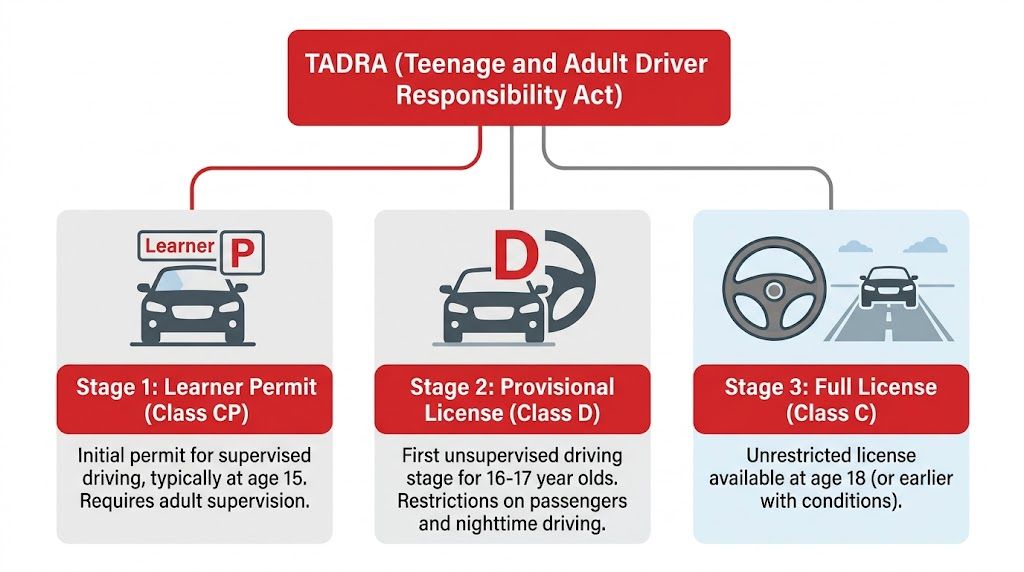
The system comes from TADRA, short for the Teenage and Adult Driver Responsibility Act. If you want a simple breakdown of the name and purpose, this page on what TADRA stands for is a useful primer.
The three stages
A teen starts with the Instructional Permit, also called Class CP. This is the supervised practice stage.
After meeting the requirements, the teen can move to a Provisional License, also called Class D. This allows independent driving, but with important restrictions.
Later, the teen moves to a Class C license, which is the full license stage.
One of the most important rules in Georgia’s GDL system is this: a teen must hold the Class CP permit for 12 months and one day before becoming eligible for a Class D license at age 16, and the Class D license includes a midnight to 5 AM curfew and immediate-family-only passengers for the first six months according to this summary of Georgia teen driving laws.
Georgia GDL stages at a glance
| Feature | Instructional Permit (Class CP) | Provisional License (Class D) |
|---|---|---|
| Main purpose | Supervised learning | Limited independent driving |
| Typical starting point | Age 15 | Age 16 or 17 after eligibility is met |
| Supervision | Must drive with a qualified adult | May drive alone, subject to restrictions |
| Time requirement | Must be held for 12 months and one day before Class D eligibility | Transitional stage before full license |
| Night driving | Supervised practice only | No driving from midnight to 5 AM |
| Passengers | Based on supervised driving setup | First six months limited to immediate family only |
Why Georgia does it this way
A new driver has to build several skills at once:
- Vehicle control: steering, braking, smooth turns, backing, parking
- Traffic judgment: gaps, right of way, lane choice, speed matching
- Hazard awareness: reading what other drivers might do next
- Confidence: staying calm instead of freezing or rushing
A permit gives families time to practice those basics with less pressure. A provisional license adds freedom gradually, not all at once.
A teen may feel ready after a few weeks. Real readiness usually shows up after many different driving situations, including rain, traffic, parking lots, left turns, and night driving with supervision.
Where families usually get confused
The biggest misunderstanding is thinking the permit and the license are separate problems. They aren’t. The permit stage should be used to prepare for every later step.
That means using the permit period to:
- Start formal driver education early
- Schedule professional lessons before bad habits settle in
- Log supervised hours steadily instead of cramming them late
- Practice the same skills that appear on the road test
Families who spread the work out usually have a much smoother experience than families who wait until the teen is almost eligible to test.
How to Meet All Joshua’s Law Requirements
Joshua’s Law is the part of georgia teen driving laws that creates the most questions. It’s also the part that families can handle most smoothly when they break it into a checklist.
Originally enacted in 2005, Joshua’s Law was updated on July 1, 2021 to extend driver education requirements to 17-year-olds, who had previously been exempt if they delayed licensure, according to this explanation of the law change.
The easiest way to think about Joshua’s Law
For most teens under 18 seeking a Class D license, there are three parts to keep straight:
- Driver education coursework
- Professional in-car instruction or the parent-taught alternative allowed under the law
- Supervised driving practice logged with a parent or guardian
What trips families up is that these pieces happen in different places. One part may be online or in a classroom. Another happens with an instructor in a training car. Another happens with a parent over time.
The classroom or online course
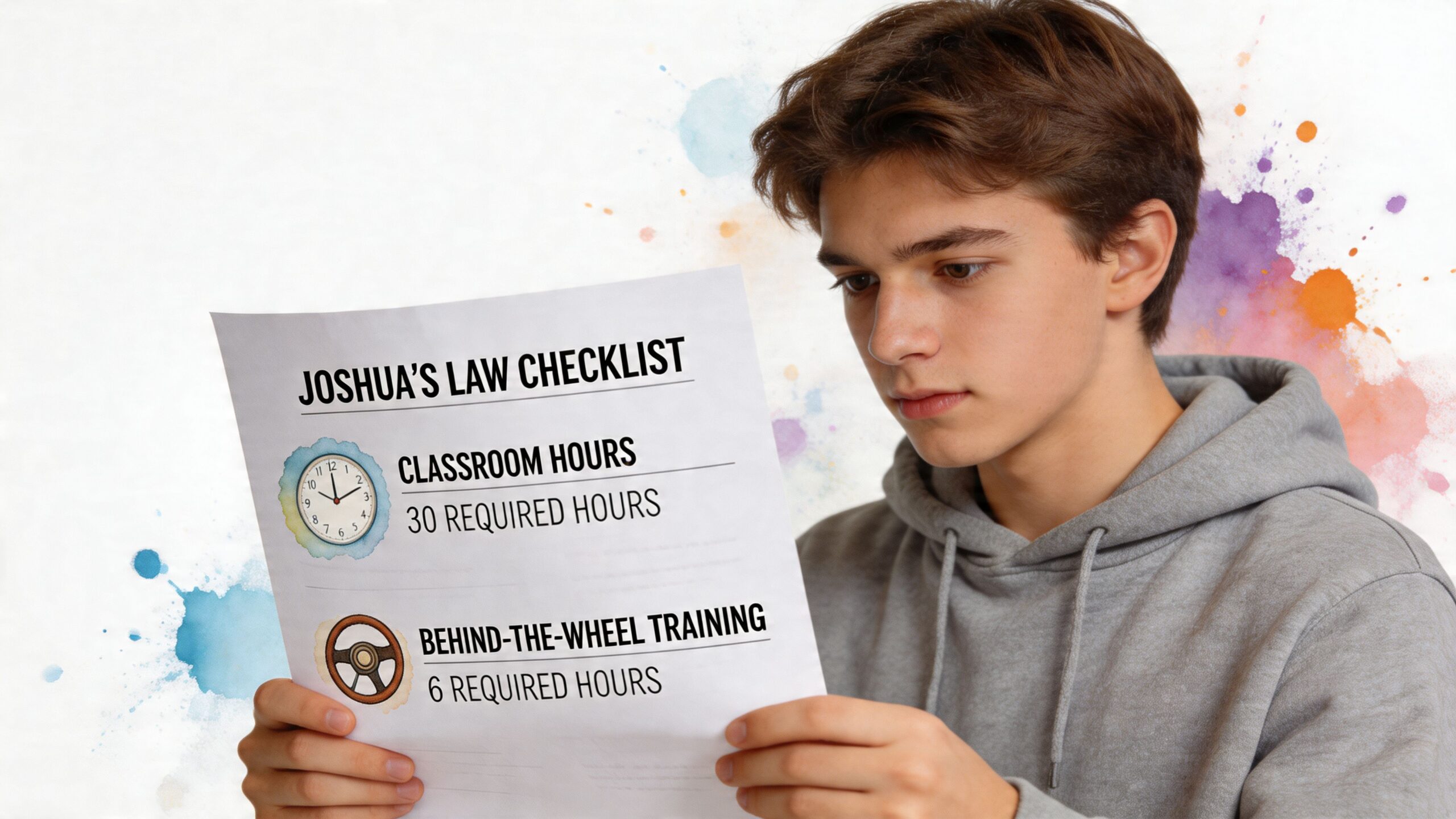
Georgia requires a 30-hour driver education course for teens covered by Joshua’s Law.
That course teaches the rules of the road, signs, driving judgment, risk awareness, and decision-making. Some students do better in a classroom because they like structure. Others do better online because they can work through the material at their own pace.
If your teen needs scheduling flexibility, one option is a state-approved online Joshua’s Law course portal such as the Joshua’s Law login page, which is designed for students completing the required coursework remotely.
The behind-the-wheel piece
Many parents often pause at this point. They assume the classroom course is the whole requirement. It isn’t.
A teen also needs the required in-car training path recognized under Joshua’s Law. Watching videos about intersections and physically handling a left turn in traffic are two different things.
Professional lessons help a student work on skills like:
- Smooth braking
- Turning into the correct lane
- Checking mirrors before changing lanes
- Keeping proper following distance
- Parking with control instead of guesswork
A parent can teach many valuable habits during supervised driving, but professional instruction often catches things families miss, especially hand position, scanning, lane placement, rolling stops, and hesitation at busy intersections.
The supervised driving log
Joshua’s Law also requires 40 hours of supervised driving, including 6 hours at night, based on the verified law summary provided in the brief.
This is the part families should start early. Don’t wait until the permit has almost reached the time requirement. If you save all the practice for the final weeks, the teen often ends up with rushed, repetitive driving instead of varied experience.
A better pattern is to rotate through different settings:
- Neighborhood driving for turns, stop signs, and speed control
- Main roads for lane management and traffic signals
- Parking lots for parking, backing, and slow-speed control
- Night practice for glare, visibility, and extra caution
Here’s a quick video many families find helpful while sorting out the process:
A simple Joshua’s Law checklist
- Get the Class CP permit
- Hold it for the required time
- Complete the 30-hour driver education requirement
- Complete the required in-car training path
- Log 40 supervised hours, including 6 at night
- Keep your documents organized for testing day
Keep this in mind: The legal requirement is the minimum. If a teen still struggles with turns, speed control, or lane positioning, more guided practice is the smart move.
One practical solution families use is a single school that offers the classroom or online course, in-car lessons, road test preparation, and testing support in one place. A-1 Driving School provides those options, including Joshua’s Law courses, online coursework, driving lessons, and road testing assistance for Georgia students.
Go Beyond Compliance with Professional Driving Lessons
Passing a written test or completing a course doesn’t automatically create a calm, skilled driver. It creates a student who has started training.
That’s why professional driving lessons matter so much. The law tells a teen what must be completed. Lessons help the teen turn that information into repeatable habits.
What professional instruction fixes faster
Parents are important teachers. But parents also tend to teach from familiarity. They know how they drive, and they often forget how many steps feel automatic to them.
An instructor slows those steps down and makes them visible.
For example, a teen may say, “I checked before changing lanes.” An instructor can break that into a sequence:
- mirror
- signal
- side check
- speed match
- smooth movement
That kind of coaching helps because it replaces vague feedback with a process the student can repeat.
Skills that usually need more than the minimum
Most teens need extra reps in a few areas before they feel steady:
- Parallel parking: not just fitting in the space, but setting up correctly
- Highway merging: judging speed and gap without panicking
- Busy left turns: deciding when to go and when to wait
- Lane changes in traffic: moving confidently without drifting
- Parking lot awareness: reading pedestrians, carts, and backing vehicles
- Test-route skills: stop signs, turns, backing, and observation habits
These are the moments where a lot of family arguments happen. A parent says, “You were too close.” The teen says, “I was fine.” An instructor can step in with neutral, specific correction.
“Practice” only helps when the student is repeating the correct technique. Repeating the wrong habit just makes the wrong habit stronger.
Why lesson packages make sense
One isolated lesson can help. A sequence of lessons usually helps more because the student gets feedback, practice time, and then a chance to improve on the next drive.
Packages are useful when a teen needs support in different stages:
- Early lessons for steering, stopping, turns, and lane position
- Mid-stage lessons for traffic judgment and complex roads
- Late-stage lessons for road test preparation and confidence polishing
Families often ask whether the required hours are enough. Sometimes they are. Sometimes they aren’t. A student who is still tense in traffic, overcorrects the wheel, brakes late, or hesitates at unprotected left turns usually benefits from more coaching before testing.
A helpful read on this point is the benefits of taking driving lessons from an instructor. It explains why students often progress faster when someone outside the family handles the skill-building.
The road test matters, but readiness matters more
A lot of teens focus on one goal: passing the road test on the first try.
That’s understandable. But the bigger goal is being able to drive to school, practice, work, or a friend’s house without making rushed decisions. The road test is short. Real driving is not.
That’s why road testing services can be helpful when paired with preparation. A student should know the vehicle, understand the maneuvers, and go into the test with a clear routine instead of guesswork.
If your teen still says things like “I know what to do, I just get nervous,” that usually points to a need for more guided repetition, not more lectures.
Rules of the Road for Your Provisional (Class D) License
Getting a Class D license is a big milestone. It’s not a full license.
A provisional license gives a teen more freedom, but it also comes with rules that families need to take seriously. These restrictions are part of georgia teen driving laws for a reason. They limit higher-risk situations while a new driver is still gaining experience.
Curfew rule
The Class D license includes a strict midnight to 5 AM curfew.
That means a teen with a provisional license cannot drive during those hours. Families should talk about this before there’s a late event, sleepover, game, or work shift that creates pressure.
A good rule at home is simple: if the plan might run late, arrange the ride before anyone leaves the house.
Passenger limits
Passenger rules are one of the easiest places to make a mistake, especially when friends assume “just one short ride” won’t matter.
Keep it straight this way:
- First six months: immediate family only
- Second six months: one non-family passenger under 21 is allowed
- After that period: the passenger limits expand under Georgia’s provisional rules
Immediate family generally includes close household and family relationships allowed under the law. If there’s any doubt, check before the teen drives.
Why these restrictions matter
New drivers often struggle most when they have extra distractions. Friends talking, music, directions, phones, and social pressure can pull attention away from the road very fast.
That’s why parents should set house rules that go beyond the legal minimum if needed.
Consider rules like these:
- No extra passengers at all until the teen has shown steady judgment
- No unfamiliar destinations alone until route planning improves
- No rushing for school, practice, or work. Leave early instead
- No phone handling in the car. Set navigation and playlist before moving
A provisional license is a learning stage with more responsibility, not proof that a teen has mastered every driving situation.
Violations can cause bigger problems than one ticket
A ticket or major violation can affect much more than a single day.
It can lead to:
- License trouble or suspension issues for certain offenses
- Delayed progress toward full driving privileges
- Insurance headaches for the family
- Loss of parent trust and driving privileges at home
Teens need this said plainly: keeping the license matters as much as getting it.
One of the best things a parent can do is set expectations before the license is issued. Talk through curfew, passengers, routes, weather, school parking lots, and what the teen should do if they feel unsure in traffic. Clear expectations prevent last-minute mistakes.
How to Get Financial Aid for Driver’s Education
Cost stops some families before training even begins. That’s a real issue, especially when the rules require formal education and supervised progress.
There’s also an information problem. Many parents know Joshua’s Law exists, but they don’t realize there may be help available for qualifying students.
According to the Georgia DDS teen driver information summarized here, many families are unaware of the Georgia Driver’s Education Grant Scholarship Program, even though the state’s child poverty rate was 12.7% in 2023 and searches for help with free or lower-cost teen driver education in Georgia have been rising, as noted on the Georgia DDS teen drivers page.
Why families miss this program
Most parents hear about licensing rules from friends, school, or a quick web search. They usually find the requirements first, not the funding options.
That creates a gap. A family may assume driver’s education has to be paid entirely out of pocket and delay training, even when the teen is ready to start.
What the scholarship is for
The Georgia Driver’s Education Grant Scholarship Program is intended to help eligible students access driver training.
The exact details of eligibility and application should always be confirmed through the state’s current DDS guidance. In general terms, families should expect to review whether the student qualifies, gather the requested documentation, and apply through the proper DDS process.
A practical way to approach it
If you think your family might qualify, do this early:
- Check eligibility requirements carefully
- Gather income and school-related documents
- Use the DDS application process rather than waiting until test time
- Ask the school you plan to use whether they participate and how scheduling works after approval
Parent reminder: Scholarship help is most useful when you apply before your teen is on a tight timeline to finish classes and lessons.
Why this matters beyond cost
Driver’s education isn’t just a licensing step. It affects when a teen can begin supervised growth, when they can prepare for testing, and how much support they have while learning.
Families who qualify for assistance shouldn’t feel like they’re asking for a favor. They’re using a program designed to improve access to lawful, structured driver training.
Your Checklist for Becoming a Safe Georgia Driver
The path is easier when you treat it like a sequence instead of a scramble.
Use this checklist:
- Start with the permit. Get the Class CP permit and use that stage for regular, supervised practice.
- Begin driver education early. Don’t wait until the last minute to handle the Joshua’s Law course requirement.
- Add professional lessons. If your teen needs help with parking, lane changes, intersections, or confidence, schedule instruction before test day.
- Track practice hours carefully. Keep supervised driving organized, including night driving.
- Prepare for the road test with intention. Practice the maneuvers, know the rules, and use a test-ready vehicle.
- Treat the Class D license as a learning phase. Curfew and passenger rules still matter after the test is passed.
Parents often want to make the milestone feel special too. If your family is celebrating a license birthday or planning transportation for a group event, this guide to planning an ultimate party bus 16th birthday can help with the celebration side while you keep the driving side safe and legal.
The main point is simple. Georgia teen driving laws are manageable when each step has a plan behind it.
Your Teen Driving Law Questions Answered
What if my teen fails the road test
It happens. Failing a road test usually means the student needs more targeted practice, not that they can’t become a good driver.
Start by finding out where the trouble was. Common issues include rolling stops, poor observation, lane position, backing, and turning errors. Then practice those specific skills before rescheduling.
Can my teen take the Joshua’s Law course online
Yes, online options are available through approved providers. For many students, online coursework is easier to fit around school, sports, and family schedules.
The key is making sure the course is the correct approved option for the teen’s licensing path.
Do the required lessons guarantee my teen is ready
No. They satisfy the legal training requirement, but readiness depends on the student.
Some teens are calm, observant, and consistent after the required training. Others still need more help with traffic flow, parking, highway driving, or test nerves.
Can my teen use any car for the road test
The test vehicle has to meet the state’s requirements. Families should make sure the vehicle is properly prepared for the exam day and that the teen has practiced in it.
Many students feel less stress when they test in a vehicle that is already set up for instruction and road testing.
What if we’re moving to Georgia with an out-of-state permit
That situation can take extra checking. Families should confirm what Georgia will accept, what needs to be transferred, and whether any additional training or testing steps still apply.
When there’s uncertainty, it helps to sort it out before the teen reaches the age or date when the family expects to test.
Should parents wait until the teen is almost eligible before booking lessons
Usually, no. Earlier instruction often works better because the teen has time to absorb corrections and practice them over weeks or months.
Late-stage cramming can create stress for everyone in the car.
If you're ready to turn the rules into a step-by-step plan, A-1 Driving School offers Georgia driver’s education options, Joshua’s Law course access, driving lessons, road test support, and scholarship information so families can handle training and licensing in one place.