
If you're staring at a page of road signs and thinking they all blur together, you're not alone. Most new drivers in Georgia don't struggle because they're careless. They struggle because they try to memorize every sign one by one instead of learning the pattern behind them.
That's the good news. The Georgia signs test gets much easier once you stop treating signs like random flashcards and start reading them like a visual language. Shape tells you the category. Color gives you a clue about urgency. The symbol or words fill in the final detail.
Your First Step to Passing the Georgia Driving Test
Before you worry about the road test, lane changes, or parallel parking, you have to get through the written exam. In Georgia, the DDS knowledge exam has two separate parts: a 20-question Road Signs Recognition Test and a 20-question Road Rules Test. You must get at least 15 out of 20 correct on each section, and if you fail either one, you'll need a retest, according to the Georgia DDS signs test format.
That separate scoring trips up a lot of students. They assume a strong road rules score will balance out a weak signs score. It won't. Signs stand on their own.
What makes the signs section hard
The hard part isn't usually reading the answer choices. It's recognizing the sign fast enough and not confusing similar-looking categories.
Students often mix up:
- Warning versus regulatory signs
- Yield versus merge-related warnings
- Guide signs versus signs that require action
- Pavement markings versus roadside signs
Practical rule: If you can identify the shape before you read the words, you're studying the right way.
A smart way to prepare is to work backward from the test. Learn what the examiner expects, then train your eyes to catch the clue that matters first. If you want a preview of what happens after the permit stage, this guide on what to expect on the Georgia road test helps connect the written material to real driving.
Why Mastering Signs is Crucial for Your Georgia License
A sign isn't just a test question. It's a decision point. You see it, interpret it, and act on it, sometimes in just a moment. That's why sign knowledge matters long before a student ever takes a road test.
Georgia has had a large wave of new teen drivers entering the system. The DDS Virtual Road Test program allowed nearly 19,500 teenagers to obtain licenses without a traditional road test, and those applicants still had to pass the knowledge exam, including the road signs portion with 75% accuracy, according to this report on the DDS Virtual Road Test program.
Why signs matter beyond the permit test
When new drivers know signs well, they make better choices earlier. They slow down sooner. They pick the correct lane sooner. They notice conflicts before they become problems.
That matters especially for teen drivers because so much of early driving is mental overload. A new driver may be trying to steer smoothly, check mirrors, judge traffic, and process a sign at the same time.
Here are the actual jobs signs do:
- They prevent late reactions: A curve warning only helps if you recognize it before you're in the curve.
- They reduce confusion at intersections: Stop, yield, lane-use, and one-way signs keep drivers from guessing.
- They support Joshua's Law training: Good sign knowledge helps students connect classroom learning to actual road choices.
A driver who recognizes the category instantly stays calmer than a driver who tries to decode the sign from scratch.
Decoding the Language of Road Signs by Shape and Color
Most students try to memorize road signs by name. A better method is to learn the system first. Georgia signs follow a visual code. Once you know that code, unfamiliar signs become easier to solve.
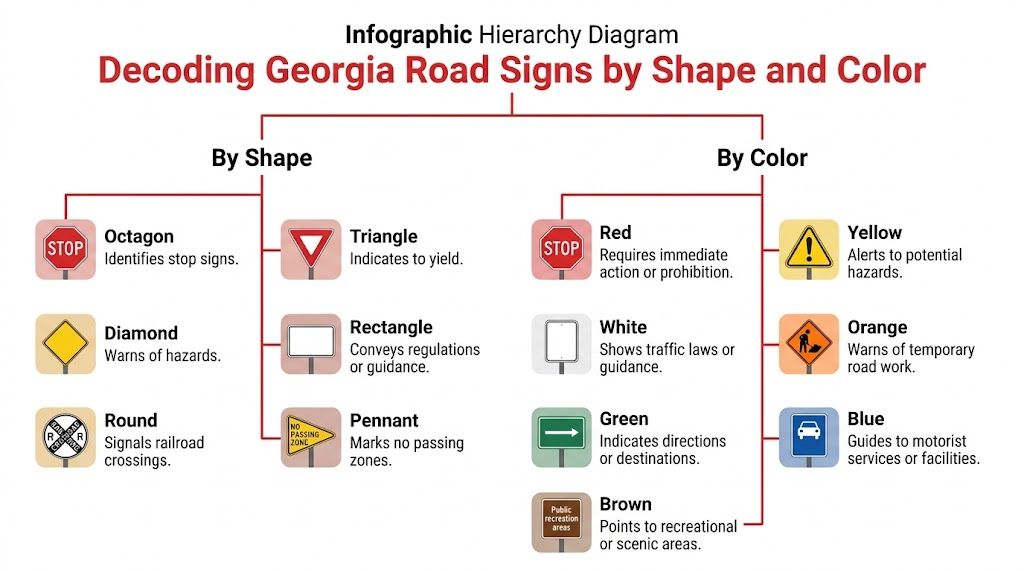
Georgia uses seven basic sign shapes for quick recognition: octagon for STOP, inverted triangle for YIELD, diamond for WARNING, pennant for NO PASSING ZONE, circle for railroad advance warning, and rectangles for REGULATORY and GUIDE signs, based on MUTCD standards, as explained in this Georgia road signs reference.
Start with shape first
Shape is your fastest clue because you can spot it before you read words.
- Octagon means stop. No debate.
- Inverted triangle means yield. Slow, check, and give the right-of-way when needed.
- Diamond means warning. Something ahead needs your attention.
- Pennant means no passing zone.
- Circle relates to a railroad warning.
- Rectangle usually means either a rule or useful guidance.
A lot of georgia driving test signs become simpler once you ask one question first: what category is this shape in?
Then use color to narrow it down
Color gives you the second clue. It tells you the tone of the message.
| Shape/Color | Meaning | Example |
|---|---|---|
| Octagon | Stop | STOP |
| Inverted triangle | Yield | YIELD |
| Diamond | Warning | Curve ahead |
| Pennant | No passing zone | No passing zone marker |
| Circle | Railroad warning | Railroad crossing ahead |
| Rectangle | Regulation or guidance | Speed limit or destination sign |
| Red | Immediate action or prohibition | Stop sign |
| Yellow | Hazard warning | Curve warning |
| White | Traffic law or guidance | Speed limit sign |
| Orange | Temporary road work warning | Construction warning |
| Green | Direction or destination | Exit or route sign |
| Blue | Motorist services | Gas or lodging sign |
| Brown | Recreation or scenic area | Park sign |
That shape-first method is one of the best ways to study what road signs mean in Georgia without getting overwhelmed.
Memory shortcut: Shape tells you the family. Color tells you the mood. Words or symbols tell you the exact message.
Regulatory Signs Explained What You Must Do
Regulatory signs tell you the law. They don't suggest. They direct. On the permit test and on the road, these are the signs that answer the question, "What am I required to do right now?"
Most regulatory signs are rectangular and often use white, black, or red. But the category also includes the stop sign and yield sign, even though their shapes are unique.
The signs students must obey exactly
A STOP sign means a full stop at the stop line, crosswalk, or the point where you can see clearly before moving. Rolling through is one of the most common beginner mistakes. This guide on what to do at a stop sign is helpful because it breaks the action into simple steps.
A YIELD sign doesn't always mean stop, but it always means be ready to give up the right-of-way. If traffic, pedestrians, or another hazard makes it necessary, you stop.
Other common regulatory signs include:
- Speed Limit: The maximum lawful speed under normal conditions
- One Way: Traffic moves only in the direction shown
- No Parking: You may not leave a vehicle there
- No U-Turn: Turning around at that location is prohibited
- Lane Use Control signs: They tell you which lane may turn or continue straight
How to handle them on the test
When the DDS shows a regulatory sign, don't overthink it. Ask yourself what action the sign requires.
A quick mental check helps:
- Is this a law sign or a warning sign?
- What exact action does it require?
- What would happen if a driver ignored it?
If the sign tells you what you must do, it's usually testing obedience, not interpretation.
Warning Signs Explained How to Prepare for Hazards
Warning signs don't usually order you to do one exact thing. They tell you to get ready. Most are yellow and diamond-shaped, which makes them easier to spot if you've trained yourself to read category before detail.
Many students often make a subtle mistake. They can name the sign, but they can't explain the safe response. The test may ask for meaning, but safe driving depends on the reaction.
Common warning signs and the right response
A Curve Ahead sign means reduce speed and prepare to steer smoothly through the bend. A Pedestrian Crossing sign means scan harder, cover the brake, and be ready to stop. A Signal Ahead sign warns that traffic may be stopped or changing soon.
Other warning signs often seen in study materials include:
- Dip
- Merge
- Slippery When Wet
- Lane Ends
- Construction or work zone warnings
- Railroad-related advance warnings
The action matters more than the label
When you study warning signs, pair each one with a driver action.
| Warning sign type | What it tells you | Smart response |
|---|---|---|
| Curve | Road direction changes | Slow before entering |
| Pedestrian crossing | People may enter roadway | Scan and prepare to stop |
| Signal ahead | Controlled intersection is coming | Check traffic flow and brake early |
| Merge | Lane pattern changes | Adjust space and check mirrors |
| Slippery when wet | Traction may drop | Reduce speed and avoid sudden moves |
If you're helping a teen understand why warning signs look the way they do, resources on broader safety warning signage can be useful because they show the same core idea: warning signs are built to trigger attention before action is needed.
Guide Signs Explained How to Navigate Your Route
Guide signs help you move from one place to another without last-second guesswork. They don't usually warn about danger or state a legal command. They give direction, route identity, and service information.
Most drivers pay more attention to guide signs after they start driving on bigger roads. That's when lane positioning becomes part of navigation.
The main kinds of guide signs
Destination signs tell you where a road leads. These are often green and may show city names, street names, exits, or distance.
Route markers identify the road you're on. They help you confirm whether you're on the correct interstate, highway, or state route.
Service signs point to useful places for drivers, such as fuel, food, lodging, hospitals, or rest areas. These are often blue.
How students get confused
A lot of students treat guide signs like background decoration. Then they miss the key detail, such as which lane they need for an exit or whether a turn is approaching.
Use this simple reading order:
- Top or main label first: What road or destination is this about?
- Direction next: Straight, right, left, exit, north, south, and so on
- Distance last: How soon do I need to act?
Guide signs reward early scanning. If you wait until you're right beside the sign, the information comes too late to help.
Reading Georgia Pavement Markings
Signs aren't only posted on the roadside. Georgia tests your understanding of what the road itself is telling you. Pavement markings are constant instructions, and many students lose easy points here because they focus only on signs with words.

Yellow versus white
The easiest way to keep markings straight is to separate them by traffic direction.
- Yellow lines divide traffic moving in opposite directions
- White lines divide traffic moving in the same direction
Then look at whether the line is solid or broken.
Solid versus broken
A broken line usually means crossing is allowed when it's safe and legal. A solid line means crossing is restricted or discouraged, depending on the situation.
Common examples:
- Solid yellow line on your side: Don't pass
- Broken yellow line on your side: Passing may be allowed when safe
- Double solid yellow lines: Traffic in both directions is separated and passing is restricted
- Solid white line: Stay in lane unless a situation allows a safe lane change
- Broken white line: Lane changes are generally permitted when safe
Other markings students should know
Pavement markings also include arrows, stop lines, crosswalks, and shared turn lane markings.
Stop where the road tells you to stop, not where it feels convenient.
That matters at intersections. If a stop line is painted on the pavement, that's the first stopping point. If a turn arrow is painted in your lane, that lane use matters just as much as a posted sign.
Avoid These Common Georgia Driving Test Sign Traps
Students rarely miss georgia driving test signs because the sign is impossible. They miss them because the question creates pressure, or because an actual situation involves more than one message at once.
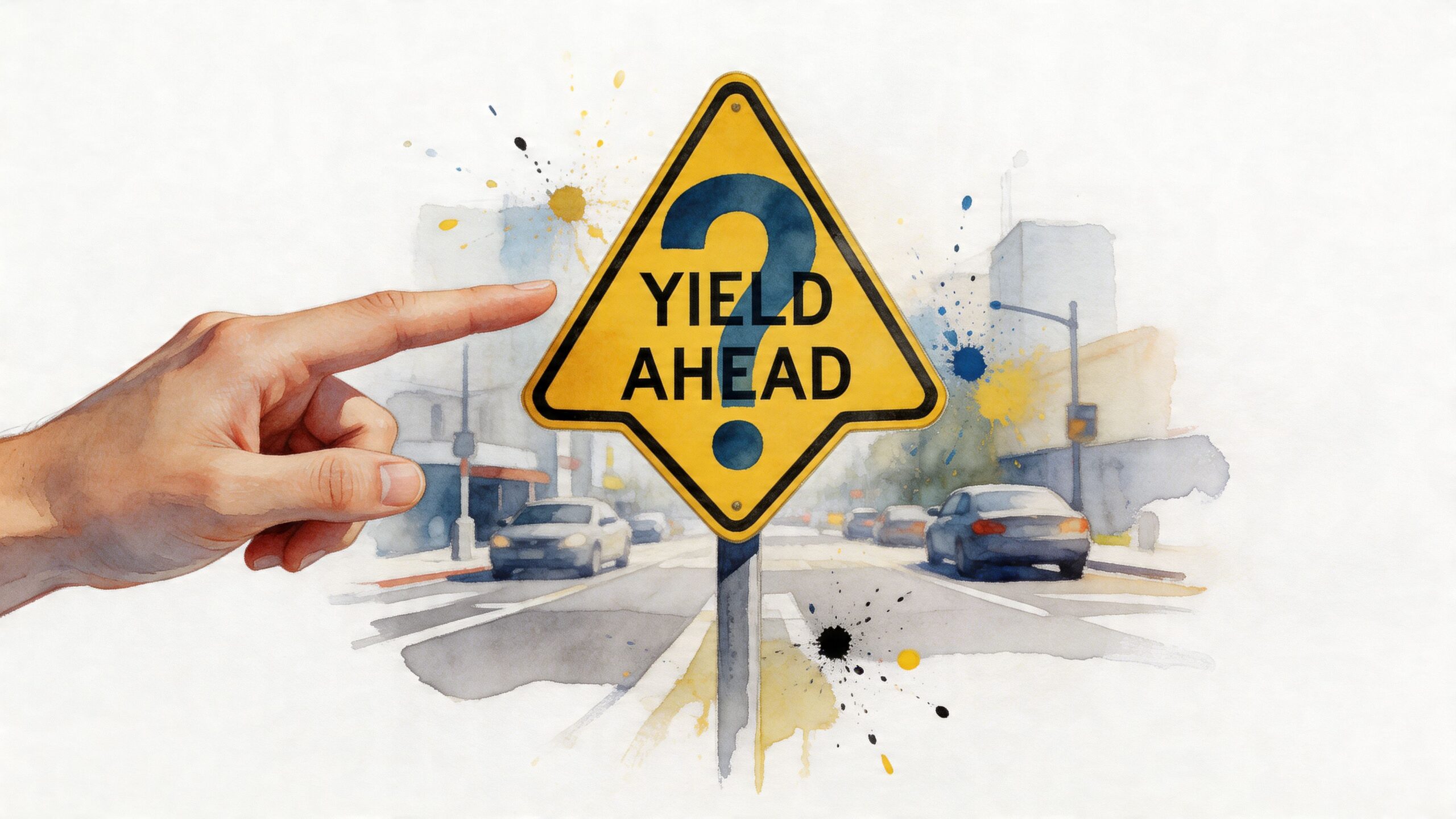
Real driving often requires you to prioritize multiple signs together, and drivers also need to recognize signs from a distance so they can react in time. Basic manuals often don't fully cover that practical skill, as noted by the Georgia DDS discussion of signs, signals, and markings.
Trap one, knowing the sign but not the response
A student sees a Yield Ahead warning and answers as if it were the actual YIELD sign at the intersection. Those aren't the same thing.
One is a warning that a yield condition is coming. The other is the command point where you must give the right-of-way.
Trap two, reading only one sign in a cluster
At a busy intersection, you might see a lane merge warning, a work-zone sign, and a yield condition close together. New drivers often lock onto whichever sign looks biggest.
That creates bad decisions. You need to sort the messages:
- Immediate legal command
- Immediate hazard
- Navigation or lane guidance
That order helps when signs stack up.
Trap three, recognizing too late
A sign you identify late is almost the same as a sign you didn't understand. Distance recognition matters because speed shortens decision time.
Train this by asking yourself two questions while studying:
- What category is it from far away?
- What action should start before I get there?
Here's a quick visual review that helps reinforce the difference between common sign meanings and driver responses.
Trap four, falling for test wording
The DDS may ask what a sign means, not what color it is. Or it may show a sign shape and ask what category it belongs to.
Use the same sequence every time:
- Shape first
- Color second
- Action third
Students who slow down mentally before answering usually make fewer category mistakes.
Your Ultimate Study Plan From Joshua’s Law to Road Ready
A strong plan beats cramming every time. If your goal is to pass the permit test, build confidence, and become a safer driver, the cleanest path is to learn in stages.
Stage one, learn the visual system
Start with sign categories, not random memorization. Study shape, color, and pavement marking rules first. That gives you a framework for everything else.
A simple weekly routine works well:
- Day one: Shapes and categories
- Day two: Regulatory signs
- Day three: Warning signs
- Day four: Guide signs and pavement markings
- Day five: Mixed practice questions
- Day six: Review mistakes only
- Day seven: Light recall and rest
Stage two, connect it to Joshua’s Law training
Students working toward a Class D license need proper driver education. A state-approved Joshua’s Law course is where many teens build the foundation for road rules, sign recognition, and safe decision-making.
Online options can help families who need schedule flexibility. In-person instruction can help students who learn better with direct guidance. The key is consistency. Don't wait until the night before the permit test to start looking at signs.
Stage three, move from knowledge to driving skill
Knowing a sign on paper isn't the same as responding to it in traffic. That's why behind-the-wheel practice matters so much.
Driving lessons are where students learn to:
- Spot signs early instead of late
- React smoothly instead of abruptly
- Read lane-use signs while steering and checking mirrors
- Handle intersections where several instructions appear together
Lesson packages can be especially helpful because some students need more work in certain areas, such as highway driving, turns, lane control, or test-day readiness.
Stage four, use every support option available
Some families may qualify for the Georgia Driver's Education Scholarship Grant Program, which can make formal training more accessible. If that applies to your family, it's worth checking eligibility early.
If you're preparing for the road test too, using a school that offers both lessons and road testing can make the process simpler. One training path, one system, and fewer surprises.
The students who improve fastest usually don't study harder. They study in the same order they will need the skill on the road.
Your Printable Georgia Road Signs Study Sheet
A printable study sheet works best when it's short enough to review in a few minutes and focused enough to build fast recall. For georgia driving test signs, that means one page with the essentials only.
Your sheet should include:
- The main shapes and their meanings
- The most common sign colors
- A small group of must-know regulatory signs
- Key warning signs
- Basic pavement marking rules
Print it, keep it in a folder, and review it in quick sessions instead of marathon study blocks. If you're making your own study tools, this guide on how to create effective flashcards is useful because it shows how to turn facts into faster recall.
A good printable sheet isn't a replacement for the manual. It's a review tool. Use it after you've already learned the sign system so it reinforces patterns instead of becoming another pile of facts to memorize.
Practice Quiz Test Your Georgia Sign Knowledge Now
Try these questions without looking back. Then check your answers and see where you need more review.
Quiz
An octagon-shaped sign means
A. warning
B. stop
C. railroad crossing
D. no passing zoneA diamond-shaped sign indicates
A. warning
B. guide information
C. stop
D. yieldWhat does a solid yellow line on your side of the road usually mean
A. passing is encouraged
B. traffic moves in the same direction
C. don't pass
D. turn here onlyA circular sign is related to
A. school zones
B. railroad warning
C. destinations
D. merge areasA rectangular sign with a white background is usually a
A. warning sign
B. regulatory sign
C. recreation sign
D. railroad sign
Answer key
B. stop
The octagon is reserved for stop signs.A. warning
Diamond-shaped signs alert drivers to hazards or changing conditions ahead.C. don't pass
A solid yellow line on your side means passing is restricted.B. railroad warning
The circular shape points to a railroad-related advance warning.B. regulatory sign
A white rectangular sign usually communicates a law, rule, or required behavior.
Frequently Asked Questions about the Georgia Signs Test
What score do I need on the signs test in Georgia
You need 15 correct answers out of 20 on the Road Signs Recognition Test. The same passing mark applies separately to the Road Rules Test.
Do I only need to pass the combined written test overall
No. Each part is scored on its own. A strong score in one section doesn't make up for a weak score in the other.
If I fail the signs test, do I have to retake both parts
Yes. The signs and rules sections are part of the knowledge exam process, and a failed section means a retest is required.
What signs should I study first
Start with the categories that give you the fastest recognition:
- Stop and yield
- Warning signs
- Regulatory rectangles
- Railroad and no-passing shapes
- Pavement markings
Students do better when they master the pattern before trying to memorize every single sign name.
Are pavement markings part of sign knowledge
Yes. Even though they aren't standing on posts, they communicate rules and guidance just like signs do. The permit test can check whether you understand line colors, line types, arrows, stop lines, and crosswalks.
What confuses students the most
Most students struggle with three things:
- Similar-looking categories
- Multi-sign situations
- Knowing the sign but not the correct driver response
That's why practice should include meaning and action, not just recognition.
How should I study the week before the test
Don't try to relearn everything at once. Review categories first, then quiz yourself in mixed sets. Spend extra time on the signs you miss twice.
Is the signs test just about memorization
Not if you study the smart way. Memorization helps, but the bigger skill is instant recognition. When you know what a shape and color usually mean, unfamiliar signs become easier to decode.
A-1 Driving School has helped Georgia drivers since 1987 with driver’s education, Joshua’s Law courses, online learning options, driving lessons, lesson packages, scholarship guidance, road test preparation, and road testing support. If you're ready for the next step, visit A-1 Driving School to find a course, schedule lessons, or explore the training path that fits your goals.