

One of the most common bad decisions on Georgia roads starts with a short thought: “It’s just one trip.”
A teen drives to school before finishing the licensing process. An adult with an expired license heads to work anyway. Someone whose license was suspended decides they’ll be careful and hope they don’t get stopped. Then blue lights appear, and a quick errand turns into a criminal charge.
If you’re searching for driving without a license in ga, you probably need straight answers, not scare tactics. Georgia treats unlicensed driving seriously. But there’s also a practical way forward. If you understand what the law says, what mistakes to avoid, and how to get properly licensed, you can move from stress and confusion to a legal, safer future behind the wheel.
The Unexpected Stop What Happens When You're Caught Driving Unlicensed
You check your mirror and see the patrol car behind you. At first, you hope it's passing. Then the lights stay on.
Your stomach drops because you already know the problem. Maybe you never finished getting licensed. Maybe your license expired and you kept putting off renewal. Maybe it was suspended, and you convinced yourself one short drive wouldn't matter. In that moment, the stop isn't just about a traffic ticket. It can become a criminal matter.

A lot of drivers assume this charge works like a minor paperwork issue. In Georgia, it often doesn't. The outcome depends on whether you forgot to carry a valid license or whether you were operating a vehicle without a valid license at all. That difference changes everything.
Sometimes the stop ends with a citation. In more serious situations, an arrest can follow. If that happens, families often scramble to figure out the next step. A practical guide on what to do when someone gets arrested can help people respond calmly and avoid making the situation worse.
The first mistake happens on the road. The second mistake happens afterward, when people ignore the citation or assume it will sort itself out.
The good news is that one stop doesn't have to define your future. What matters next is understanding your exact situation, following the court process, and getting on a real path to becoming a legal driver.
Decoding Georgia's Unlicensed Driving Laws
A lot of drivers hear the phrase "driving without a license" and assume it means one thing. In Georgia, it covers several different situations, and the difference matters the way the difference between a warning light and a dead battery matters. One is often fixable with paperwork. The other points to a legal problem that can bring a criminal charge.
The key question Georgia asks
The officer and the court focus on one issue. Was your driving privilege legally valid at the time you were behind the wheel?
That question separates a simple document problem from true unlicensed driving.
If your license was valid and you just did not have it with you, the situation is often less severe. Many courts allow drivers to show proof that the license was valid and clear up the matter with a relatively small penalty. It is still a mistake, but it usually does not carry the same weight as driving without a valid license.
True unlicensed driving usually falls into one of these categories:
- Never licensed: You have never been issued a driver's license.
- Expired license: Your license ran out, and you kept driving.
- Suspended license: Your privilege to drive was temporarily taken away.
- Revoked license: Your privilege to drive was removed and is not currently active.
Those categories all point to the same basic problem. Georgia does not see you as legally cleared to drive.
A quick way to sort out your situation
Here is the simplest way to read it:
| Situation | General legal risk |
|---|---|
| You have a valid license, but left it at home | Often resolved by showing the license was valid |
| You never got licensed | Criminal charge risk |
| Your license expired and you still drove | Criminal charge risk |
| Your license was suspended or revoked | Criminal charge risk, often more serious |
This trips people up all the time. Drivers often focus on the physical card, but Georgia focuses on legal status. A plastic card in your wallet does not help if the license attached to it is expired, suspended, or revoked.
Why the state treats these cases differently
A driver's license is more than an ID card. It is the state's confirmation that you met the training, testing, and legal requirements to operate a vehicle. It also shows that your driving privilege is still active.
That is why an expired, suspended, or revoked license creates a much bigger problem than forgetting your wallet on the kitchen counter.
Practical rule: If your license is not legally valid, Georgia treats you as unlicensed.
That may sound strict, but it also gives you a clear path forward. Once you know which category you are in, you can stop guessing and start fixing the issue. For adults, that may mean renewal or reinstatement. For teens, it may mean following permit rules until they are eligible for the next step. Either way, the goal is the same: get fully legal, drive with confidence, and avoid turning a temporary setback into a lasting problem.
The Steep Consequences of Driving Without a License in Georgia
A driver gets pulled over for something small. Maybe a broken taillight. Maybe rolling through a stop sign. Then the officer checks the person's legal driving status, and the whole situation gets heavier in a hurry. In Georgia, an unlicensed driving charge can grow from a stressful stop into a criminal case with fines, jail time, and long-term setbacks.
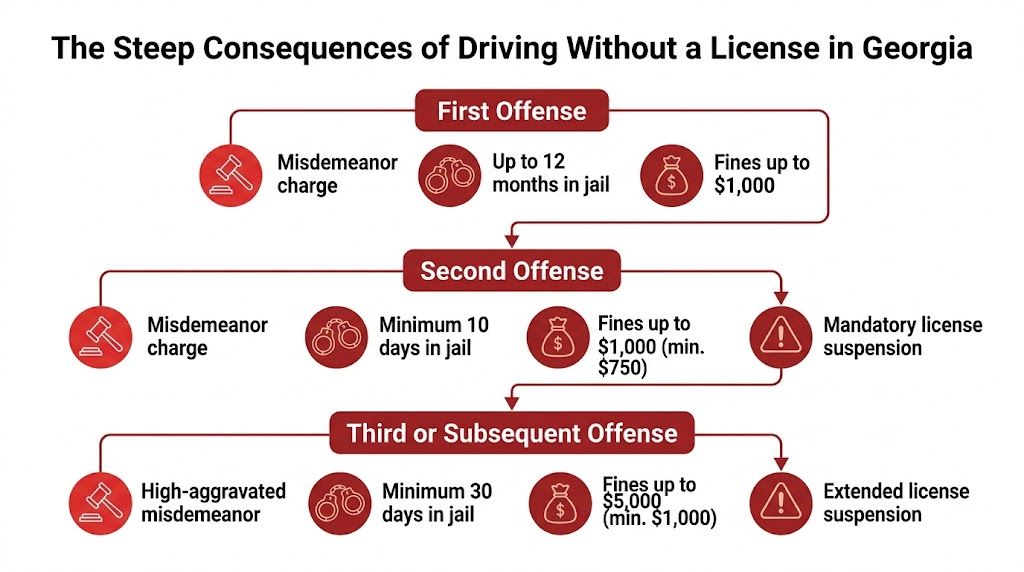
Georgia raises the penalties quickly when someone drives without a valid license. For a first offense, penalties can include a fine of $500 to $1,000, at least 2 days in jail, and a 6-month license suspension, according to this Georgia penalty overview.
A second or third offense within five years is much more serious. Georgia treats it as a high and aggravated misdemeanor, with fines of $1,000 to $2,500 and a minimum of 10 days in jail.
The pattern is clear. The state gives people a chance to correct the problem early. If they keep driving anyway, the punishment gets sharper.
What these penalties mean outside the courtroom
Court penalties are only part of the picture. The practical effects often last longer than the traffic stop itself.
- Jail time can interrupt work and family life. Missing even a few days can put pressure on a job, childcare, or school responsibilities.
- A suspension can make daily life harder. If your license is already invalid, another suspension can delay the point when you are finally allowed to drive legally again.
- A criminal conviction can follow you. Employers, landlords, and licensing boards may see it on a background check.
- Insurance costs can rise. Insurance companies often view unlicensed driving as a high-risk behavior.
- Repeat cases draw more court scrutiny. Judges tend to pay close attention when someone keeps making the same unsafe decision.
That is why fixing the problem early matters so much. The longer a person waits, the more pieces there are to repair.
Repeated violations can lead to a felony
Many drivers are surprised to learn how far this can go. A fourth offense within five years can become a felony under Georgia law. At that point, the case can carry 1 to 5 years of imprisonment and fines from $2,500 to $5,000.
Georgia treats repeated unlicensed driving as a public safety issue, not a paperwork problem. Earlier in this guide, we also noted research showing that crashes involving drivers without a valid license are a serious safety concern. That helps explain why courts do not treat repeated violations casually.
The better outcome starts with a change in direction
If you have been cited, the goal should be simple. Stop adding risk and start building a legal path back onto the road.
That usually means:
- Take the citation seriously
- Do not keep driving illegally
- Work on getting legally licensed or reinstated
- Show the court that you are correcting the issue
Judges and prosecutors may not be persuaded by excuses. They do notice responsible action. Enrolling in training, gathering your documents, and following a clear licensing plan can help show that you are treating the situation seriously. If you need a practical starting point, review the steps to get a Georgia driver's license and begin working through them one by one.
That is the encouraging part of this story. A citation can be the moment where things get worse, or it can be the moment where you finally get legal, build real driving skill, and gain the freedom and peace of mind that come with doing it the right way.
Your Step-by-Step Path to Becoming a Licensed Georgia Driver
A lot of people reach this point after a close call. Maybe it was a traffic stop. Maybe it was borrowing a car for a quick trip that turned into a legal problem. Either way, the next move matters. The goal now is to build a legal, safe path to full driving privileges in Georgia.
That process gets easier once you stop treating the license as a single event. It works more like building a house. You need the foundation first, then the structure, then the final approval. Driver education, practice, paperwork, and testing each play a separate role.

Step one starts before the road test
Getting a Georgia license is the final stage of a longer process that begins with preparation. Before anyone should drive alone, they need to be legally eligible, trained in the rules of the road, and practiced enough to make safe decisions without panic or guesswork.
That is the part people often underestimate.
A person can know how to turn the wheel and press the brakes and still be unready for real traffic. Safe driving also requires judgment. You have to read intersections, manage speed, check blind spots, respond to mistakes by other drivers, and stay calm under pressure. A license shows the state has approved you to handle those responsibilities on your own.
For teens, Georgia uses a staged system
Teen drivers follow a structured path for a reason. Georgia does not treat a new driver the same way it treats someone with years of experience. The state adds requirements in stages so young drivers can build skill before full independence.
Joshua's Law is part of that process for many teens. It requires approved driver education before licensure for qualifying young drivers. That instruction covers traffic laws, hazard awareness, and the habits that help prevent bad decisions behind the wheel.
Shortcuts usually create delays. A teen who drives before meeting the requirements may end up with a citation, court trouble, and a longer wait to become legally licensed.
Adults need a clear plan too
Adults often assume driver education is only for high school students. In practice, many adults benefit from a structured plan just as much.
That includes adults who never got licensed, drivers whose license expired long ago, people who recently moved to Georgia, and former drivers who feel rusty after years off the road. Each situation is a little different, but the basic idea stays the same. Learn what Georgia requires, complete the right steps in order, and avoid driving alone until your legal status is clear.
If you need a practical starting point, review these steps to get a Georgia driver's license and use them as a checklist.
What the process usually involves
The exact steps depend on your age and current record, but the path usually includes these parts:
Identify your starting point
Find out whether you are applying for a first license, replacing an expired one, transferring from another state, or trying to reinstate driving privileges.Gather the required documents
Georgia will expect proof of identity, residency, and other eligibility documents. Missing paperwork can slow everything down, even if you are ready for the test.Complete any required education
Teens should follow Joshua's Law rules closely. Adults can also benefit from formal instruction, especially if they have little driving experience or need to rebuild confidence.Practice with supervision and purpose
Good practice is more than driving around the block. It should cover lane position, mirror checks, turns, parking, speed control, right-of-way decisions, and handling traffic calmly.Study for the knowledge and road tests
The written exam checks whether you understand Georgia rules. The road test checks whether you can apply them safely. Both matter.Wait to drive alone until you are fully licensed
Being almost ready is not the same as being legal. Driving independently before your license is issued can create a new problem right when you are trying to solve the old one.
The fastest way to stop worrying about driving without a license in ga is to complete the licensing process fully and legally.
Why this path is worth it
A valid license gives you more than permission to drive. It gives you stability. You can get to work, school, appointments, and family responsibilities without wondering whether one stop will turn your day upside down.
It also builds peace of mind. Drivers who train properly tend to make steadier choices because they are working from skill, not luck.
That is the positive side of this process. Yes, Georgia takes unlicensed driving seriously. But the better story is what happens when you fix the problem. You gain freedom, safety, and confidence that can stay with you for years.
Achieve Your License with A-1 Driving School’s Proven Programs
A lot of people get stuck at this stage for a simple reason. They know they need a license, but they do not know how to turn that goal into a clear plan.
That is where a good driving school can change the outcome.
A-1 Driving School has been serving Georgia drivers for decades, and its programs are built around the steps students need to complete, from education to hands-on instruction to test preparation. For someone trying to stop the cycle of unlicensed driving, that kind of structure matters. A license is earned one completed step at a time, much like building a safe lane change. Check first, position the car, move carefully, then finish cleanly.
Driving lessons are where skill starts to feel real
Reading rules is one kind of learning. Driving in traffic is another.
A student may understand mirror checks, speed control, right-of-way, and parking in theory, then struggle to do all of them at once. That is normal. Driving pulls several decisions together in a matter of seconds, and beginners often need a calm instructor to slow the process down, correct one habit at a time, and build repeatable routines.
A-1 places strong emphasis on driving lessons and lesson packages for both teens and adults. That helps several groups of students:
- Brand-new teen drivers who need structure in addition to practice time
- Adults starting later in life who want patient, respectful instruction
- Nervous drivers who need steady progress in smaller steps
- Road test candidates who need cleaner, more consistent execution
One-on-one instruction helps fix the habits that cause trouble
An instructor sees patterns that students often miss in themselves.
One driver brakes late at every stop sign. Another turns too wide. Another forgets blind-spot checks whenever traffic picks up. Those mistakes are hard to correct with guesswork alone. A trained instructor can spot the pattern, explain why it happens, and give the student a specific correction to practice until it becomes automatic.
Here are a few examples of what focused lessons can improve:
| Skill area | What students often need |
|---|---|
| Intersections | Better scanning and right-of-way judgment |
| Lane changes | Mirror use, blind-spot checks, smoother movement |
| Parking | Repetition with clear reference points |
| Speed control | Matching conditions without rushing or hesitating |
| Test readiness | Consistency under pressure |
That kind of repetition builds more than test readiness. It gives drivers a steadier way to handle everyday roads.
A road test rewards consistent habits.
Joshua's Law options can make the process easier to finish
For many families, the hard part is not knowing that driver's education matters. The hard part is fitting it into real life.
School, sports, work schedules, and family responsibilities can turn a simple plan into a delayed one. A-1 offers Joshua's Law courses in different formats, including online and in-person options, which can help families choose a path they are more likely to complete. Parents who are sorting out age-based requirements can also review these Georgia teen driving laws to understand how classroom work, supervised practice, and licensing rules fit together.
That flexibility matters because unfinished training often leads to frustration. Finished training leads to progress.
Road test preparation works best when it matches real driving
Some students treat the road test like a separate event, almost like cramming for a quiz. That approach usually creates stress and uneven performance.
Good preparation works more like rehearsal for a performance. The student practices the same core actions again and again until the examiner's instructions feel familiar instead of overwhelming. Road test support helps with common weak spots such as backing, turns, parking, traffic checks, and maintaining control when nerves show up.
That preparation can save time, reduce repeat attempts, and help a student approach test day with a calmer mind.
Cost barriers should not push families toward risky choices
Money problems can delay driver's education. When that happens, some families start cutting corners with practice or put the whole process off longer than they want to.
Georgia's Driver's Education Scholarship Grant Program can help qualifying students access training. That matters for safety, but it also matters for peace of mind. A legal training path lowers the pressure to "just drive anyway" before everything is in place.
Why the right school changes the whole experience
A weak start often creates confusion and bad habits. A structured start creates momentum.
Students usually need clear instruction, scheduling options that fit real life, and support that carries them from coursework to road readiness. A-1 is known for offering driver's education, online learning options, driving lessons, road test support, and school-based programs in one place.
For someone worried about driving without a license in ga, that is the positive path. Get trained. Build skill. Pass the required steps. Get legal. The reward is much bigger than avoiding a citation. It is the freedom to drive with confidence, the safety that comes from real preparation, and the peace of mind that follows you every time you turn the key.
Special Rules for Teens and Georgia Permit Holders
Teens often get into trouble because they think a permit means “almost full driving rights.” It doesn't. A learner's permit and a provisional license come with limits, and those limits matter.
Parents should take those restrictions seriously too. The fastest way to delay a teen's driving future is to ignore the rules attached to each stage.
Permit and provisional status are not the same as full licensure
A permit holder can't treat practice driving like independent driving. A provisional driver also has restrictions that don't apply to fully licensed adults.
The exact details can change based on age and license class, so families should review Georgia-specific rules carefully. This guide to Georgia teen driving laws is a helpful reference for permit holders, Class D drivers, and parents trying to keep everything straight.
Where teens get confused most often
These are the problem areas instructors hear about all the time:
- Driving alone too soon: A permit is not permission to drive independently.
- Ignoring restrictions: Passenger and time-of-day limits aren't optional.
- Assuming classroom work is enough: Real skill comes from supervised, legal practice.
- Thinking one citation won't matter: Early violations can delay progress toward full licensing.
A teen who's cited for driving outside permit rules or before completing the licensing process isn't just dealing with a bad day. That mistake can interrupt the timeline toward a full license and create legal consequences that follow them longer than expected.
What parents should emphasize
Parents don't need to know every legal code section by memory. They do need to be consistent.
A good family rule set is simple:
- No solo driving before it's legal
- No “just this once” exceptions
- No practice without the required supervision
- No rushing the process because friends are already driving
For teens, patience is part of driver training. The students who wait and learn usually gain independence faster than the ones who try to jump ahead.
The teen years are exactly when good habits should be built. That's why formal driver's education, supervised lessons, and careful rule-following matter so much.
Navigating a Citation for Driving Without a License
A traffic stop is stressful. A citation for driving without a license can make it feel like the road just narrowed in front of you.
The first job is simple. Slow the situation down and deal with it in order.
Read every line on the citation. Check the court date, the location, and the specific reason you were cited. Georgia treats these situations differently depending on whether you never had a license, forgot to carry it, let it expire, or were driving while suspended or revoked. That difference matters because the next step for each problem is different, much like using the right key for the right lock.
What to do right away
A calm, organized response usually looks like this:
- Show up when required: Missing court can create a second problem on top of the first one.
- Gather your records: If you had a valid license but did not have it with you, bring proof.
- Stop driving until your status is legal: One more stop can make the situation harder to fix.
- Start correcting the root issue: Apply, renew, or begin reinstatement if you qualify.
- Document responsible action: Driver education or lessons can show that you are taking safety and the law seriously.
If your situation involves clearing fees or getting legal again after a suspension issue, this guide on paying fines and reinstating a Georgia driver's license online can help you understand part of the process.
Why quick action helps
A citation is a warning light on the dashboard. Ignoring it does not make the engine healthier. It usually gives the problem more time to grow.
Georgia can increase penalties for repeat unlicensed driving offenses, as noted earlier in this article. That is one reason to treat the first citation as a turning point. The better goal is not only avoiding more punishment. It is getting yourself onto a legal path that leads to real independence, safer habits, and less stress every time you get behind the wheel.
This is not legal advice, and each case has its own facts. Still, one lesson stays the same. Drivers who face the citation directly, follow the court instructions, and fix the licensing problem usually put themselves in a much stronger position than drivers who stall, guess, or keep driving anyway.
From Unlicensed to Unstoppable Your Road to Safe Driving
A blue light appears in your mirror on the way to work, school, or the grocery store. In that moment, driving without a license in ga stops feeling like a small shortcut and starts feeling like what it really is: a legal and safety problem that can follow you long after that trip ends.
Georgia treats repeat unlicensed driving seriously, and as noted earlier, the penalties can grow fast. That matters. But if you stop there, you miss the more useful lesson. The goal is to move out of reaction mode and into a position where you can drive legally, safely, and without that constant fear of the next traffic stop.
A person driving unlicensed is often stuck in a cycle. One errand leads to one stop. One stop can lead to court, fines, delays, and more pressure. It works like driving with a warning light you refuse to check. The car does not fix itself, and the problem usually gets harder to handle with time.
Getting licensed changes the whole experience. You gain legal freedom to drive to work, class, and family obligations. You build skills that help you make better decisions in traffic. You also get something people rarely mention enough: peace of mind. That quiet feeling matters every time you turn the key.
If you are a teen, the smart move is to finish each part of the licensing process and build safe habits early. If you are a parent, your job is to slow the process down enough for your student to learn it well. If you are an adult who never got licensed, or who let a valid license lapse, the best time to correct it is now, before another citation makes the road steeper.
The path forward is clear. Stop driving until you are legal. Complete the training you need. Handle the paperwork carefully. Ask for help if you are confused. Then return to the road as a driver who earned that privilege and knows how to protect it.
A good driving school can make that process less intimidating and more practical. The right program helps you learn the rules, practice real-world skills, prepare for testing, and build confidence one step at a time. That is how unlicensed becomes licensed, and how licensed becomes capable.