
A lot of teens start in the same place. They’ve got a birthday coming up, a parent is asking when they want to schedule the DDS visit, and everyone keeps using terms like permit, Joshua’s Law, driver’s ed, and road test as if it all fits together automatically.
It usually doesn’t feel automatic at first.
If you’re asking how do you get your permit in Georgia, the short answer is that you study, gather the right documents, pass the DDS vision and knowledge tests, and make sure you meet the training rules that apply to your age. The better answer is that your permit is the beginning of a longer safe-driving process, not just a one-day errand.
That’s why families often feel less stressed when they think about the process in order. First comes eligibility. Then documents. Then the permit tests. After that, supervised practice, lessons, and the road test all build on each other. Georgia’s system is designed that way for a reason.
For teens especially, that structure matters. Georgia uses a Graduated Driver Licensing process, and Federal Highway Administration findings on driver licensing show that these programs can reduce fatal crash rates for new drivers by 20 to 40% nationally.
Your First Step to Driving Freedom in Georgia
A permit feels small when you’re holding it in your hand. In real life, it changes a lot.
For a teen, it means the first legal chance to get behind the wheel with a qualified adult and start building skill. For parents, it means the process has officially begun, and now there’s a clear path instead of a vague plan to “start driving soon.” That’s a big shift.
I’ve seen students go from nervous questions like, “What if I fail the written test?” to steady, confident drivers because they followed the steps instead of trying to rush them. The families who have the smoothest experience usually aren’t the ones who know every rule from the start. They’re the ones who slow down, check each requirement, and avoid preventable mistakes.
Practical rule: Treat the permit as the first training milestone, not the finish line.
That mindset helps right away. Instead of asking only, “What do I need for one DDS appointment?” you start asking better questions. Am I old enough? Do I need Joshua’s Law? Do I have the school paperwork? Have I studied road signs well enough to pass the test the first time?
Those are the questions that keep your day from falling apart at the DDS counter.
Georgia’s permit process is manageable when you break it into pieces. The confusion usually comes from mixing up permit rules with license rules, or from assuming the DDS will sort out missing paperwork for you. They won’t. You need to show up ready.
Here’s the good news. Once you understand the order of the process, most of the stress disappears. The next step is figuring out whether you meet Georgia’s permit eligibility rules and how Joshua’s Law fits into your age group.
Are You Eligible Understanding Georgia’s Permit Rules
Eligibility is where many families either build momentum or lose a few weeks to avoidable confusion.
In Georgia, a teen can apply for a learner’s permit at age 15 or older through the Georgia Department of Driver Services. That sounds straightforward, but age is only the first checkpoint. For many teens, the bigger question is how permit rules connect to school status, driver education, and the timeline for earning a Class D license later.
For students under 18, the permit is part of a training path, not a one-time trip to the DDS. That is where Joshua’s Law matters. The law created a more structured start for young drivers after a fatal crash involving an unlicensed teen driver, and it changed how teens in Georgia prepare for driving.

What Joshua’s Law means for teens
Joshua’s Law works like a training plan with guardrails. The state does not want a 15 or 16-year-old learning by guessing, picking up habits from friends, or rushing from a permit straight to independent driving.
For teens under 18, that structure includes:
- Starting with a learner’s permit: You first pass the DDS knowledge test and vision screening.
- Driver education requirements tied to the licensing path: Joshua’s Law includes 30 hours of classroom instruction and 6 hours of on-road training through a state-approved driver education course for teens working toward a Class D license.
- Supervised practice after the permit: Skill builds in stages, with an adult in the car and clear limits on what comes next.
That step-by-step design matters because new drivers need repetition, feedback, and time. A permit gives you legal practice. Driver education helps you use that practice well.
At A-1 Driving School, families often tell us this is the point where the process starts to make sense. A teen may begin with permit prep, then complete a Joshua’s Law course that fits around school, sports, or part-time work, and later add driving lessons instead of scrambling to piece everything together from different places.
Where families often get tripped up
A lot of confusion starts with school schedules and proof of education. Parents may assume the classroom portion can wait, or students sign up for a course without checking whether it meets Georgia’s rules.
That creates problems later.
A permit applicant under 18 may also need school-related documentation that is current and correctly completed. If you want a clear breakdown of what the DDS may ask for, review these Georgia ID and document requirements for teen drivers before you book the appointment.
The easiest way to avoid delays is to treat eligibility like a checklist with timing attached. Age matters. School paperwork matters. Approved training matters too. If one piece is missing, the whole process can stall, even if the student studied hard for the test.
This is one reason A-1 offers Joshua’s Law options built for real student schedules. Families with packed calendars usually do better when they choose a course format early, finish it on time, and keep each record in one place. We also help students continue after the classroom phase with lesson packages that carry the same steady, safety-first approach onto the road.
A quick age-based way to think about it
Use this simple breakdown:
- Age 15 to 17: Focus on permit eligibility, school-related paperwork, and the Joshua’s Law path connected to earning a Class D license.
- Age 18 and older: You can still get a permit, but the teen-specific rules and training path are different.
Parents often ask, “Should we wait until everything is perfect before starting?” Usually, no. Start by confirming the age rules and choosing an approved course plan that fits your student’s routine. That gives you a smoother path from the classroom to supervised practice, then to behind-the-wheel lessons and the road test.
For some families, cost is part of the timing question too. A-1’s scholarship opportunities can make that first step easier, especially for students who are motivated but need a little help getting started the right way.
Gathering Your Essential Documents and Information
A lot of DDS visits go wrong before the test even starts. The student may be ready, but the paperwork isn’t.
This part needs a checklist mindset. Don’t rely on memory. Don’t assume one document can do the job of two. And don’t wait until the night before your appointment to figure out whether a form is expired or missing a signature.
What to bring to the DDS
For most teen applicants, you’ll need documents that prove your identity, age, residence, Social Security number, and school status if you’re under 18. You’ll also need a parent or guardian present for consent if required.
Here’s a simple phone-friendly checklist.
| Document Category | Accepted Examples | Key Tip |
|---|---|---|
| Identity and age | Birth certificate or passport | Use an official document, not a photocopy if the DDS requires the original |
| Georgia residency | Two proofs of residency | Bring two separate items with matching current address information |
| Social Security number | Social Security card or approved proof | Make sure the name matches your other documents |
| School enrollment verification | School enrollment form or school-issued verification for under-18 applicants | Check dates carefully so the form is still valid on appointment day |
| Parent or guardian consent | Parent or guardian present if required | Bring the adult who can legally sign |
| Study preparation items | Knowledge test confirmation, manual notes, glasses if needed | Keep test-day items together in one folder or envelope |
If you want a fuller breakdown of acceptable identification paperwork, review these Georgia ID requirements for driver services before your appointment.
Why this step matters more than people think
The DDS can’t “mostly” accept your paperwork. Either your documents satisfy the requirements or they don’t.
That’s why families should check three things before leaving home:
- Names match across documents.
- Addresses match on residency documents.
- School paperwork is current if the applicant is under 18.
A small mismatch can turn into a wasted trip. If a utility statement shows one address and another document shows a different one, or if a school verification form is outdated, the appointment can stall fast.
Bring more documentation than you think you’ll need. Extra proof is easier to carry than a second DDS trip.
This is also the point where parents should keep copies for their own records. The permit process doesn’t end at the permit. You’ll likely need to stay organized for the next stage too.
Conquering the DDS Vision and Knowledge Tests
A lot of teens walk into the DDS worried about getting trick questions. Parents usually worry about nerves, timing, and whether one rough moment will throw off the whole appointment. In practice, this part of the permit process is much more manageable when you know what the DDS is checking and you prepare for those checks on purpose.
The visit usually begins with a vision screening. After that comes the knowledge test. You can think of it as a safety check in two parts. First, can you see well enough to drive safely? Second, do you know the rules well enough to begin supervised practice?
The vision screening is usually straightforward
If you already wear glasses or contacts, bring them and use them for the test. If you have been squinting at classroom boards, street signs, or your phone from arm’s length, handle that before DDS day.
A vision issue can slow the whole process down. That surprises some families because they focus so much on the written test. But safe driving starts with being able to read signs, judge distance, and spot hazards early. A permit is the beginning of a safe-driving journey, not just a form to collect, so it makes sense to solve vision concerns before you start practicing behind the wheel.
What the knowledge test actually measures
Georgia uses a 40-question knowledge test, and you must score at least 75% to pass. The questions come from the Georgia Driver’s Manual and cover road signs, traffic laws, signals, right-of-way rules, and basic safe-driving habits.
Students often ask whether the test is just common sense. Some questions will feel familiar. Many will not.
Road signs are the part that trips up a lot of teens. On the road, you might figure out a sign from context. On a test, you have to recognize it quickly and know exactly what it means. That is why sign study matters so much. If you want a preview before test day, this guide on what a Georgia permit test looks like helps students see the question style ahead of time.
Study for recognition, not just memory
Reading the manual once is a start. It usually is not enough.
The strongest preparation looks more like practice for a sport than last-minute cramming for a vocabulary quiz. You want short, repeated sessions that train your eyes and your judgment. Read a section. Answer a few questions. Check what you missed. Then go back and correct that weak spot while it is still fresh.
A-1 Driving School works with families who need that kind of structure. Many teens do better when their Joshua’s Law coursework fits around school, sports, and activities, because steady progress beats rushed studying almost every time. When students build good habits in class and then carry that same approach into the permit test, the whole path to lessons and road practice feels smoother.
A practical study plan for the week before your test
Use a simple routine you can follow:
- Break the manual into small sections: One study block for signs, another for rules, another for penalties and safe-driving concepts.
- Study signs by pattern: Shape, color, and symbol recognition help you answer faster.
- Use practice questions after each session: They show whether you understood the material or just read it.
- Review missed questions out loud: Explaining the right answer helps it stick.
- Study across several days: Short sessions usually work better than one long cram session.
The following video helps you get familiar with the process before your DDS visit.
Common mistakes on test day
The biggest problems are often simple ones.
A student studies traffic laws but skips road signs. A teen rushes because everyone in the waiting room seems finished already. A parent assumes glasses are optional for the screening. Small mistakes like these can change the outcome.
One more thing matters here. Failing a permit test does not mean a student is a bad driver in the making. It usually means the preparation missed a category, often signs and signals, or the student let nerves take over. Treat the result like feedback. Fix the weak area, reset, and try again with a better plan.
That is one reason A-1 looks at the permit as the first step in a longer process. The goal is not only passing a DDS test. The goal is building a safe, confident driver from the classroom stage to practice lessons to the final road test. For some families, that path also becomes more reachable through A-1 scholarship opportunities and lesson packages that keep progress organized instead of pieced together at the last minute.
From Permit to License Your Path Forward with Driving Lessons
Getting the permit is a win, but it’s only the start of real driving development. The permit gives you legal access to practice. It doesn’t give you experience yet.
That next stage is where habits form. Steering control, mirror checks, turns, speed management, parking, lane changes, and calm decision-making all improve through repetition and guided correction.
What comes after the permit
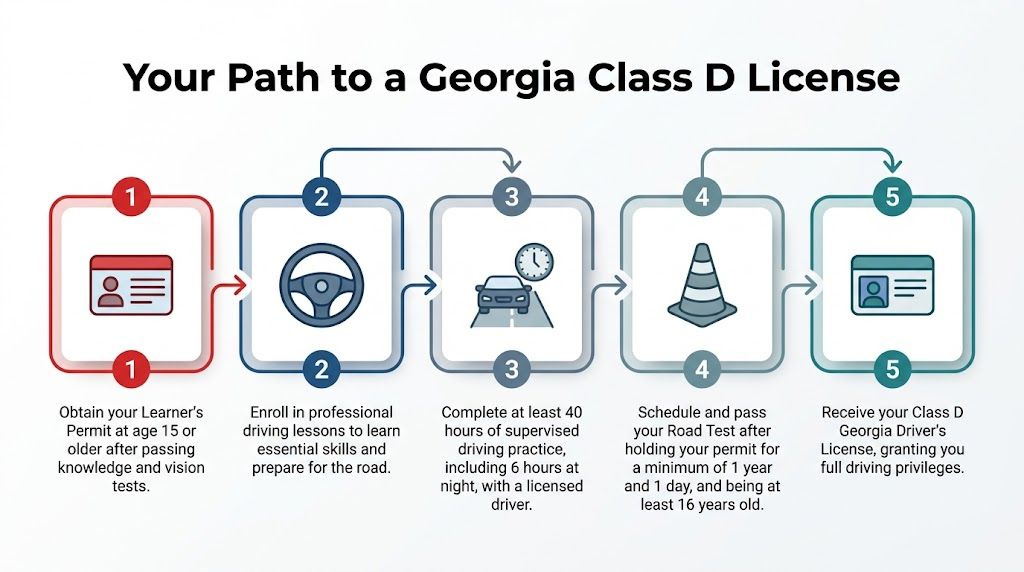
For Georgia teens, the path forward includes supervised driving and preparation for the eventual road test.
Verified guidance for this stage includes:
- At least 40 supervised driving hours: This includes 10 hours at night.
- A signed driving log: Teens use the DDS YLDP-1 form, signed by a parent, guardian, or qualified instructor.
- A waiting period before the road test: The permit must be held long enough before moving to the Class D stage.
That’s why permit holders shouldn’t wait months to start practicing. If you delay the first lesson, every later step feels rushed.
Why professional instruction helps
Students often get plenty of family support, but family practice and professional lessons do different jobs.
A parent helps build comfort and seat time. A trained instructor catches patterns. That includes rolling stops, late mirror checks, wide turns, weak lane positioning, overcorrection, parking habits, and hesitation in traffic. Those small issues matter because they show up under pressure.
According to A-1 Driving School’s Georgia driver education information, the statewide first-attempt road test pass rate is around 78%, while it rises to over 92% for students who complete a structured program with an experienced provider.
What to practice during the permit phase
A strong permit phase includes more than “drive around the neighborhood.”
Mix your practice:
- Short local drives: Great for starts, stops, neighborhood scanning, and right-of-way judgment.
- Busier roads in daylight: Helpful for traffic flow, lane changes, and signal timing.
- Parking lot sessions: Good for backing, parking control, and low-speed steering.
- Night practice: Required experience matters because visibility and decision-making change after dark.
One student may need extra work on turns. Another may need confidence merging into traffic. Lesson packages usually work best when they build from low-pressure driving to more complex conditions instead of throwing everything in at once.
The road test side of the journey
The road test is where students finally show they can apply what they’ve practiced.
Georgia road testing typically includes control skills like parking, turning, signaling correctly, obeying signs and signals, and handling the vehicle smoothly. Families should also remember the practical side of test day. Logs must be complete, and the test vehicle must meet requirements.
If you’re comparing options for the full training path, these Georgia driver’s education courses and lesson options give a useful overview of classroom instruction, online choices, and behind-the-wheel support.
Good drivers don’t become confident because they “feel ready.” They become confident because they’ve repeated the right skills enough times that the basics stop feeling new.
For families concerned about cost, the Georgia Driver’s Education Scholarship Grant Program can make driver training more accessible for qualifying students. It’s worth checking eligibility early, especially before peak permit and road test seasons when schedules fill faster.
Your Permit Questions Answered for Special Cases
A lot of families reach this point and realize their situation does not match the usual checklist for a 15-year-old first-time driver. That is common. The permit process still works. You just need to know which rules apply to your case and which steps stay the same.
What if you’re over 18
Adults often ask if they still need a permit first. In many cases, yes. The permit is still the practice stage before full licensing, even though the teen-specific Joshua’s Law requirements work differently for adult drivers.
The good news is that the basics do not suddenly become harder because you started later. You still need to prepare for the vision and knowledge tests, bring the right identity and residency documents, and practice with purpose. Adult learners often do especially well with structured lessons because they want clear instruction, calm feedback, and a plan. At A-1, we see this every week with adults who are learning for the first time, coming back to driving after a long break, or helping their own teen through the process while getting licensed themselves.
What if you already have an out-of-state permit
An out-of-state permit is a little like bringing transfer credits to a new school. Some parts may carry over, but you should not assume everything transfers in the way you expect.
Georgia may still require state-specific documents, and age matters. Permit status matters too. Before you schedule a visit, confirm the current DDS guidance for your situation and gather the paperwork that fits your age group, including school-related documents if they apply. A short phone call or careful review now can save a wasted trip later.
What if your permit expires or gets suspended
An expired permit usually means delay, paperwork, and another round of waiting, so handle it as soon as you notice the date has passed.
A suspension needs a different response. First, find the exact reason. It may be tied to eligibility, a records issue, or another licensing requirement. Guessing tends to slow families down. Confirm the problem with DDS, fix that issue first, then return to the permit or licensing step that comes next.
Why Georgia uses a staged process at all
Parents sometimes ask why the state does not let a new driver move straight from a written test to full independence. The answer is safety and skill-building.
A permit works like supervised practice in sports or music. You do not start with the final performance. You learn the basics, repeat them with a coach nearby, and add harder situations as your judgment improves. Georgia’s step-by-step system is built around that idea. It gives teens time to practice, gives parents a clearer role, and gives instructors room to correct habits before those habits become risky.
That bigger picture is also where A-1 can make the process feel more organized. A student might begin with a Joshua’s Law class that fits around school, continue into driving lesson packages that match their confidence level, and get help understanding scholarship options if cost is a concern. The permit is not a paperwork stop. It is the first stage of a full training path.
One last parent question about the bigger picture
As your teen gets closer to driving alone, insurance becomes part of the planning too. If you want a plain-language overview of policy basics, this guide to understanding auto insurance requirements is a useful starting point for thinking through coverage questions and what families usually need to review.
If your family may qualify for the Georgia Driver’s Education Scholarship Grant Program, ask early, gather income-related documents carefully, and leave time for follow-up. Many delays come from the same simple problem. Missing paperwork.
If you want a smoother path from permit prep to actual driving practice, A-1 Driving School offers Georgia driver’s education, Joshua’s Law courses, online options, road test support, scholarship guidance, and lesson packages for teens and adults across metro Atlanta.