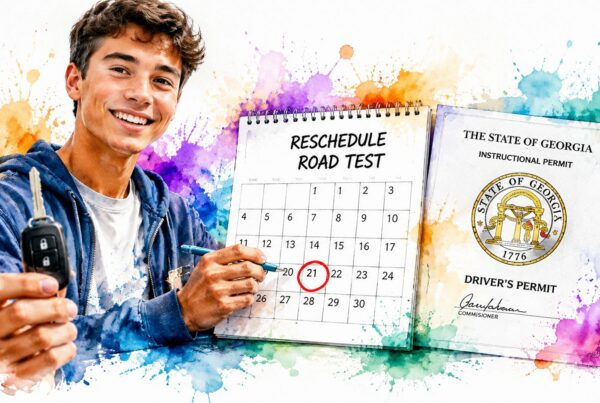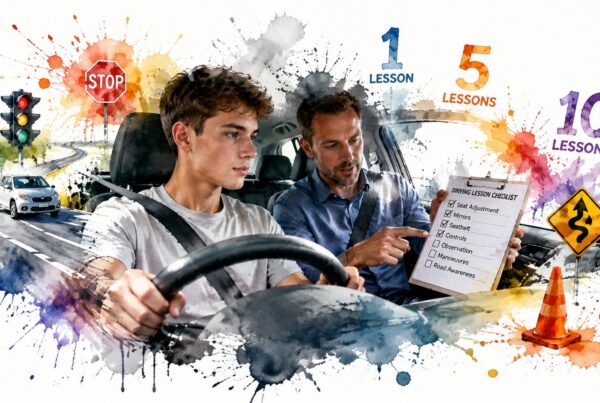

A lot of Georgia families start in the same place. A teen turns 15 or 16, wants to drive as soon as possible, and suddenly the simple idea of “getting a license” turns into permits, classes, supervised hours, road tests, and legal rules that all seem to blur together.
Parents usually have the same reaction. They want to help, but they also want to make sure their child is doing everything the right way. That’s where driving law in georgia can feel more intimidating than it needs to be. The rules are there for a reason, but they make more sense when you see the full path from first permit to full license.
Your Guide to Georgia's Driving Laws and Licensing
The excitement of driving is real. So is the responsibility.
Georgia recorded 401,543 traffic crashes in 2023, with 1,797 fatalities, according to Georgia car accident statistics. That’s one reason the state takes teen licensing seriously. The laws are designed to slow the process down just enough for new drivers to build judgment, not just basic car control.
For most teens, the path looks something like this:
- Get a learner’s permit
- Complete the education and training required for a teen license
- Practice with an adult
- Pass the road test
- Drive with the habits that keep you safe long after test day
That sounds simple on paper, but people get stuck on the details.
Where families usually get confused
Some teens think the permit is the hard part and the rest will sort itself out. Some parents assume any practice time counts the same way. Others aren’t sure whether online driver’s ed is allowed, what Joshua’s Law requires, or whether professional lessons are really necessary after a classroom course.
Those are normal questions.
Practical rule: Don’t treat licensing as one event. Treat it as a sequence. Each step prepares you for the next one.
A good example is the difference between knowing a rule and using it under pressure. A teen might understand right-of-way perfectly while sitting at the kitchen table. That same teen can still freeze at a busy left turn, misjudge a merge, or forget mirror checks in traffic. Georgia’s licensing process is built around closing that gap.
What matters most
The goal isn’t just to “pass.” The goal is to become a driver who can handle the everyday situations that cause stress for beginners:
- Neighborhood driving with parked cars, children, and sudden stops
- Busy intersections where timing matters
- Lane changes when traffic is moving faster than expected
- Night driving when visibility drops
- Highway entry and exit where hesitation can create problems
That’s why the smartest approach is to build your plan early. Know what the permit requires. Know what Joshua’s Law requires. Know how supervised practice fits in. Know what the road test expects. Once you see the path clearly, driving law in georgia feels much more manageable.
The First Step Your Georgia Learner's Permit
The Class CP learner’s permit is where most teen drivers begin. If you’re new to the process, think of it as your legal starting point. It lets you begin supervised driving while you build knowledge and skill.
What age can you get it
In Georgia, teens can start the permit process at age 15. That’s why many families begin gathering documents and studying before the birthday arrives. It saves stress and helps you move quickly once you’re eligible.
The permit process usually includes a vision screening and a knowledge test. You’ll also need the right documents. The exact paperwork matters, so it’s smart to check the current requirements before your appointment. A practical overview of that process is available in this guide to a permit in Georgia.
What the permit actually allows
A learner’s permit doesn’t mean independent driving. It means supervised driving.
That distinction trips people up. A teen with a permit can practice, but only under the conditions Georgia allows. The point is to create a safe learning phase before full driving privileges begin.
Here’s the mindset that helps most students:
- The permit is for learning, not freedom
- Every drive should have a purpose
- Early habits matter more than early confidence
How to make permit practice useful
Once the permit is in hand, many families feel relief. Then they lose momentum. A few parking lot sessions happen, then schedules get busy, and the teen doesn’t build steady experience.
A better approach is to practice in layers.
Start with low-pressure environments
Use quiet neighborhoods, empty parking areas, and simple right turns first. Let the new driver focus on steering, braking, stopping smoothly, and scanning.
Add one challenge at a time
Don’t mix everything together too early. A beginner doesn’t need downtown traffic, rain, highway speeds, and complicated navigation on the same day.
Try adding skills in this order:
- Basic control
- Residential turns and stop signs
- Traffic lights and busier roads
- Lane changes
- Night driving
- Highway work
A permit works best when each drive has one main goal. “Today we’ll practice left turns” is more effective than “Let’s just drive around.”
Common permit-stage mistakes
Parents and teens often run into the same avoidable problems:
- Practicing too little too late so the road test starts feeling rushed
- Giving too many directions at once from the passenger seat
- Skipping difficult settings until just before the exam
- Confusing familiarity with readiness because the teen drives the same short route repeatedly
The permit stage should build consistency. If a student can start, stop, steer, park, and follow directions calmly in different settings, they’re building the right foundation for everything that follows.
Navigating Joshua's Law A Must for Georgia Teens
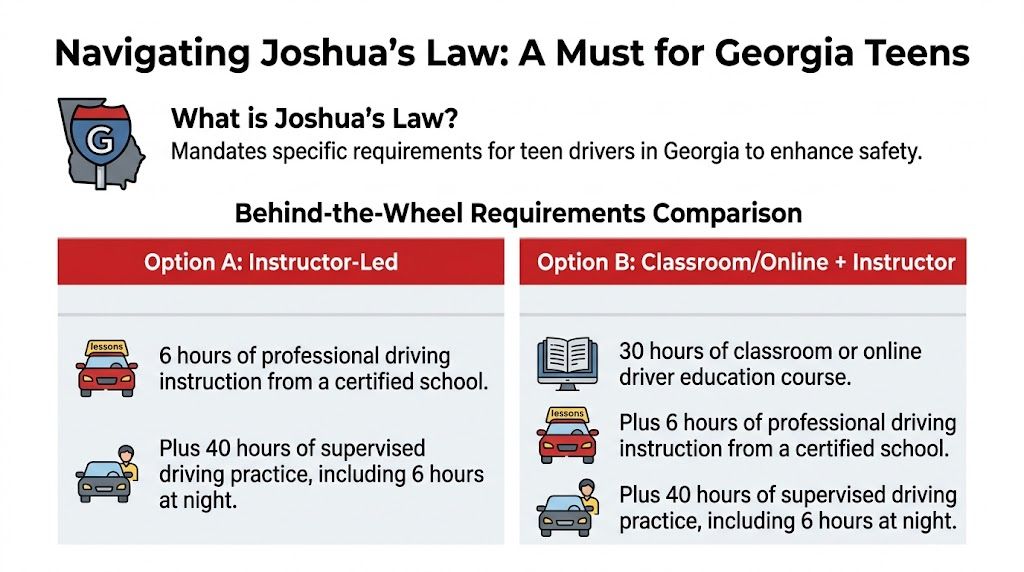
Joshua’s Law is one of the most important parts of driving law in georgia for teens. If your goal is a teen license, this law affects the route you’ll take to get there.
Joshua’s Law requires young drivers to complete driver education and practice before moving into licensed driving. It exists because teen drivers need more than a written test and a few casual drives around the neighborhood. They need structured learning and time behind the wheel.
What Joshua’s Law asks from teen drivers
The biggest point to understand is that Joshua’s Law isn’t only about classroom instruction. It combines learning, professional training, and supervised practice.
A simple summary is:
| Path | What it includes |
|---|---|
| Instructor pathway | 6 hours of professional driving instruction plus 40 hours of supervised driving practice, including 6 hours at night |
| Course plus instruction pathway | 30 hours of classroom or online driver education, plus 6 hours of professional driving instruction, plus 40 hours of supervised driving practice, including 6 hours at night |
Families often want to know which option is “better.” The honest answer is that it depends on the student’s schedule, learning style, and confidence level.
Option one works well for students who learn best in the car
Some teens don’t absorb much from reading about driving. They understand it once they’re driving. For those students, professional in-car instruction can be the part that makes everything click.
This route still requires supervised driving with a parent or guardian. The difference is that the student gets guided coaching from a trained instructor first, then uses family practice to reinforce those habits.
Best fit for this option
- Hands-on learners who need real-world repetition
- Students who already studied the rules and want to focus on execution
- Teens who get nervous easily and benefit from calm, structured coaching
Option two gives more structure up front
The classroom or online route gives a teen more formal instruction before or alongside in-car lessons. Many families prefer this because it creates a clearer rhythm. Learn the concepts, discuss traffic situations, then apply them in the vehicle.
Online learning can be especially useful when a teen has a packed school schedule, transportation limits, or prefers working through material at home. In-person instruction can help students who focus better with direct teacher interaction and a set meeting time.
For a plain-language overview of requirements, this guide to Georgia teen driving laws can help families compare the expectations.
How parents should choose
Parents often overfocus on convenience and underfocus on fit. The better question is not “Which option is faster?” It’s “Which option helps my teen become calmer, safer, and more prepared?”
Use these decision points:
- Choose online learning if your teen is self-directed and does well with flexible scheduling.
- Choose in-person classroom learning if your teen benefits from live instruction and fewer distractions.
- Prioritize professional lessons either way if your teen needs help with confidence, lane control, traffic judgment, or parking.
The most successful students don’t just complete Joshua’s Law. They use it to build routines that continue through permit practice and road test prep.
Why this law matters in real life
Distracted driving is a major concern for young drivers. Georgia’s highway safety data shows that young drivers ages 15 to 24 made up 26% of distracted drivers in crashes, 28% in fatal crashes, 32% of post-crash citations, and 21% of convictions, according to the Georgia Traffic Safety Facts on distracted driving.
That’s the practical reason Joshua’s Law exists. It’s not paperwork for the sake of paperwork. It gives teens more guided time to build habits before they drive on their own.
Beyond the Classroom Mastering the Road with Driving Lessons
A classroom course can teach signs, laws, and right-of-way. It can’t teach how it feels to merge into fast traffic, judge the speed of an oncoming car, or recover after a rough turn without getting flustered.
That’s where driving lessons matter most.

Parent practice and professional lessons are not the same
Parents are essential. They know their teen, they provide much of the supervised practice, and they can reinforce consistency over time. But parents aren’t always the best people to introduce every skill.
Some parents teach patiently. Others get tense, over-explain, or wait too long to correct a mistake. Teens react to that. Sometimes they become defensive. Sometimes they get overwhelmed. Sometimes they avoid driving altogether because every practice session feels stressful.
A professional lesson changes the dynamic. The instructor can focus only on the driving task, spot small errors early, and explain corrections without the family baggage that often comes with passenger-seat coaching.
What a good lesson actually improves
Professional behind-the-wheel instruction helps students develop skills that are hard to teach casually:
- Scanning habits so they’re not staring only at the car ahead
- Lane positioning so the vehicle stays centered through curves and turns
- Speed judgment so they stop rushing or creeping
- Turn timing at busy intersections
- Parking technique without panic
- Decision-making when traffic changes quickly
Those details matter because beginners often think a mistake is random when it’s really a pattern. A student who turns wide, brakes late, or drifts during lane changes usually needs technique, not just more miles.
Instructor insight: More practice helps only when the practice is correcting something. Repeating the same mistake for weeks doesn’t build skill. It builds a habit.
When extra lessons make the biggest difference
Some students only need a small amount of targeted work. Others need a fuller progression. That’s why lesson packages are often more useful than a one-size-fits-all approach.
Here are common situations where additional lessons help:
The nervous beginner
This student understands the rules but freezes in traffic, hesitates on turns, or avoids roads with more activity. Short, focused sessions usually help them build calm repetition.
The teen with inconsistent parent practice
Schedules get messy. Work, sports, school, and family obligations can leave long gaps between drives. Structured lessons create momentum and keep learning from stalling out.
The student who’s close to test-ready but not quite there
These drivers can handle normal roads but still struggle with parking, lane changes, smooth stops, or pre-test nerves. A few targeted sessions can clean up those last weak spots.
The adult beginner or returning driver
Not every new driver is a teen. Adults often want private, practical instruction without sitting in a teen-centered class. Customized lessons are especially valuable here.
What to look for in lesson packages
Families often ask whether they should book one lesson or a package. The answer depends on the goal.
| Need | Best fit |
|---|---|
| Brush-up before a test | A focused refresher lesson |
| A true beginner | A multi-lesson package with progressive skill building |
| Help in one weak area | A targeted lesson on parking, lane changes, or traffic confidence |
| A nervous driver | Several shorter sessions spread over time |
The biggest advantage of a package is continuity. The student doesn’t start from zero each time. One lesson builds on the last, and that makes progress easier to see.
Real progress looks ordinary at first
Families sometimes expect a dramatic shift after one lesson. Most improvement looks quieter than that. The student checks mirrors without being reminded. They enter a turn at a better speed. They stop overcorrecting the wheel. They make decisions a little earlier.
Those are the signs that a beginner is becoming a driver.
Making Driver's Ed Affordable The GA Scholarship Program
Cost matters for many families. Driver education is valuable, but it can still feel like one more expense added to school fees, sports, activities, and everything else that comes with raising a teen.
Georgia offers help through the Driver’s Education Grant Scholarship Program. For qualifying students, this program can make approved driver education far more accessible.
What the scholarship is for
The scholarship is designed to help eligible students pay for a 30/6 driver education course. That means the funding is aimed at the standard combination of classroom or online learning plus professional driving instruction.
For families, the key point is simple. If cost has been the reason for delaying driver’s ed, it’s worth checking whether your student qualifies.
Who should look into it
The program is generally intended for Georgia students who meet the age and eligibility requirements and who need financial help to complete driver education. Because application details can change, it’s important to work through an approved provider and verify the current process before making plans.
A practical place to start is this information on the Georgia Driver’s Education Grant Scholarship Program.
How families usually approach it
The easiest way to think about the scholarship is in three parts:
- Check basic eligibility
- Review what course format is covered
- Apply through an approved school
That third step is the one many families miss. The application process isn't something many individuals can successfully complete by guessing. It helps to work with a school that already understands how the paperwork and scheduling usually fit together.
Questions parents often ask
Does the scholarship cover any driving service
Usually, families should assume the program is tied to specific approved education formats rather than every possible lesson or add-on service. Always verify what’s included before enrolling.
Should we wait to schedule until we know
That depends on timing and availability. Some families want to confirm funding first. Others want to gather information early so they can move quickly when openings are available.
If you think your teen may qualify, start the scholarship conversation early. Waiting until the last minute can make scheduling harder.
Is it only for teens
This program is commonly discussed in the context of teen driver education, especially where Joshua’s Law requirements are involved. Families should check the current eligibility details for the student’s situation.
The best part of the scholarship program is what it represents. It recognizes that safe driver education shouldn’t be out of reach for families who need support.
Passing Your Georgia Road Test with Confidence
By the time a student reaches the road test, most of the work should already be done. The test isn’t supposed to be the moment they suddenly learn to drive. It’s the moment they show they can drive safely, follow directions, and stay composed.
That’s why the best road test preparation feels calm, not frantic.

What examiners are usually watching
Many students think the road test is full of tricks. It isn’t. Examiners generally look for safe, consistent fundamentals.
That includes things like:
- Vehicle familiarity before you begin
- Smooth starts and stops
- Proper turns
- Lane control
- Checking mirrors and surroundings
- Following signs and signals
- Parking and basic maneuvering
- Calm responses to instructions
The hardest part for many teens isn’t the task itself. It’s doing ordinary things while someone evaluates them.
Why students fail when they already know how to drive
Sometimes a student has enough skill but still struggles on test day. Usually the problem falls into one of these categories:
Rushing
Nerves make students drive too fast, turn too quickly, or skip checks they normally do.
Overthinking
A student hears one instruction, then mentally argues with it, second-guesses it, and creates confusion that wasn’t there before.
Weak fundamentals under pressure
The student can do the skill in familiar places, but not consistently in a test setting.
A road test usually rewards steady driving more than impressive driving. Smooth and attentive beats flashy every time.
How to prepare in the week before the test
A smart prep plan is simple.
Drive the basics on purpose
Don’t spend the final days doing random driving. Practice the exact categories that appear most often on tests: turns, stops, lane changes, parking, backing, and observation.
Use the same routine every time
Before moving the car, adjust the seat, mirrors, and belt. When turning, signal, check, and go. When stopping, brake early and smoothly. Repeating the same sequence lowers stress.
Practice speaking less, noticing more
Some teens rely on the adult passenger to fill every silence with reminders. On test day, those reminders won’t be there. Practice independent scanning and decision-making.
A quick visual walkthrough can also help students understand what to expect:
What to do on test day
The best test-day habits are surprisingly ordinary:
- Arrive early so you’re not rushed
- Bring the correct documents
- Wear shoes you drive well in
- Avoid cramming at the last minute
- Listen fully before acting
- If you make one small mistake, keep going
One imperfect turn doesn’t automatically ruin an exam. Students often get more trouble from panic after a mistake than from the mistake itself.
A calmer way to think about the road test
Treat the test like a normal supervised drive with higher attention to detail. If you’ve practiced in varied environments and cleaned up the recurring weak spots, the road test becomes a short demonstration of habits you already own.
That’s the mental shift that helps most. You’re not going in to prove you’re fearless. You’re going in to show you’re ready.
Essential Georgia Traffic Laws Every New Driver Must Know
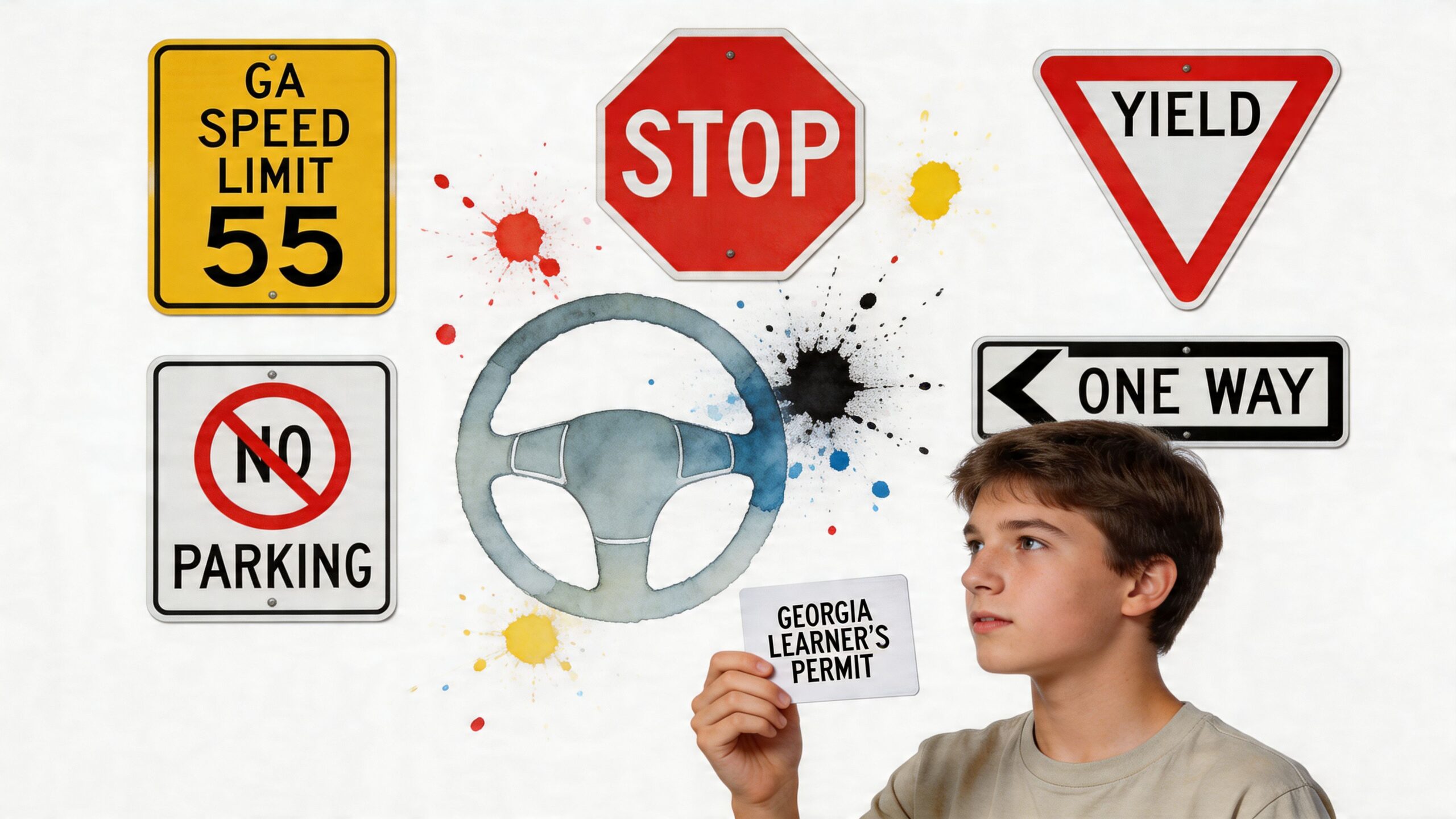
A new driver doesn’t need to memorize every statute before the first solo trip. But there are a few rules that deserve extra attention because they affect daily driving decisions almost immediately.
Hands-free means hands-free
Georgia’s Hands-Free law prohibits drivers from physically holding or supporting a wireless device while operating a motor vehicle, as outlined in the Georgia DDS traffic laws and safe driving guidance. For new drivers, the practical takeaway is simple. Set navigation, music, and calls before the car moves.
This rule matters because distraction isn’t just about texting. It’s also about reaching, looking down, fiddling with a screen, or splitting your attention when traffic needs your eyes.
A good beginner habit is to put the phone out of reach entirely. If you need directions, start them before leaving. If you need to answer someone, pull over safely first.
Left lane and roadside safety rules
Georgia also has a Slowpoke law, which requires drivers in the leftmost lane on multi-lane highways to yield to faster overtaking traffic. The same legal guidance many students learn also includes the Move Over law, which requires drivers to change lanes or slow when approaching emergency or certain service vehicles stopped with active lights, as summarized in this overview of Georgia driver laws.
These laws can confuse new drivers because they involve judgment, not just memorization.
Slowpoke law in plain language
If you’re in the far-left lane and a faster vehicle is overtaking from behind, don’t camp there. Move right when it’s safe.
Move Over law in plain language
If you see emergency or similar vehicles stopped ahead with active lights, create space. Change lanes if you safely can. If you can’t, reduce speed as required.
Good traffic law habits are really space-management habits. Leave room, leave time, and don’t make other drivers guess what you’ll do next.
Reporting crashes and carrying insurance
Georgia law also requires crash reports in certain situations, including crashes involving injury, death, or enough property damage to meet the reporting threshold under state law, as noted in the earlier crash data source. New drivers should also understand that driving legally means carrying proper insurance and keeping proof available.
If a family wants a practical explanation of what can happen after an uninsured driving issue, this guide on penalties for driving without insurance gives useful context in plain language.
The beginner version of traffic-law success
For a new driver, the law is easiest to follow when it becomes routine:
- Buckle up before moving
- Put the phone away
- Use signals early
- Stay right unless you need the left lane
- Give stopped roadside vehicles extra space
- Handle paperwork and insurance before there’s a problem
That’s the goal of driving law in georgia for beginners. Not fear of tickets. Predictable, safe behavior that becomes automatic.
Your Journey to Safe Driving Starts Here
The path to a Georgia license can look complicated at first, but it becomes much easier when you break it into pieces. Start with the learner’s permit. Understand Joshua’s Law. Build real skill through guided practice. Prepare for the road test with intention. Then carry the right habits into everyday driving.
For teens, that process builds more than legal eligibility. It builds judgment.
For parents, the biggest relief usually comes when the process stops feeling mysterious. Once you know what each step is for, you can help your teen move forward without guesswork. You don’t need to know every legal detail by memory. You just need a clear plan and enough time to practice well.
The students who do best are rarely the ones trying to rush through the process. They’re the ones who give themselves room to learn, make corrections, and grow comfortable in different driving situations. That’s what creates safer drivers, and it’s what these laws are aiming for.
If you’re starting this process now, keep it simple. Get the permit step right. Choose the training path that fits. Practice steadily. Ask questions early. Work on the skills that feel uncomfortable instead of avoiding them. Confidence comes after repetition, not before it.
If you’re ready for the next step, A-1 Driving School offers Georgia driver’s education, Joshua’s Law options, online courses, road test support, and driving lesson packages designed for teens and adults who want a clear path from permit to license.