You’re probably close to one of two moments right now. You’ve either booked your Georgia road test and you’re wondering if you’re ready, or you haven’t booked it yet because you know there are still a few weak spots in your driving.
That’s normal.
Candidates often don’t fail because they’re incapable of driving. They fail because they show up with gaps. Missing documents. A bad brake light. Weak observation habits. Nerves that turn a simple stop sign into a rushed mistake. If you want to know how to prepare for driving test day the right way, the answer isn’t “practice more” in a vague sense. It’s to prepare in the right order.
After years of working with Georgia teens and adult drivers, I can tell you this much. The students who pass consistently are the ones who treat the test like a process, not a guess. They handle the paperwork first. They build a focused practice plan. They learn the exact maneuvers the examiner cares about. Then they make test day feel familiar.
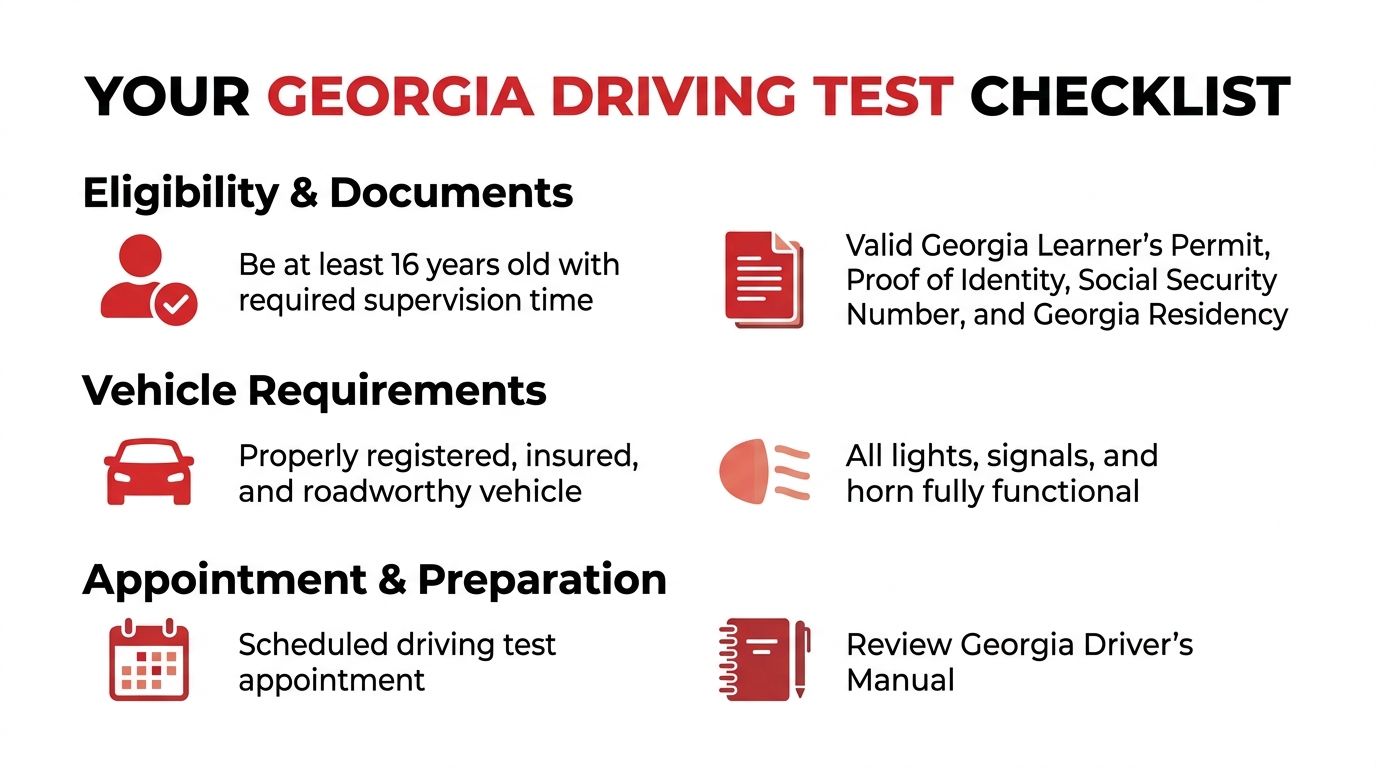
First Things First Your Georgia Driving Test Checklist
A student can drive well enough to pass and still get sent home at the check-in window. I see it in Atlanta every year. The problem usually is not steering or speed control. It is a missing document, a permit issue, or a car with a light out.
Know which Georgia path applies to you
Georgia does not give every driver the same route to the road test. Teens, adults, and families returning after a delay need different paperwork and different training steps. Getting that straight first saves a lot of wasted practice time.
For teens working toward a Class D license, Joshua’s Law is part of the path. That means driver education, supervised driving, and the right records all need to line up before test day. A clear breakdown is in Georgia driver’s license requirements.
Adults over 18 usually have fewer steps, but the standard is still the same. Bring the correct identity documents, confirm your permit status, and make sure the test vehicle meets Georgia requirements.
At A-1, this is one of the first problems we clear up for families. A teen may need a Joshua’s Law course and a supervised log. An adult may need a short lesson package to fix specific habits before testing. The right service depends on the driver, not just the calendar.
Build your document folder the night before
Do not collect paperwork the morning of the test. Put it in one folder the night before and leave it where you cannot miss it.
Use this checklist:
- Learner’s permit: Bring your valid Georgia learner’s permit.
- Drive log if required: Georgia teens under 18 should have their supervised driving log ready.
- Driver education records: If Joshua’s Law applies, bring the completion documents.
- Identity support documents: Bring any required proof of identity, residency, or Social Security in accepted form.
- Parent or guardian paperwork if needed: Teens should confirm whether consent paperwork is required.
- Registration and insurance: If you are using your own vehicle, bring current proof of both.
Practical rule: If a document is still sitting in the glove box, backpack, or kitchen drawer, it is not test-ready.
Instructor guidance cited earlier notes that paperwork problems account for a large share of road test dismissals. I believe it. In real life, these are the easiest mistakes to prevent and the most frustrating ones to explain after the appointment is lost.
Use the training option that fits your real schedule
Families often stall out here. School, work, sports, and transportation all compete for time, so driver training gets pushed back. Then the test date gets close, and everyone is rushing.
A better approach is to choose the format that matches the student:
| Option | Works well for | What to watch for |
|---|---|---|
| Online driver education | Busy students who need schedule flexibility | Confirm it meets Georgia requirements |
| In-person classroom course | Students who learn better with structure and live instruction | Plan around fixed class times |
| Driving lesson package | Students who need hands-on correction and test-focused practice | Pick lessons based on actual weak areas, not guesswork |
A-1 helps with all three pressure points Georgia families run into most. Joshua’s Law courses cover the education requirement for teens. The Georgia Driver’s Education Scholarship Grant Program can reduce cost barriers for eligible students. Our driving lesson packages help teens and adults fix the exact issues that hold them back, and on-site road testing gives many students a more familiar setting once they are ready.
Confirm your vehicle before you think about skills
The test car can cancel your plans fast. If the horn does not work, a brake light is out, or the windshield limits visibility, the examiner may not even start the drive.
A quick pre-check should cover:
- Lights and signals
- Horn
- Brakes
- Tire condition
- Windshield and windows
- Mirrors
The same previously cited instructor guidance also points to vehicle defects and visibility problems as a common reason tests end before they begin. That matches what instructors see every week. Students spend hours worrying about parallel parking and then show up in a car that was never ready for inspection.
Handle the checklist first. Once the paperwork is set and the vehicle is cleared, every practice hour after that counts more.
Build Your Confidence with a Strategic Practice Plan
A student can drive for weeks and still feel shaky the moment the examiner gets in the car. I see that in Atlanta all the time. The issue usually is not courage. It is scattered practice, repeated habits, and no clear plan for fixing what keeps showing up.
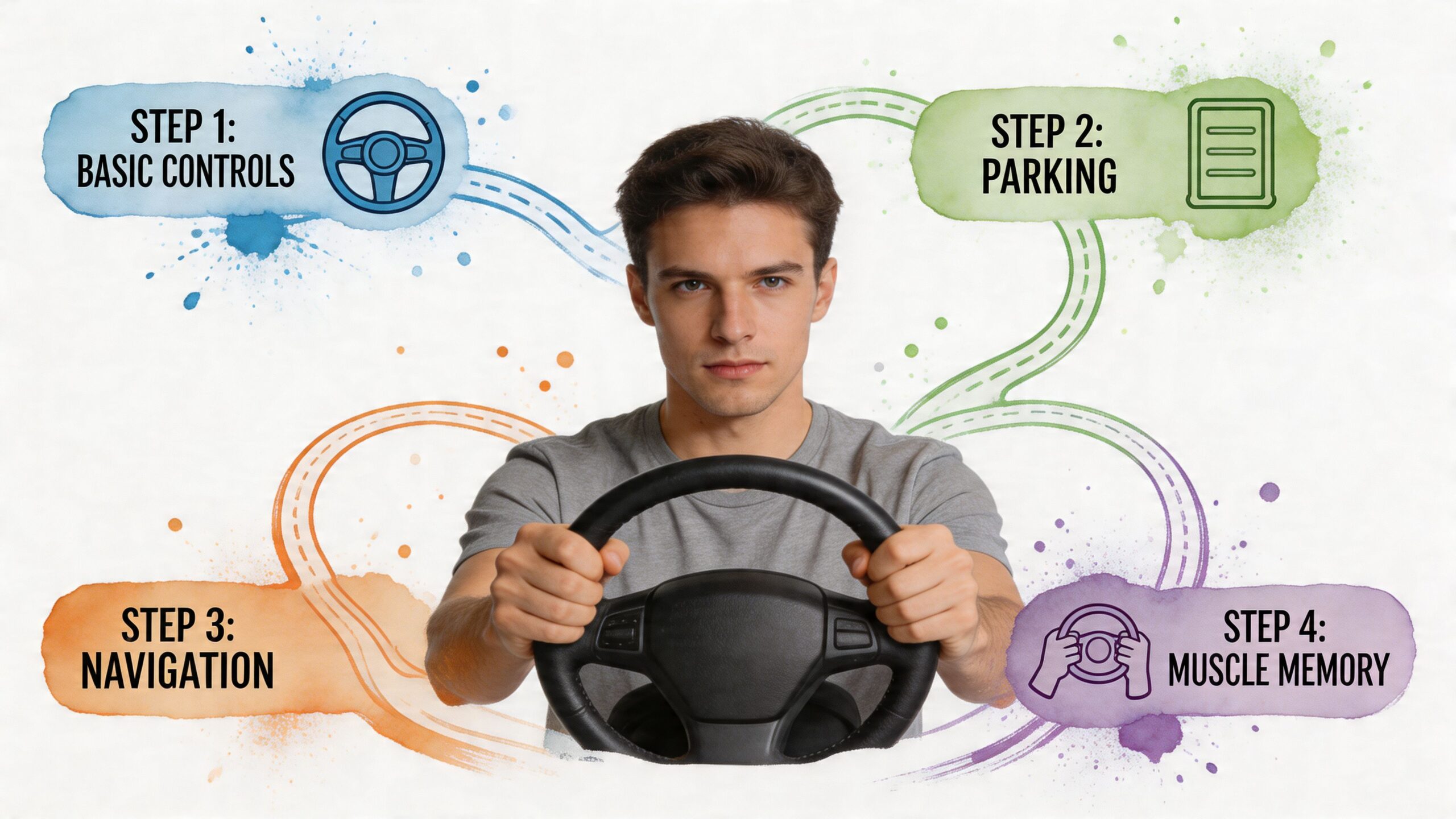
Confidence grows faster when practice has a target. Instructor guidance commonly recommends about 6 to 10 hours of professional behind-the-wheel work, often spread across several lessons, and those same recommendations stress practicing in varied conditions rather than repeating the same easy route every time (professional lesson recommendations and varied-condition practice guidance).
Practice for skill, not just for hours
A lot of Georgia learners get comfortable in one neighborhood, at one speed, with one parent in the passenger seat giving the same reminders. That builds familiarity. It does not always build test readiness.
A stronger plan changes the environment on purpose. Use different intersections. Drive at different times of day. Practice in light traffic and moderate traffic. Work on parking lots, neighborhood streets, and busier roads. The goal is to make observation and control automatic, even when the setting changes.
A weekly rotation like this works well:
- One session for vehicle control: Smooth starts, smooth stops, steering, lane position
- One session for intersection habits: Stop signs, left turns, right turns, yielding, scanning
- One session for low-speed maneuvers: Backing, three-point turns, parking, and parallel parking step-by-step practice
- One session for mixed driving: Speed changes, school zones, neighborhood streets, and heavier traffic
The trade-off most families miss
Practice with family helps because it gives repetition and keeps costs down. It also has limits. Family driving often turns into errand driving, and errand driving skips the same weak skills over and over.
Professional lessons shorten the learning curve because the correction is more precise. If a student swings wide on right turns, the cause might be speed, hand position, late steering, or looking too close to the hood. Until someone identifies the cause, the mistake keeps repeating.
That is why A-1’s Georgia-focused lesson packages help both teens and adults. Teens often need structured hours tied to Joshua's Law. Adult drivers usually need direct road test preparation without wasting time on skills they already handle well. At A-1, we build lessons around the exact habits that cost points on Georgia road tests, then many students finish the process with on-site testing in a setting that feels more familiar.
What good practice looks like
Students improve fastest when each drive has one clear purpose.
Use this filter after every session:
| Practice style | What it helps | Where it falls short |
|---|---|---|
| Focused lesson with feedback | Catches mistakes before they become habits | Requires honest attention to weak areas |
| General family driving | Builds comfort with the car and normal traffic | Often misses test-specific maneuvers |
| Repeating favorite routes | Reduces early anxiety | Leaves drivers stiff in unfamiliar situations |
| Last-minute review | Refreshes rules and reminders | Does little for observation and control habits |
One sentence matters here. Repetition without correction can lock in the wrong behavior.
Build the right habits in the right order
Students who feel overwhelmed usually try to fix everything at once. That rarely works. Start with the habits the examiner can see immediately.
Set up the car the same way every time
Adjust the seat, mirrors, and posture before moving. A rushed setup usually leads to tense steering and late observations.Make every stop complete and controlled
The car should be fully still. Rolling stops are one of the easiest ways to lose points.Check mirrors before changing speed or direction
Mirror checks need to happen at the right moment, not as a performance after the move has already started.Signal early enough to show intent
Late signals make turns and lane changes look reactive.Finish turns in the correct lane position
Many learners start the turn fine, then drift wide on the exit.
Use your lessons like a scorecard
At the end of each drive, answer one question: What mistake showed up more than once?
That answer tells you what the next lesson should cover. It also keeps practice honest. “I did okay” does not help much. “I braked late at two stop signs and forgot one blind spot check” gives you something you can fix next time.
Keep a short log after every practice session:
- One thing I did well
- One habit I need to correct
- One maneuver to repeat next time
I have watched this approach change students fast, especially the ones who already know the basics but keep losing consistency. Once the mistakes become specific, the progress usually does too.
Confidence comes from predictability. When the same good habits show up on every lesson, the road test starts to feel like another practice drive instead of a one-shot event.
How to Master Georgia's Trickiest Test Maneuvers
You pull away feeling fine, then the examiner asks for a three-point turn or a parallel park. That is where a lot of Georgia test nerves show up. The drivers who pass are usually not the ones with flashy car control. They are the ones who stay calm, set the car up correctly, and make each movement on purpose.
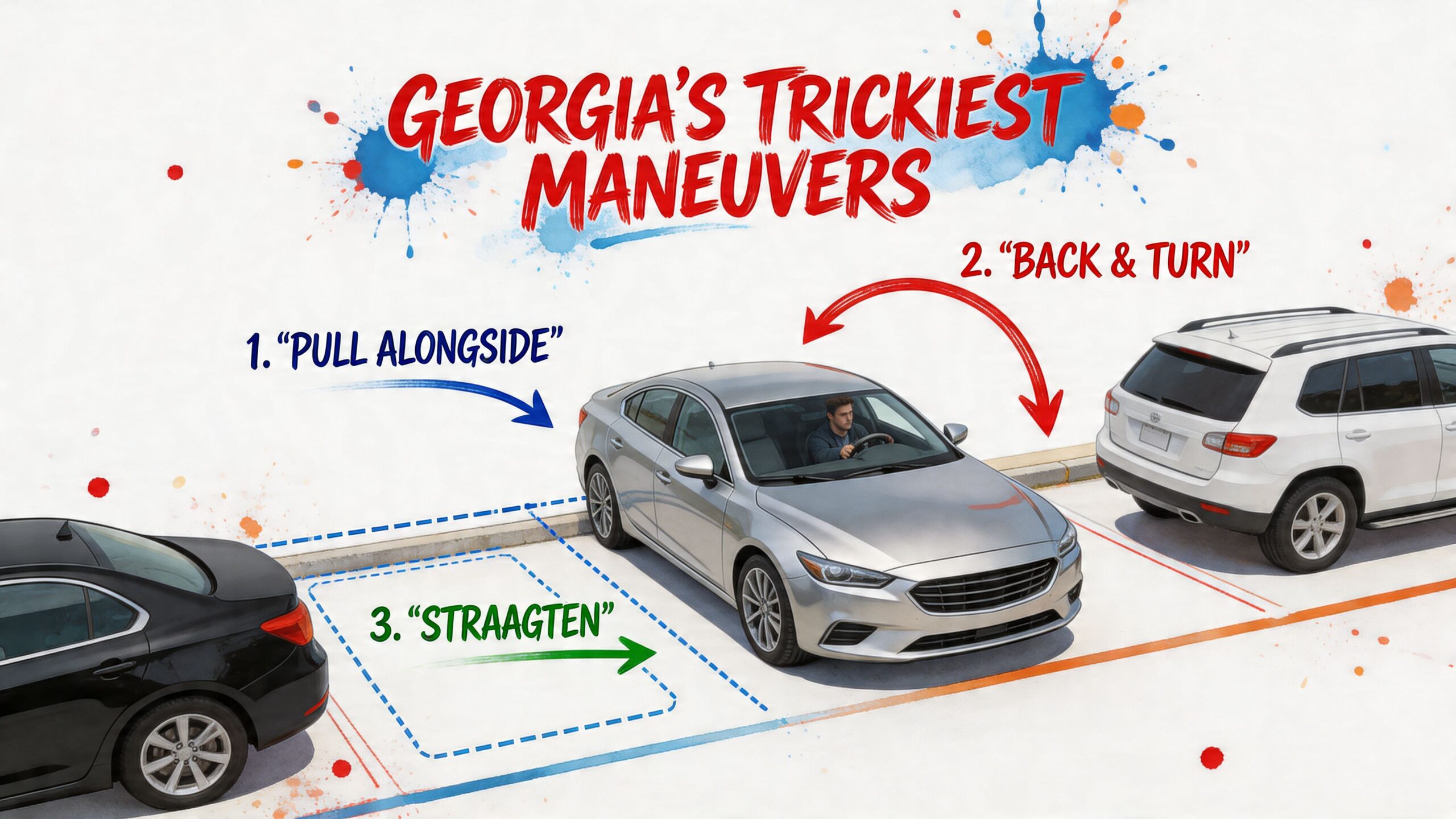
One road test review of failure patterns found an overall pass rate of 51% during the period studied, with frequent mistakes tied to mirror checks, speed control, signaling, and general observation (road test failure patterns). That lines up with what I see in Atlanta every week. Students rarely fail because a maneuver is impossible. They fail because they rush the setup, miss an observation, or let speed get sloppy halfway through.
At A-1, we coach these maneuvers the same way Georgia examiners score them. We do not treat parallel parking, backing, and turning around as isolated tricks. We tie them to timing, vision, lane position, and vehicle control, because that is how the road test is judged.
The stop at a sign or line has to be clean
A weak stop costs easy points.
The car should settle fully before you move your eyes to the next decision. If the front wheels are still creeping, it is not a stop. If braking throws you forward, you waited too long. The same source also notes that drivers lose points for poor speed control and rough braking, which is why I teach students to arrive at the stop already calm, not scrambling in the last few feet.
Watch for these common errors:
- Rolling past the stop line
- Stopping after the crosswalk instead of before it
- Braking late and hard
- Checking for traffic after the car has already edged out
Georgia examiners notice this right away, especially at quiet neighborhood intersections where students tend to get casual.
Parallel parking gets easier when the setup is consistent
Parallel parking scares teens and adults far more than it should. The problem is usually not steering. It is indecision.
Use a repeatable routine:
- Pull up parallel to the parked vehicle with steady spacing.
- Stop and confirm your position before shifting to reverse.
- Back slowly enough to keep control.
- Turn at your reference point, not whenever the space starts to look wrong.
- Pause if needed and correct in small amounts.
- Finish straight, centered, and reasonably close to the curb.
That is exactly why our lesson packages spend time on reference points in the same type of vehicle you may test in. Students improve faster when they stop guessing. If you want a visual refresher between lessons, use this parallel parking step-by-step guide.
Backing and three-point turns expose rushed habits
These two maneuvers tell an instructor a lot. They show whether the driver can slow the whole process down and stay organized.
For backing in a straight line:
- Start with the wheels straight
- Move at idle speed or just above it
- Look to the rear and keep checking around the car
- Use small steering corrections so the car does not zigzag
For a three-point turn:
- Pull to the proper position before starting
- Check traffic carefully before each part of the turn
- Use full stops when changing direction
- Keep speed very low so the wheel work stays controlled
In Georgia, these are not advanced maneuvers. They are control tests. A student who hurries usually creates extra steering, extra braking, and extra mistakes.
Observation is a critical skill that examiners score heavily
A lot of learners focus on where the wheel goes and forget what the examiner is watching. Eyes first. Car second.
Poor mirror checks and missed blind spot checks showed up repeatedly in the same source. That matters during every maneuver, not just lane changes. Before backing, before turning into the roadway, before moving across the lane for a three-point turn, your observation has to be timely and believable.
Use this simple standard:
| Situation | What the examiner expects |
|---|---|
| Before slowing or stopping | Mirror awareness and controlled braking |
| Before turning | Early visual check, signal, and steady entry speed |
| Before changing position on the road | Mirror, blind spot, then smooth movement |
| Before and during backing | Active observation around and behind the vehicle |
Do not exaggerate your head movement like you are on stage. Make the checks clear enough that the examiner can see they happened at the right time.
Practice the maneuvers in a test-ready car
One more trade-off matters here. Students often practice parking and turns in a family car with poor visibility, then test in a different vehicle and wonder why the reference points feel off. If you are close to test day, consistency helps. That is one reason many Atlanta students use our driving lessons and on-site road testing option. They get practice, feedback, and the test setup in a familiar Georgia-focused environment.
If you are using your own vehicle for practice, confirm the basics before every session. A quick review with this ultimate vehicle inspection checklist helps you catch simple issues that can distract you while you are trying to sharpen maneuver work.
The drivers who master these maneuvers are usually the ones who stop treating them like scary moments. They treat them like routines. That is how you want the examiner to see them too.
Scheduling Your Test and Prepping Your Vehicle
A lot of Georgia test problems start before the engine even turns on. I have seen students drive well in practice, then lose time, money, and confidence because they booked the wrong setup, forgot a document, or showed up in a car with a simple equipment issue.
Handle the scheduling piece early. Keep your permit, insurance, registration, and appointment details in one folder so you are not hunting for paperwork the night before. If you want a clear step-by-step walkthrough, use this guide on how to schedule a road test in Georgia.
Pick the testing setup that gives you the fewest surprises
Students in Atlanta usually do best when they choose the option that matches how they have been practicing.
| Option | Good fit for | Main consideration |
|---|---|---|
| DDS test location | Drivers who are comfortable handling the state process on their own | You need to confirm documents, appointment details, and vehicle readiness yourself |
| Driving school road test support | Drivers who want a familiar car, a familiar process, and less guesswork | Appointment availability depends on location and demand |
That trade-off matters. A state site may work well if you are organized and already have a test-ready vehicle. A driving school setup can remove a lot of last-minute problems, especially for teens finishing Joshua's Law requirements or adults who want a few final lessons before testing. At A-1, many students use lesson packages and on-site road testing for one reason. They want to practice and test in a Georgia-focused environment that feels familiar.
Treat the car like part of the test
Examiners notice the vehicle before they notice your turns.
A bad brake light, expired paperwork, worn tires, or a horn that does not work can stop the test before it starts. That is frustrating because it has nothing to do with your actual driving ability, yet it still costs you the appointment.
Check these before test day:
- Registration and insurance are current
- Brake lights work
- Turn signals work
- Horn works
- Tires are in safe condition
- Windows and mirrors are clean
- The cabin is presentable and free of clutter
If you want a broader maintenance reference before your appointment, this ultimate vehicle inspection checklist helps catch the small problems drivers miss.
I tell students this all the time. A prepared driver can still be turned away by an unprepared car.
Get familiar with the area, not locked into a route
It helps to drive near the test area once or twice. Pay attention to school zones, lane markings, speed changes, tight neighborhood streets, and intersections where drivers rush the light. That kind of practice sharpens judgment.
Trying to memorize every turn usually backfires. If the examiner takes you one street over, the script is gone. The stronger approach is to get comfortable reading the road in real time.
That is the kind of confidence that holds up under pressure.
Your Test Day Game Plan From Nerves to Success
The final stretch isn’t about learning something brand new. It’s about protecting what you already know and keeping your mind from getting in the way.

This is the part many learners underestimate. Up to 70% of first-time test failures are attributed to anxiety-induced errors like hesitation or improper scanning, and simple mindfulness techniques such as 5-minute breathing exercises before the test can improve pass rates by 25% (anxiety and breathing guidance).
The night before matters more than one extra hour of cramming
Students often want to squeeze in last-minute driving late at night. Usually, that’s not the best use of energy.
A better night-before routine is simple:
- Lay out your document folder
- Confirm your appointment time and location
- Check the car if you’re using your own
- Review key routines, not every possible scenario
- Get enough sleep
If you’ve prepared well, the final night should feel quiet, not frantic.
Use a short mental routine before you start the car
Nerves don’t always look dramatic. Sometimes they show up as rushing. Talking too fast. Gripping the wheel too tightly. Forgetting your setup routine.
Try this before the examiner begins:
- Sit back fully in the seat.
- Breathe slowly for five minutes.
- Set your mirrors and seating position.
- Put both hands in a stable position on the wheel.
- Tell yourself one job at a time. Start. Observe. Decide. Move.
Small mistakes don’t fail most tests. The panic after a small mistake is what causes the next one.
That mindset matters. If you brake a little late once or feel awkward on one turn, don’t assume the test is over. Keep driving well. Many students recover just fine when they stay composed.
Communicate clearly and drive in a steady rhythm
If an examiner gives an instruction you didn’t hear clearly, ask for it again. That’s better than guessing.
Then keep your driving rhythm simple:
| Moment | Best response |
|---|---|
| Before moving off | Breathe, observe, move deliberately |
| When you get an instruction | Listen fully, then act calmly |
| If you make a small mistake | Reset immediately, don’t narrate it |
| At stops and turns | Slow down enough to think clearly |
A respectful tone helps, but performance comes from control. The most convincing drivers on test day don’t look perfect. They look settled.
Don’t try to impress the examiner
This is one of the biggest mental traps. Students sometimes drive more aggressively on the test because they want to appear confident. They accelerate too briskly, take turns too quickly, or force decisions they would normally wait on.
That doesn’t read as confidence. It reads as poor judgment.
Calm, legal, observant driving is what passes road tests. If you’ve done the work, your only job on test day is to let the examiner see it.
Your Partner on the Road to Getting Your License
A passing road test usually comes down to a few practical things done well. Correct paperwork. A legal vehicle. Repeated practice on the right skills. Calm execution under pressure.
That’s the full path for anyone learning how to prepare for driving test success in Georgia. Not shortcuts. Not tricks. Just the right preparation in the right order.
For teens, that often starts with Joshua’s Law coursework and a plan to complete behind-the-wheel requirements. For adults, it may mean targeted lessons to clean up long-standing habits. For both, driving lesson packages are often the difference between feeling unsure and being fully ready for the examiner.
Here’s a simple way to match the service to the need:
| Service | Best For | Link |
|---|---|---|
| Joshua’s Law course | Georgia teens who need state-approved driver education | Joshua’s Law and driver education options |
| Driving lessons and lesson packages | Teens and adults who need behind-the-wheel practice and feedback | Driving lessons in Georgia |
| Road test preparation and testing help | Students who want a clearer path to scheduling and test readiness | Georgia road test support |
| Online driver education | Students who need a flexible classroom option | Online driver education courses |
| Scholarship information | Families exploring help with training costs | Georgia driver education resources |
If you’re serious about passing, don’t leave your weak spots unaddressed. Fix them before the test, and test day gets much simpler.
If you want help turning this checklist into a real plan, A-1 Driving School offers Georgia-focused driver education, Joshua’s Law courses, online class options, road test support, and driving lessons packages for teens and adults. If cost is a concern, check their information on the Georgia Driver’s Education Scholarship Grant Program, then choose the training path that matches where you are right now.