
A lot of Georgia families start in the same place. A teen is excited to get behind the wheel, a parent opens the DDS website, and within a few minutes everyone feels like they’re sorting through forms, rules, deadlines, and unfamiliar terms all at once.
That reaction is normal.
The ga driver's permit requirements aren't hard once you see the process in the right order. The problem is that most families don’t need more scattered checklists. They need someone to walk them through what happens first, what can wait, what causes delays, and what matters most after the permit is issued. That’s where good guidance makes the whole experience calmer.
Your Guide to Navigating the Georgia Driver's Permit Process
Georgia starts teen drivers in a graduated driver licensing system, which means teens move forward step by step instead of going straight from no experience to full driving privileges. That structure matters because it gives new drivers time to learn with supervision before they drive on their own.
For most families, the path looks like this. First, a teen checks eligibility for a Georgia learner’s permit. Then the family gathers documents for the DDS visit, including the items that often trip people up. After that comes the vision screening and knowledge exam. Once the permit is issued, true learning begins through supervised driving, Joshua’s Law requirements, and preparation for the road test.
Practical rule: Treat the permit as the beginning of driver training, not the finish line.
Parents often get confused in two places. The first is paperwork, especially residency documents. The second is what happens after the permit, because many people think passing the permit test means they’re almost done. In Georgia, the permit is only the first part of building a safe, confident driver.
A smoother experience usually comes down to three habits:
- Start with eligibility: Make sure the teen is old enough and understands the supervision rules before scheduling anything.
- Build a document folder early: Pull paperwork together before the DDS visit so you’re not scrambling the night before.
- Plan beyond the permit: Think ahead about driver education, practice time, and road test preparation from the start.
Families who take it one step at a time usually find the process much less stressful. The details matter, but they’re manageable when you know what each step is for.
First Steps Are You Eligible for a Georgia Learner's Permit
A parent often finds out the primary concern is not “Can my teen pass the permit test?” It is “Are we at the proper starting point?” That matters, because the permit is the first step in a longer training path that leads to safe, independent driving.

In Georgia, a teen can apply for a learner’s permit at age 15. The permit is called a Class CP Learner’s Permit. That gives a young driver the legal ability to begin practicing, but only with the right adult in the car and the right expectations at home.
At A-1 Driving School, we encourage families to treat eligibility like the foundation of a house. If the foundation is clear, the later steps are easier. If there is confusion at the beginning, it usually shows up later in missed practice, delayed licensing, or stress right before a road test.
The age rule and what it really means
Age 15 is Georgia’s starting point for permit eligibility. It is not a green light for independent driving. It is permission to begin supervised learning.
That distinction helps families make better decisions early. A permit works best when a teen is ready to listen, practice consistently, and build habits one layer at a time. Good drivers are trained. They are not rushed.
Georgia’s rules for younger drivers are structured for a reason. Teens need time to practice simple skills first, then busier roads, then harder conditions. That step-by-step approach lines up with how A-1 teaches, whether a family starts with permit prep, plans ahead for professional lessons, or wants a full path through the road test.
Who qualifies to supervise a permit driver
A permit holder cannot drive alone. The supervising driver must be at least 21, licensed to operate the vehicle, able to take control if needed, and seated in the front passenger seat.
That seating rule causes more confusion than families expect. The supervising adult cannot sit in the back seat. They also cannot follow in another car. They need to be beside the teen, watching traffic choices in real time and stepping in if something goes wrong.
A simple way to check the rule is to ask four questions:
- Is the adult at least 21?
- Is the adult properly licensed for that vehicle?
- Is the adult sitting in the front passenger seat?
- Is the adult alert and able to help immediately?
If the answer to any of those is no, the practice drive should wait.
The permit period is part of the training, not a delay
Georgia requires the learner’s permit to be held for 12 months and 1 day before the next licensing step. Families sometimes hear that and focus only on the calendar. A better way to look at it is seat time with purpose.
A new driver needs repetition in ordinary conditions before handling difficult ones well. Parking once is not enough. Driving around the neighborhood a few times is not enough either. Real progress comes from repeating the same core skills until they feel steady, then adding more challenge.
During that permit period, teens usually grow most by practicing:
- turns and lane position
- parking and backing
- residential driving
- busier traffic patterns
- night driving
- judgment in rain and low visibility
This is also the stage where professional instruction can save families time and frustration. Parents know their teen best, but many parents also appreciate having an A-1 instructor coach mirror checks, speed control, scanning, and decision-making in a calm, structured way.
Joshua’s Law comes later, but it should be on your radar now
Many families ask about Joshua’s Law before the permit appointment, which is completely understandable. The key is knowing the order.
A teen does not complete Joshua’s Law before getting the permit. Joshua’s Law becomes part of the path after the permit, for teens who want to move on to a Class D license at 16 or 17. That path includes a state-approved driver education course and supervised driving practice, including required night hours.
Knowing that early helps families plan instead of scramble. Some start mapping out lessons right after the permit arrives. Others look into cost-saving options, including A-1’s scholarship information and course support, so the training side feels manageable from the start. If you also want to get ahead on DDS paperwork, A-1’s guide to Georgia ID requirements and document rules can help you prepare the right folder before your visit.
Gathering Your Documents The DDS Checklist Deconstructed
A lot of families feel confident until the paperwork folder opens at the DDS counter. Then a document with the wrong date, the wrong format, or the wrong name turns a planned permit day into a return trip.

The good news is that this part gets much easier once you sort the papers by purpose instead of by where they came from. A birth certificate, school form, utility bill, and Social Security document may all belong in the same folder, but they do different jobs. A-1 encourages families to build that folder one category at a time, the same way a driving instructor teaches one skill at a time. Clear steps prevent rushed mistakes.
If you want a practical reference while you gather everything, A-1’s guide to Georgia ID requirements and accepted document types can help you check your folder before appointment day.
The four document categories
DDS paperwork usually makes more sense when you group it into four questions:
| Category | What you're proving | Common family mistake |
|---|---|---|
| Identity | Who the applicant is | Bringing a document with a different name than the current legal name |
| Social Security | The applicant’s SSN | Assuming another record already covers it |
| Citizenship or lawful status | Legal presence in the U.S. | Using a document without checking whether DDS accepts it in that form |
| Georgia residency | That the applicant lives in Georgia | Bringing papers that show an address but do not count as residency proof |
That last category trips up many families because “has our address on it” and “DDS accepts it” are not always the same thing.
Residency proof causes the most confusion
Georgia requires two proofs of residency. Families often get stuck here because the documents sound reasonable at home but do not fit DDS rules at the counter. DDS guidance explains that some items people expect to work, such as school records by themselves or a parent’s license by itself, do not serve as standalone residency proof. It also notes that time-sensitive documents like utility bills or rental paperwork must meet current date requirements, as described in Georgia teen permit requirements.
That pattern is common, and it is frustrating. A parent may bring a full folder and still miss the one detail DDS needs.
Here are the trouble spots A-1 families ask about most often:
- School papers by themselves: They may help support other records, but they usually do not satisfy residency proof alone.
- A parent’s Georgia license: It shows the parent’s address, but it does not automatically count as one of the teen’s two residency documents.
- Older mail: The document type may be acceptable, but the issue date can still make it unusable.
- App screenshots: A screenshot from a banking or phone app may not count as an official statement.
Start with the date. Then check whether DDS accepts that document type.
Real-world residency examples
Household setup matters here. A teen living with parents often uses parent-linked address documents plus any supporting paperwork DDS allows. A family renting a home may use a current lease if it fits the DDS rules. A student in a dorm or a teen in military housing may need housing paperwork that clearly ties the applicant to that Georgia address.
The key question is simple. Does this document just sound helpful, or does it meet DDS rules in the exact form required?
This short walkthrough can help you think through the DDS visit before you go:
The school enrollment form
Many teens also need the Certificate of School Enrollment, often called the DS-1 form. Families often wait until the week of the appointment and then learn they must request it from the school and use it within its valid time window.
Treat the DS-1 like fresh paperwork, not something to collect months early. Get it close enough to the DDS visit that it will still be valid when your teen checks in.
A simple pre-appointment document check
Before you leave home, pause for one last review:
- Does each document clearly match the applicant’s legal name?
- Do the residency documents meet DDS type and date rules?
- Are you relying on any item that only seems acceptable, rather than one DDS clearly accepts?
- Did you bring paper copies or official documents instead of phone images?
That five-minute check can protect the whole day. It also helps the rest of the journey go more smoothly, because a permit process that starts organized is usually easier for families to manage all the way through lessons, supervised practice, and the road to a full license.
Passing the Tests Your Guide to the Vision and Knowledge Exams
The next question many families ask at this point is simple. What happens once your teen sits down at the DDS testing station?
For many students, this is the most nerve-racking part of the permit appointment. The good news is that both exams are predictable. Once a teen knows the format and has practiced the right way, the testing room feels a lot less intimidating.
What happens at the vision screening
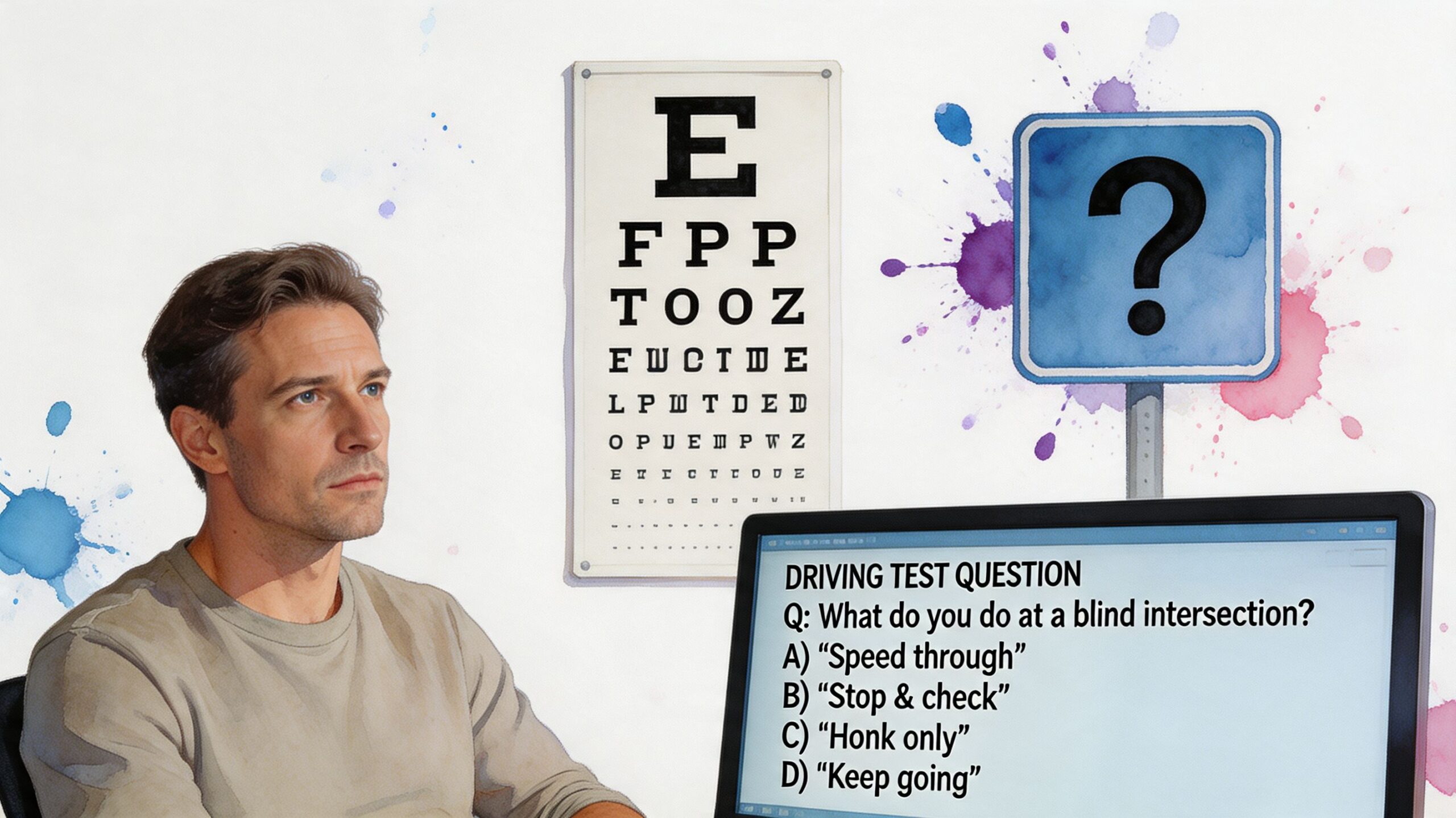
The vision screening is a basic safety check. The DDS wants to confirm that the applicant can see well enough to read and respond on the road.
If your teen already uses glasses or contacts, bring them. That sounds obvious, but families forget this more often than you would expect. A student can study for weeks and still create a problem on test day by leaving corrective lenses at home.
A good way to frame the vision check is this. It works like checking mirrors before a drive. It is not the whole trip, but it has to be right before anything else goes smoothly.
How the knowledge exam works
The knowledge portion covers two areas. One section tests road signs. The other tests road rules. Your teen has to pass both sections, so it helps to prepare for them as two separate jobs instead of one big blur of information.
That detail matters. A strong score on signs does not erase weak understanding of rules, and the reverse is true too.
Families usually get better results with steady review than with one long cram session the night before. Here is a practical way to study:
- Start with road signs. Focus on sign shapes, colors, warnings, and what action each sign requires.
- Move to road rules. Study right-of-way, turning, lane position, following distance, and safe choices in everyday traffic situations.
- Review in short sessions. Fifteen calm minutes a day is easier to retain than an hour of stressed memorization.
- Use real scenarios. Ask questions like, “Who goes first here?” or “What does this sign require you to do?” so the rule connects to an actual driving decision.
Teens usually remember rules better when they understand the reason behind them.
Why real understanding matters
A permit test is only the front gate. Safe driving comes from judgment.
Some students can memorize answers well enough to pass, then feel lost when a real intersection gets busy or a lane change has to happen quickly. That gap is exactly why guided instruction helps. A good program teaches what a rule means on paper and how it works behind the wheel.
At A-1 Driving School, we prepare students for more than the quiz on the screen. We help them connect signs, right-of-way, scanning, spacing, and attention habits into one driving system they can keep using through Joshua's Law training, lessons, and the road test later on. If your family wants extra help before the DDS visit, our Georgia permit test practice guide is a useful starting point.
A calm test-day routine
Test day goes better when the morning feels ordinary.
| Before leaving home | At the DDS |
|---|---|
| Bring glasses or contacts if needed | Read each question slowly |
| Double-check documents | Treat signs and rules as separate sections |
| Eat something light | Do not rush because other people are waiting |
| Arrive with time to spare | Re-read any question that feels unclear |
One more tip helps a lot. Tell your teen they do not need to “ace” the permit test to become a strong driver. They need a solid start, clear thinking, and the right support after the permit is issued. That longer path is where confidence really gets built, and it is where A-1 can make the process much easier for families.
Beyond the Permit Mastering Joshua's Law and Driving Skills
A family gets home from the DDS, the permit is finally in hand, and everyone feels a little relieved. Then the bigger question shows up. What happens over the next several months that turns that permit into a safe, confident driver?
That period matters more than many families expect. A permit gives a teen the legal right to practice. It does not give them the judgment, timing, or calm decision-making that licensed drivers use every day. Those skills are built one drive at a time.
Joshua's Law is a training framework
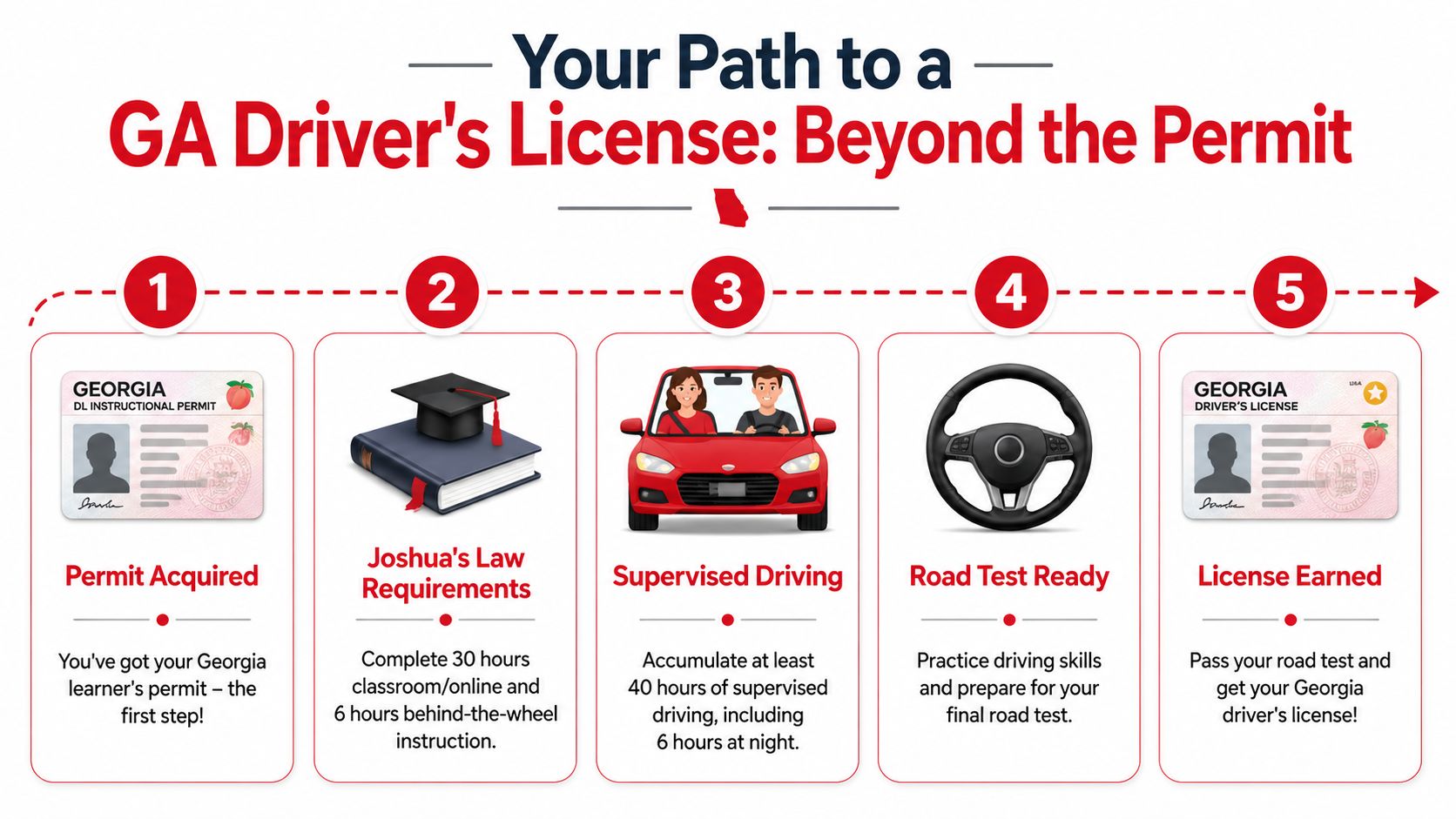
Joshua's Law works like a structured practice plan. For Georgia teens seeking a Class D license at age 16 or 17, it includes a 30-hour driver's education course and 40 hours of supervised driving, with 6 hours at night, based on the Georgia requirements already noted earlier.
That structure helps because new drivers need more than repetition. They need the right kinds of repetition. A teen who only drives to school and back may log hours without learning how to handle rain, busy left turns, parking lots, or dark roads.
At A-1 Driving School, families often feel less overwhelmed when they break Joshua's Law into stages. First comes the course. Then guided practice. Then skill checks. Then road test preparation. That full path is what helps a student grow from permit holder to capable driver.
What the learning year should include
A good practice year should look like a ladder. Each step should feel a little harder than the one before it.
Start with simple environments and add complexity over time:
- Quiet streets: starts, stops, steering, and basic right-of-way
- Neighborhood routes: turns, speed control, and lane placement
- Main roads: traffic flow, spacing, and mirror use
- Parking areas: backing, parking, and low-speed control
- Night driving: visibility limits and earlier decision-making
- Moderate traffic: staying calm while processing more information
Families often worry when a teen struggles in one of those settings. That is normal. A student can meet the legal requirements and still need more guided work in one or two skill areas.
The difference between practice and coaching
Parent-supervised driving and professional lessons do different jobs.
Practice time is where habits get repeated. Coaching is where habits get corrected. The difference matters. If a teen keeps turning too wide or braking too late, more practice alone may repeat the same mistake. A trained instructor can spot the pattern, explain why it happens, and give the student a simple reference point to fix it.
Here are a few patterns we see often:
| Skill area | What teens often do | What helps |
|---|---|---|
| Turning | Turn too wide or too tight | Clear aiming points and repeated setup practice |
| Braking | Brake late or abruptly | Earlier scanning and gradual pedal pressure |
| Lane position | Drift within the lane | Looking farther ahead instead of at the hood |
| Intersections | Miss part of the traffic picture | A steady left-center-right scan routine |
| Parking | Overcorrect | Small, repeatable steps with calm feedback |
That extra coaching also helps parents. You do not have to invent a training plan on your own or carry every correction yourself. A-1 lessons give families a clearer roadmap, and students often accept feedback more easily from an instructor who teaches these skills every day.
A permit allows learning. Strong driving comes from guided repetition and correction.
Online course or classroom course
The best course format is the one a teen will engage with.
Some students focus better in a classroom with a set schedule and live discussion. Others do better online because sports, work, or family transportation make in-person attendance harder. Neither option is automatically better. The key question is whether the student will pay attention, retain the material, and complete the course responsibly.
If cost is part of the decision, families should also review the Georgia driver's education grant scholarship program through A-1 Driving School. That support can make it easier to start training earlier instead of postponing it.
Logging the supervised hours the right way
The strongest practice logs are planned, not rushed.
Waiting until the last month usually creates the same problem. The teen may still need night hours, broader driving experience, and enough consistency to feel steady behind the wheel. A better approach is to spread practice across the permit period, using short drives with a purpose.
One week can focus on intersections. Another can focus on lane changes. Another can focus on parking and backing. That kind of rotation builds a driver who can adapt, not just repeat one familiar route.
Road test readiness is more than technical skill
Road test readiness is part skill, part composure. A student may handle the car well with a parent in the passenger seat and still get tense when another adult gives directions.
That is why preparation should include more than basic vehicle control. A ready driver usually shows:
- Smooth, predictable control of the car
- Consistent mirror checks and head checks
- Calm stops, starts, and turns
- Reliable attention to signs, signals, and lane markings
- The ability to follow directions without getting flustered
A-1 helps families at this point too. Lessons can target the exact habits that affect a road test, and road test services can make the final step more organized and less stressful.
Why this stage shapes long-term drivers
Georgia's permit requirements are meant to build safer habits early. As the same 2020 report noted earlier, crashes involving young drivers remain a real concern. That is why the learning year should be treated as training, not just waiting time before a license.
The change in a teen over those months is usually easy to see. Early on, many students react late and feel rushed. With enough variety, coaching, and repetition, they begin to scan sooner, leave better space, and make steadier choices.
That is the goal. A plastic card matters. A young driver who knows how to handle real roads with confidence matters more.
Making It Affordable The Georgia Driver's Ed Scholarship
A lot of families reach the same point in this process. Their teen is ready to learn, the permit is in place, and everyone agrees that formal driver education would help. Then the cost lands on the kitchen table with everything else.
Georgia does have a way to help with that. The Georgia Driver’s Education Grant Scholarship Program can cover the full cost of an approved driver education course for eligible teens, including the classroom portion and behind-the-wheel training, as explained by Joshua’s Law guidance for Georgia licensing.
For a family, that can change the timeline. Instead of putting lessons off for months, a student may be able to start training while the permit period is still fresh, which usually leads to better habits and steadier progress.
Who this can help
The scholarship is designed for teens from families who meet financial eligibility guidelines. One of the main factors is household income.
If you are unsure whether your family qualifies, it is still smart to check. Many parents assume a program like this is only for a small group of applicants, then find out they were closer to qualifying than they expected.
That matters because driver education is not just another box to check. It works like guided practice at the right stage. A teen gets structure, feedback, and repetition before weak habits have time to settle in.
Why checking early helps
Early planning makes the whole path easier. If scholarship support is available, a family can line up class time, driving lessons, and later road test preparation with less financial strain and less last-minute scrambling.
At A-1, that bigger picture matters. The goal is not only to help a teen get through one course. The goal is to help families build a clear path from permit holder to trained, licensed, confident driver, with support at each step.
If you want one place to review eligibility, application details, and how A-1 helps families use this program, the Georgia Driver's Education Grant Scholarship Program page at A-1 Driving School is a practical place to start.
Your Journey to Becoming a Confident Georgia Driver
The permit process can look like a pile of rules at first. It becomes much clearer when you break it into real steps. Confirm eligibility. Gather the right documents. Pass the vision and knowledge tests. Then use the permit period the way Georgia intended, with steady practice, driver education, and careful preparation for the road test.
That last part matters most.
A permit lets a teen start driving. It doesn’t make them ready for every road situation. Confidence comes from repetition, coaching, and time. Families who approach the ga driver's permit requirements as a full learning path usually end up with a driver who is not only licensed, but more alert, more capable, and more responsible behind the wheel.
If your family is ready for the next step, choose the support that fits your stage. Some students need a Joshua’s Law course. Some need flexible online options. Some need focused driving lessons and lesson packages. Others are ready for road test preparation and final scheduling help.
If you want experienced help from permit prep through road test day, A-1 Driving School offers Joshua’s Law courses, online driver’s education options, road testing support, scholarship guidance, and driving lessons designed to build real skill and confidence.