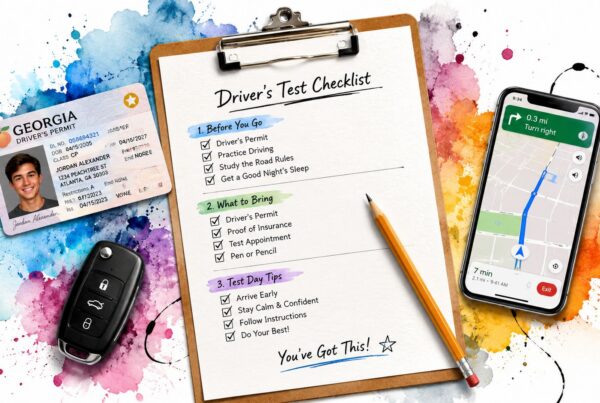

A lot of Georgia families hit the same moment at about the same time. A teen is ready to drive, a parent starts searching, and suddenly the process feels bigger than expected. You see terms like Joshua's Law, Class D license, ADAP, supervised hours, road test, and online course options, and it's not obvious what has to happen first.
The good news is that the path is clear once you break it into parts. If you're trying to figure out online Joshua's Law in Georgia, the main job is understanding which steps can be done online, which steps still happen in a car, and which documents you'll need when it's time for the license.
This guide walks through that path in plain language. You'll see what Joshua's Law requires, how online driver's education fits in, where families often get stuck, how driving lesson packages can simplify the process, and how road testing and scholarship questions fit into the bigger picture.
Your Guide to Getting a Georgia Driver's License
For many teens, getting a license starts with excitement and then quickly turns into a checklist. For many parents, it starts with one simple question: “What exactly do we have to do?”
That question matters because Georgia doesn't treat teen licensing as a single class or a single test. It's a sequence. Some parts teach road rules. Some parts build actual driving skill. Some parts are paperwork and proof. If you miss one piece, the whole timeline can stall.
Why families get confused
Most confusion comes from mixing together three different things:
- Driver's education for the classroom or online learning portion
- Behind-the-wheel lessons with a certified instructor
- Parent or guardian supervised practice outside professional lessons
Those are related, but they are not the same step.
Practical rule: If a teen wants a Georgia Class D license before turning 18, the family should think in terms of course, lessons, practice, paperwork, and test.
What makes the online option easier
Online learning helps because it gives families flexibility. A teen can complete the required coursework on a home schedule instead of waiting for a fixed classroom date. That can be a huge relief for students balancing school, sports, jobs, or a long commute.
But online learning only solves one part of the process. It covers the theory side. It doesn't replace in-car instruction, parent-supervised driving, or the final road test.
That's why the smoothest path usually comes from planning the whole sequence early. Enroll in the course, line up driving lessons, keep the supervised practice log organized, and decide ahead of time where the road test will happen.
What Is Joshua's Law and Who Needs It
Joshua's Law is a Georgia law that changed how teens qualify for a license. It was enacted in 2007 and was named after Joshua Brown, a 16-year-old from Tucker, Georgia, who died in a 2003 car accident, according to Georgia's Joshua's Law course overview.
For families, the practical question is simple. Who has to follow it?
Who the law applies to
Joshua's Law applies to teens seeking a Class D provisional license in Georgia. A clear summary from Certus on Joshua's Law requirements states that enacted in 2007, Joshua's Law mandates that 16 and 17-year-olds complete a 30-hour driver education course, 6 hours of professional behind-the-wheel training, and 40 hours of supervised practice to get a Class D license. This requirement was extended to all 17-year-olds on July 1, 2021.
That means families shouldn't assume the law only matters for younger teens. If your student is 16 or 17, it still matters for the licensing path.
The core requirements
Here's the part most parents want in one place:
- 30-hour driver education course. This is the classroom or online theory portion required for teen licensing.
- 6 hours of professional behind-the-wheel training. These lessons must be done with a certified instructor.
- 40 hours of supervised practice. A parent or guardian oversees this driving practice.
- 6 of those supervised hours must be at night. Night driving isn't optional inside that practice requirement.
Those numbers aren't suggestions. They are the framework the state uses for teen licensing.
Why the law feels bigger than a single class
A lot of families first hear “Joshua's Law” and think it means one online course. It doesn't. It's better to think of it as a complete preparation standard.
The course teaches rules, signs, judgment, and safety concepts. The professional lessons focus on actual skill in a vehicle. The family practice hours give the teen repetition in everyday conditions.
Joshua's Law is easier to manage when you stop thinking of it as one requirement and start treating it like a training sequence.
That's also why waiting until the last minute creates stress. If your teen is close to licensing age, it helps to start the course and lesson planning early so the supervised driving hours don't become a scramble.
Choosing Your Path Online vs Classroom Courses
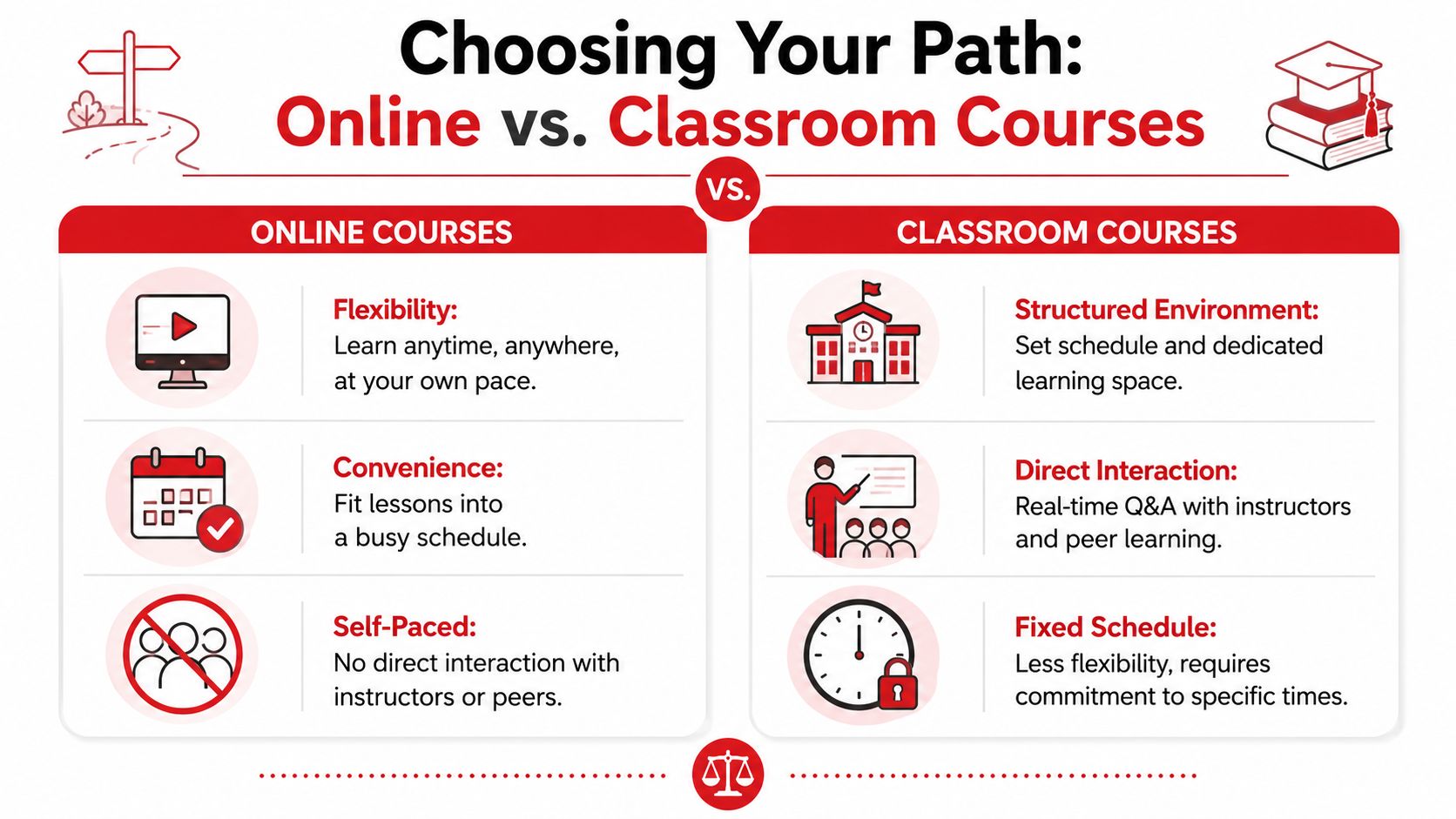
Some teens do better with a structured room and a fixed schedule. Others learn better when they can move through lessons at home. Georgia allows both approaches for the classroom portion of Joshua's Law.
What the online option covers
According to the Georgia DDS Joshua's Law requirements page, the online component of Joshua's Law allows teens to complete the 30-hour classroom requirement through a DDS-approved virtual program. The same DDS page also explains that once the course is completed, a certificate is reported to DDS, but the online course does not replace the required 6 hours of professional behind-the-wheel training.
If you want a fuller overview of how virtual coursework fits the state process, this explanation of online driver's education in Georgia can help.
Side-by-side comparison
| Course format | Good fit for | What families should know |
|---|---|---|
| Online course | Students with packed schedules or who prefer self-paced work | It satisfies the theory requirement if it's DDS-approved |
| Classroom course | Students who learn better with live structure and face-to-face instruction | It offers a scheduled environment and direct interaction |
How to choose the right format
Use the online option if your teen needs flexibility. It often works well for athletes, students with after-school activities, and families trying to avoid adding another weekly trip across town.
Use a classroom option if your teen focuses better in a live setting with immediate instructor interaction.
What doesn't change is the legal outcome for the theory portion. A DDS-approved online course is treated as a valid way to complete that educational requirement. The part that still has to happen in person is the professional in-car training.
One common misunderstanding
Parents sometimes ask if completing the online course means the driving school part is finished. It doesn't.
The online course checks off the theory requirement. The in-car lessons are still separate, and they matter because they build habits that reading alone can't teach, such as lane position, turning judgment, parking, and test-day vehicle handling.
Your Step-by-Step Pathway to a Georgia Class D License
A clear order makes this process much less stressful. Instead of trying to do everything at once, treat each step as a checkpoint.
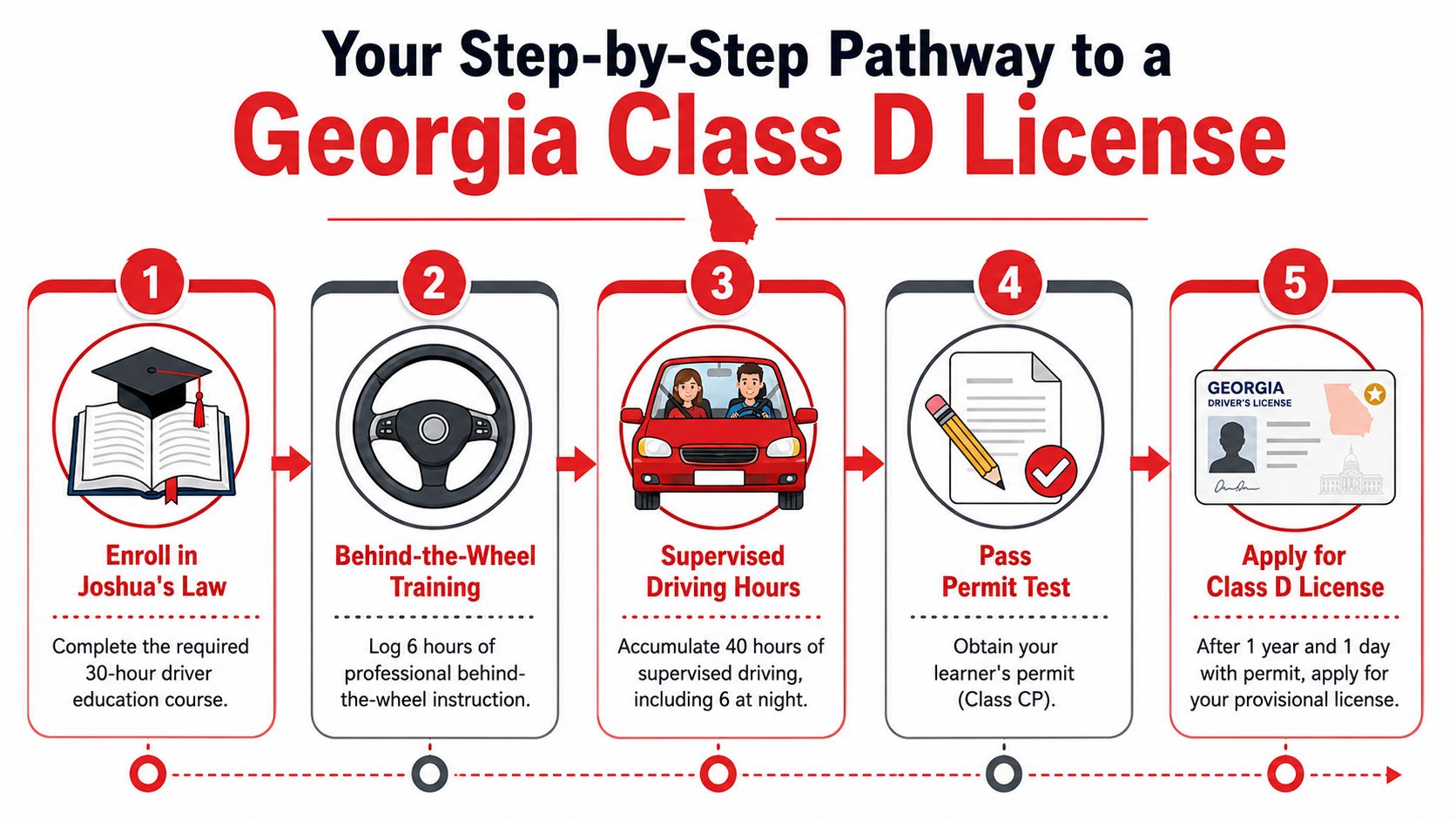
Step 1 Enroll in a Joshua's Law course
Start with the educational requirement. If your family wants flexibility, choose a DDS-approved online Joshua's Law course. The required classroom content is 30 hours, and that has to be completed before the road test.
For a practical licensing walkthrough, this guide on how to get a Georgia provisional license helps families line up the sequence.
Step 2 Complete the theory portion and watch for certificate reporting
After the course is completed, the certificate isn't something families usually need to hand-carry immediately from provider to state system. The NHSA explanation of Georgia online Joshua's Law notes that the 30-hour course completion triggers automated digital transmission of the certificate to Georgia DDS, and that this has to be paired with an in-person administrative step later.
That automatic reporting helps, but it doesn't mean all paperwork is finished.
Keep your own completion records organized anyway. Even when systems report electronically, families should save confirmations and emails.
Here's a quick visual guide to the overall flow:
Step 3 Schedule the professional behind-the-wheel lessons
The next checkpoint is the professional in-car training. During this training, a certified instructor works with the student in a real vehicle.
Parents often ask whether this step should wait until the teen feels more confident. Usually, the answer is no. Early professional coaching often helps the teen practice correctly from the start instead of building habits that are harder to fix later.
Step 4 Log the supervised driving practice carefully
The family practice requirement is separate from the professional lessons. The teen must complete 40 hours of supervised driving, including 6 hours at night. For this practice, consistency matters.
A simple way to manage it is to spread practice across familiar streets, larger roads, parking situations, turns, lane changes, and nighttime driving. Keep the driving log updated as you go. Families who wait to reconstruct their hours later usually create extra stress for themselves.
Step 5 Prepare the affidavit and final testing steps
The supervised hours don't only need to be completed. They also need to be verified properly. The same NHSA source explains that a parent or guardian must present a notarized affidavit at a DDS center to verify the supervised driving hours.
That's the part many families don't expect. The workflow is partly digital and partly in person.
Step 6 Take the road test
After the course, lessons, supervised driving, and paperwork are in place, the final step is the road skills test. Some families test through DDS. Others prefer to test through a school that offers road testing services.
That choice often comes down to scheduling, familiarity with the vehicle, and whether the student wants a more guided test-day experience.
How A-1 Driving School Fulfills Your Joshua's Law Needs
For families trying to keep the whole process in one place, it helps to choose a provider that handles more than just the online course.

Putting the pieces together
A-1 Driving School offers a DDS-approved online Joshua's Law course for the theory portion, along with driving lessons, lesson packages, and road testing support through its Joshua's Law driver's education page.
That matters because most families don't need just one service. They need a path.
Where driving lesson packages help most
Driving lesson packages are useful because they turn a legal requirement into a practical plan. Instead of treating the 6 hours of instructor training as a separate item to remember later, families can schedule it as part of a larger progression.
That's especially helpful for students who need more than the minimum. Some teens pick up driving quickly but still want more work on parking, lane changes, busy intersections, or road test skills. Others need a slower pace and more repetitions before they're ready to test.
A package approach can help with:
- Meeting the required in-car instruction with a certified instructor
- Building confidence gradually instead of cramming practice close to test day
- Targeting weak spots such as parallel parking, turns, merging, or road test maneuvers
- Keeping scheduling organized so the family isn't chasing separate providers
Why road testing in one place can reduce stress
The road test is where nerves spike for many teens. If the student can prepare and test through the same school environment, that often makes the last step feel more familiar.
A smoother licensing experience usually comes from fewer handoffs. When the course, lessons, and testing logistics connect well, families spend less time untangling details.
That doesn't mean every family needs the same setup. Some only need the online class and required lessons. Others want additional road test prep, a tune-up lesson, or a package that supports the student all the way through the final test.
A practical way to decide
If your teen is organized, self-directed, and already getting steady parent practice, a basic online course plus required in-car lessons may be enough.
If your teen is nervous, inconsistent with practice, or needs more coaching in real traffic, a broader lesson package and road test support may be the better fit. The extra structure can make the process feel more manageable for both the student and the parent.
The Georgia Driver's Education Scholarship Explained
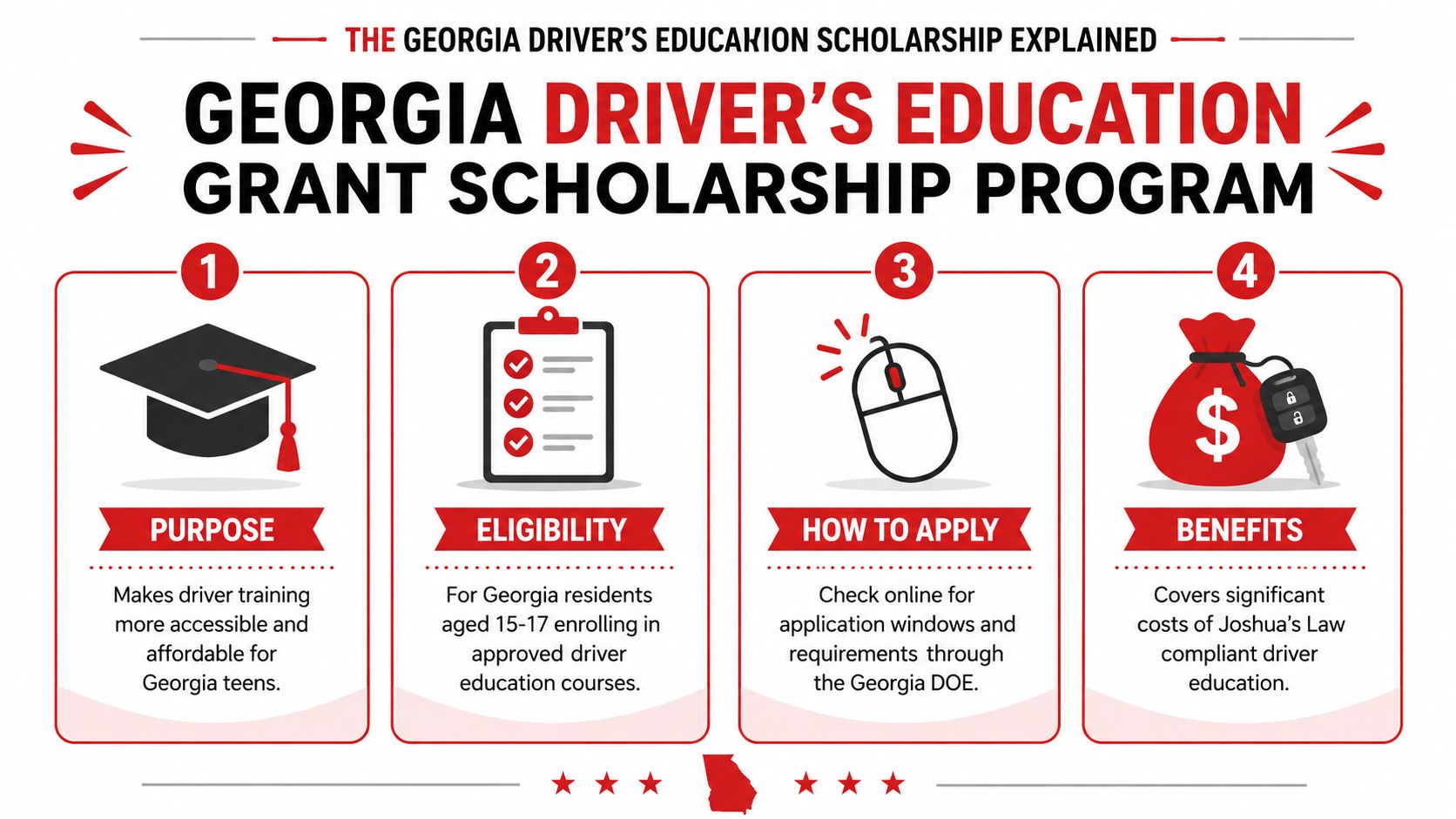
Cost is one reason families start comparing providers so carefully. Georgia does have a Driver's Education Grant Scholarship Program, but it often leads to mixed messages for many.
What's clear about the scholarship program
The key point from WSB-TV's reporting on Georgia driver education scholarship funding is that millions in state-funded driver education scholarships are primarily funneled through Georgia's technical college system. That report also highlights an important problem for families choosing virtual providers. Authoritative sources do not clarify if these funds can be applied to private online Joshua's Law courses, creating uncertainty for families choosing virtual providers.
So yes, the scholarship program exists. But no, families shouldn't assume that every DDS-approved online option automatically fits the scholarship rules.
What families should ask before enrolling
Before signing up, ask these questions:
- Does this course qualify for scholarship funding? Don't assume online approval and scholarship eligibility are the same thing.
- Where is the funding administered? The reporting points families toward the technical college system.
- If funding matters, what documentation should we confirm first? It's better to verify before paying.
For families trying to sort that out, this page on the Georgia Driver's Education Grant Scholarship Program can serve as a starting point.
The practical takeaway
The scholarship conversation has two separate layers. First, the state may offer funding pathways. Second, the provider and format you choose may or may not match those funding pathways in a clear way.
That's why it's smart to treat scholarship planning as its own task, not an afterthought. If your family is counting on state support, verify compatibility before locking in an online course. If you're paying privately, focus on the format, lesson access, and testing support that best fits your teen's needs.
Answering Your Top Joshua's Law Questions
Is ADAP the same as Joshua's Law
No. They are separate requirements. According to this Georgia ADAP and Joshua's Law guide, teens must complete the Alcohol and Drug Awareness Program (ADAP) as a separate DDS requirement and present both the ADAP certificate and the Joshua's Law completion certificate at the road test.
If my teen finishes the professional lessons, do we still need the supervised driving hours
Yes. The in-car lessons with a certified instructor do not erase the family practice requirement. Parents should still treat supervised driving as an important part of skill-building, not just a form to sign later.
Can a teen do Joshua's Law online and still take driving lessons in person
Yes. That's a common setup. The online course handles the theory portion, while the in-car training happens separately with an instructor.
Can we take the road test at a driving school instead of DDS
In many cases, yes, depending on the services offered by the school you choose. Families often like that option because it can simplify scheduling and make the teen more comfortable on test day.
What's the biggest mistake families make
Waiting too long to coordinate the moving parts. The course, lessons, practice log, affidavit, ADAP certificate, and road test all connect. Starting early gives you room to handle each step without rushing.
If you're ready to turn the checklist into a real plan, A-1 Driving School offers online Joshua's Law courses, driving lessons, lesson packages, and road testing support so Georgia teens and parents can move from enrollment to license with fewer surprises.