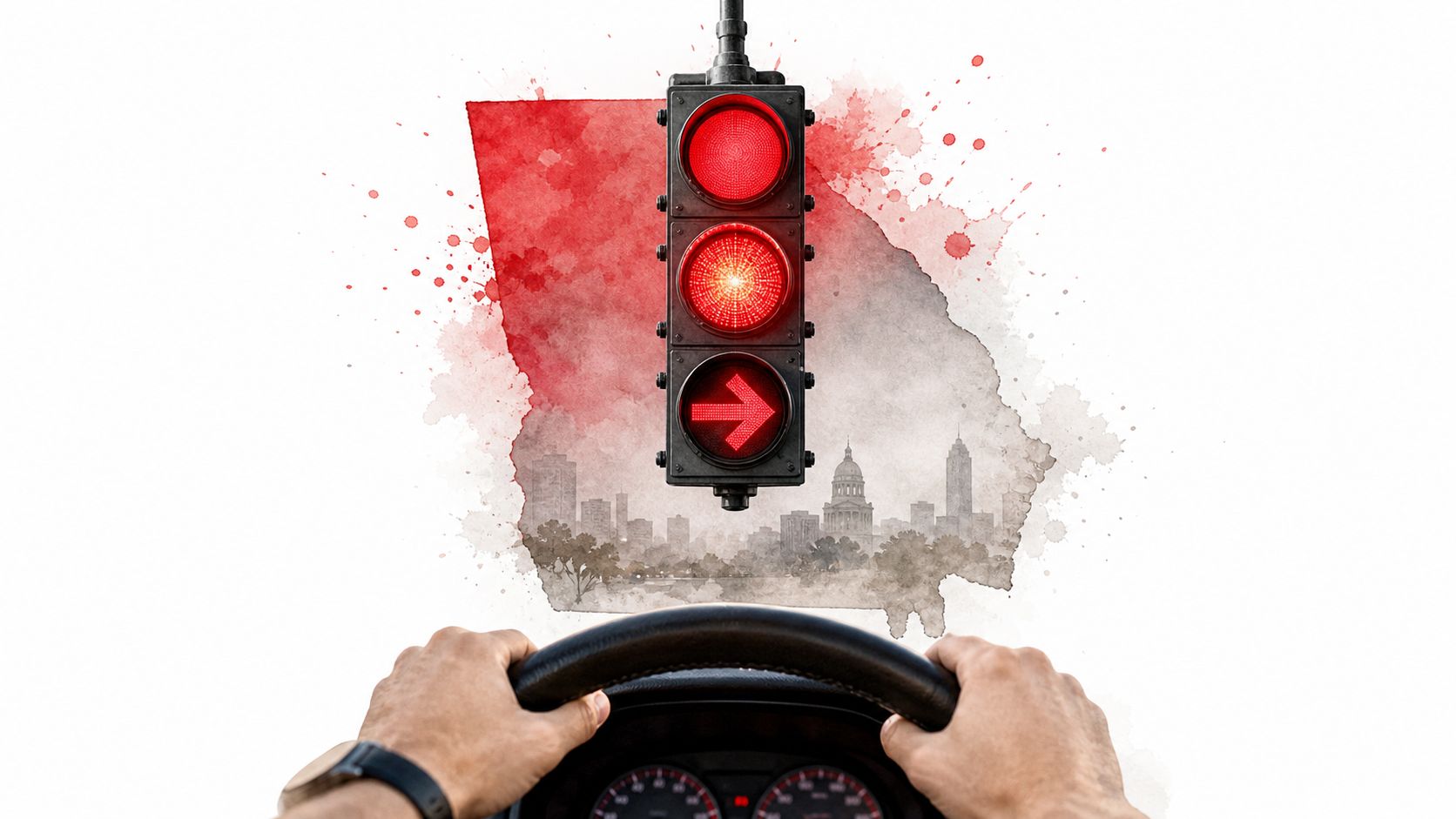
You're driving with your permit for one of the first times. The road feels manageable until you reach a wide Georgia intersection, the light changes, and your brain starts asking fast questions. Brake now? Keep going? Can you turn? What if the car behind you is close?
That moment is where a lot of new drivers get tense. It's also where a clear rule helps. If you understand what does a red light mean, you don't have to guess. You make the safe choice, the legal choice, and the choice a road test examiner wants to see.
Your First Big Intersection
A red light seems simple when you're reading the manual at home. On the road, it can feel less simple because traffic is moving, pedestrians may be crossing, and you may be trying to judge distance and speed at the same time.
For a new driver in Georgia, that's normal. Red lights test more than memory. They test timing, observation, patience, and judgment.
The core rule is straightforward. A steady red light means you must come to a complete stop before the marked stop line, before the crosswalk, or before entering the intersection. A flashing red light also requires a complete stop, but then you may proceed when the intersection is clear because it works like a stop sign, as described in the traffic light rule summary.
Practical rule: If your wheels are still rolling, you haven't stopped yet.
That matters on your road test. Examiners watch for complete stops, not slow rolling pauses. They also watch whether you stop in the right place. Stopping too far forward can put you in the crosswalk. Stopping too far back can limit your view.
Many teens also get confused by the yellow light that comes right before red. The safest approach is to decide early. If you can stop smoothly before the line, stop. If you're already too close to stop safely, continue through without speeding up.
That's one reason practice matters. Classroom knowledge gives you the rule. Real driving lessons help you apply it in live intersections, with real traffic, at normal Georgia driving speeds.
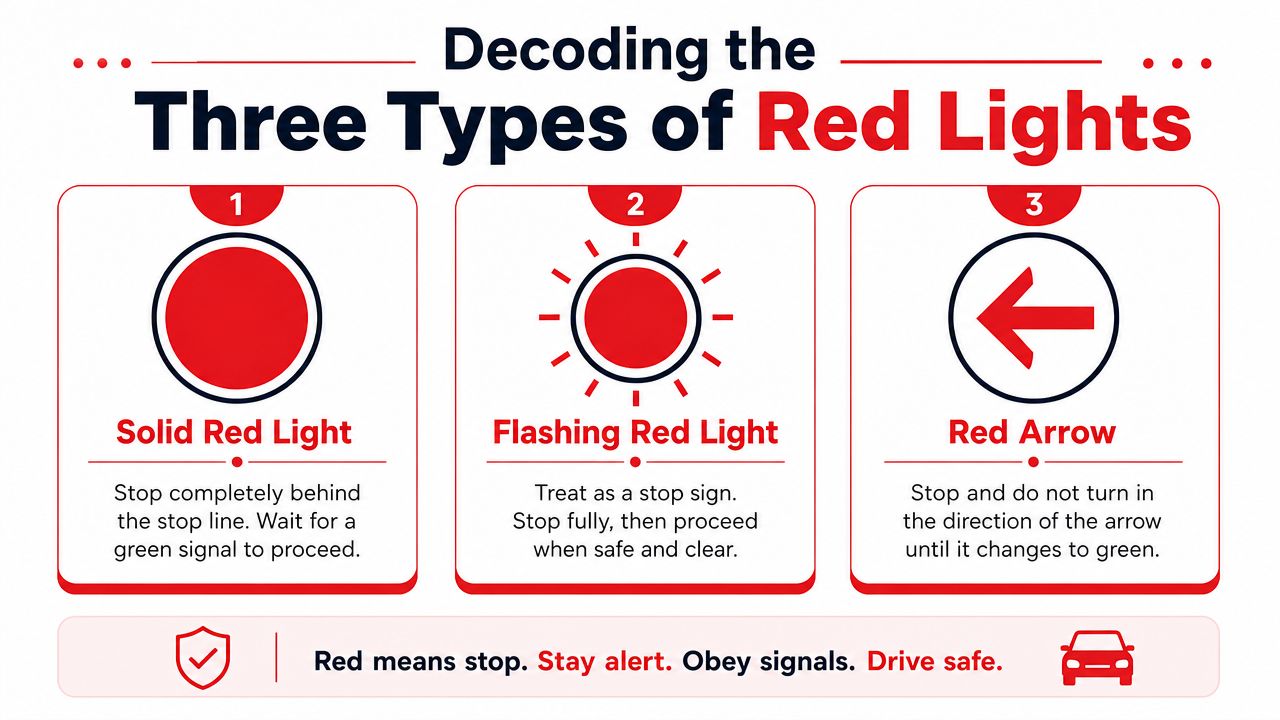
Decoding the Three Types of Red Lights
Not every red signal means the same exact thing. The color tells you to stop, but the type of red light tells you what happens next.
Solid red light
This signal is often the first that comes to mind. A solid red light means stop completely behind the stop line or before the intersection. You can't continue straight through just because the road looks empty.
A lot of new drivers make one of two mistakes here:
- Rolling forward slowly: They treat the stop like a pause instead of a full stop.
- Stopping too late: They pass the line first, then stop in the crosswalk or at the edge of the intersection.
If you want a helpful companion explanation, A-1 also has a guide on what a flashing red light means for Georgia drivers.
Flashing red light
A flashing red light is different from a steady red. You still must stop fully, but after that you treat the situation like a stop sign. You yield to other traffic and proceed only when the way is clear.
This often shows up where drivers need extra caution, such as places where traffic flow changes or where a full stop protects people from severe crashes.
A quick comparison helps:
| Red signal | What you do |
|---|---|
| Steady red | Stop and wait for a legal signal or legal turn movement |
| Flashing red | Stop, yield, then go when clear |
A flashing red light isn't a “slow down and look” signal. It's a stop first signal.
Red arrow
A red arrow is more specific. It controls movement in the direction of the arrow. If the arrow points left, you can't turn left in that direction until the signal changes and the turn is allowed.
This trips up new drivers when the main signal nearby looks more permissive than the arrow for their lane. Always obey the signal that controls your lane and your movement.
Keep one mental checklist at every signal:
- Which lane am I in?
- Which signal controls my lane?
- Am I stopping, waiting, or legally turning after a full stop?
That small pause in your thinking can prevent a rushed decision.
Georgia's Rules for Turning on Red
Georgia drivers hear “right on red” so often that some teens start to think it's automatic. It isn't. The key word is may, not must.
Right turn on red
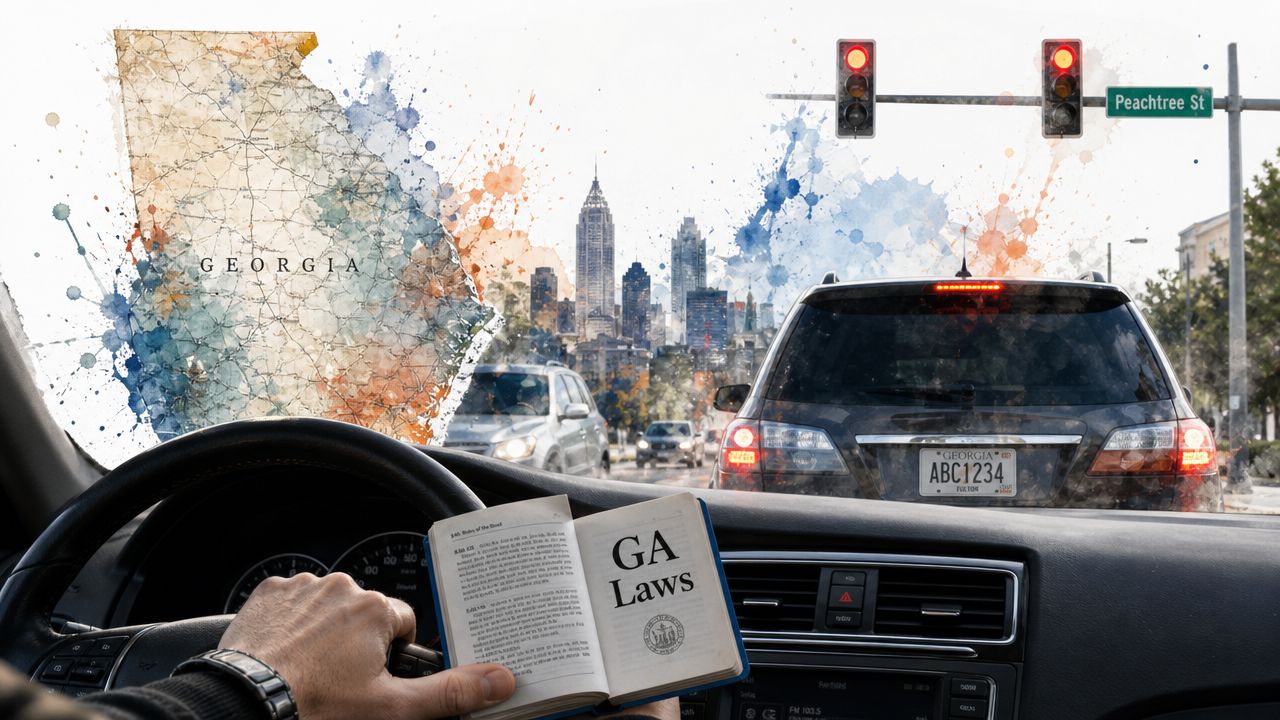
In Georgia, turning on red is generally allowed after a complete stop, unless a sign or signal prohibits it. That means you stop first, check for pedestrians, check for cross traffic, and only turn if the path is clear.
That's where many new drivers get in trouble. They look left for cars and forget to check right for pedestrians stepping into the crosswalk. On a road test, that's a serious mistake because it shows incomplete scanning.
A simple routine helps:
- Stop fully: Come to a complete stop in the proper place.
- Check signs: Look for any instruction that removes the turn option.
- Scan both ways: Watch traffic and the crosswalk before moving.
- Turn only if clear: If anything feels uncertain, wait.
Restrictions and local judgment
Not every red light gives you the same turning choice. The turn on red overview notes that turning on red is generally permitted after a stop, but 12 US states, including Georgia, have specific restrictions. The same source says a 2024 NHTSA study found that 37% of teens incorrectly believe turn-on-red is universally allowed, contributing to 18% of red-light-related teen crashes in Georgia.
That tells you something important. Confusion at intersections isn't rare. New drivers often know the general rule but miss the exception.
If you want a Georgia-focused explanation of this specific maneuver, review when you can turn right on red.
Road test mindset: If a sign, signal, pedestrian, or traffic flow makes the turn questionable, waiting is usually the better decision.
The dilemma zone
There's another place drivers get confused. You approach an intersection on green or late yellow, and suddenly you're not sure whether to brake or continue.
That's sometimes called the dilemma zone. It's the space where a driver may feel too close to stop smoothly but not fully confident about clearing the intersection before red. New drivers often make this worse by hesitating, then changing their mind at the last second.
The fix is calm judgment, not panic. Look ahead early. If the light has been green for a while, prepare for a possible change. Ease off the gas slightly, cover the brake if needed, and decide sooner rather than later. Sudden braking and sudden acceleration are both risky choices.
The Real Consequences of Running a Red Light
Running a red light isn't just a technical mistake. It creates a crash pattern that often hurts people who did nothing wrong.
The most important consequence is safety. According to the Cherokee County safety summary on red lights and stop signs, red light running causes over 900 fatalities annually in the United States and injures nearly 200,000 people, with approximately 50% of these deaths being pedestrians and occupants of other vehicles struck by the violators.
That last part matters. A rushed driver often harms someone crossing legally or driving lawfully through a green light.
What it means for a new driver
For teens and first-time license holders, a red light citation can affect more than one day. It can add stress to your driving record and create problems that follow you after the stop itself. If you're trying to understand how violations can affect your record, this guide on Georgia driver's license points is a useful place to start.
If you ever need to compare how traffic court works in another state, a practical outside example is this legal guide for Illinois traffic offenses. The rules and procedures differ by state, but it helps show that traffic violations can become more complicated than many drivers expect.
Why instructors focus on stopping early
Driving instructors keep repeating “scan ahead” for a reason. Good red light habits start before the light turns red. You read the intersection, check the signal status early, and plan a smooth stop instead of a dramatic last-second one.
The goal isn't to drive scared. The goal is to make early, calm decisions so red lights never become emergencies.
Go from Learner to Licensed Driver with A-1
Knowing the rule is one thing. Using it in traffic, with pressure from cars behind you and distractions around you, is different. That's why new drivers usually improve fastest when they combine classroom study with actual behind-the-wheel practice.
Under Georgia's Joshua's Law, teens ages 15 to 17 must complete a state-approved driver's education course with exactly 30 hours of classroom instruction and 6 hours of professional behind-the-wheel training to earn a Class D license before age 18, as explained on Georgia driver's education courses.
What practice should actually cover
A good lesson plan shouldn't stop at memorizing signals. It should include the moments that make new drivers nervous, such as:
- Approaching stale green lights: Learning when to prepare for a possible change.
- Stopping at the correct line: Not in the crosswalk and not halfway into the intersection.
- Turning right on red safely: Watching pedestrians and checking for posted restrictions.
- Handling arrows and lane control signals: Following the signal that applies to your lane.
That's where driving lessons and lesson packages matter most. Repetition builds timing. Timing builds confidence.
Course options and road test support
Georgia families often need flexibility. Some students do better in a classroom setting. Others need online options that fit around school, sports, and work. Along with Joshua's Law coursework, A-1 Driving School offers driving lessons, lesson packages, and road testing options so students can practice the same red-light decisions they'll face on the exam and in daily driving.
If cost is a concern, it's also worth asking about the Georgia Driver's Education Scholarship Grant Program. For some families, that can make professional instruction more accessible.
Classroom learning helps you know the rule. Driving lessons help you recognize the moment when the rule applies.
Common Red Light Scenarios for Your Road Test
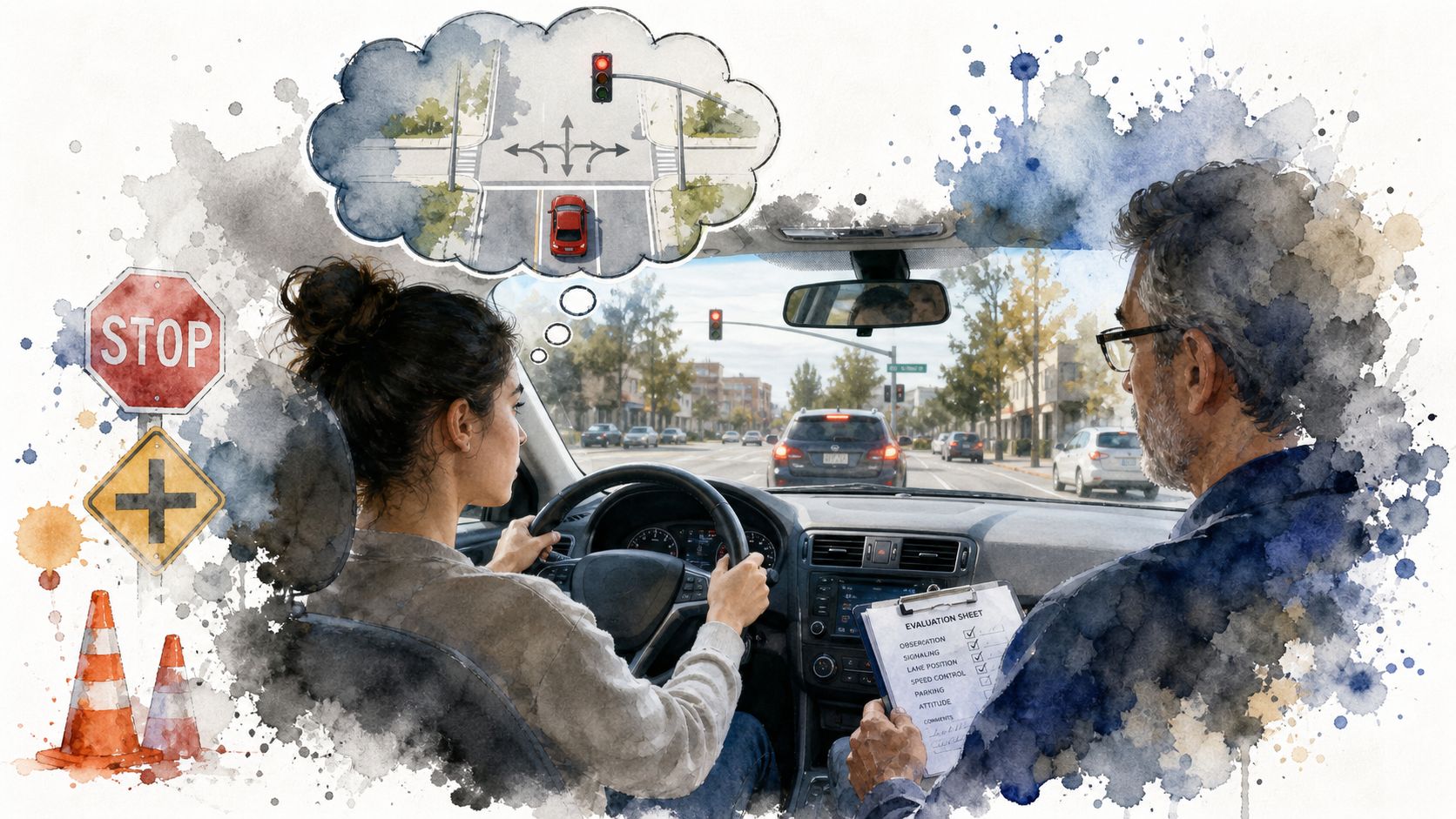
Road tests don't just measure whether you know definitions. They measure whether you make the right choice in a live traffic situation.
What if I'm waiting to turn left and the light turns red
If you were already in the intersection waiting for a safe chance to turn left, you should clear the intersection when it's safe. A driver who is already in the intersection waiting to turn left isn't treated the same as a driver who entered after the light turned red.
The important part is how you got there. You entered lawfully, then waited for oncoming traffic to clear.
What if I want to turn right on red and a pedestrian is in the crosswalk
Wait. Don't inch forward to pressure the pedestrian, and don't focus only on car traffic. On your road test, the examiner wants to see that you protect the crosswalk first.
What if my lane has a red arrow but the light next to me is green
Follow the signal for your lane. If your lane has the red arrow, that's the signal that controls your movement. The green light for another lane doesn't give you permission to go.
A short visual review can help before your test:
What if I stop, then feel pressured by the car behind me
Stay calm and keep following the rule. A driver behind you doesn't decide whether your turn is safe. If the intersection, crosswalk, or signal says wait, you wait.
That's one of the biggest signs of a mature driver. You don't let someone else's impatience make your decision.
If you want help practicing intersections, red-light turns, and road test habits in real Georgia traffic, A-1 Driving School offers Joshua's Law courses, online course options, road testing, and driving lessons with lesson packages that give new drivers more time behind the wheel where these decisions happen.