
You're sitting at a Georgia insurance office with your teenager, a learner's permit in hand and a first policy quote on the screen. The liability section looks familiar, but then you see uninsured motorist protection, stacked coverage, bodily injury limits, and property damage options. Your teen asks the sensible question: “Do we really need all of that?”
For a Georgia family, that question belongs in the same conversation as Joshua's Law, supervised driving, road testing, and the first solo trip. Driver education helps a new driver avoid crashes, while uninsured motorist protection helps protect the family when another driver causes a crash and lacks enough insurance to pay for the harm.
Why Uninsured Motorist Protection Matters on Georgia Roads
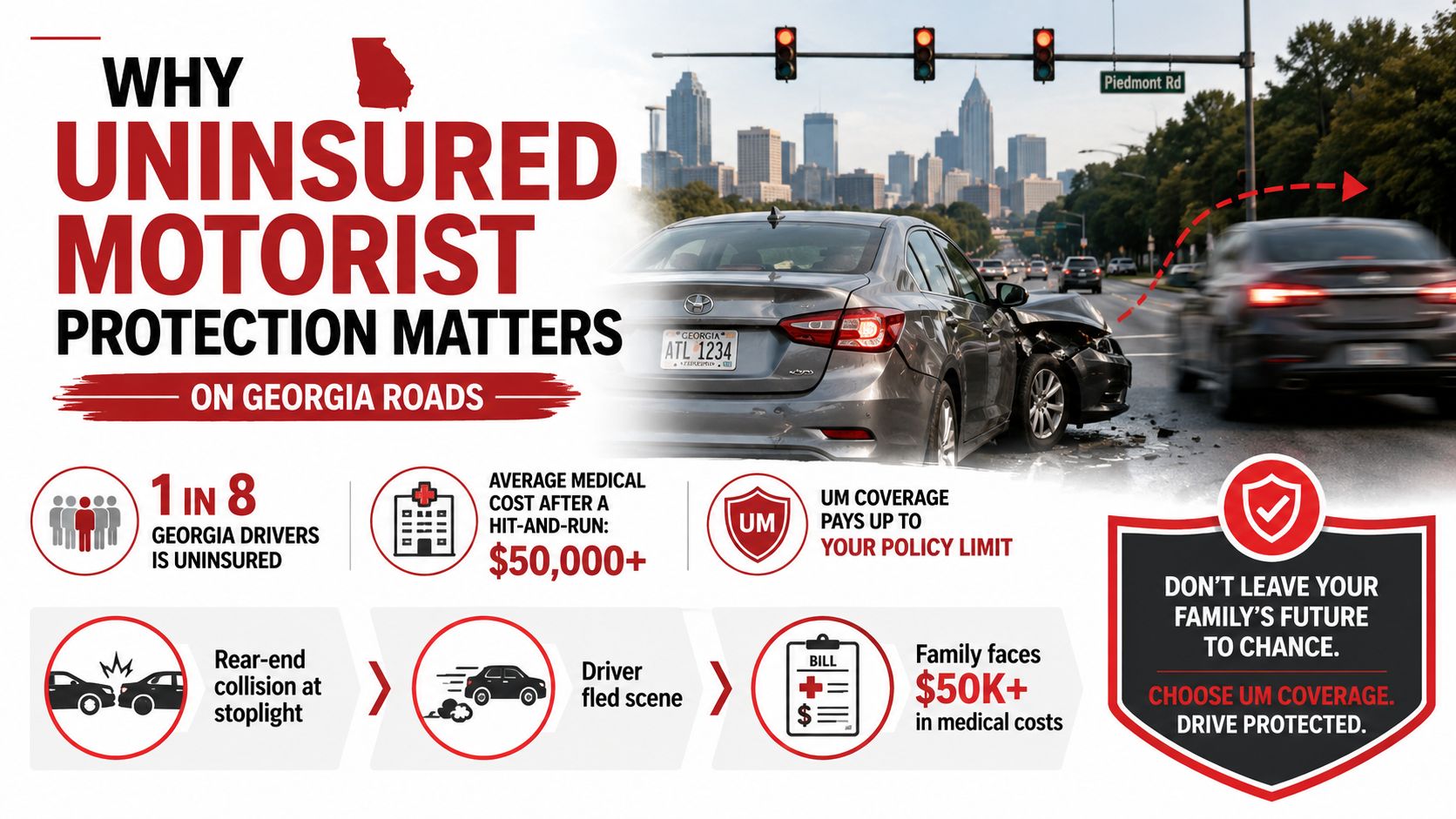
A teenager is stopped at a traffic light on a busy Atlanta-area road. The car behind them hits hard, the teen's vehicle moves forward, and before the family can collect every detail, the other driver leaves. The parent arrives to find a damaged car, a shaken young driver, and unanswered questions about medical care and payment.
That situation is especially difficult when nobody can identify the fleeing driver. Uninsured motorist, or UM, coverage is designed to act as a safety net when the at-fault driver has no liability insurance. Depending on the policy and state rules, it can help with injuries and may also include protection for vehicle damage.
The risk isn't limited to one careless driver
The Insurance Research Council estimated that 15.4% of U.S. motorists were uninsured in 2023, up from 12.4% in 2017. The estimate reached 14.3% in 2020, then increased to 15.2% in 2022 and 15.4% in 2023, according to the Insurance Information Institute's uninsured motorist statistics. In practical terms, more than one in seven motorists nationwide was uninsured in 2023.
That national picture explains why a Georgia parent shouldn't treat UM as an obscure add-on. A driver can follow the rules, maintain a policy, and still be injured by someone who has no coverage or cannot be found after a hit-and-run. Readers who want a legal perspective on how this protection can affect an injured person may also find the Law Office of Bryan Fagan PLLC uninsured coverage resource useful, although Georgia policy language and law control a Georgia claim.
The right questions are practical: What does the policy pay? Which injuries qualify? Does it cover damage to the car? What happens after a hit-and-run? The answers depend on the difference between UM and underinsured motorist coverage, the limits selected, the stacking election, and the claim process.
Uninsured vs Underinsured Motorist Coverage
Think of a restaurant bill shared by two diners. UM coverage applies when the at-fault diner has no money at all for the bill. UIM coverage applies when that diner pays part of the bill, but the remaining balance is still larger than what they can afford.
UM responds to a driver with zero liability insurance, including some hit-and-run situations where the responsible driver can't be identified. UIM responds when the other driver has liability insurance, but that policy limit is too low to cover the injured person's damages. The distinction matters because a valid policy on the other vehicle doesn't guarantee that the policy can pay for a serious injury.
The Insurance Research Council estimated that the national underinsured-driver rate reached 15.7% in 2022, while the combined uninsured and underinsured share reached 33.4% in 2023, as reported in this explanation of UIM coverage and the floating-layer theory. Those figures describe a broader problem than drivers who carry no insurance at all. Many crashes involve a driver who has coverage, but not enough of it.
| Coverage Type | At-Fault Driver Situation | What It Pays |
|---|---|---|
| UM bodily injury | The driver has no liability insurance, or the crash may qualify as a hit-and-run | Covered injury losses, up to the selected UM limit |
| UIM bodily injury | The driver's liability policy exists but is inadequate | The covered gap, subject to policy limits and Georgia rules |
| UM property damage | The responsible driver has no insurance and the policy includes this protection | Covered vehicle damage, subject to policy terms and deductible rules |
| UIM property damage | The other driver's property-damage limit doesn't cover the loss | Any available covered shortfall, subject to the policy |
Bodily injury coverage focuses on people, including the insured driver and potentially passengers. Property damage coverage focuses on the vehicle and other covered property. A parent comparing policies should review both rather than assuming bodily injury protection automatically pays for every repair.
Coverage can also be stacked or non-stacked, depending on the policy and written election. Stacking may provide access to limits associated with more than one insured vehicle, while non-stacked coverage generally limits recovery to the selected limit for the applicable vehicle. For a plain-language refresher on the other driver's required protection, review these liability insurance basics.
Georgia UM Rules and Minimum Limits
Georgia treats uninsured motorist coverage as a default part of an auto policy unless the named insured rejects it in writing. That means a parent usually doesn't have to remember to request the coverage from scratch. The parent must take affirmative action to decline it.
Georgia law also establishes a statutory minimum. The cited explanation of O.C.G.A. § 33-7-11 identifies at least $10,000 in UM coverage in a single policy, while the policy itself can provide higher limits. The statute's purpose is straightforward: protect an insured person when the driver responsible for the crash has no liability insurance. Review the Georgia UM statute explanation for the statutory context, then confirm the exact language in the policy and declarations page.
What the policy terms mean
An insured generally refers to the people protected under the policy, such as the named insured and other qualifying drivers or occupants. The exact definition comes from the contract, so a family shouldn't rely on a verbal assumption about every household member or passenger.
A hit-and-run involves a driver who leaves without fulfilling the duties required after a crash. The other vehicle may be known, partially identified, or completely unknown. UM treatment depends on the policy and the evidence, so the family should report the event and preserve information rather than assuming the claim automatically qualifies.
Georgia's default rule changes the buying conversation. A parent isn't deciding whether to add an optional product. The parent is deciding whether to keep the protection already included, select higher limits, and understand any written election involving stacking or reduced coverage.
Practical rule: Never sign a rejection or reduced-coverage form until you can explain what protection disappears and what limit remains.
Parents sometimes compare UM limits with general liability requirements and stop there. For broader context on how numbered liability limits are explained in the region, read this guide to understanding the 25/50/25 requirement, but remember that Georgia law and the Georgia policy govern this purchase.
How to Choose the Right UM Limits
Start with the declarations page, the summary page that lists the policy's selected coverages and limits. Liability and UM limits often appear near each other, which makes comparison easier. Read every number separately instead of treating a string such as “per person/per accident” as one amount.
A per-person limit applies to one injured person's covered claim. A per-accident limit places a total ceiling on covered bodily injury claims arising from one crash. The policy may also distinguish between the named insured, household members, passengers, and other qualifying insureds, so ask the agent to explain who is covered.
Use the family's actual exposure
Suppose a newly licensed teen suffers serious injuries in a crash caused by a driver with no insurance. A $25,000 per-person limit could be exhausted quickly by emergency treatment and follow-up care. That doesn't mean every family must purchase the highest available limit, but it does show why the lowest quote isn't automatically the safest choice.
Consider the household's health-insurance deductible, available savings, income that could be lost during recovery, and the value of the vehicles. Also ask whether UIM applies when the other driver's policy pays something but leaves a gap. UM and UIM should be evaluated beside liability coverage, not as an isolated checkbox.
| Coverage Example | Per-Person Limit | Per-Accident Limit | What It Can Mean |
|---|---|---|---|
| Lower selected UM limit | $25,000 | $50,000 | A smaller cushion for one serious injury or several injured people |
| Higher matched limit | Same as the family's liability selection | Same as the family's liability selection | A simpler structure to understand and compare |
| Stacked selection | The policy limit may combine across qualifying vehicles | The available amount may be higher than one vehicle's limit | More protection may be available, subject to policy language and Georgia rules |
The table uses examples, not a recommendation for every household. A family with a teen may find matching UM limits to liability limits easier to manage because the two protections can be reviewed together. Ask for quotes at more than one limit, request the exact premium difference, and ask whether the coverage is stacked, non-stacked, or subject to exclusions.
The best choice balances budget and risk. A lower premium today can leave the family responsible for a larger uncovered loss after a crash, while a higher limit may provide a more meaningful financial buffer.
Filing a UM Claim After a Crash
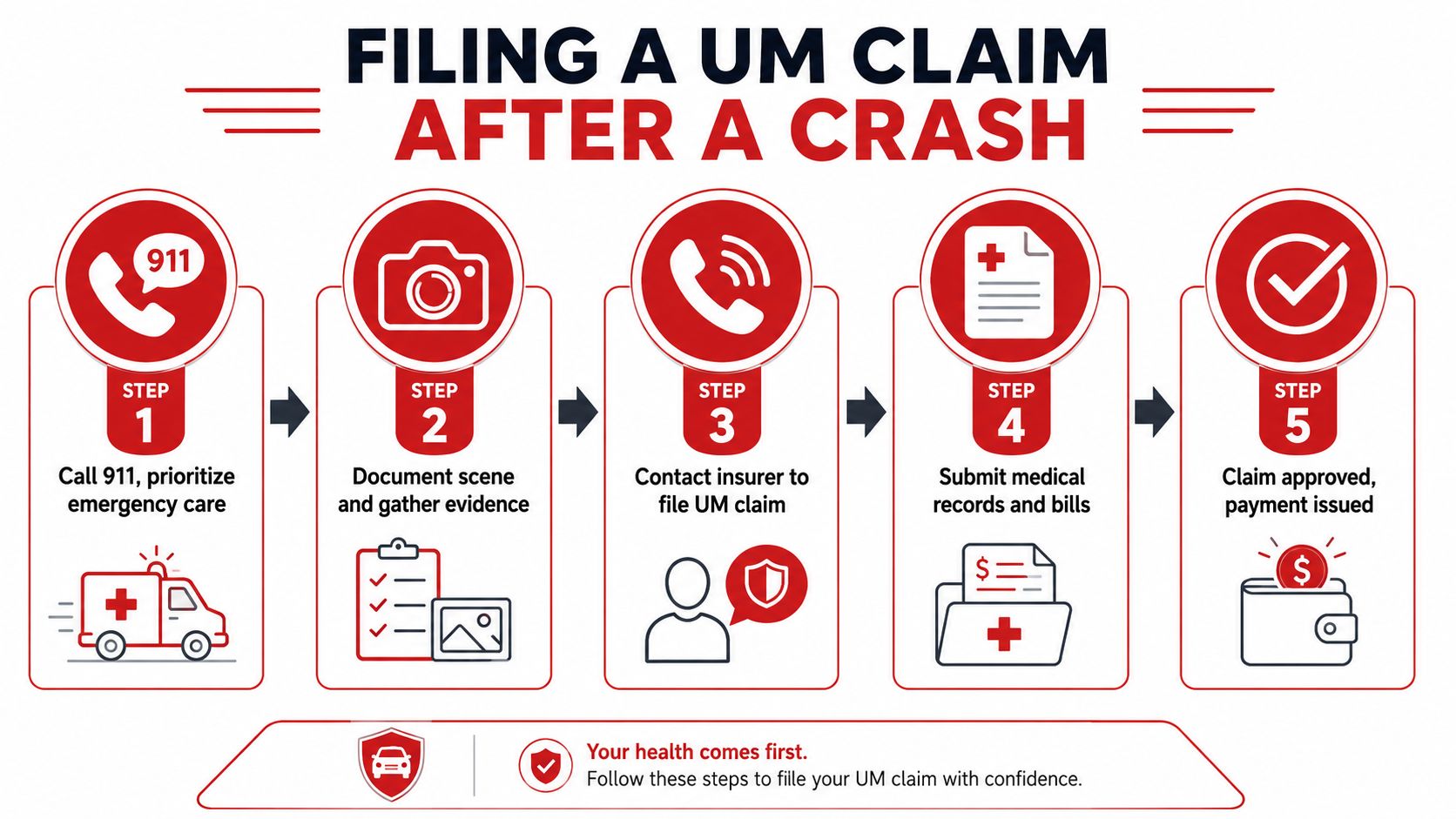
The claim begins with safety, not paperwork. If the teen is injured, call 911, move to safety when possible, and seek medical care without delay. Emergency care takes priority over taking perfect photographs.
After the immediate danger passes, the parent can help create a reliable record. Collect the other vehicle's description, license plate information, driver details if available, witness names, roadway conditions, photographs, and damage information. If the driver fled, report the crash to police when required and obtain the report or case information.
A claim timeline a family can follow
Get medical attention. Keep diagnoses, discharge paperwork, prescriptions, treatment notes, and receipts. Don't minimize symptoms because they seem manageable immediately after the collision.
Notify the insurer promptly. Tell the family insurer about the crash and ask the adjuster to open a UM claim. Request the claim number, policy details, repair process, medical-bill instructions, and any recorded-statement requirements.
Preserve the full impact. Save photographs, police information, witness contacts, vehicle estimates, work records, and a simple diary of pain, missed activities, and treatment effects. Families can use this insurance claim documentation guide to organize the file.
Review any settlement carefully. Don't accept a quick payment before the medical picture is clear. A release may affect later recovery, so don't sign one without understanding what rights it ends.
Get help when the claim becomes difficult. Legal advice may be appropriate when injuries are severe, fault is disputed, multiple people seek payment, or the insurer delays or denies the claim.
The adjuster works for the insurer, even when the claim is filed under the family's own policy. Clear records and calm communication help, but serious injuries may require professional guidance. For additional general claim-handling suggestions, see My Policy Quote claim tips.
The sequence is easier to remember when the family has discussed it before the crash. A parent can save the insurer's claim number instructions in the vehicle, teach the teen how to call 911, and explain that medical care should never be postponed to protect a no-claims discount.
Teen Driver Discounts and Joshua's Law Savings
Insurance discounts can make driver education more affordable, but parents should compare the complete policy price, not just the course fee or one advertised discount. Each insurer sets its own eligibility rules, documentation requirements, and treatment of teen drivers.
Georgia's Joshua's Law connects training with licensing. The Georgia Department of Driver Services explains that a 16- or 17-year-old seeking a Georgia driver's license must complete an approved driver education course. The approved pathways include 30 hours of classroom instruction plus 6 hours of behind-the-wheel training and 40 hours of supervised driving, or 30 hours of online instruction plus the same 6 hours of behind-the-wheel training and 40 hours of supervised driving. The state also allows an alternate parent-taught pathway for the behind-the-wheel portion. These requirements appear in the Georgia DDS Joshua's Law guidance.
Georgia DDS also states that a 16-year-old applying for a Class D license must complete approved driver education and 40 hours of supervised driving, including 6 hours at night, with parent or guardian verification. On July 1, 2021, 17-year-olds were added to the group required to complete driver training before receiving a Class D license, as described by the Georgia Highway Safety Office.
| Program or Discount | Typical Evidence | Potential Value | Check Before Relying on It |
|---|---|---|---|
| Good-student discount | Current school records or insurer form | May reduce the teen's policy cost | Ask about grade standards and renewal proof |
| Driver-training credit | Approved course completion certificate | May support an insurance discount | Confirm the insurer recognizes the specific course |
| Low-mileage or usage-based program | Mileage or driving-program data | May fit a teen who drives infrequently | Review privacy, driving, and participation rules |
| Vehicle-safety features | Vehicle identification and equipment details | May affect eligible vehicle discounts | Ask which features the insurer credits |
| Family-policy placement | Household policy information | May be less expensive than a separate policy | Compare total limits, deductibles, and driver assignment |
Scholarship support can change the starting cost
The Georgia Driver's Education Grant Scholarship Program helps eligible students complete a driver education course that includes 30 hours of classroom training and 6 hours of behind-the-wheel training. Eligibility is limited to Georgia residents actively enrolled in school, ages 15 to 17, who have a valid Georgia instructional permit or driver's license, according to the Georgia scholarship program rules.
The program uses two priority tiers. Priority one includes children or dependents of Georgia first responders disabled or killed in the line of duty, children or dependents of U.S. military members killed in action, and students in state custody. Priority two is based on family income need. Families should verify current eligibility and approved-provider requirements before enrolling.
Keep the course completion certificate and send it to the insurer. The discount is helpful, but UM limits, liability protection, deductibles, and the teen's driving record still deserve equal attention.
Stacked Coverage and Hit-and-Run Scenarios
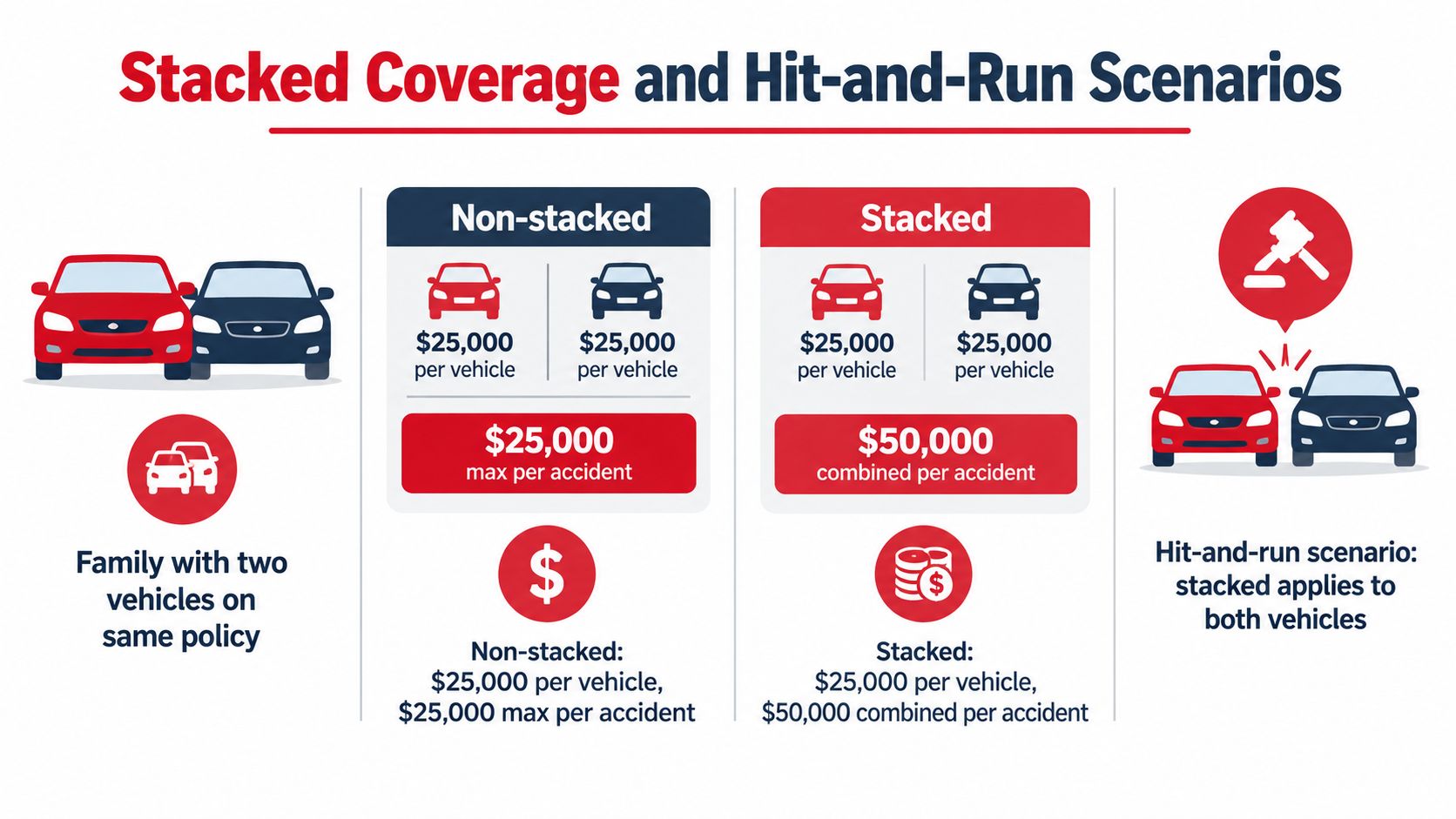
A Georgia family has two vehicles on one policy, a minivan used by a parent and a smaller car driven by a teen. The family selects a $25,000 UM limit per vehicle. With non-stacked coverage, the available amount may remain $25,000 per accident. With stacked coverage, the combined amount in this example may reach $50,000 per accident, subject to the policy and applicable law.
| Election | Vehicle Limits in This Example | Possible Combined Limit | Family Question |
|---|---|---|---|
| Non-stacked | $25,000 on each vehicle | $25,000 per accident | Is one vehicle's limit enough for the household's risk? |
| Stacked | $25,000 on each vehicle | $50,000 per accident | Does the added protection justify the premium? |
The figures above are the specific illustration required to show the mechanics. They aren't a promise that every Georgia policy will calculate a claim identically. Ask the agent how the policy defines stacking, which vehicles count, and whether an election must be made in writing.
Hit-and-run claims need evidence
A hit-and-run driver may leave before the family obtains insurance information. Georgia's hit-and-run duties are addressed in O.C.G.A. § 40-6-270, but whether UM responds depends on the policy's definition and the facts. The parent should report the crash promptly, obtain the police case number, notify the insurer within the policy's reporting window, and provide evidence that helps satisfy the insurer's reasonable-identification requirements.
That evidence may include a license plate fragment, witness account, traffic-camera information, photographs, vehicle debris, or nearby business video. The family shouldn't assume that “the driver got away” ends the claim, but it also shouldn't assume that every unidentified impact automatically qualifies.
Read this practical guide on what to do after a hit-and-run in Georgia for an organized response plan.
Georgia's written-rejection rule deserves careful attention. Rejecting UM entirely, choosing lower limits, or declining stacking may require a signed form from the named insured, depending on the policy structure and election. Before signing, ask: What are the limits per person and per accident? Is property damage included? Is the coverage stacked? What evidence does the insurer require for a hit-and-run? What changes if the teen drives either family vehicle?
Putting It Together for Georgia Families
A teen's first solo drive should represent more than passing a test. It should mean the family has completed the training pathway, practiced real road skills, and reviewed the insurance protection that responds when another driver causes harm.
Start with Joshua's Law. The Georgia pathway includes a 30-hour driver education course, available through classroom or online instruction, plus 6 hours of behind-the-wheel training through an approved school. The teen then completes supervised driving and prepares for the license test at a DDS customer service center. The exact route can differ when a parent-taught option is used, so verify the current DDS requirements before scheduling.
A practical readiness checklist
- Finish approved education: Keep the course completion record and ask the insurer whether it supports a driver-training discount.
- Build supervised experience: Record the required practice driving, including the nighttime experience required for the applicable licensing pathway.
- Prepare for the road test: Practice lane changes, turns, parking, speed control, observation, and calm decision-making.
- Review the policy at the permit stage: Tell the insurer when the teen receives a permit and confirm how the teen is covered while practicing.
- Recheck coverage after licensing: Ask whether UM and UIM limits should match the family's liability limits once the teen drives independently.
- Discuss stacking: Request a written explanation of stacked and non-stacked options before making an election.
- Store proof of insurance: Keep current proof in the vehicle and ensure the teen knows where to find it.
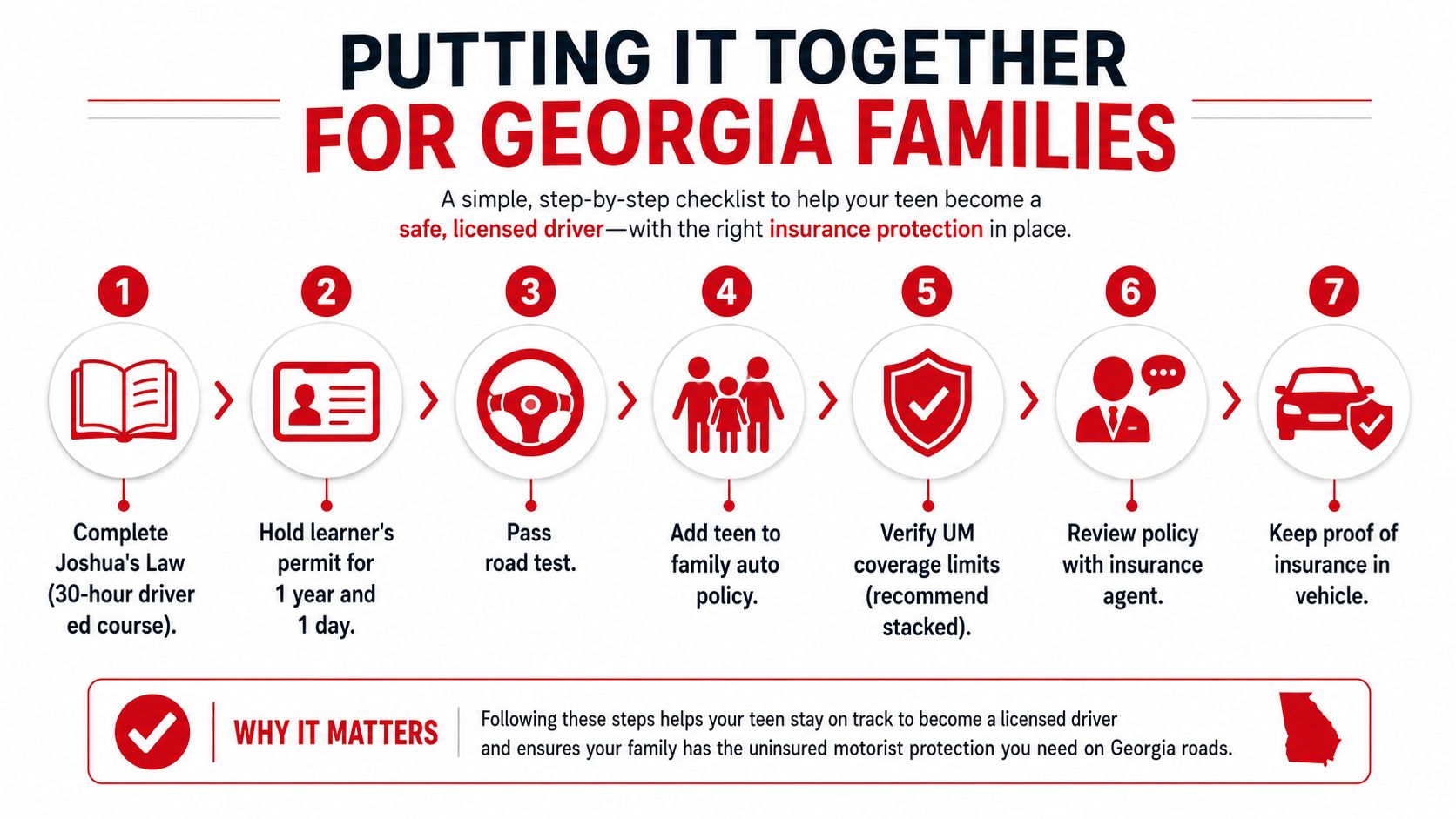
The final policy review should include UM and UIM limits, stacking, medical payments coverage, collision deductibles, liability protection, and teen-specific discounts such as a good-student discount or driver education certificate. Parents should bring the declarations page, ask for the exact cost of higher limits, and request the stacking election form before the teen drives alone.
A 30-minute conversation can prevent a rushed decision at the insurance counter. Gather the declarations pages, schedule the review with the agent, and compare the policy choices before the first solo trip, not after a crash forces the family to learn them.
A-1 Driving School offers Georgia families Joshua's Law classroom and online courses, personalized driving lessons and lesson packages, and road test preparation and testing assistance. Visit A-1 Driving School to connect your teen's education, behind-the-wheel practice, and licensing steps with a confident start on Georgia roads.