You've just passed your friend's driveway on a quiet Georgia street. The road is clear, the driveway looks usable, and turning around feels easier than driving several blocks. Before you move the steering wheel, though, you need to decide whether the space, traffic, sight distance, and curb clearance support a safe two point turnabout.
This low-speed maneuver can be smooth and predictable when you use it deliberately. It also appears as a formal road-skill item in Georgia driver education and testing materials, so learning the decision-making behind it matters as much as memorizing the steering sequence. Georgia's Department of Driver Services describes the maneuver as a way to reverse direction by entering or backing into a driveway, with backing into a driveway on the same side of the roadway identified as the safest method.
What a Two Point Turnabout Is
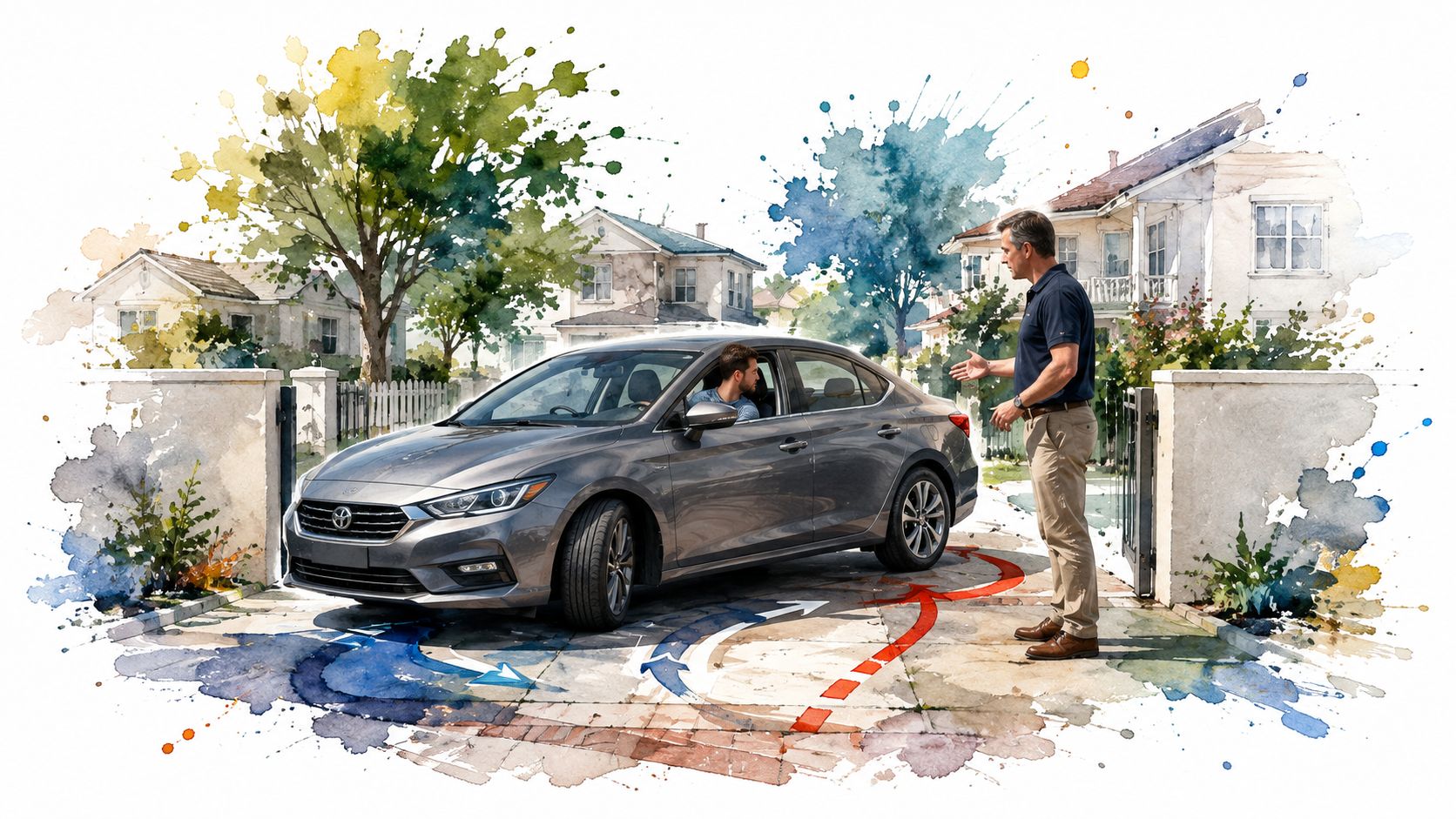
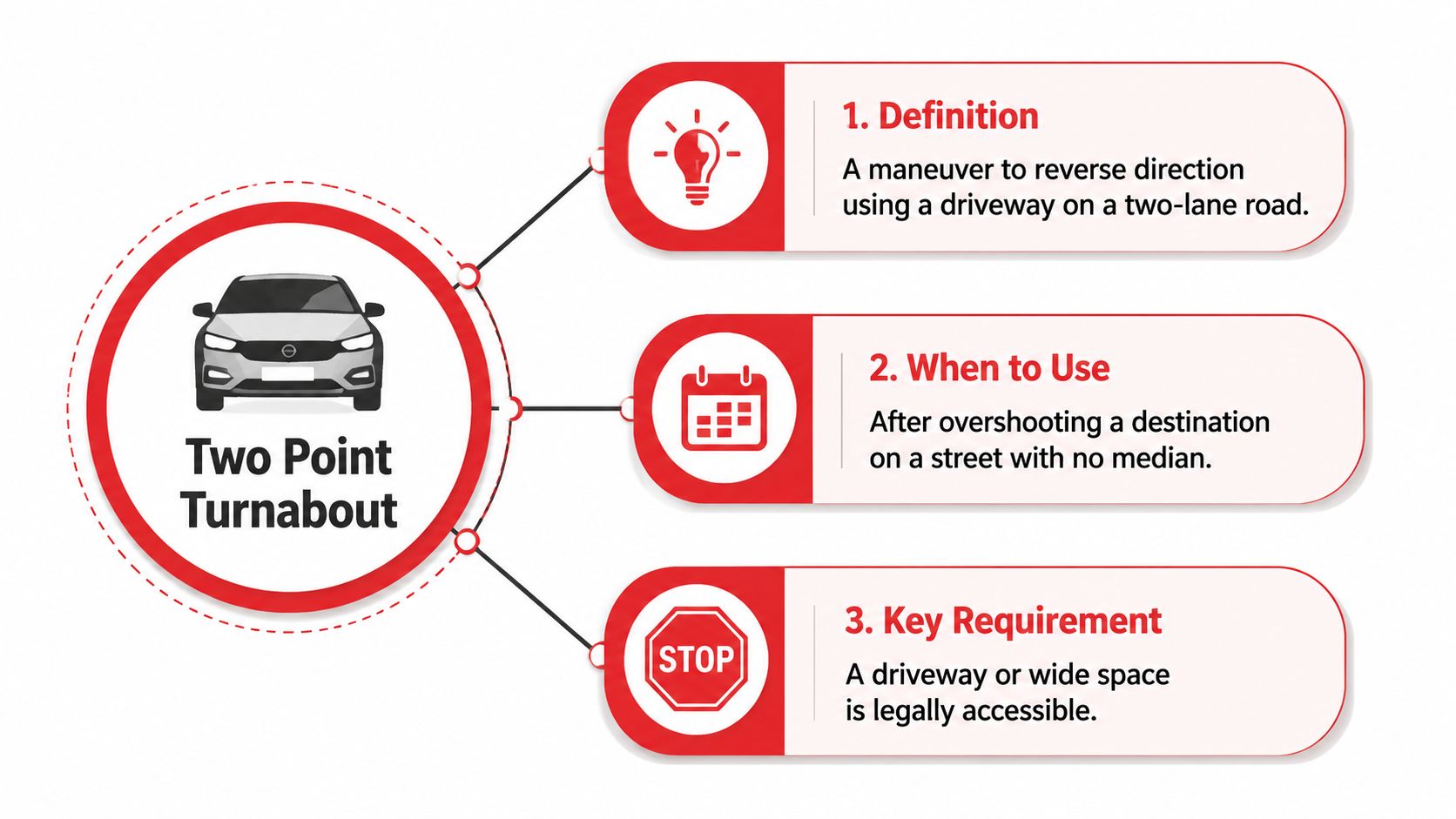
You pull alongside the narrow driveway, signal, and notice that your friend's house is behind you. A two point turnabout gives you a way to change direction with one forward movement and one reverse movement. Typically, the first point uses the roadway and the second uses a driveway, alley, or other wide, legally accessible space.
The usual version involves pulling forward into a driveway, stopping, and then reversing out so the vehicle faces the opposite direction. In another setup, a driver may back into a driveway and then drive forward into the new direction of travel. Georgia licensing materials treat the maneuver as a formal road skill, not an informal local trick. Georgia DDS road-skill materials specifically explain that a driver can reverse direction by entering or backing into a driveway on either side of the roadway.
The name can confuse new drivers because a three point turnabout also changes direction in a confined area. The difference is the space used by the vehicle. During a two point turnabout, a driveway or comparable area provides room for the reverse movement. During a three point turn, the rear of the vehicle swings into the roadway as the driver alternates forward and reverse movements.
The safety decision comes first
A driveway doesn't automatically make the maneuver appropriate. You need to scan both directions, judge how far you can see, check whether the entrance is wide enough, and confirm that the curb or driveway edge won't trap your wheels.
Instructor rule: Choose the space before you choose the steering angle. If the space isn't clearly safe, continue to a better turning location.
Compared with a mid-block U-turn, a driveway can provide a more controlled place to reverse and may reduce the time your vehicle occupies the path of oncoming traffic. That advantage is situational, not universal. On a busy road, near a curve, or where pedestrians and vehicles can appear suddenly, driving around the block may be the wiser decision. For a useful comparison with the mechanics of a three-point turn, review how to make a 3-point turn.
How to Perform a Two Point Turnabout
A calm sequence helps prevent rushed steering and missed observations. Practice the movement at walking speed or a similarly controlled pace, and stop whenever the situation changes.
Set up the approach
First, signal right and slow down. Check the inside mirror, side mirror, and the area beside the vehicle. Position yourself within about a car length of the selected driveway or alley, but don't cut sharply toward it before confirming that the entrance is clear.
Next, stop and reassess. If local practice allows, use the four-way flashers while completing the low-speed maneuver, but don't treat them as a substitute for signaling or observation. Look in both directions again, including for a vehicle following closely or a cyclist approaching near the curb.
Turn the front wheels toward the driveway mouth and ease forward. The front bumper should clear the curb line without driving into private property or scraping the edge. Keep the vehicle moving slowly enough that a gentle brake application will stop it immediately.
Reverse with control
Stop completely before selecting reverse. Look over your left shoulder toward the rear path, check the mirrors, and scan the blind spot before the vehicle moves. The blind-spot checking guidance is useful because mirror coverage alone won't show every area beside and behind the vehicle.
Back in a controlled line while turning the wheel so the rear swings toward the roadway. As the rear clears the driveway edge, begin straightening the wheel. Don't reverse too early. Driving-test instruction warns that early reverse timing can place the rear wheels on a curb or driveway edge, and it emphasizes fast but controlled steering while the vehicle is moving instead of dry-steering. The road-test demonstration also identifies observation, curb contact, and steering at the wrong moment as central failure points.
Keep the car slow, keep checking, and let the vehicle's position tell you when to straighten.
The following video provides a visual reference for the overall movement.
Re-enter the road cleanly
Once the vehicle faces the new direction, shift to drive, signal left, and wait for a safe opening. Re-enter your lane without crossing too far over the centerline, then center the vehicle and cancel the signal. The techniques from Skillz2Drive instructors can offer additional perspective on smooth vehicle handling and observation during low-speed exercises.
Your final position should be parallel to the curb or properly centered in the lane, not diagonally placed across the roadway. If traffic changes while you're reversing, stop where you are, secure the vehicle, and reassess rather than forcing the completion.
When to Use the Maneuver
A two point turnabout isn't automatically safer because it uses a driveway. The correct choice depends on the road environment, not just on whether you can see an opening.
A quiet residential street with usable driveways, low traffic, and clear sight distance may support the maneuver. A cul-de-sac with a broad driveway apron gives you more room to position and straighten. A narrow alley behind shops creates different problems, including pedestrians, delivery vehicles, limited visibility, and uncertain access. A gravel rural shoulder may look wide but have soft edges that can reduce tire stability.
Before committing, ask yourself three questions:
- Is there a safe space to reverse? The driveway should be wide enough and legally accessible, with a firm surface and no obstruction.
- Can I see far enough in both directions? Hills, curves, parked vehicles, vegetation, and buildings can hide approaching traffic.
- Is there a simpler alternative? Driving around the block may take longer but avoid a difficult reverse and roadway exposure.
The maneuver becomes less suitable on busy multilane roads, near schools, around bends, over hills, or during heavy traffic. A following driver may not expect you to stop and reverse, and a long reverse movement can leave you exposed while that driver approaches.
| Factor | Safer Choice | Avoid If |
|---|---|---|
| Traffic | The road is quiet and approaching drivers have time to react | Vehicles are arriving quickly or following closely |
| Sight distance | You can see clearly in both directions | A hill, curve, parked car, or building blocks the view |
| Space | The driveway is wide, firm, and legally accessible | The entrance is narrow, soft, obstructed, or restricted |
| Road setting | A calm residential or rural street supports the movement | Pedestrians, school activity, or multilane traffic dominate |
| Alternatives | No simpler turning location is nearby | Driving around the block offers an easy, low-risk option |
For broader guidance on deciding when a U-turn is appropriate, pass the G1 with this guide offers a useful comparison framework, though local Georgia rules and road conditions must control your decision. The best driver isn't the one who completes every maneuver. It's the one who recognizes when not to start.
Common Mistakes and Corrections
Road-test errors usually come from a breakdown in observation, timing, or positioning rather than from one mysterious steering technique. Georgia training materials describe the two point turnabout as a controlled exercise involving clear lane placement and careful backing, and some documents require the vehicle to remain out of the roadway while the maneuver is completed. Noncommercial driver-training materials reflect that emphasis on precision and control.
| Mistake | Correction | Instructor Cue |
|---|---|---|
| Reversing without a blind-spot check | Stop fully, check over the shoulder, then use mirrors while backing | “Look before reverse.” |
| Turning the wheel too soon | Move forward far enough for the front to clear the curb line before stopping | “Clear, stop, then turn.” |
| Touching or climbing the curb | Reduce speed and straighten earlier as the rear clears the driveway edge | “Watch the rear wheels.” |
| Rushing the steering correction | Keep the vehicle moving slowly while making controlled steering input | “Slow hands, steady car.” |
| Re-entering across the centerline | Wait until the vehicle is aligned, then enter the correct lane | “Face the lane, not the gap.” |
| Ignoring approaching traffic | Stop and let traffic pass before continuing | “Traffic first.” |
One common diagnostic clue is a feeling of uncertainty while reversing. If you can't explain where the rear wheels are going, the vehicle is moving too quickly or your visual checks aren't frequent enough. Stop, reset your position, and repeat the observation before continuing.
Another mistake is stopping at an angle and treating the maneuver as finished. The car may technically face the opposite direction, but angled lane placement leaves less space for passing traffic and makes the next acceleration less predictable. Finish parallel to the curb or centered in the proper lane.
Build corrections into every practice attempt. A verbal cue such as “mirror, shoulder, reverse” is more useful than a vague instruction to “be careful,” because it gives your eyes and hands a repeatable order.
Practice Drills and Instructor Cues
Start in a controlled area where the learner can focus on vehicle movement without making a complicated traffic judgment. Use cones or visible markers to represent a driveway mouth, but don't treat the cones as permission to ignore the world scan that must come later.
Build the movement in stages
Cone-only drill: Practice the signal, approach, curb-line stop, reverse path, and final alignment. The instructor can pause the exercise after each action and ask the learner to identify where the front and rear wheels are positioned.
Controlled street drill: Move to a quiet residential road. Use real driveways only when they are legally accessible and clearly suitable. The instructor gives short prompts such as:
- “Setup.” Slow down and establish the approach.
- “Observation.” Check mirrors, blind spots, and both directions.
- “Reverse.” Select reverse only after a complete stop.
- “Steer.” Turn while the vehicle moves slowly.
- “Straighten.” Align the rear and prepare to face the lane.
- “Re-enter.” Signal and join traffic only when the gap is safe.
Full scenario drill: The learner chooses whether to use the maneuver at all. This is the important transition from mechanical practice to judgment. The instructor should sometimes present a driveway that isn't appropriate so the learner practices declining the turnabout and continuing.
Use a feedback loop
After each repetition, discuss one successful action, one correction, and one cue for the next attempt. For example, “Your observation was complete. You stopped too close to the curb. Next time, clear the curb line before the stop.”
Practice should include curb-line stopping, slow reverse steering, shoulder checks at consistent reference points, and controlled re-entry. Once the learner can repeat the movement smoothly, add realistic distractions such as a following vehicle or reduced sight distance, but stop the drill if the conditions become unsafe.
Drivers who also need to refine other low-speed skills can review reverse parking techniques because the same habits apply, especially slow speed, reference points, mirror use, and deliberate steering corrections. The purpose isn't to create a memorized path. It's to help the driver understand how the vehicle responds and recognize when the available space is changing.
Georgia Road Test and Training Options
Georgia treats turnabout as a formal road-test skill, so a learner should practice it as both a maneuver and a judgment exercise. The Georgia DDS road-test requirements state that applicants need a valid Georgia noncommercial learner's permit, must complete and certify 40 hours of supervised road driving including 6 hours at night, and must pass the driver's license knowledge exam before taking the road test.
The applicant provides the test vehicle. DDS requires a valid registration and license plate. If the vehicle has a temporary dealership tag, the applicant must provide a bill of sale proving purchase within the last 30 days, or within 7 days when the vehicle was bought from a third party. DDS testing information explains these vehicle requirements.
A road-test preparation lesson should therefore include more than the steering sequence. The instructor can watch for complete observations, controlled braking, curb clearance, lane placement, signaling, and a calm decision to abandon the maneuver when conditions don't support it. Targeted driving lessons and lesson packages give learners repeated opportunities to practice those details instead of trying to correct everything during one final appointment.
Joshua's Law and online options
Georgia recognizes multiple Joshua's Law completion paths. DDS lists a 30-hour classroom course plus 6 hours of behind-the-wheel training, along with 40 hours of supervised driving with a parent or guardian. DDS also recognizes a certified virtual option with 30 hours of online instruction, which can help families fit classroom learning into a busy schedule. The Joshua's Law course chart outlines these paths.
The Georgia Driver's Education Grant Scholarship Program is open to Georgia residents ages 15 through 17 who hold a valid Georgia instructional permit or driver's license. The scholarship covers 30 hours of classroom instruction plus 6 hours of behind-the-wheel driving instruction with an approved instructor, satisfying Joshua's Law requirements for eligible participants. The Georgia Driver's Education Grant Scholarship Program provides the eligibility and program details.
A-1 Driving School offers instructor-led and online driver education, customized teen and adult driving lessons, lesson packages, Georgia road-test preparation, and testing assistance. Families can use those services to connect classroom requirements with deliberate practice of turnabouts, backing, lane placement, and other road-test skills.
Safe Practice and Next Steps
A good two point turnabout begins before the signal. You need a legal, usable space, a clear view, enough time for other road users to respond, and a plan for stopping if the situation changes. If any part of that picture is uncertain, continue forward and choose a safer location.
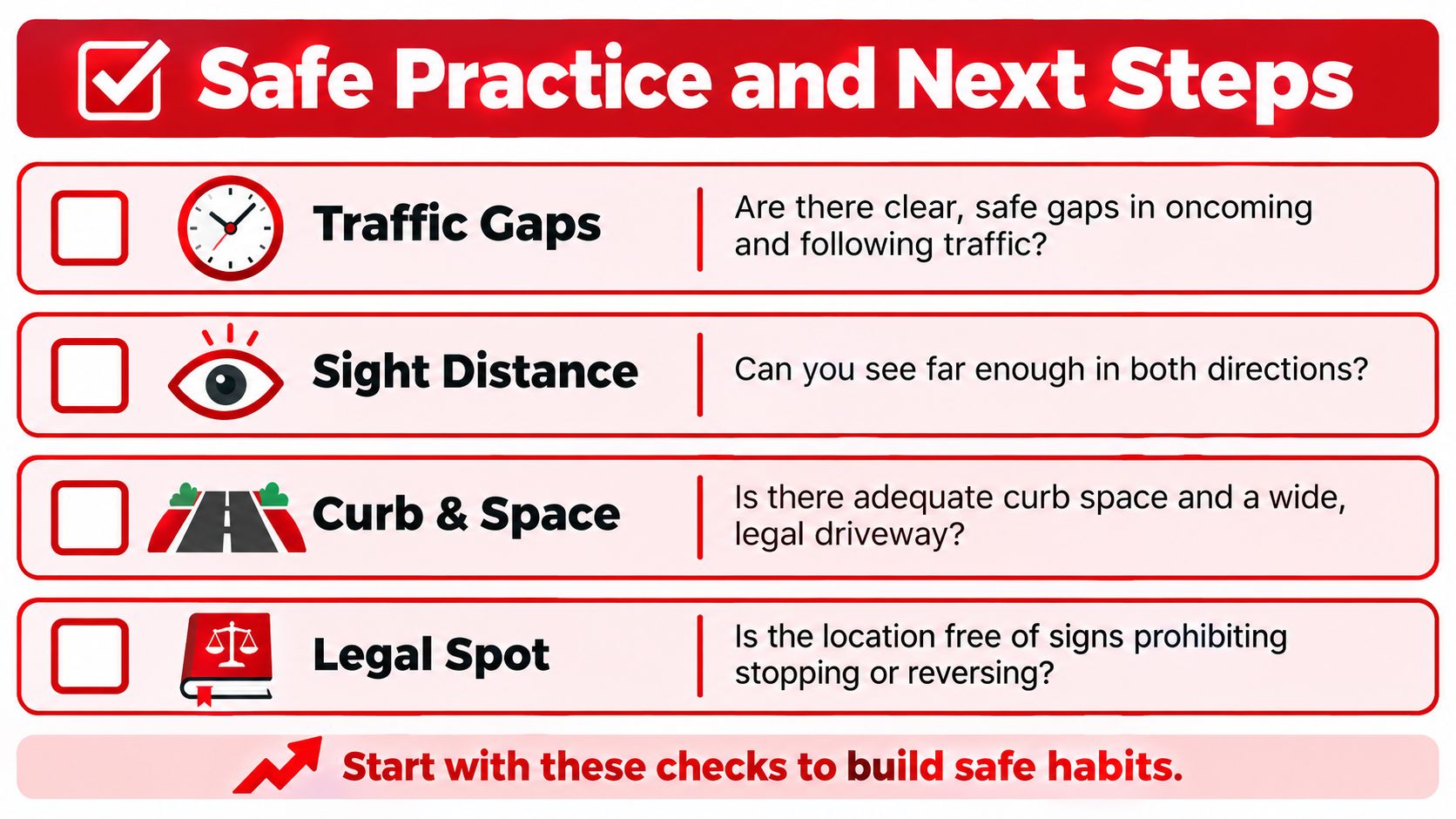
Use this checklist before committing:
- Traffic gaps: Are there clear, safe gaps in oncoming and following traffic?
- Sight distance: Can you see far enough in both directions?
- Curb and space: Is there adequate curb clearance and a wide, legal driveway?
- Legal spot: Are there signs or conditions that prohibit stopping, entering, or reversing?
Walk the path when you're learning in a private practice area, and ask an instructor to point out the curb line, rear-wheel path, and final lane position. On public roads, don't stop in an unfamiliar location to force practice. Use a quiet cul-de-sac or suitable residential setting, log repetitions, and gradually add independent decision-making.
If conditions change after you begin, stopping safely is a successful correction, not a failed maneuver.
The most practical next step is to book a behind-the-wheel lesson or road-test package that includes low-speed maneuver practice. Ask for repeated turnabout attempts, observation feedback, and a mock Georgia road-test evaluation so you can identify whether your main issue is setup, reversing, steering timing, or re-entry. Supervised repetition builds a dependable habit far more effectively than risky solo attempts on unfamiliar streets.
Book driving lessons or a road-test preparation package with A-1 Driving School to practice the two point turnabout, backing control, lane placement, and complete observation with an instructor. You can also ask about Joshua's Law classroom options, online course availability, and the Georgia Driver's Education Grant Scholarship Program to choose a training path that fits your schedule and eligibility.