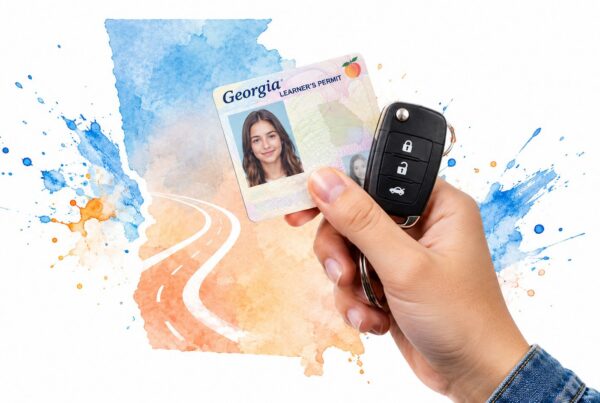

A Georgia parent can discover the actual cost of driver training in one conversation with a teenager: the Joshua's Law classroom course, six hours of professional driving instruction, license costs, and the time required to practice at home. If that total doesn't fit the family budget, the teen may postpone training, delay licensing, or rely on an incomplete path that creates problems later.
Learning how to get grants and scholarships for driving school starts with separating the cost into manageable parts, finding programs that match the student's situation, and submitting every required document before the deadline. Georgia families may find support through state-administered programs, private scholarships, driving schools, nonprofits, and community partners. The process rewards preparation more than last-minute searching.
Why Driving School Grants Matter for Georgia Families
Driver training is an education expense, but families often treat it as an optional purchase until a teenager needs transportation for school, work, sports, or family responsibilities. A parent may be able to supervise practice driving but still struggle to cover certified classroom instruction, behind-the-wheel lessons, and testing-related expenses at the same time.
Georgia's Driver's Education Grant Scholarship Program can reduce that barrier for eligible students. The program covers the training pathway connected to Joshua's Law, including a 30-hour classroom component and six hours of behind-the-wheel training when the student meets the applicable requirements and uses an approved provider. The Georgia administrative rule for the Driver's Education Grant Scholarship Program identifies the program's age, residency, enrollment, permit, and training requirements.
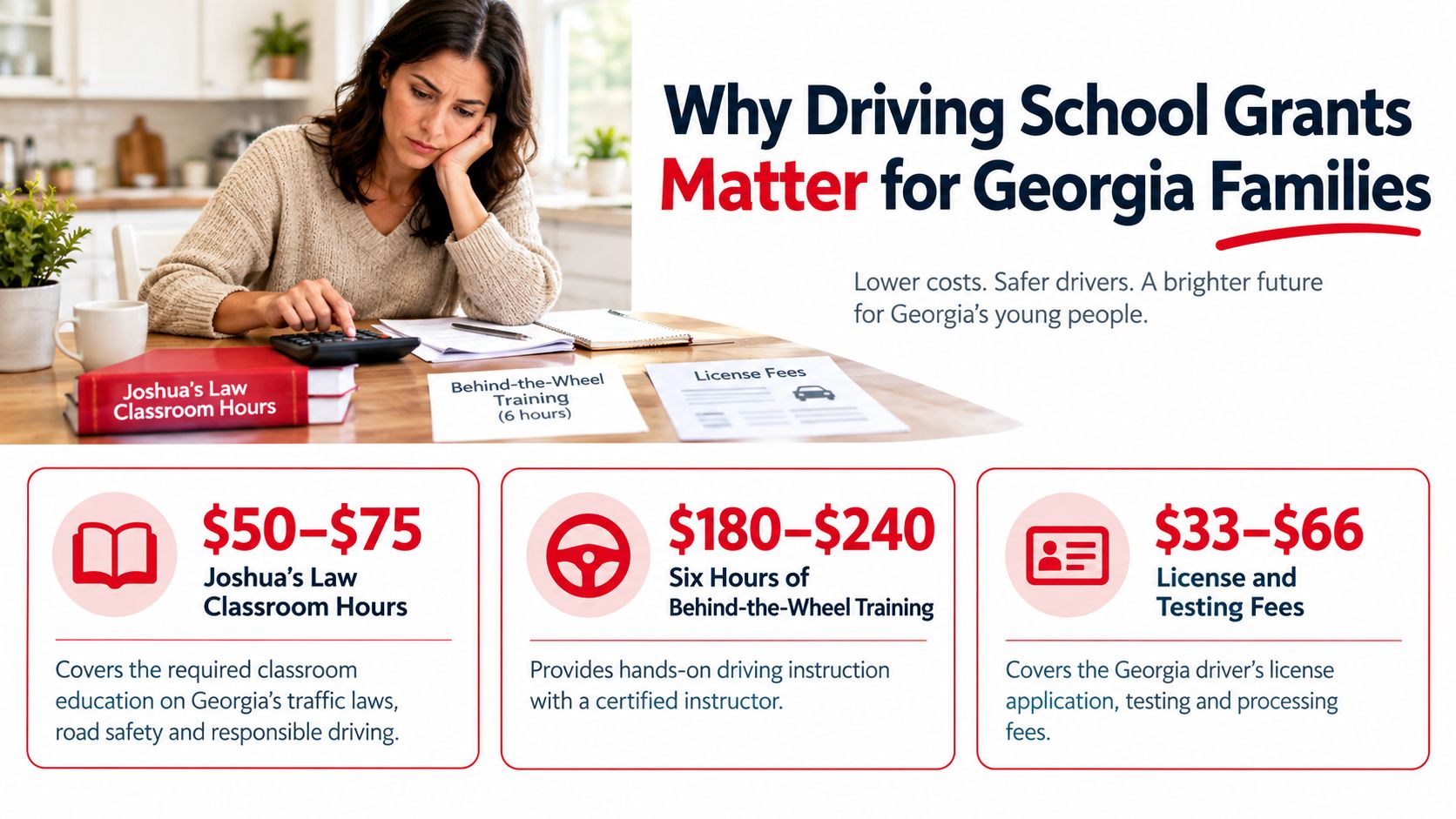
The financial question also has a practical side. Skipping certified instruction can delay a teen's license, complicate the family's insurance planning, and limit access to the training documentation needed for Georgia's licensing pathway. A grant won't solve every cost, because families still need to plan for licensing and testing expenses, but it can remove the largest training obstacle.
Start with the funding search
Use a simple three-part process:
- Identify the required training. Confirm whether the student needs the full Joshua's Law classroom and behind-the-wheel pathway, an individual driving lesson package, or road test preparation.
- Match the student to programs. Check state eligibility first, then search local scholarships offered by civic groups, nonprofits, schools, employers, and community partners.
- Build a complete application file. Keep identification, school records, permit information, signatures, and any required financial documents together before applying.
Families searching beyond the state program can use a focused directory such as Grantlas Georgia funders to find organizations that may support education and youth-related expenses. Read each award's rules carefully. A scholarship that helps with general education may not pay a certified driving school directly.
Practical rule: Treat driver-training funding as a process, not a single application. Start early, apply where the student fits, and track every deadline and document requirement.
What Grants and Scholarships Cover for Driver Training
A grant is generally connected to financial need and usually doesn't require repayment when the recipient follows the program rules. A scholarship may also consider need, but it can be based on academic performance, community service, background, participation in a program, or another stated criterion. Both can reduce the amount a family pays out of pocket, but the award terms control how the money may be used.
For Georgia teens, the most important question is whether the award pays for the exact training components required under Joshua's Law. The classroom portion, behind-the-wheel instruction, and any observation requirement may be treated differently by different funders. Some awards are sent directly to an approved driving school. Others may reimburse a family after the student completes the approved training, which means the parent may need to cover the cost temporarily.
| Funding Source | Award Type | What It Typically Covers |
|---|---|---|
| Georgia state-administered program | Driver education grant scholarship | Approved Joshua's Law classroom instruction and behind-the-wheel training, subject to program rules |
| Local driving school or community partner | Private scholarship | A defined course, lesson package, or portion of training named in the award |
| Nonprofit or civic organization | Need-based or participation scholarship | Eligible driver education expenses, often with provider and documentation restrictions |
| Employer or family-support program | Private education award | Approved training costs according to the sponsor's terms |
The provider matters as much as the award. Georgia's rules define the covered training as 30 hours of classroom instruction plus six hours of behind-the-wheel training, and the Governor's Office of Highway Safety describes the scholarship as support for completing that pathway with an approved instructor. A private lesson taken outside the approved program may not satisfy the voucher conditions, even if the lesson is useful.
Track the money before booking
Create a record with the award name, sponsor, approval date, expiration date, covered services, payment method, and required proof of completion. A dedicated scholarship fund tracking resource can help families keep those details separate from ordinary household expenses.
Ask the funder or school these questions before scheduling:
- Does the award pay the provider directly?
- Does it cover classroom instruction, behind-the-wheel lessons, or both?
- Can the student use online instruction?
- Must the student complete training by a specific date?
- What happens if the student misses a scheduled lesson?
- Is unused funding transferable or forfeited?
Clear answers prevent the most common mistake, which is assuming that every scholarship covers every driving-related expense.
Georgia's Driver's Education Grant Scholarship Program Explained
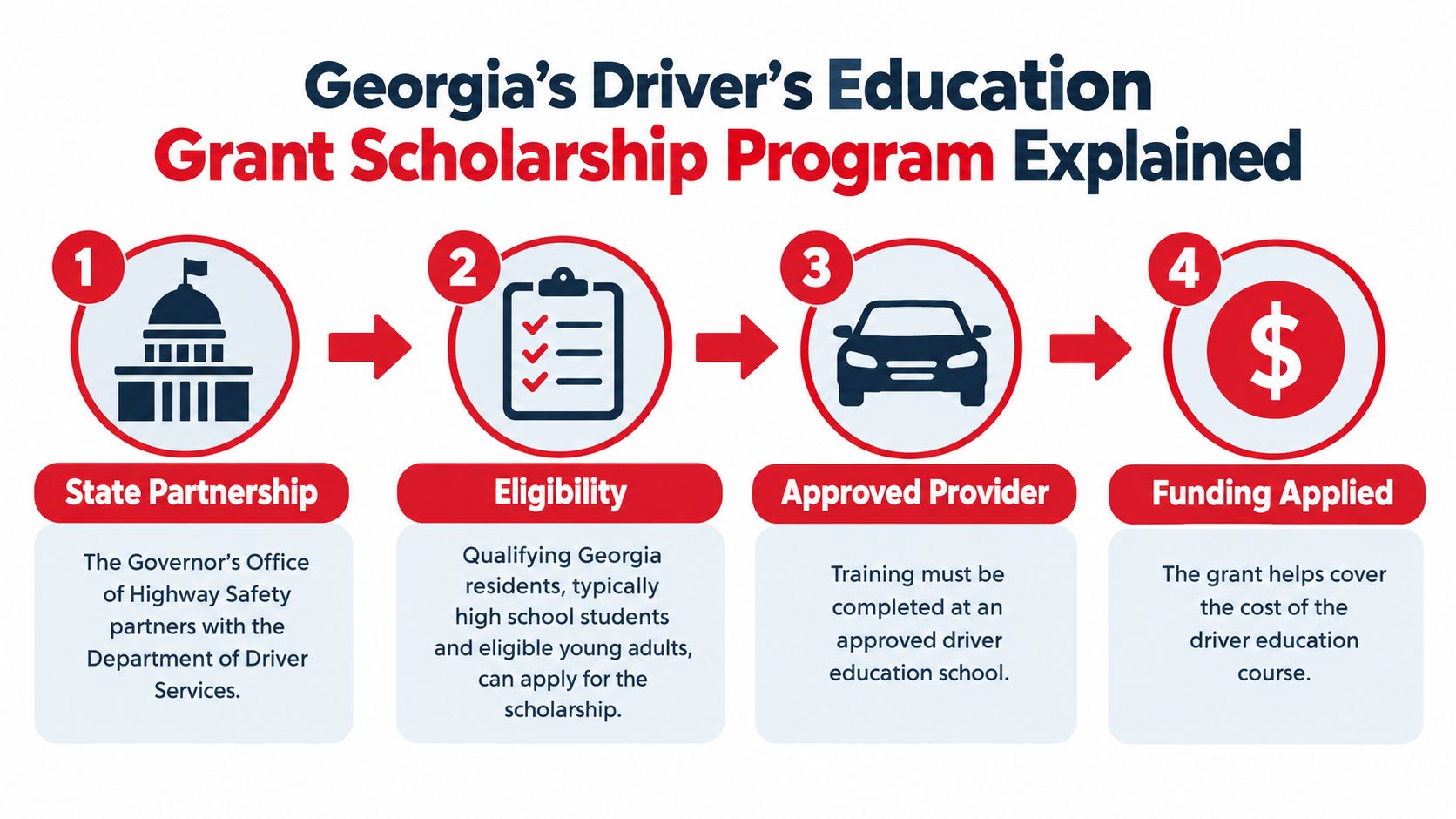
Georgia's program connects public safety funding with a practical education requirement. The Georgia Governor's Office of Highway Safety identifies the scholarship as a way for students to complete Joshua's Law training, while the state rules define the eligibility and training conditions. Families should verify the current application process because program administration and available allocations may change.
The basic path is straightforward:
- Check the student's eligibility. The administrative rule identifies Georgia residency, active school enrollment, an age range of 15 to 17, and possession of a valid Georgia instructional permit or driver's license as program conditions.
- Submit the required application. The parent or guardian should follow the current state process and provide the requested student, school, identification, and eligibility information.
- Wait for a funding decision. The program uses priorities when available funds are limited, so submitting a complete application matters.
- Use the award with an approved provider. The covered training consists of a 30-hour classroom component and six hours of behind-the-wheel training.
Understand the priority order
The program isn't a first-come system. A Georgia technical college page describing the scholarship rules lists first priority for a child or dependent of a public safety professional or a U.S. military member killed in the line of duty. Second priority goes to eligible applicants who can demonstrate financial need based on family income. Other eligible applicants fall into the third priority group.
The same source says allocations are distributed evenly among Georgia's congressional districts. A legislative brief reports that the program began in 2017, expired briefly in 2022, and was revived in 2023 with a 3% surcharge on traffic violations supporting the scholarship fund. Those details explain why families should check the current application window rather than rely on an old school handout or social media post.
A provider can also help prevent a mismatch between the award and the training. Families can review the Georgia Driver's Education Grant Scholarship Program information from A-1 Driving School before registering, then confirm that the selected course and lesson schedule meet the award terms.
Eligibility Rules and Documents You Need to Apply
A complete application begins with eligibility, not the essay or registration page. Georgia's program rules identify students who are Georgia residents, actively enrolled in school, 15 through 17 years old, and holders of a valid Georgia instructional permit or driver's license. The program is designed for students enrolled in school, and families should confirm whether the current process accepts the student's public, private, or home study enrollment documentation.
The parent or guardian generally needs to manage the application for a minor. That adult should use an email address checked regularly, because an incorrect address can delay approval notices, requests for clarification, or award information.
Build one application folder
Keep paper and digital copies in a single folder. Families commonly need:
- Student identification: A valid Georgia instructional permit, driver's license, or state identification document, depending on the application requirements.
- Social Security information: Enter the student's Social Security number exactly as requested and avoid photographing or sending it through unsecured channels.
- School enrollment proof: Request a current enrollment letter, school record, or other accepted proof from the school office. Home study applicants should prepare the documentation required for their program.
- Parent or guardian identification: Keep the adult applicant's identification available, especially when the portal asks for guardian verification.
- Income documentation: Gather income verification if the application uses family income to determine need or priority.
- Guardianship records: If the adult submitting the application isn't the student's parent, prepare documentation showing legal authority to apply.
Photograph the permit as soon as it's issued, but check that the image is readable and includes the full document. Ask the school office for enrollment proof before summer staff schedules become limited. Name files clearly, such as StudentName_Permit or StudentName_Enrollment, so the wrong attachment doesn't get uploaded.
Avoid preventable rejection
Missing signatures, expired permits, inconsistent names, unreadable scans, and applications submitted outside the open window can stop an otherwise eligible student. Before submitting, compare every field with the permit and school record. Save the confirmation page and any application number.
The scholarship eligibility requirements can serve as a preparation checklist, but families should still rely on the current state application instructions for final requirements. Eligibility doesn't guarantee an award, particularly when funds are limited.
Training Paths That Pair With a Scholarship Award
Once a student receives funding, the family still has a scheduling decision. Georgia allows the 30-hour classroom portion to be completed online, and the Georgia Department of Driver Services distinguishes online coursework from classroom-based options. The teen also needs to plan the required behind-the-wheel instruction and the supervised driving that forms part of the broader licensing process.
The right format depends on the student's learning habits and the family calendar. Online theory can work well for a teen who can study independently. In-person instruction may suit a student who learns through conversation and needs a fixed routine. A blended plan combines structured theory with scheduled professional driving lessons.
| Training Path | Format | Scheduling Flexibility | Scholarship Fit |
|---|---|---|---|
| Online driver education | Approved online classroom coursework | High flexibility for theory; driving lessons still require appointments | Suitable when the award permits online classroom completion and approved behind-the-wheel training |
| In-person classroom | Scheduled classroom sessions at a local school | Lower theory flexibility, but a predictable calendar | Suitable when the award requires or permits classroom-based instruction |
| Blended driving lesson package | Online or virtual theory paired with professional driving appointments | Flexible theory with fixed driving slots | Suitable when the provider confirms that both components match the award |
Match the plan to the household
A parent-taught practice schedule can add valuable road experience, but it doesn't automatically replace the required professional instruction. Families should reserve driving appointments after confirming the award's authorization, especially during summer and school breaks.
Splitting lessons across weekends may be easier than trying to complete every appointment in one week. A student with sports or a summer job may prefer online coursework and shorter, scheduled driving sessions. A student who needs more repetition may benefit from a larger driving lesson package, even when the scholarship pays only for the defined award components.
Families comparing local options can review free driving lessons in Atlanta and then ask how the offer relates to the grant, Joshua's Law requirements, and the student's preferred training schedule. Don't assume that a promotional lesson, a private practice session, and a scholarship-funded lesson have the same status.
Application Tips, Timelines, and Road Test Planning
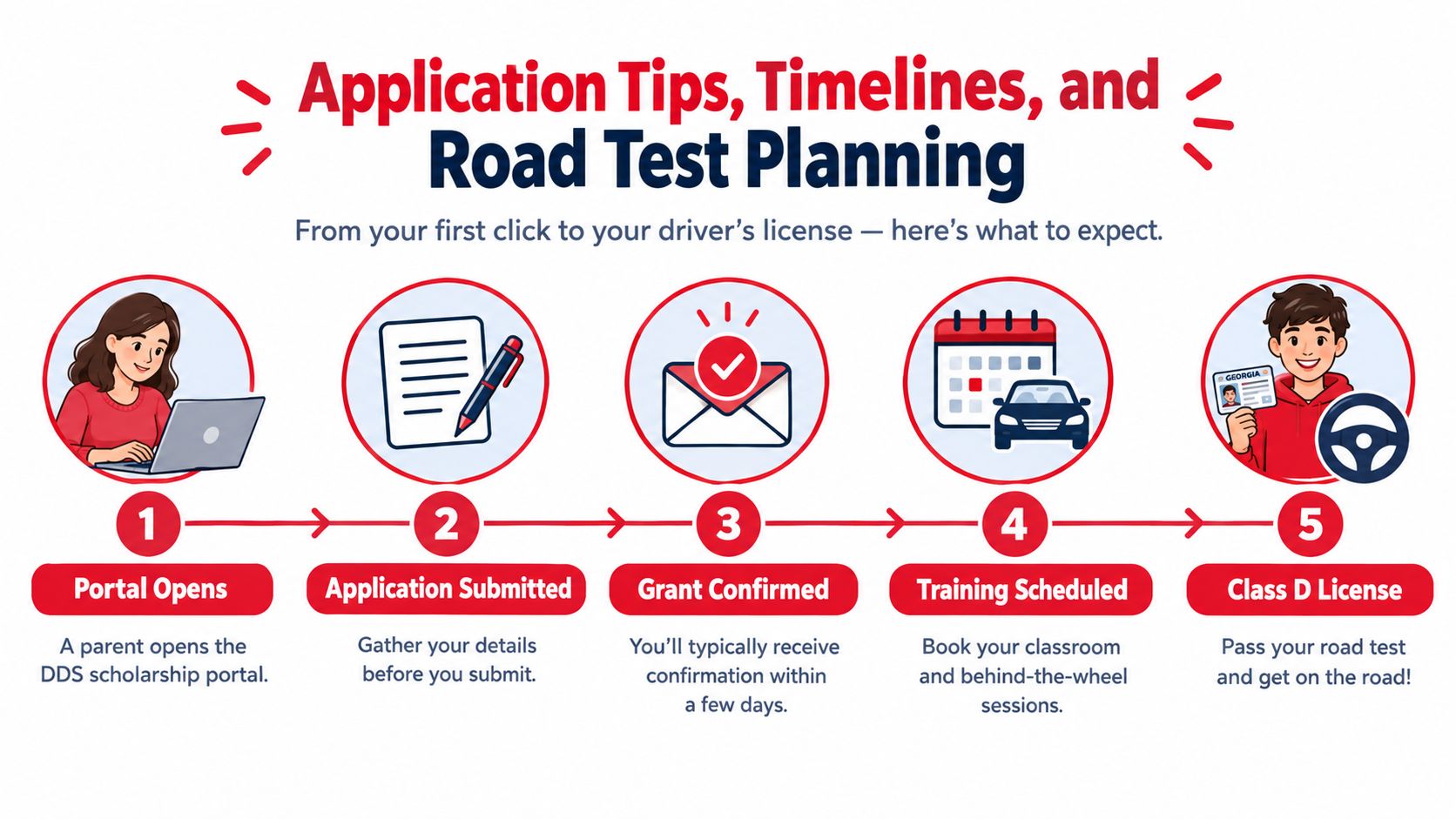
A Georgia family can lose weeks by waiting until summer to prepare. Maya's parent starts in spring by checking the student's permit, requesting proof of school enrollment, scanning identification, and creating a folder for income or guardianship records if the application requires them.
When the application portal opens, the parent submits promptly and saves the confirmation email. A review may take four to six weeks according to the Georgia Driver's Education Grant Scholarship Program guidance, so the family waits for the award decision before booking training that cannot be refunded.
Use a calendar that follows the student
Build the schedule around school, work, and the award decision:
- Spring: Confirm age, Georgia residency, school enrollment, permit status, and the current program instructions.
- Early summer: Gather the required records and submit as soon as the application window opens.
- Review period: Watch email and the portal for questions or missing information.
- After approval: Save the award letter or voucher details, print a copy, and provide them to the approved driving school.
- Before school resumes: Complete classroom work if the family wants the theory requirement finished before the academic year.
- Fall: Schedule behind-the-wheel appointments around classes, employment, and supervised practice.
- Road test planning: Confirm the applicable permit class and DDS waiting-period rule before booking the skills test.
The Georgia DDS road-test page states that a teen skills-test applicant must hold the applicable Georgia instructional permit, identified as AP or BP, for at least 14 days before testing. Confirm the permit class and current requirements directly with DDS, because the wrong permit information can disrupt an otherwise ready student's test appointment. Schedule lessons with that waiting period in mind.
Protect the award and the appointment
Check the parent's email address before submitting. Save the award letter digitally, keep a printed copy for the driving school, and contact the program administrator if the voucher is lost. Starting a second application can create avoidable confusion.
If the application is denied, read the decision carefully. Correct missing documentation and ask the administering office about its appeal or reissue process.
Set aside money for the license fee, road test costs, and possible retakes. The scholarship pays for approved training, not every cost associated with earning a license.
Next Steps With A-1 Driving School
The roadmap is simple once the family separates eligibility, funding, training, and testing. Confirm that the student fits the Georgia program rules, prepare the documents, apply through the current process, and wait for approval before treating the award as available money.
Joshua's Law training has two central pieces, 30 hours of classroom education and six hours of behind-the-wheel instruction. Georgia permits online classroom coursework, while families may also choose in-person instruction or a blended schedule. The selected provider must be approved for the training connected to the award.
A-1 Driving School offers state-approved classroom options, online and virtual learning formats, professional driving lessons, road test preparation, and scheduling support. Families should confirm scholarship compatibility, covered services, and available dates directly with the school before enrollment.
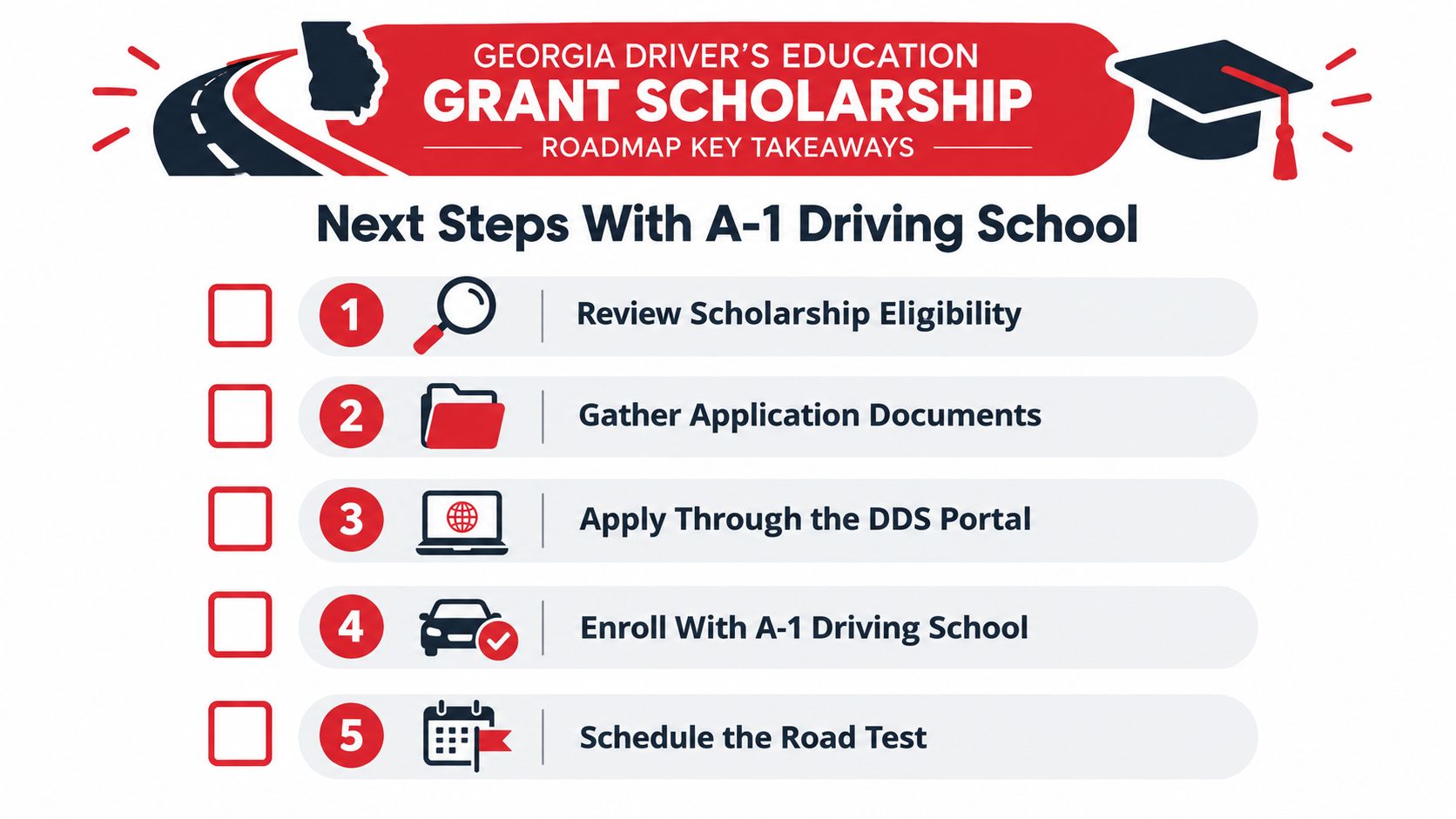
Use this week's checklist:
- Review eligibility: Confirm age, enrollment, residency, permit, and current application status.
- Gather documents: Create one folder for identification, school records, signatures, and any required income information.
- Submit or monitor the application: Save the confirmation number and check the parent or guardian email.
- Choose training dates: Match the approved course and driving lesson package to the award terms and family calendar.
- Plan the road test: Account for the DDS permit waiting period, lesson availability, and separate testing expenses.
Visit A-1 Driving School to discuss Joshua's Law courses, scholarship-compatible driver training, professional driving lessons, and road test preparation. Contact the school this week to confirm eligibility, organize enrollment, and reserve classroom and driving lesson dates before summer or school-break schedules fill up.