

Most families who search for free driving lessons in Atlanta start in the same place. A parent sees the cost of a full driver education package, a teen needs Joshua's Law completed, and everybody assumes they'll have to piece together classes, driving time, and road test prep on their own.
In practice, the clearest path is usually not chasing random discounts. It's using Georgia's state scholarship program correctly, then moving quickly from approval to an actual lesson slot with an authorized provider. That's where many families get stuck. They hear “free,” but they don't realize the main challenge is paperwork first, then scheduling.
I've seen the same pattern again and again in Atlanta. The families who do best are not the ones who search the longest. They're the ones who understand the process, gather documents early, and redeem the scholarship as soon as they're approved.
The High Cost of Driving and Atlanta's Best Kept Secret
Atlanta families feel the pressure fast. A teen needs to drive for school, work, sports, or family logistics. The parent wants professional instruction, not just parking lot practice. Then the search begins, and “free driving lessons in Atlanta” sounds too good to be real.
Sometimes the confusion gets worse because families are already juggling insurance questions, schedule changes, and paperwork from multiple places. If your household is also sorting through policy calls or claim-related questions, dependable phone support for insurance can help keep those conversations organized while you focus on getting your teen through driver education.
What families usually get wrong
The biggest mistake is assuming “free lessons” means a school is waiving fees. That's usually not what's happening. In Georgia, the strongest path to no-cost instruction for many teens is a state-backed scholarship tied to Joshua's Law training.
That matters because the process is structured. It isn't informal, and it isn't a one-off promotion.
Free driving lessons in Atlanta usually mean funded lessons through a state process, not a casual discount from a school.
What actually works
Families make faster progress when they stop searching for the cheapest ad and start asking better questions:
- Is the teen in the eligible age range? That determines whether the scholarship is even on the table.
- Does the student already have the right permit status? That affects application timing.
- Is the provider approved and practical to reach? A funded course still has to become a real seat in a class and a real in-car appointment.
The secret isn't hidden because Georgia lacks a program. It's hidden because the program is often misunderstood. Once you know that, the path gets a lot more direct.
Understanding Georgia's Driver Education Scholarship Program
A parent usually calls us after hitting the same wall three times. The teen needs Joshua's Law training. The price is higher than expected. Every website seems to explain one piece of the process, but not how those pieces fit together.
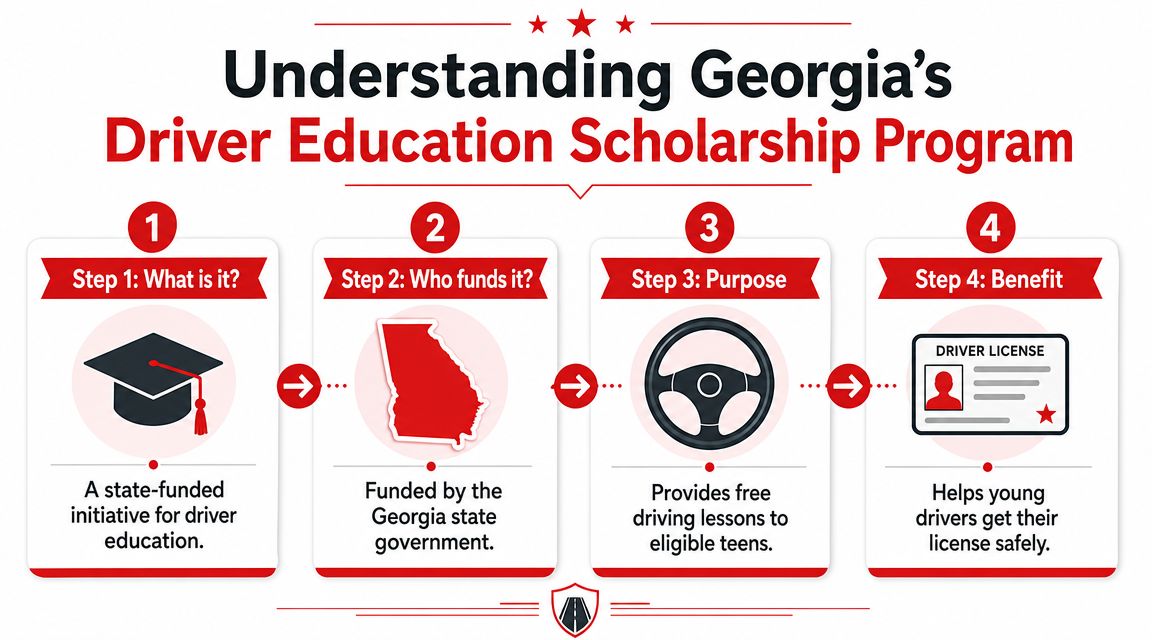
Georgia does have a state-supported answer. The Georgia Driver's Education Grant Scholarship can cover the cost of an approved Joshua's Law course for eligible teens. According to the Georgia Driver's Education Grant Scholarship details, the program is available to qualifying Georgia teens ages 15 through 17 who hold a valid Georgia instructional permit or driver's license, and it applies to the required course package that includes classroom instruction and behind-the-wheel training.
What “free” really means
From a school administrator's side, “free lessons” usually means state-funded enrollment, not a school creating a special discount. That distinction matters because families often expect a coupon-style transaction, then get frustrated when they find out the student still has to qualify, apply, and redeem the award through an authorized provider.
The scholarship covers the standard driver education package tied to Joshua's Law. The structure matters. A teen is not just getting a few isolated drives. The funding is tied to a program with classroom hours and professional in-car instruction that must be delivered through approved channels.
How the program works in real life
The state supplies the funding framework. The provider turns that approval into an actual class seat and actual driving appointments. That is where families either gain traction or lose time.
Here is the practical breakdown:
| Part of the program | What it means for your family |
|---|---|
| State scholarship approval | The student can have tuition covered for the qualifying course |
| Joshua's Law course package | Training follows Georgia's required format, not a pieced-together set of lessons |
| Authorized school participation | The family can book the course and driving sessions through a provider approved to honor the scholarship |
At A-1, we see the same avoidable problems every season. Families assume approval automatically books the student. It does not. Others wait too long to contact a participating school and run into scheduling delays. A few start with the wrong documents and have to correct the file before training can begin.
That is why the provider perspective matters. A scholarship approval is only the halfway point. The full process, including how approved students use the award with a participating school, is outlined on A-1's Georgia Driver's Education Grant Scholarship Program page.
Practical rule: Ask two questions early. Is the teen eligible, and is the family ready to redeem the scholarship with an authorized provider as soon as approval comes through?
Confirming Your Eligibility and Preparing Documents
The scholarship process gets easier when families handle eligibility before they ever open the application. That cuts down on abandoned applications and last-minute scrambling.
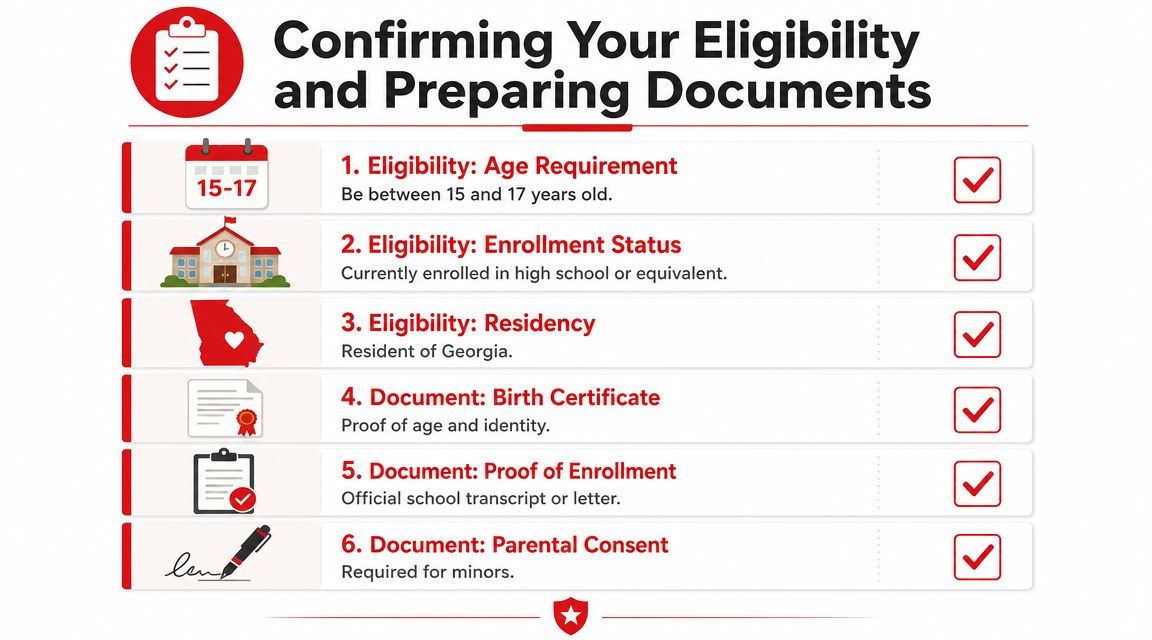
The state framework matters here because Georgia ties early licensing to formal training. For a teen to get a Class D license before age 17, the DDS requires a program with 30 hours of classroom or online instruction, 6 hours of professional on-road instruction, and 40 hours of supervised driving including 6 hours at night, as listed in the Georgia DDS driver manual.
Start with the simple checks
Before you spend time on forms, confirm the basics:
- Age fits the scholarship window. The program is for teens in the qualifying range set by Georgia.
- Georgia residency is clear. The student must qualify as a Georgia resident.
- Permit status is active. The teen should already have the valid instructional permit or other qualifying status called for by the scholarship rules.
If a family is unsure whether their identification and residency documents line up correctly, this guide to Georgia ID requirements is a useful starting point.
What to gather before applying
Families do better when they treat this like a file-prep task, not a casual online form. Have the core information ready in one place.
- Student identification details. Full legal name, date of birth, and permit information.
- Residency support. Whatever documents the family uses to establish Georgia residency.
- Parent or guardian information. Keep contact details consistent across all forms.
- Scheduling reality check. Know which days the student can attend class or drive.
The application itself is rarely the hardest part. Missing documents and mismatched information create more delays than the form does.
One more practical point. Scholarship approval helps with the funded course, but it doesn't replace the student's own supervised practice. Families still need a plan for regular driving outside formal lessons.
Your Step-by-Step Guide to Applying for the Grant
Once the student is eligible and the documents are ready, the process becomes straightforward. The key is to stay with the official scholarship path and avoid random third-party pages that make the process look more complicated than it is.

How families move through it smoothly
Use this order:
- Confirm eligibility first. Don't start the application as a guess.
- Use the official state scholarship pathway. That keeps your information in the right system.
- Enter student details carefully. Most slowdowns come from basic entry mistakes.
- Watch for the award notification and redemption code. That code is what moves the student from approval to enrollment.
- Redeem quickly with an approved provider. Waiting too long can make scheduling harder.
The bottleneck most people don't expect
Families often think approval is the finish line. It isn't. The operational challenge starts right after that.
According to the scholarship redemption explanation at West Metro Driving School's program overview, a student receives a redemption code and must then enroll with a certified school on the state list, which means provider location and scheduling matter just as much as approval.
That's the part that catches Atlanta families off guard. A scholarship doesn't automatically put your teen into the nearest class or the next available in-car session.
What helps after approval
A short checklist keeps things moving:
- Call or enroll as soon as the code arrives.
- Ask about the next class format available. In-person and online options may differ.
- Check in-car lesson availability immediately.
- Pick a location your family can realistically reach without constant rescheduling.
Approval gets you through the gate. Fast redemption is what gets your teen into the car.
Redeeming Your Scholarship with A-1 Driving School
A parent gets the approval email on Tuesday, assumes the hard part is over, then waits two weeks to act. By the time they start calling schools, the class they wanted is full and the after-school drive slots are gone. I see that pattern every season. Scholarship approval helps with cost, but fast, accurate redemption is what gets a teen into training.
A-1 Driving School's driver scholarship program is built for students using the Georgia grant pathway, and that matters for one reason. Redemption works better when the school handles this process every week, not once in a while.

Why provider infrastructure matters
Families often focus on whether a school accepts the code. The better question is whether the school can turn that code into an actual start date without repeated delays.
That depends on a few practical details. The provider needs regular class availability, enough instructors for behind-the-wheel lessons, and locations that make sense for Atlanta traffic patterns and family schedules. A school with broad metro coverage can save a family hours of missed work, rescheduling, and cross-town driving. That trade-off is easy to underestimate until the student is approved and ready to book.
A-1 has been serving Atlanta families for decades, and that operating experience shows up in the part parents care about most. Getting from award notice to seat assignment, lesson scheduling, and course completion with fewer handoff problems.
What a smooth redemption looks like
The families who move through this fastest usually do four things well:
- Send the redemption code as soon as it arrives. Waiting narrows your schedule choices.
- Choose the course format based on the student, not convenience alone. Some teens stay engaged online. Others do better with a fixed classroom routine.
- Schedule driving sessions early. Weekend and after-school times fill first.
- Plan the full sequence at the start. Coursework, in-car lessons, and test preparation should work as one training track.
One more point from the provider side. Students improve faster when the first lesson is booked with a clear baseline in mind. If a teen is nervous in traffic but comfortable in parking lots, the lesson plan should start there and build outward. If the student already has basic control but struggles with lane changes or left turns, the instructor should know that before the first drive, not halfway through the package.
Road test prep works the same way. Parallel parking gets better with a repeatable method and consistent reference points, as shown in this parallel parking demonstration. Random corrections usually create more frustration than progress.
Affordable Driving Lessons If You Don't Qualify
Not every search for free driving lessons in Atlanta ends with scholarship approval. Some students are too old for the program. Some started late. Some just need targeted behind-the-wheel work instead of a full funded course.
That doesn't mean the next step has to be expensive or complicated. In practice, there are two affordable paths that tend to make sense.
Two options that usually work well
| Situation | Better fit |
|---|---|
| The student still needs the academic requirement | A Joshua's Law online course |
| The student already has coursework but lacks confidence | A driving lesson package focused on skill building |
Online coursework helps families who need scheduling flexibility. It's especially useful when school, sports, or work make fixed classroom attendance difficult.
Driving lesson packages are the better choice when the issue is not legal eligibility but practical performance. That includes lane changes, traffic judgment, parking, merging, and road test nerves.
Where families should be selective
Don't buy more instruction than the student needs. Some teens need a full package. Others need a short block of focused lessons with a clear goal.
Look for:
- A defined lesson plan. Students improve faster when each session builds on the last.
- Joshua's Law compliance where needed. If the student still needs the educational requirement, make sure the course satisfies it.
- Road test readiness support. A lesson package should lead cleanly into test prep when that's the next milestone.
For students outside the scholarship window, the smartest move is usually simple. Take the least complicated path that closes the actual skill gap.
If you're ready to move from searching to scheduling, A-1 Driving School offers Georgia driver's education, Joshua's Law course options, driving lessons, and road testing support so families can choose the path that matches the student's age, eligibility, and experience level.