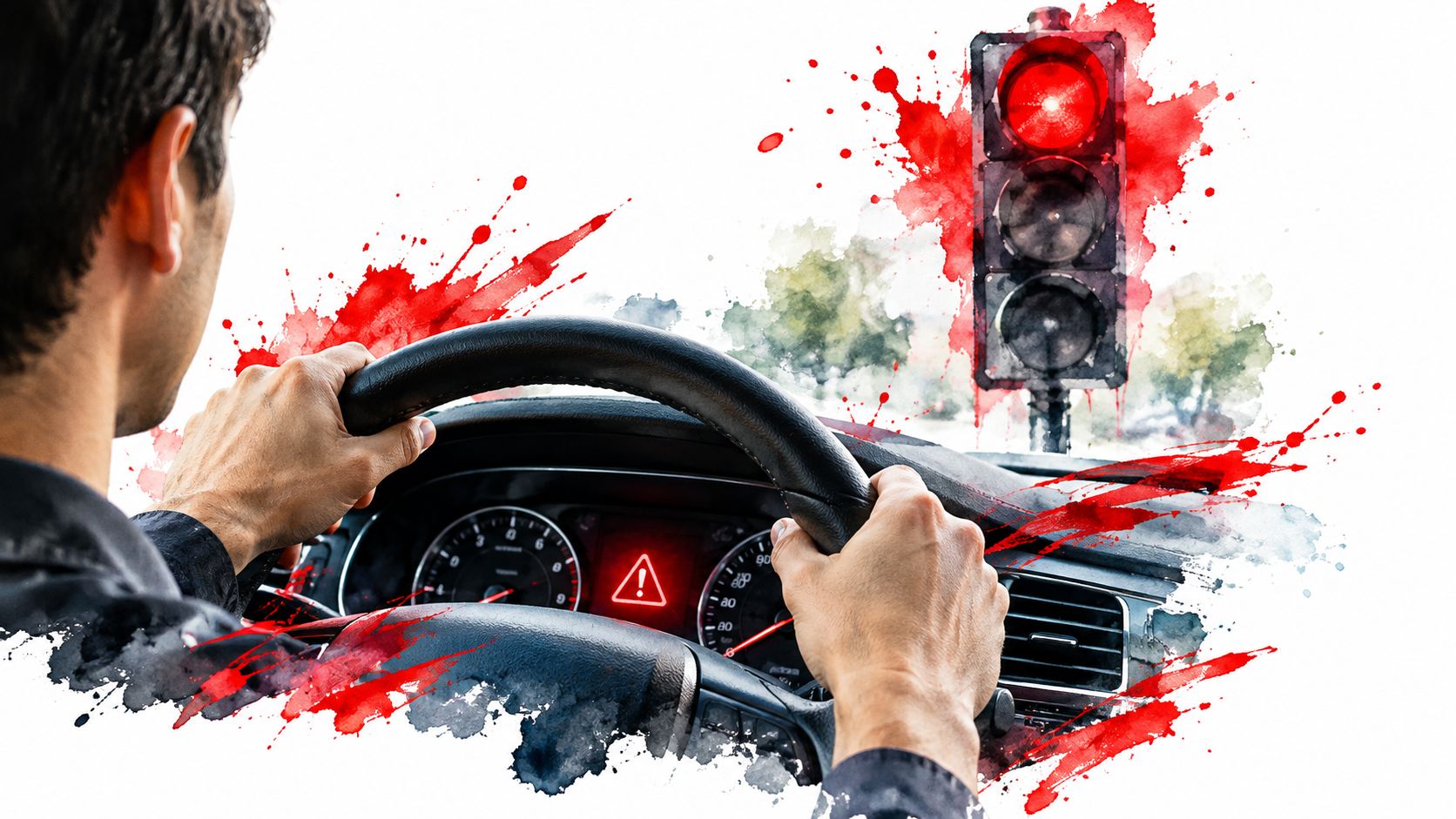
You're approaching a familiar Georgia intersection when the signal suddenly changes from its normal cycle to a pulsing red light. Your first thought might be, “Is this broken?” or “Can I keep moving if nobody's coming?” The safe answer starts with a complete stop, but red light flashes can mean more than one thing.
Drivers encounter flashing red lights in two very different places. A flashing red traffic signal controls your movement on the road. A flashing red dashboard warning tells you that your vehicle may need immediate attention. Both deserve a calm response, but they don't call for the same action. You can review other signal examples in this traffic signal meanings guide, then use the practical rules below to build better habits during supervised driving and everyday trips.
What Red Light Flashes Really Mean for Drivers
A traffic signal flashing red is directing you to stop before you assess the intersection. A dashboard light flashing red is asking you to assess the vehicle, often by pulling over safely. Confusing those situations can create danger, especially for a new driver who's still learning to separate road information from vehicle warnings.
Start with the location of the light
If the red flash is above the roadway, near a crosswalk, or at a railroad crossing, treat it as traffic control. Your vehicle must stop at the marked stop line. If there isn't a line, stop before the crosswalk, and if there's no crosswalk, stop before entering the intersection.
If the red flash is inside the instrument cluster, take your foot off the accelerator and identify the symbol. A red dashboard symbol may involve the brakes, oil pressure, engine, battery, airbag, or another important system. The owner's manual is the right place to confirm the meaning because symbols and warning strategies vary by vehicle.
Instructor's rule: A flashing red signal outside the car controls right-of-way. A flashing red warning inside the car controls your next safety decision.
The road signal normally gives you a clear sequence: stop, look, yield, and proceed when safe. The dashboard warning requires a different sequence: reduce risk, move to a safe location, check the symbol, and decide whether the vehicle should be shut off or inspected.
That distinction helps parents supervising practice hours, too. Ask the teen driver to say where the warning appeared and what action it requires. Repeating that habit turns a moment of confusion into a deliberate safety check.
Flashing Red Traffic Signals Explained
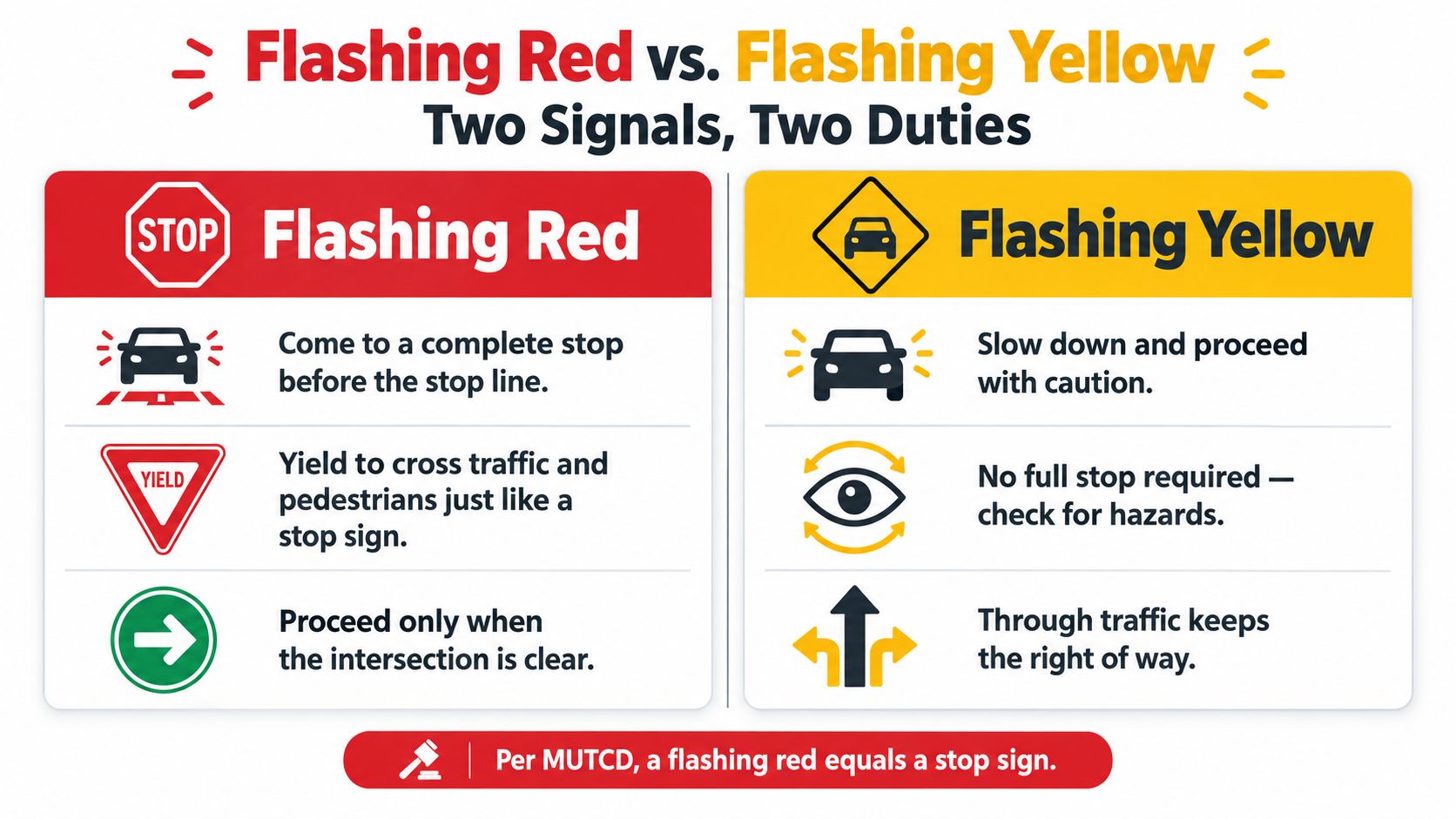
A flashing red traffic signal is a stop-and-yield control indication, not a suggestion to slow down and continue. The Federal Highway Administration's Manual on Uniform Traffic Control Devices states that when a red lens flashes rapidly, drivers must stop at the marked stop line, or before the crosswalk or intersection point when no line or crosswalk is present.
Think of it as a stop sign that happens to glow. You don't wait for the signal to turn green, because flash mode doesn't operate like the usual red, yellow, and green cycle. You stop completely, check cross traffic and pedestrians, yield to vehicles that have priority, and proceed only when the path is clear.
Use the four-way-stop routine
At an all-way flashing red intersection, every approach follows stop-sign rules. The driver who arrives first generally proceeds first. If two vehicles arrive at about the same time, communicate through position and caution, and yield according to the applicable stop-sign rule. Never assume another driver has seen you or will follow the sequence correctly.
A flashing yellow has a different meaning. It tells you to slow down and proceed with caution when clear. Flashing yellow does not require the full stop that flashing red requires, although you still need to watch for pedestrians, cyclists, turning vehicles, and other hazards.
Signals may enter flash mode during low-traffic periods, equipment problems, maintenance, or other temporary operating conditions. The reason for the flash doesn't change your duty. A driver approaching a flashing red must still stop first.
Historical Federal Highway Administration research found that replacing normal signal operation with yellow and red flash increased right-angle accidents in several settings, including central business and industrial districts. The study proposed considering flashing operation when main-street hourly volume was under 200 vehicles per hour, or above that level when the volume ratio exceeded 3:1, and recommended ending flashing operation after specified right-angle crash patterns. Those findings show why drivers shouldn't treat flash mode casually. It's a traffic engineering choice with safety tradeoffs, not merely a broken light. Read the Federal Highway Administration study on flashing signal operation.
In Georgia, rolling through a flashing red can expose a driver to the consequences associated with failing to obey a stop control, including a moving violation, license points, and possible insurance effects. The simplest way to avoid that chain of problems is to make the complete stop automatic.
Where You Will See Flashing Red on Georgia Roads
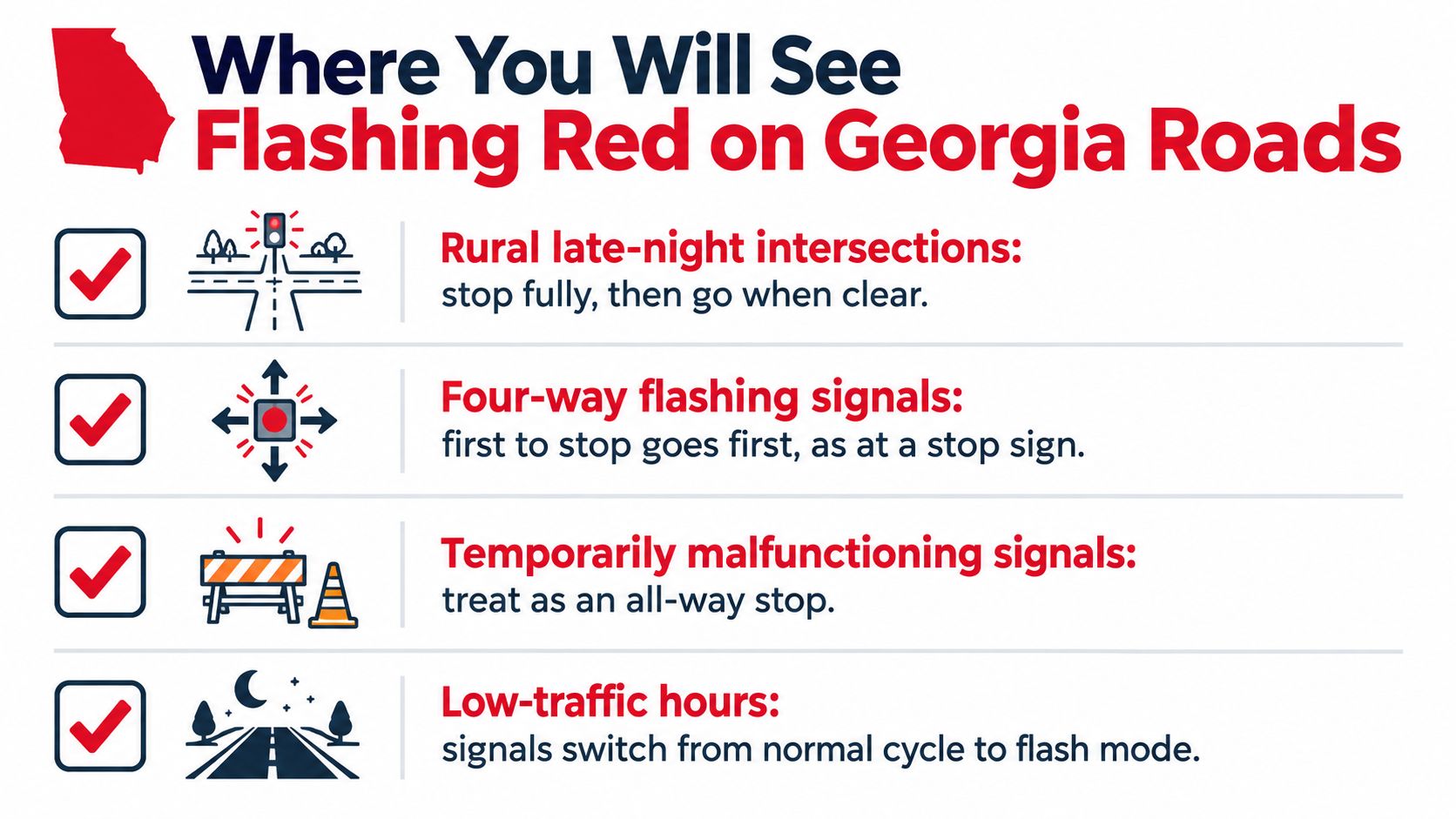
Georgia drivers may meet flashing red lights in ordinary intersections, controlled crossings, and temporary traffic situations. The setting changes, but the first response remains consistent: stop where the control requires you to stop, then identify what you're yielding to.
At a rural intersection or a signal operating in late-night flash mode, stop behind the line and scan in every direction. If all approaches flash red, treat the location like a four-way stop. A flashing red on your approach doesn't give you permission to continue just because the road looks empty.
Railroad crossings require extra patience. Red crossing lights may flash when a train is approaching or occupying the crossing. Stop before the crossing and remain stopped while the warning system indicates an active train movement. Never stop on the tracks, drive around a lowered gate, or rely only on what you can see, because a train may be closer or faster than it appears.
Recognize special road users and crossings
A school bus displaying its flashing red warning lights requires traffic to stop under the applicable school-bus rules. Don't begin moving again until the warning has ended and the roadway is safe. Watch carefully for children who may cross from a direction you can't see immediately.
Emergency vehicles, tow trucks, and funeral processions may use flashing red lights to signal priority or a controlled movement. Slow down, pull over when required and safe, and yield rather than trying to pass through the group.
Pedestrian hybrid beacons can use red flash indications after a pedestrian activates the crossing. Stop, look for people still crossing, and continue only when the crossing is clear and the signal permits movement. School-zone and temporary traffic controls also deserve a slower approach, because children, workers, and pedestrians may enter the roadway unexpectedly.
A useful practice routine is to name the hazard before moving: “train crossing,” “pedestrian,” “school bus,” or “cross traffic.” That short verbal check encourages the driver to look for the specific conflict rather than treating every flashing light as the same event.
Flashing Red Dashboard Warning Lights
A dashboard warning deserves a different kind of attention. The traffic signal tells you how to interact with other road users. A flashing red dashboard light tells you that your vehicle may no longer be operating safely.
Vehicle makers use different symbols and warning strategies, so color provides a starting point rather than a complete diagnosis. Green and blue indicators usually communicate system status. Yellow or amber warnings generally call for caution and service planning. A steady red warning often requires prompt attention, while a flashing red warning should be treated as urgent until the owner's manual says otherwise.
Follow a simple severity ladder
If a red symbol appears while you're driving, keep both hands controlled, reduce speed, and avoid sudden steering. Look for a safe place to stop, such as a well-lit parking area or a location away from moving traffic. Don't keep driving just because the vehicle still feels normal. Some failures become dangerous before the driver notices a change.
Check the symbol legend in the owner's manual. The manual explains whether the indicator relates to brake pressure, oil, charging, engine operation, restraint systems, or security. It also tells you whether the maker recommends stopping immediately, arranging service, or taking another specific step.
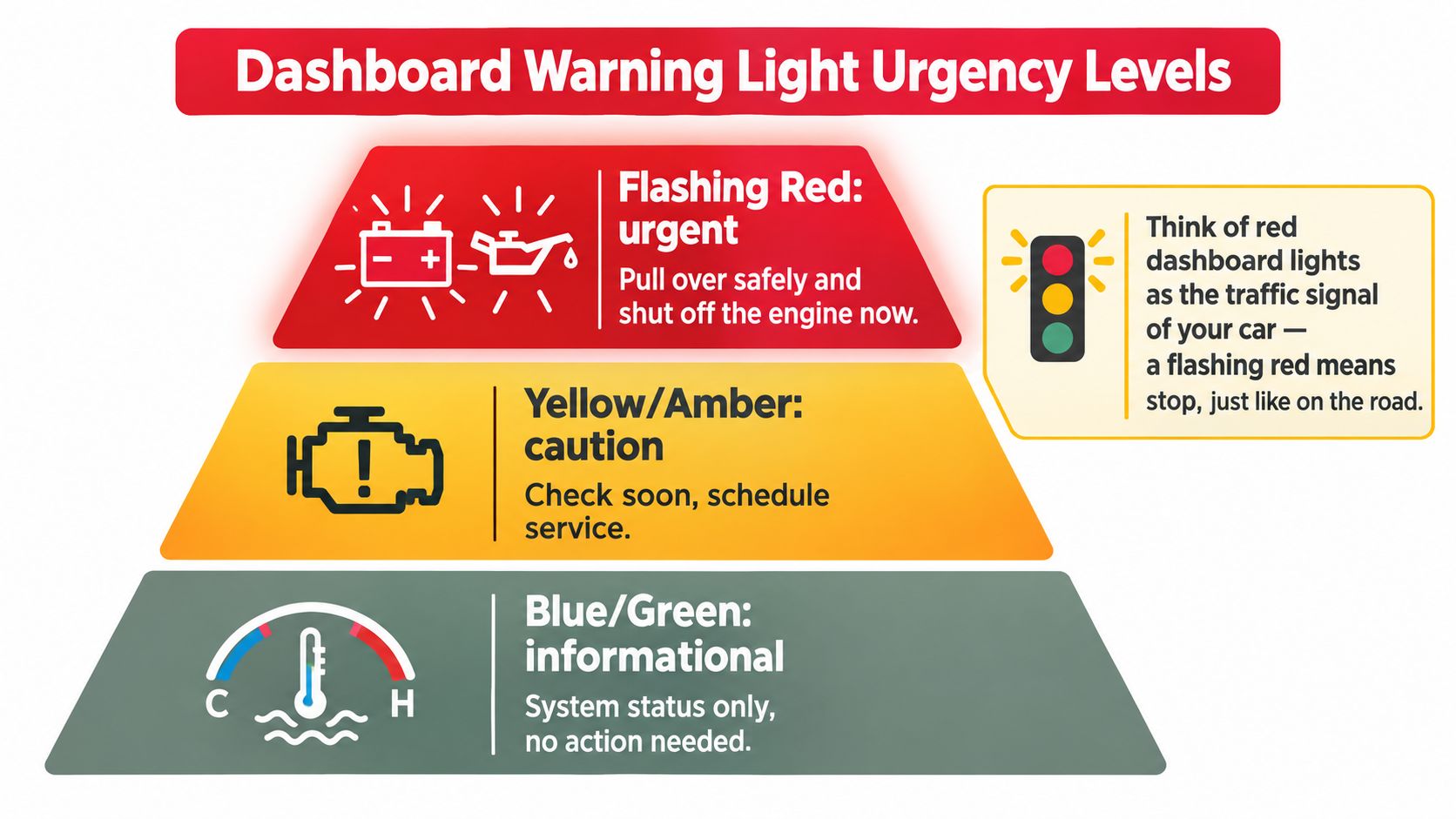
The flash pattern can add information, but you shouldn't diagnose a serious fault from pulse speed alone. A rapid flash may accompany a critical brake, oil, or engine warning, while a slower flash may relate to a security or sensor condition. The icon, the vehicle's behavior, and the manual matter more than guessing from the rhythm.
Drivers who want background on restraint-system warnings can also review this practical explanation of an SRS warning light from Seat Belt Repair. It's useful supplemental reading, but it doesn't replace a professional inspection when a safety-system warning appears.
Safety priority: If a red dashboard light flashes, routine plans can wait. A safe stop and accurate diagnosis matter more than reaching school, work, or the test appointment on time.
Common Causes Behind a Flashing Red Dashboard Light
A flashing red dashboard symbol doesn't identify one universal fault. Use the icon and the vehicle manual to narrow the possibilities, then choose the safest response instead of trying to repair the issue while parked beside traffic.
Brake system warnings
A flashing brake warning may relate to an engaged parking brake, low brake fluid, or a fault involving the anti-lock braking system. Confirm that the parking brake is fully released. If the light remains on or the pedal feels soft, sinks unusually far, or requires pumping, stop driving and arrange assistance.
The brake system inspection service from A-1 Driving School can help a driver understand why brake condition matters before lessons or testing. A driving instructor should never encourage a student to continue practicing in a vehicle with uncertain braking performance.
Engine and oil warnings
A flashing check-engine light commonly indicates an active misfire. Continuing to drive can increase heat in the exhaust and may damage emissions components, so reduce speed only long enough to reach a safe stopping place, then seek qualified service.
An oil-pressure warning is more urgent than a reminder to schedule an oil change. If it flashes while the engine is running, stop safely and shut the engine off. Continuing without adequate oil pressure can cause severe internal damage.
Battery and other vehicle systems
A charging or battery warning may mean the alternator isn't maintaining the vehicle's electrical supply. The car may continue briefly and then stall, so avoid unnecessary driving and arrange help if the warning persists.
Security, key-fob, lane-departure, and airbag indicators require interpretation from the manual. Some show a system state, while others indicate a fault that needs service. Don't disable a restraint or driver-assistance feature just to make the warning disappear.
| Icon / System | Likely Cause | Recommended Action |
|---|---|---|
| Brake system | Parking brake, low fluid, or brake-system fault | Stop safely, check that the parking brake is released, and arrange inspection if the warning remains |
| Check engine | Active engine misfire or related fault | Reduce risk, stop when safe, and seek service rather than continuing a normal trip |
| Oil pressure | Oil pressure below a safe operating level | Pull over and shut off the engine immediately |
| Battery or charging | Charging voltage outside the expected range | Stop in a safe place and arrange assistance before the vehicle stalls |
| Airbag or SRS | Restraint-system fault | Avoid treating the warning as cosmetic, and schedule qualified service |
| Security or key fob | Theft-deterrent or key-recognition activity | Consult the manual and use the vehicle's specified reset or service procedure |
Connecting These Lessons to Joshua's Law and Driver Training
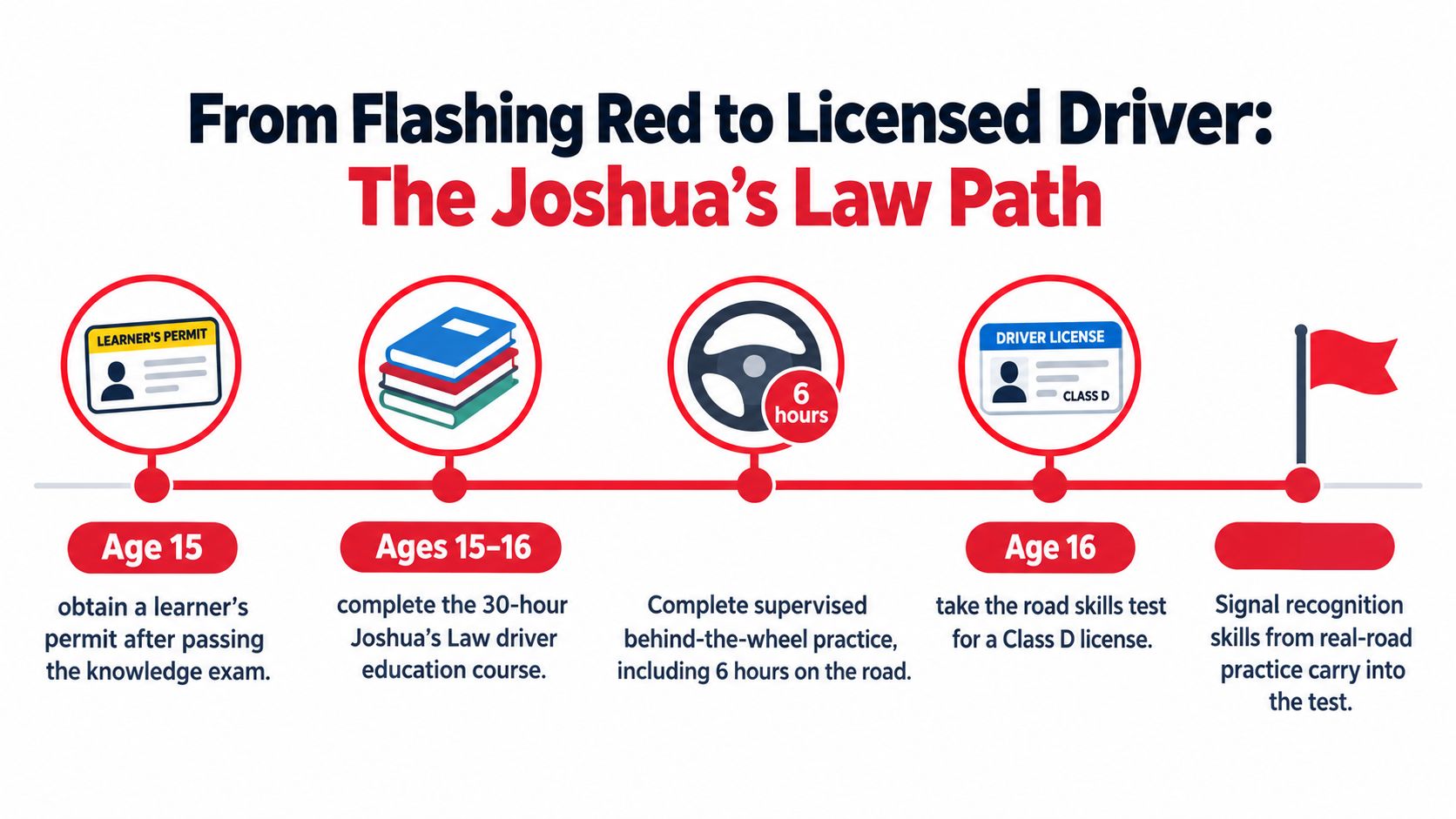
Georgia teen drivers learn these decisions through both formal education and supervised practice. Joshua's Law requires approved driver education and one of several training pathways. One pathway includes 30 hours of classroom instruction, 6 hours behind the wheel, and 40 hours of supervised driving with a parent or guardian, including 6 hours at night. Another combines 30 hours of classroom instruction with 40 hours of parent-taught behind-the-wheel training. Georgia also permits online instruction options within approved pathways, as described by the Georgia Department of Driver Services Joshua's Law requirements.
The DDS describes the theoretical component as at least 30 hours, with practical training completed through a DDS-certified instructor or the Parent/Teen Driving Guide. A Class D applicant who is 16 or 17 also needs ADAP, and must show the required education and supervised driving components when taking the road test. The Georgia DDS driver's manual provides the state's current licensing information.
Turn recognition into a practiced response
A lesson on flashing red signals isn't just memorization. The student must see the signal early, brake smoothly, stop at the correct point, scan for conflicts, and make a safe decision. A dashboard warning adds another layer, because the driver must control the vehicle while identifying whether the car itself is becoming unsafe.
A-1 Driving School provides classroom and online Joshua's Law courses, parent-taught alternatives, and private behind-the-wheel lessons through its Georgia driver education programs. You can review the Joshua's Law Georgia driver education options before choosing a format that fits the student's schedule and experience.
Parents can reinforce the same habits during supervised hours. Ask the student to identify the stop line, explain who has priority, and describe what a dashboard warning would change about the trip. If a minor crash ever occurs, keep a practical minor car accident step-by-step guide available for the immediate sequence of safety and documentation decisions.
Take the Next Step With A-1 Driving School
Understanding the rule is important, but new drivers gain confidence by practicing the response in real traffic. A lesson can place a student at signalized intersections, rural crossings, school zones, and other locations where stopping distance, visibility, pedestrians, and right-of-way all matter at once.
A-1 Driving School offers private driving lessons and lesson packages for teens and adults, including Joshua's Law-compliant combinations of online education and behind-the-wheel training. Students can also choose classroom instruction or one-on-one practice based on their previous experience. That flexibility matters when a learner needs more time with intersections, parking, lane changes, or road-test maneuvers rather than a one-size-fits-all schedule.
The school also offers Georgia road-test support. An instructor can drive the student to the DDS exam, and the student can use the training vehicle for the test. That arrangement can reduce the scheduling and vehicle concerns that often fall on parents, while keeping the focus on test readiness and safe vehicle control.
Eligible Georgia students may also qualify for the Georgia Driver's Education Grant Scholarship Program. The program serves residents ages 15 through 17 who are enrolled in school and hold a valid Georgia instructional permit or driver's license. The grant is intended to cover 30 hours of classroom instruction and 6 hours of behind-the-wheel instruction with an approved instructor. Eligibility and program rules should be confirmed through the Georgia scholarship grant regulations, since details may change.
A free consultation gives a student and parent a chance to discuss driving experience, school commitments, preferred online or classroom delivery, lesson packages, and road-test goals. The right plan should make signal recognition, dashboard awareness, and calm decision-making part of normal driving practice.
A-1 Driving School offers Joshua's Law education, online and classroom courses, private driving lessons, flexible lesson packages, scholarship guidance, and Georgia road-test support. Visit A-1 Driving School to explore the options and choose practical training for safer responses to every flashing red light you encounter.