Yes, driver's education is worth it for Georgia teens. State law requires it for most 16- and 17-year-olds seeking a Class D license, and a 2025 study found participants had a 11.1% first-two-year crash rate versus 12.9% among peers who skipped it.
But is drivers ed worth it if a teenager still has to practice, take a road test, and follow Georgia's graduated licensing rules? That's the question many Atlanta parents ask after seeing a course described as a simple box to check. The honest answer is that driver's education matters most when it connects classroom knowledge with coached driving lessons, supervised practice, and a realistic plan for the road test.
Is Drivers Ed Actually Worth the Time and Money
A parent sits across from a teenager at an open house. The teen wants a license quickly. The parent wants to know whether a course will create a safer driver or just help the student memorize signs for a test.
For Georgia families, driver's education has two kinds of value. First, it can be part of the licensing pathway for a Class D license. Second, it gives a new driver an organized introduction to traffic laws, hazard awareness, space management, and vehicle control before independent driving begins.

A classroom or online course can't reproduce every situation a teen will meet on Atlanta roads. It can, however, give the student a framework for recognizing a developing hazard, choosing a safe following distance, understanding right-of-way, and anticipating how traffic behaves. Without structured instruction, many beginners learn those ideas slowly through mistakes, rushed decisions, or anxious reactions.
The course also isn't the same thing as professional driving lessons. Classroom learning explains the rules and reasoning. Behind-the-wheel instruction shows the student how to apply them while turning, braking, scanning intersections, changing lanes, and managing traffic.
A useful standard: Driver's education is worth more when it changes how a student practices, not merely when it produces a completion certificate.
Families also have different schedules and educational arrangements. Parents comparing flexible learning options may find broader planning context in these homeschool facts for parents, especially when an online course needs to fit around school, activities, or home instruction.
The safety evidence supports a measured answer. Formal education can provide a meaningful early benefit, but it doesn't eliminate crash risk. A teen still needs supervised driving, seat-belt habits, distraction control, and enough practice to make safe decisions without a parent giving every instruction.
That's why I tell families to judge a program by what happens after the lesson ends. Does the student have a skill to practice? Does an instructor identify specific weaknesses? Does the family know how to progress from quiet streets to nighttime driving, multilane roads, rain, and unfamiliar routes? Those details determine whether tuition becomes practical preparation or only paperwork.
Georgia Joshua Law Requirements and License Path
Joshua's Law is easier to understand when families view it as a sequence rather than a single course. A teen may finish the classroom requirement and still have important driving, testing, and permit obligations ahead.
For a 16- or 17-year-old seeking a Georgia Class D license, the main pieces are:
Hold an instructional permit. The applicant must generally be at least 16 and have held the permit for 1 year and 1 day before applying for the Class D license. The permit period gives the family time to build supervised experience.
Complete the classroom requirement. Georgia requires an approved 30-hour classroom or online course for the applicable Class D pathway. The program should come through a DDS-certified provider so the completion can be documented.
Complete supervised driving. The student must complete 40 hours of supervised driving, including at least 6 hours at night. This practice is where classroom concepts become habits.
Complete professional instruction or the permitted alternative. The traditional “30 and 6” format includes at least 6 hours of certified behind-the-wheel instruction. Georgia also permits the parent-taught alternative described by DDS.
Pass the required examinations. The student still needs a vision examination and the road skills test. Completing driver's education doesn't replace the need to demonstrate safe vehicle operation.
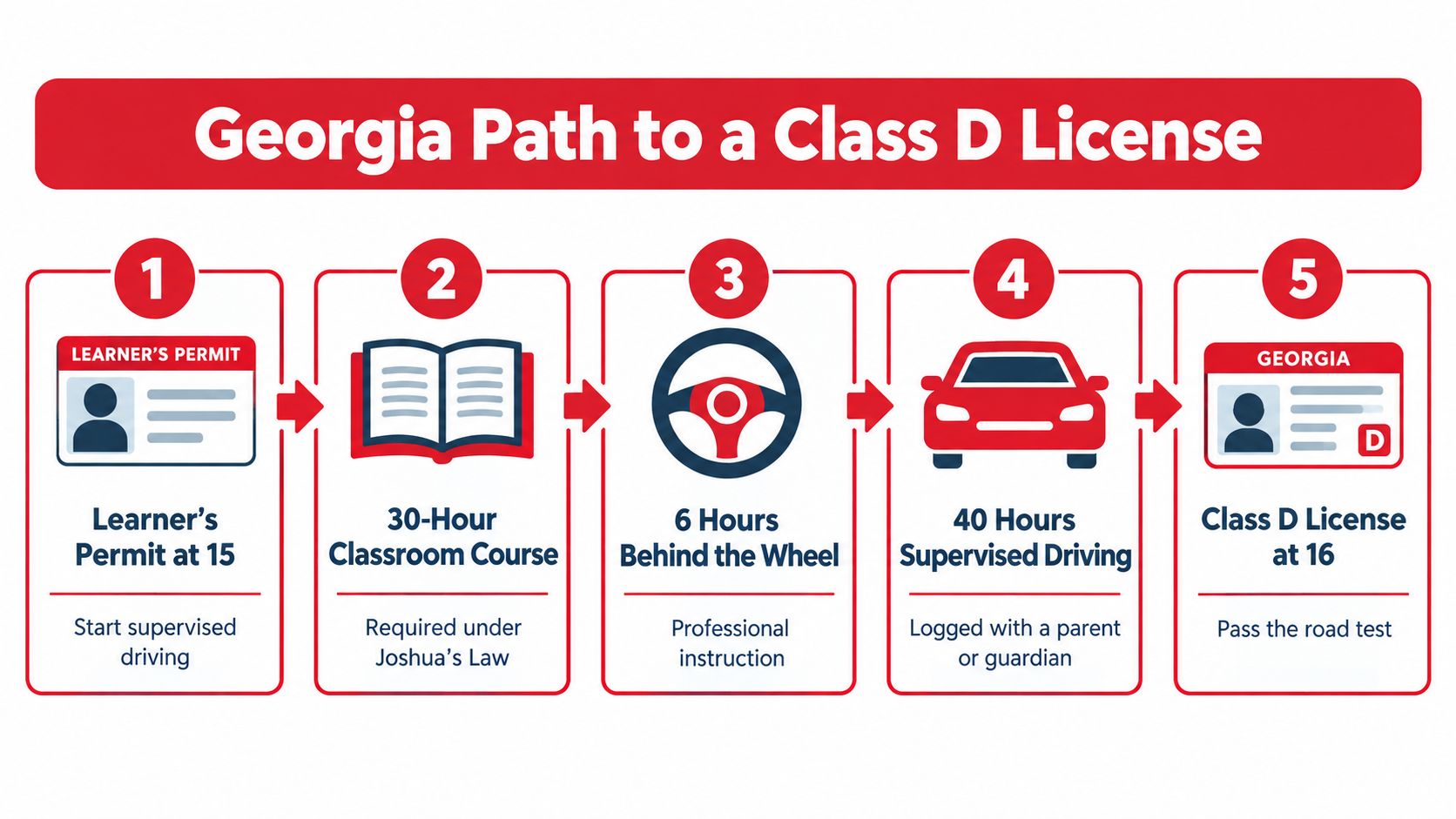
The Georgia DDS Joshua's Law requirements explain how classroom education, supervised experience, and behind-the-wheel training fit together. DDS states that the overall supervised-driving requirement is 40 hours, including 6 nighttime hours, and that a parent, guardian, or qualified certified instructor must affirm that the required experience was completed when the license is issued. A separate driving log isn't required under the DDS process described there.
The practical distinction matters. Six hours with an instructor can provide feedback on steering, braking, lane placement, scanning, and decision timing, but those hours aren't a substitute for the entire supervised-practice requirement. Parents should continue driving with the teen and gradually introduce more difficult conditions.
Georgia DDS also requires the applicant to meet the permit and testing conditions before receiving the license. The Joshua's Law driver education course can be one way for families to organize the classroom portion and understand how it connects with professional instruction.
A course certificate is useful documentation, but it isn't a road-test waiver. The student must still show that they can operate the vehicle safely during the official skills examination.
What the Safety Data Actually Shows
The strongest answer to “is drivers ed worth it” requires separating measurable association from proof of causation. A large 2025 University of Nebraska study followed more than 150,000 teen drivers for eight years. During the first two years of driving, 11.1% of teens who completed driver's education were involved in a crash, compared with 12.9% of teens who didn't take driver's education (University of Nebraska study summary).
The same study reported a lower rate of crashes involving injury or death among the education group, 2.1% versus 2.6%. It also found that teens without driver's education were 16% more likely to have any accident, 24% more likely to be involved in a fatal or injury accident, and 75% more likely to receive a traffic ticket. Those findings support the practical value of structured instruction during the early period of independent driving.
The absolute difference in any crash involvement was 1.8 percentage points. That's meaningful, but it doesn't mean a course removes danger. The study was observational rather than a randomized experiment, so family supervision, driving exposure, vehicle access, and other factors may also influence the result.
What the numbers mean for parents
A driver's-ed participant may be less likely to crash or receive a ticket early on, but the course should be treated as one layer of protection. A teenager still needs supervised practice and clear limits around distraction, passengers, nighttime driving, speeding, and seat-belt use.
Graduated driver licensing has a broader effect because it controls exposure while novice skills develop. The CDC's overview of graduated driver licensing reports that GDL systems reduce overall crash rates by approximately 20% to 40%. A meta-analysis of 14 studies found reductions of about 19% in injury crashes and 21% in fatal crashes among 16-year-olds.
The historical trend also shows the importance of licensing restrictions. The Insurance Institute for Highway Safety reports that U.S. teenage crash deaths fell from 5,819 in 1996 to 2,899 in 2024, a 50% decline, after the first three-stage GDL program was implemented.
Why classroom education still matters
Research on pre-licensure education is mixed. A Cochrane review found that school-based driver education led to earlier licensing but didn't provide consistent evidence of lower crash involvement. NHTSA therefore describes pre-licensure education as potentially helpful, but unlikely by itself to produce dramatic crash reductions.
The balanced conclusion is straightforward. Driver's education can improve preparation, knowledge, early compliance, and possibly early crash and ticket outcomes. The largest safety gains come when it works alongside supervised practice and protective licensing restrictions.
Classroom Learning Versus Real Driving Lessons
A student can explain the meaning of a solid yellow line and still hesitate when traffic closes in behind them. That gap between knowing a rule and using it under pressure is where professional driving lessons become valuable.
Classroom or online education builds the mental model. Students learn signs, traffic laws, right-of-way, hazard recognition, distraction risks, and the decisions that support defensive space. The setting is useful because the instructor can explain why a choice is safe before the student has to make it on a busy road.
Driving lessons build physical and practical skill. A certified instructor can observe whether the student checks mirrors consistently, brakes too late, drifts within a lane, looks far enough ahead, or becomes overwhelmed during a turn. The instructor can then give immediate feedback and repeat the situation until the response becomes calmer and more reliable.
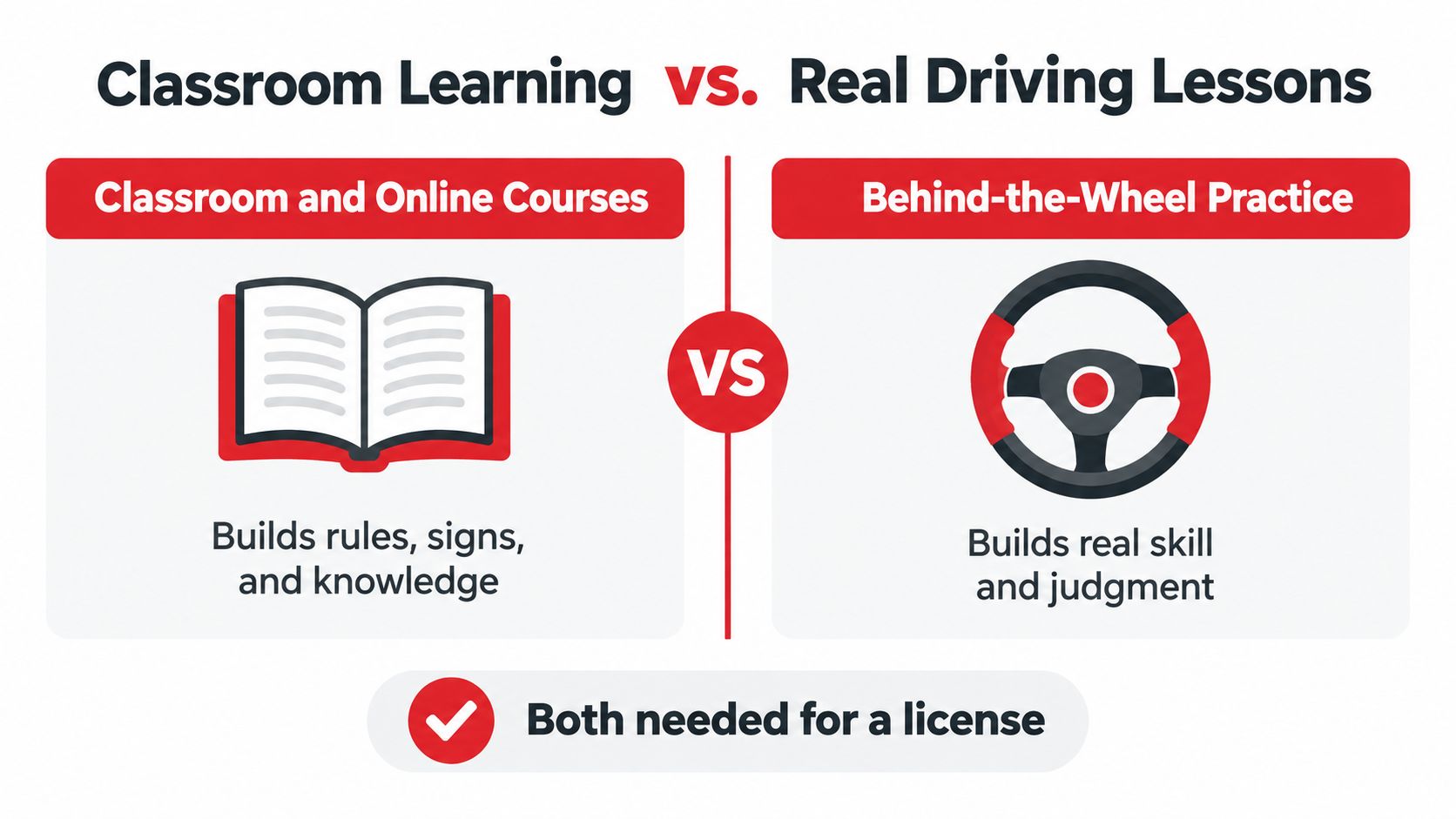
| Classroom or online course | Professional driving lessons |
|---|---|
| Explains traffic laws and signs | Applies those rules in live traffic |
| Builds hazard-perception concepts | Develops scanning and decision timing |
| Covers licensing responsibilities | Coaches steering, braking, lane position, and turns |
| Supports Joshua's Law completion | Supports road-test readiness and confidence |
A classroom-only route may work for a student who has a highly involved parent, a suitable practice vehicle, and a clear progression plan. It can be less effective for a nervous beginner or a teen whose parent finds it difficult to give calm, technical feedback while managing traffic.
The value of a lesson isn't only the time spent behind the wheel. It's the quality of the correction. A parent might say, “Slow down and look,” while an instructor can identify whether the student is approaching too quickly, scanning too narrowly, or braking because they noticed the hazard too late. That precision makes practice more productive.
The benefits of taking driving lessons from an instructor become clearest when a student needs help with a specific skill such as merging, reversing, lane changes, parking, or managing a multilane road.
Georgia's structure supports combining both forms of learning. The classroom provides the reasons behind safe decisions. Supervised practice supplies repetition. Professional lessons add trained observation and controlled exposure to situations that families may avoid.
Practical rule: Use professional lessons to establish technique, then use family practice to repeat that technique in increasingly challenging conditions.
A strong package may also include road-test preparation or testing assistance. That doesn't guarantee a passing result, but it helps the student understand what the examiner will observe and what safe, complete vehicle control looks like.
How to Choose a Georgia Approved Driving Program
The first question isn't “Which course is cheapest?” It's “Does this provider meet Georgia's requirements and help my teen become capable on the road?”
Start by verifying that the school is DDS-certified and that its classroom or online course is approved for the applicable Joshua's Law pathway. Ask how the provider documents completion and what paperwork the family will receive for the Class D application.
Check the program design
Look for a format that fits the student's actual schedule. An online course may help a teen balance school, athletics, work, or home instruction. An instructor-led class may provide accountability and immediate discussion. Neither format replaces the need for supervised driving, so the best choice is the one the student can complete attentively and connect to practice.
Then ask whether the provider offers professional behind-the-wheel instruction. A program that combines classroom education with lessons can give families a more coherent progression from rules to road behavior.
Evaluate the lesson content rather than accepting a generic promise of “road experience.” A useful program should address:
- Vehicle control: Smooth acceleration, braking, steering, reversing, and stopping.
- Traffic judgment: Intersections, following distance, lane changes, merging, and right-of-way.
- Progressive exposure: Quiet streets first, followed by heavier traffic, multilane roads, rain, night driving, and unfamiliar routes.
- Road-test preparation: Practice with the skills the official examiner evaluates, not just repetitive route memorization.
- Family coordination: Clear guidance about what parents should practice between lessons.
A package with several targeted lessons may be more useful than the minimum professional requirement for a student who has little experience or becomes anxious behind the wheel. At the same time, families should remember that lessons supplement the required supervised practice.
Ask about affordability
Georgia's Driver's Education Scholarship Grant Program can make approved training accessible for qualifying teens. Eligibility and availability should be confirmed with the provider and the current program information, but families shouldn't assume tuition makes driver's education unavailable before asking about grant support.
The guide to choosing a driving school can help parents compare certification, scheduling, lesson structure, vehicle arrangements, and road-test services.
A-1 Driving School offers instructor-led and online Joshua's Law courses, professional driving lessons, road-test preparation, and packages that connect education with practical training. Its Scholarship Grant Program is another option for eligible Georgia teens who need help accessing instruction.
Finally, ask what happens if the student isn't ready after the first lesson. A responsible provider should identify the next skill to practice rather than rush an unprepared beginner toward testing.
Final Verdict on Georgia Drivers Education Value
So, is drivers ed worth it in Georgia? Yes, especially for a teen who needs the course to follow the Class D licensing pathway. The value also goes beyond compliance when the program teaches the student how to recognize hazards, manage space, follow traffic laws, and make decisions before driving independently.
The safety evidence supports a moderate conclusion, not a sales promise. The Nebraska study found lower early crash and ticket rates among teens who completed driver's education, while broader research shows that graduated licensing restrictions generally produce stronger crash reductions. Driver's education helps most when it becomes part of a larger system.
That system should include:
- A DDS-approved classroom or online course.
- The required supervised driving, including nighttime practice.
- Professional coaching for vehicle control and judgment.
- Repetition in traffic conditions that gradually become more demanding.
- Clear limits on distraction, passengers, and high-risk driving.
- Road-test preparation based on safe driving, not route memorization.

Classroom-only education may be enough for some students to understand the rules, but it doesn't show whether they can apply those rules smoothly under pressure. Driving lessons make the education practical by giving the student feedback on scanning, braking, lane placement, turns, merging, parking, and decision timing.
Parents should choose a program based on the student's needs. A confident beginner may need structured road-test preparation. A nervous teen may benefit from several coached lessons before family practice. A busy household may need online coursework, flexible appointments, and a package that keeps the licensing steps organized.
The honest verdict is that driver's education is worth it, but classroom completion alone isn't the full product families need. The strongest path combines approved education, meaningful professional instruction, steady supervised practice, and preparation for the official road test.
A-1 Driving School offers Georgia Joshua's Law courses in instructor-led and online formats, customized driving lessons, road-test preparation, and driving lesson packages for teens and adults. Visit A-1 Driving School to compare course options, explore lesson packages, and ask whether your teen may qualify for the Georgia Driver's Education Scholarship Grant Program.