
Your teenager has a learner's permit, school activities fill the calendar, and your phone now contains several driving-school websites that all promise affordable training and confident drivers. One school is close to home. Another advertises a lower package price. A third talks about pass rates without explaining what its lessons include.
After more than three decades advising Georgia families, I recommend a different starting point. Don't choose a driving school by price or distance alone. Choose the provider that matches the student's licensing path, teaches skills in a logical order, offers lessons when the student can attend, and explains exactly what happens if scheduling or testing plans change.
A well-run school should make the process easier to manage, not create another administrative burden. The same principle schools use when they boost school attendance with SMS applies here: clear, timely communication helps families stay on schedule. For driver training, that means reliable lesson reminders, progress updates, transparent policies, and a direct answer when you need help.
The right comparison includes Joshua's Law compliance, instructor credentials, curriculum, vehicle condition, lesson packages, online options, road testing support, and scholarship guidance. This guide gives you a practical way to compare those details before you pay.
Introduction Why Your Driving School Choice Matters More Than Price
A parent may call three schools and hear three different versions of the same package. One includes classroom instruction but says little about behind-the-wheel scheduling. Another offers individual lessons but doesn't explain whether the student will follow a progression from basic control to road-test preparation. A third has an attractive headline price, but important fees and cancellation rules appear only after enrollment.
Those differences matter because driver education isn't just a purchase of hours. The student needs a complete path from permit preparation to supervised practice, structured lessons, and a properly timed road test. If the school can't explain that path clearly, the family may pay for training that doesn't fit the student's age, permit status, experience, or licensing goal.
My rule for families: compare what the student will be able to do after completing the program, not only what the package costs today.
Instructor quality and organization affect the day-to-day experience. A study of car-driving training centers identified eight factors affecting learner satisfaction, with support services, facilities, and training organization among the strongest perceived influences, followed by teaching staff, cost, and program design. The study's findings support a practical conclusion: a low price won't compensate for missed appointments, unclear feedback, poor vehicles, or a package that doesn't build skills in sequence.
Georgia families also need to separate marketing promises from licensing requirements. A school should tell you whether its course satisfies Joshua's Law, whether lessons are included, how supervised driving fits into the plan, and whether road-test assistance is available. Those answers let you compare nearby providers on the things that protect your time and your student's progress.
What Georgia Requires Before You Compare Schools
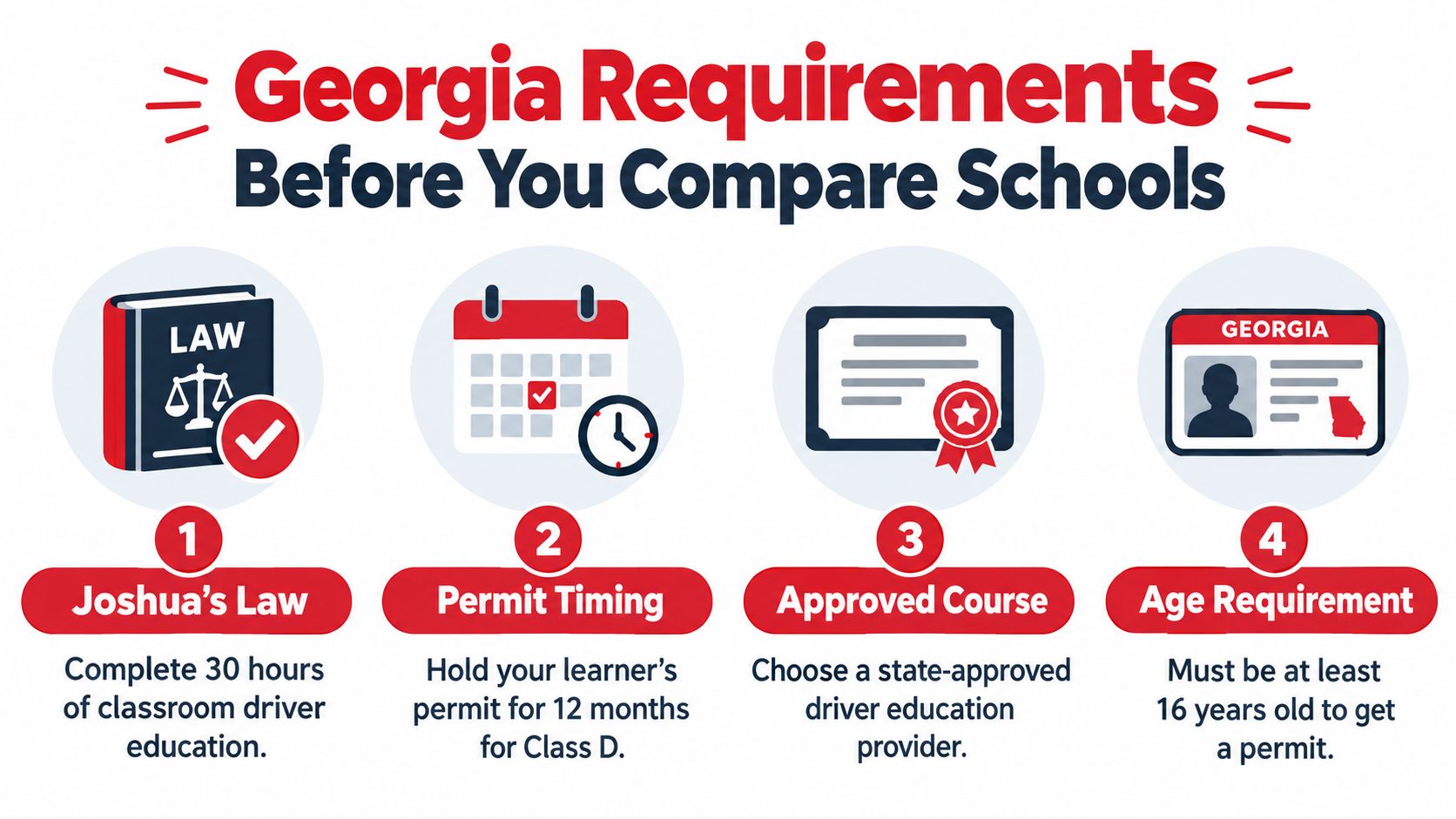
Start with the state pathway, then evaluate the provider. Georgia's Joshua's Law requires a teen applying for a Class D license to complete an approved driver education course and 40 hours of supervised driving, including 6 hours at night. The approved education paths include 30 hours of classroom instruction and 6 hours behind the wheel, a 30-hour online course plus 6 hours behind the wheel, or parent-taught versions of the behind-the-wheel component. Verify the current requirements through the Georgia DDS Joshua's Law requirements before enrolling.
Check the permit and course path
A compliant provider should identify exactly which part of the requirement it supplies. Ask whether the course is approved, whether the six behind-the-wheel hours are included, and what documentation the student receives at completion. If a school uses terms such as “teen package” or “full program,” ask the staff to translate that label into classroom, online, behind-the-wheel, and supervised-practice components.
Permit timing can also disrupt a family's plan. Georgia DDS requires an applicant to hold a valid Georgia Non-Commercial Learner's Permit before taking the road test. For a Class D license, the DDS states that the permit must be held for 12 months and 1 day. Review the complete Georgia driver's license requirements and put the permit date on the family calendar immediately.
Audit every school's explanation
Use these questions on your first call:
- Approval: Is the course approved for the Georgia requirement?
- Completion records: What documents will the student receive?
- Behind-the-wheel hours: Does the package include the required instruction, and how are lessons scheduled?
- Supervised practice: What must the parent or supervising adult document?
- Testing timeline: Can the school help prepare for or provide the road test?
Georgia's requirements are the floor, not the full definition of good instruction. A school that can't explain them plainly should not be your choice, regardless of its location or advertised price.
How to Evaluate Credentials Curriculum and Support Quality
Call two or three schools with the same questions and write down the answers. Don't rely on a polished website to tell you whether the actual training operation is organized. You want proof that the instructors are qualified, the vehicles are suitable, the curriculum has structure, and the office can keep lessons moving.
The UK's national driver and rider training standard offers a useful general benchmark for thinking about instructor credentials. Its framework says an instructor should hold a current license and master the competencies expected of a qualified driver. UK Approved Driving Instructor rules also require an instructor to be 21 or over and to have held a full license for at least 3 years to accompany a learner, with paid instruction requiring registration or a trainee instructor license. Those are UK rules, not Georgia rules, but the principle travels well: ask what license, registration, supervision, and training standards apply in your market. Read the national standard and ask Georgia schools to document their own compliance.
Use the same matrix for every provider
| Evaluation Criteria | What to Ask | Why It Matters |
|---|---|---|
| Instructor credentials | Who teaches, and what credentials do instructors hold? | Qualified instructors provide a safety and consistency baseline. |
| Curriculum | How are classroom knowledge, vehicle control, observation, and decision-making connected? | Students need more than memorized answers or one familiar test route. |
| Training vehicles | How are vehicles maintained, equipped, and assigned? | A dependable vehicle lets the student focus on learning. |
| Lesson organization | Will the student have one instructor, or will notes transfer between instructors? | Consistent feedback prevents repeated lessons and conflicting advice. |
| Scheduling | What appointment times are currently available? | A package has little value if the student can't complete it on time. |
| Test preparation | Does instruction include varied roads, parking, and realistic test preparation? | Students must apply skills beyond a single neighborhood route. |
| Support services | What happens with rescheduling, weather, instructor changes, or retesting? | Clear procedures protect the family from avoidable disruption. |
A strong school can describe its curriculum in practical terms. It should explain how the student progresses from basic control to turns, lane positioning, intersections, parking, traffic judgment, and test readiness. It should also explain how parents receive useful practice recommendations between lessons.
Watch for conduct and complaint failures
Safety includes professional conduct. The UK DVSA received 912 complaints about driving instructors in one year, and one in ten involved indecency, sexually inappropriate behavior, or harassment, according to Which? reporting on driving-lesson complaints. Georgia families should ask about instructor screening, safeguarding policies, complaint handling, instructor substitution, and what a student should do if a lesson feels unsafe or uncomfortable.
A provider that answers those questions directly has a stronger operating standard than one that talks only about price. If staff evade questions about credentials, vehicle safeguards, refund terms, or complaints, keep calling other schools.
You don't need a school that makes extravagant safety promises. Research is mixed. A Traffic Safety Marketing factsheet cites a large U.S. study in which teen drivers without driver education were 75% more likely to receive a traffic ticket, 24% more likely to be involved in a fatal or injury crash, and 16% more likely to have a crash, while systematic reviews found that driver education alone doesn't consistently reduce crashes. Review the evidence and its limitations. Judge a provider by its curriculum, practice structure, and honesty, not by guarantees.
How to Compare Driving Lessons and Lesson Packages That Actually Build Skills
Driving lessons are where the student turns knowledge into judgment. A package should show a progression, not promise a block of appointments. Ask what the instructor expects the student to learn first, how progress is recorded, and how later lessons build on earlier ones.
Match the package to the student
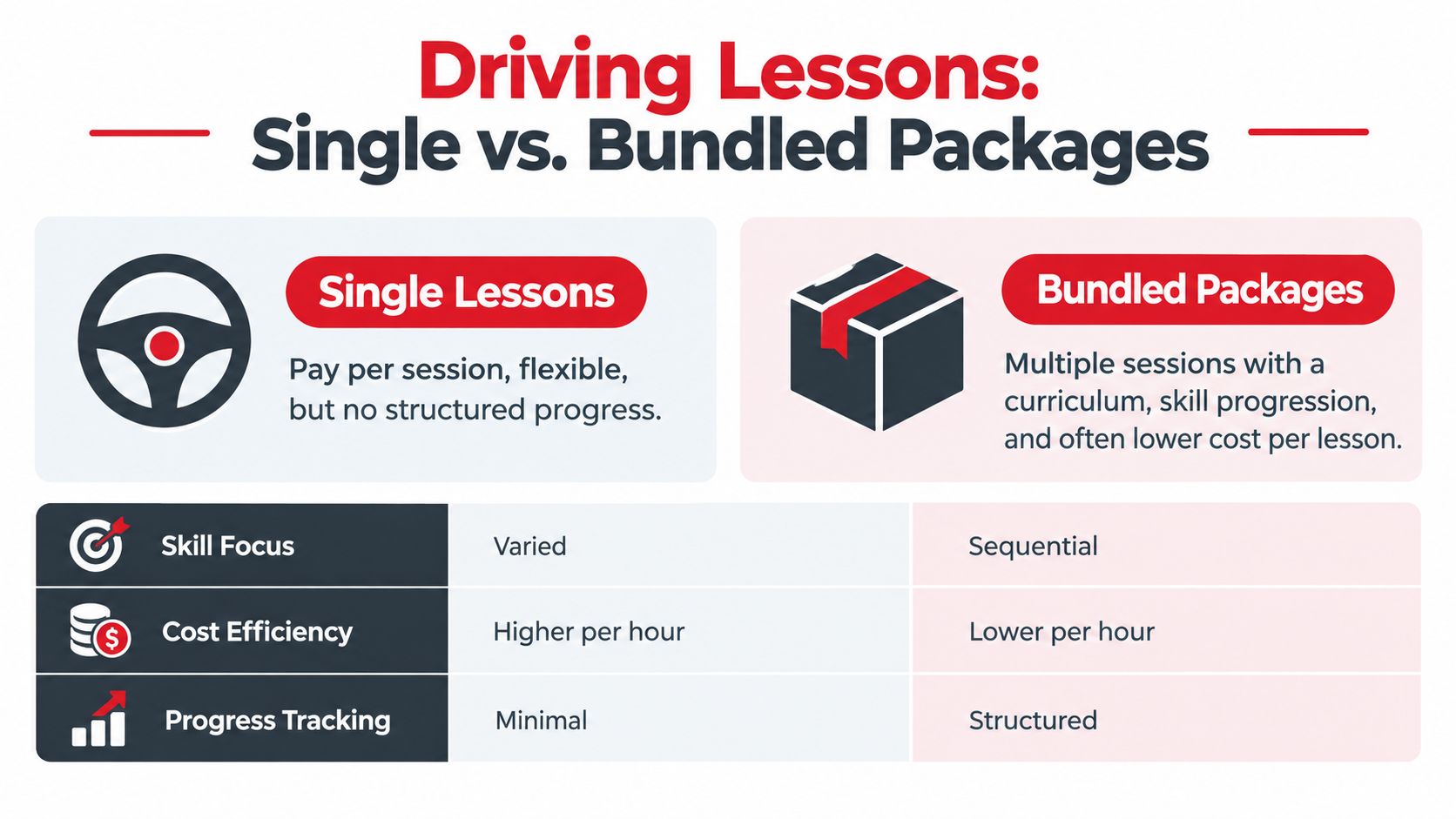
A single lesson can suit an adult who needs a targeted refresher, a licensed driver preparing for a particular maneuver, or a family that wants to evaluate an instructor before committing. The trade-off is that individual appointments may not create a deliberate sequence unless the instructor supplies a written plan.
Bundled lessons make more sense for a new teen, a nervous beginner, or anyone working toward a road test on a defined schedule. The package should move through a logical set of skills, with room to revisit weak areas. Don't buy the largest package automatically. Ask the school to recommend a starting point based on the student's experience, permit status, available practice at home, and target test date.
Ask this exact question: “What will my student practice in the first lesson, what comes next, and how will you tell us when the student is ready for the road test?”
Inspect the details behind the hours
Lesson length matters, but it isn't the only variable. Ask whether the package includes pickup and drop-off, how much time is spent driving rather than waiting, and whether the student practices on neighborhood streets, busier roads, highways where appropriate, parking areas, and routes that resemble local testing conditions.
A useful weekly plan might place lessons after school, while a working adult may need evenings or weekends. Confirm the earliest realistic appointment, the normal time between lessons, and the process for weather cancellations or instructor changes. If the student can only attend a narrow window, availability should be checked before payment.
Use this checklist when comparing packages:
- Progress notes: Will the instructor document strengths, weak areas, and the next practice goal?
- Instructor continuity: Can the student stay with one instructor, or does the school have a reliable handoff process?
- Vehicle readiness: Does the school explain maintenance and training controls?
- Route variety: Will the student drive in more than one traffic environment?
- Extra practice: What happens if the included lessons aren't enough?
- Test-day support: Does the school offer vehicle use, preparation, or testing assistance?
The road-test evidence also deserves a realistic interpretation. A large review found that driver education increased licensing completion slightly, with 87% of students in the education group obtaining a license compared with 84.3% in the control group, but it found no evidence of reduced crash involvement. Another synthesis across 16 studies reported only 1.9% fewer crashes per driver, with confidence intervals reaching zero. Read the systematic review. Quality lessons should build readiness and sound habits, but no honest school can guarantee every outcome.
Before enrolling, read the school's reviews for repeated comments about scheduling, communication, instructor professionalism, and package clarity. Families also benefit from asking how a school handles feedback and review requests, which is why resources such as increase Google reviews for a driving instructor can help providers build a clearer public record of student experiences.
Pricing Flexibility Online Options Road Testing and Scholarship Access
Price comparisons fail when families compare unlike packages. Request a written breakdown showing classroom or online instruction, behind-the-wheel sessions, lesson length, pickup boundaries, road-test preparation, testing assistance, rescheduling rules, and any costs that apply when a student needs more practice. The useful question isn't “What's your cheapest package?” It's “What will this student need to complete the Georgia pathway on time?”

Choose the format the student will finish
In-person classroom instruction gives students live interaction and a fixed learning environment. An online course can work better for a self-directed student managing school, work, sports, or family responsibilities. Georgia's approved Joshua's Law paths allow a 30-hour online course plus 6 hours behind the wheel, but confirm that the exact provider and course satisfy the current state requirement.
The best format is the one the student will complete attentively and on schedule. Ask whether online lessons are self-paced, instructor-led, timed, or subject to a deadline. Also ask how completion is recorded and how the classroom component connects to behind-the-wheel instruction. You can review one Georgia option that combines online driver's education and behind-the-wheel packages while comparing it with local classroom choices.
Plan the road test before the final week
A Georgia Class D applicant must hold a valid Georgia Non-Commercial Learner's Permit before taking the road test. The permit must be held for 12 months and 1 day, so permit timing can determine when the student is legally ready, even if lessons are complete. Use the Georgia DDS road-test requirements to verify the mechanics and ask the school whether it offers preparation or testing assistance.
Scholarship access deserves an early question, not a last-minute search. The Georgia DDS Driver's Education Scholarship Grant Program is limited to Georgia residents ages 15 to 17 who are actively enrolled in school and have a valid Georgia instructional driving permit or driver's license. The rules describe the program's eligibility framework, so families should review the Georgia scholarship grant rules and ask the school whether staff can explain application steps, documentation, and enrollment timing.
Industry availability and vehicle choices also affect fit. In a 2025 instructor survey, 45.4% reported availability for new pupils, up 8.8 percentage points from 2024, while more than half charged £36 to £40 per hour and 22.5% charged £41 to £45, figures reported for that industry survey and not Georgia pricing. Read the survey commentary. Ask Georgia schools about automatic and manual options, especially if the student expects to drive an electric or hybrid vehicle later. Digital booking, student portals, progress tracking, and clear refund policies can also reduce administrative friction, a trend discussed in industry commentary on digital driving education.
Your Next Steps to Book With Confidence
You don't need a complicated spreadsheet. You need consistent questions and honest answers.
First, write down the student's age, permit date, prior driving experience, school and work schedule, preferred transmission, and target licensing timeline. Then confirm which Joshua's Law path applies and whether the provider supplies the classroom or online component, behind-the-wheel instruction, or both.
Next, call two or three schools. Ask each one about current lesson availability, package contents, instructor credentials, vehicle condition, progress tracking, cancellation rules, road-test assistance, and scholarship guidance. Record the answers in the comparison matrix rather than trusting memory.
Use this enrollment checklist
- Verify compliance: Confirm approval and completion documentation.
- Check timing: Match lessons to the permit holding period and the student's schedule.
- Examine the package: Count included lessons, lesson length, route variety, and support.
- Ask about flexibility: Compare classroom, online, virtual, automatic, and in-person choices.
- Protect the student: Review conduct standards, complaint handling, and instructor substitution.
- Plan testing: Ask when and how the school prepares students for the Georgia road test.
- Read the agreement: Understand cancellations, rescheduling, transfers, refunds, and extra lessons.
A-1 Driving School offers Georgia families in-person, online, and virtual driver's education, customized teen and adult driving lessons, lesson packages, and road-test preparation and testing assistance through its Atlanta-area locations. It also provides a route for eligible families to ask about the Georgia Driver's Education Scholarship Grant Program.
Make the call before the permit timeline becomes urgent. A school that gives direct answers, shows how lessons progress, and puts the full cost and schedule in writing is the school worth serious consideration.
Choose a provider that can connect Georgia driver's education, Joshua's Law coursework, structured driving lessons, flexible lesson packages, and road-test support in one clear plan. Visit A-1 Driving School to review available courses and lesson options, then book the format and schedule that fit your student's goals.