

The confirmation email says 9:40 a.m. on a Tuesday, and the family group chat has gone quiet. The car belongs to a parent. The insurance card has been in the glovebox since spring. The sixteen-year-old has driven to practice and back for months, but nobody has totaled the supervised hours in the notebook on the kitchen counter.
The road test itself lasts about as long as a sitcom episode. Everything that goes wrong usually goes wrong before the examiner opens the passenger door: an expired tag, a missing sign-off, a supervising adult who can't get the morning off work. Booking a Georgia road test appointment is one link in a chain, and the chain is what fails.
Eligibility Rules by Age and Permit Route
Most wasted appointments start with a misread eligibility rule, not a bad driver. The rule that decides the majority of teen bookings is simple: a 16-year-old applying for a Class D license must complete an approved driver-education course and document 40 hours of supervised driving, including 6 hours at night, with sworn verification from a parent or guardian. That requirement has applied to 16-year-old applicants since January 1, 2007, as the DDS explanation of Joshua's Law sets out.
What the approved course actually contains
Families lose the most time here, because "driver's ed" means something specific to DDS. The approved pathway is either 30 hours of classroom instruction or an equivalent online virtual course, plus 6 hours of behind-the-wheel training with a certified instructor, or completion of the DDS Parent Teen Driving Guide in place of those behind-the-wheel hours. Teens aged 16 and 17 also need the Alcohol and Drug Awareness Program (ADAP), and the supervised hours are certified through a DDS affidavit at the road test, per the DDS licensing guide.
| Applicant case | Hours and permit needed | Who must verify or accompany |
|---|---|---|
| Age 16, approved driver-education course completed | 30 hours of course, 6 hours behind-the-wheel or the Parent Teen Driving Guide, 40 supervised hours including 6 at night, ADAP, plus a permit held for the required period (confirm your permit date with DDS) | Parent or guardian sworn verification of supervised hours |
| Age 16, no approved course | Generally not eligible for Class D until age 17; 40 supervised hours including 6 at night and ADAP still required | Parent or guardian sworn verification of supervised hours |
| Age 17, approved course completed | Same course and supervised-hour rules, plus ADAP completion | Parent or guardian sworn verification of supervised hours |
| Age 17, no approved course | Must be at least 17; 40 supervised hours including 6 at night, plus ADAP | Parent or guardian sworn verification of supervised hours |
| Age 18 and older | Joshua's Law does not apply; confirm current DDS requirements before booking | Confirm requirements with DDS |
The no-course path surprises people. An applicant who hasn't finished an approved driver-education course generally has to be 17 before qualifying, and still meets the supervised-driving requirement. If a birthday is weeks away, waiting is often faster than hunting for a last-minute course seat. Adults should confirm their own requirements with DDS directly, since this table can't fill that row.
Readiness is arithmetic. Total the supervised hours, count the night hours separately, check the course completion certificate, confirm ADAP, and know your permit date. If you're still mapping the age rules to your situation, when you can get your license in Georgia walks through the sequences.
Book Driving Lessons Before Your Georgia Road Test
If your road test is booked before your final lesson, you may reach the appointment without enough practice. Schedule lessons first, then choose a test date that allows time to finish them.
One program instead of three vendors
A-1 Driving School offers Georgia DMV-approved Joshua's Law and driver's education courses, including education and road testing. Students can choose instructor-led classes or an online Joshua's Law course. The school also offers the Georgia Driver's Education Scholarship Grant Program for applicants who qualify.
A lessons package can provide the 6 hours of certified behind-the-wheel instruction. The 40 supervised hours are logged separately with a parent or guardian. If you're deciding how much instruction to schedule, review how many driving lessons you may need, or call the Driver's Education Hotline at (770) 603-3320.
Set the lesson schedule before booking the test. Aim for an appointment after your last lesson, not in the middle of the package.
- Confirm your requirements: age, course status, ADAP, supervised hours, and permit date.
- Choose a lessons package that finishes before your target test week.
- Book the DDS appointment for a date after the final scheduled lesson.
Documents and Vehicle Checks Before Test Day
The car is the most common reason an appointment is thrown away, and it's the cheapest problem to fix. For a Class C or D test, DDS requires a four-wheel vehicle supplied by the applicant, with current registration or a valid license plate, liability insurance, and a vehicle that passes a DDS safety inspection.
| Item | What DDS requires | Check before test day |
|---|---|---|
| Vehicle | Four-wheel vehicle supplied by the applicant | Confirm it is registered and the plate is not expired |
| Registration | Current registration or valid license plate | Bring a paper copy |
| Insurance | Liability insurance; current insurance card | Keep a paper copy of the card in the car |
| Safety inspection | Vehicle passes a DDS safety inspection | Test brakes, tires, lights, seat belts and turn signals |
| Temporary tags | Bill of sale for a qualifying recent purchase: 30-day limit for certain purchases, 7-day limit for third-party sales | Keep the bill of sale in the glovebox |
| Turn signals | Illuminated signals; legal hand signals required if they are absent | Practice hand signals before the test |
| Rental car | Applicant's name must appear on the rental agreement | Bring the signed rental agreement |
| Accompanying driver | Licensed driver at least 21 years old; only the applicant and that driver inside the vehicle | Confirm the driver can attend the full appointment |
Two days out, audit the car
Work down the vehicle in the order an inspector would. Walk the tires for tread and pressure. Have someone stand behind the car while you test brake lights, both turn signals, and the headlights on low and high beam. Pull every seat belt out and let it retract. If a signal isn't working and can't be repaired in time, the hand-signal rule applies, so rehearse the arm positions until they're automatic. DDS states plainly that missing illuminated signals mean you demonstrate legally recognized hand signals during the test.
Two items trip up otherwise-prepared families. Temporary tags need a bill of sale proving a qualifying recent purchase, with a 30-day limit for certain purchases and a 7-day limit for third-party sales. Rental cars need the applicant's name printed on the rental agreement, which is easy to overlook when a parent books the car.
Practical rule: if the car fails your own lights check at home, you've saved yourself an appointment. If it fails at the test center, you've lost one.
The night before, audit the paper
Print the registration and the current insurance card rather than relying on a phone screen. Confirm the plate isn't expired, and that the insurance is active on the test date, not the date the policy was issued. Then lay out the morning stack on the kitchen table: permit, driving-education completion certificate, signed supervised-hours affidavit, appointment confirmation, and the adult's license.
Choosing a Location and Time Slot That Works
Two decisions matter more than the waitlist: which center you can reach without stress, and which hour of the day your supervising adult can attend. A twenty-minute commute through unfamiliar traffic before a test is a bad warm-up. Pick a center inside your normal driving radius, then practice on the roads around it in the final week so the intersections and speed limits feel familiar.
Time of day splits families cleanly. Early weekday slots usually mean lighter traffic and a driver who is fresh, but they demand a parent who can take a morning off. Later and weekend slots suit working households, and the trade-off is busier roads and a tired teenager. A sooner slot your supervising adult can't attend is worse than a later one they can.
Georgia's own scheduling build-out shows what these bookings are for. The DDS appointments page reports that in fiscal year 2024, customers could schedule and complete commercial vehicle tests on the same day, reducing a previous waiting period of approximately 6 weeks. That's commercial testing, not the Class D test most teens take, but it shows the system allocates capacity and shortens queues. In metro Atlanta, that capacity tightens fast.
Some readers want training and testing from a single provider, which is where our coverage helps. We run 18 locations across Georgia, including Athens, Atlanta, Buford, Conyers, Decatur, Douglasville, East Point / College Park, Forest Park, Gainesville, Johns Creek, Jonesboro, Kennesaw, Lawrenceville, Marietta, Riverdale, Roswell, Sandy Springs and Snellville, so most metro families have a site within reach. Browse the Georgia road test sites to compare. Wherever you test, book a primary slot and keep a second viable location in reserve so a fill or a schedule change doesn't cost you a month.
Skills Examiners Score and Mistakes That Fail Tests
The mistake applicants underestimate most is the rolling stop. A stop sign that gets a pause instead of a full stop, wheels still turning, is one of the most consistent failure points on a road test, and it's the easiest habit to correct with a week of practice.
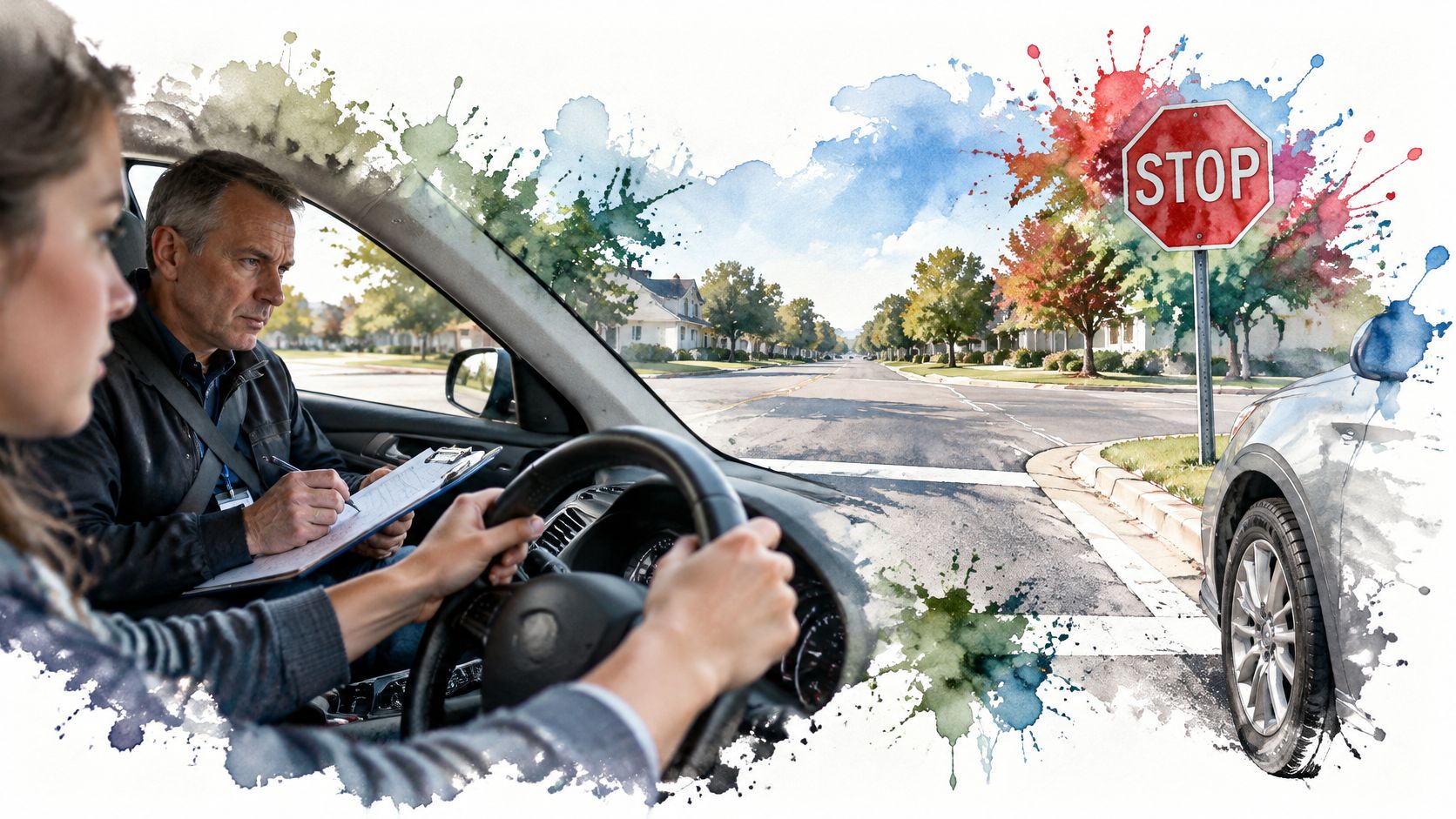
What the examiner is scoring
The evaluation groups into four clusters, and each cluster has a drill.
- Basic control: smooth starts and stops, safe acceleration and braking, steering that keeps the car centered in its lane. Drill it by driving a quiet stretch at a steady speed and narrating your own inputs.
- Turns and intersections: proper right and left turns, a complete stop at every stop sign, correct yielding, and turning into the correct lane rather than drifting wide. Drill a single intersection until the sequence is automatic.
- Lane changes: mirror check, blind-spot check, signal early, move smoothly. Drill by signaling every lane change for a week even when the road is empty.
- Parking: parallel parking or parking between lines depending on the site, plus pulling in and backing out under control. Drill the maneuver the site uses, not the one you practiced.
The four mistakes that cost the most
Forgetting to signal is the quiet killer, because it happens on autopilot when a driver is nervous. Make signaling a spoken habit in practice until it's muscle memory. Speed errors cut both ways: too fast in a school zone fails a driver, and creeping 10 mph under the limit on a main road shows a lack of control, so match the traffic around you.
Skipping blind-spot checks looks like a head that never turns. Exaggerate the glance so the examiner can see it. Panicking after a small error turns one mistake into four, because the driver spends the next minute reliving a wide turn instead of watching the road.
A single small error is recoverable. Panic is what converts it into a failed test.
Teach the reset out loud: shoulders down, eyes up the road, next instruction only. That's the skill that carries a driver through a bad minute.
Book, Confirm and Reschedule Your Road Test
Georgia runs road skills tests by appointment only. The DDS road test page states that automobile, motorcycle, and commercial road skills tests are administered by appointment, and walk-ins are not accepted. That makes the booking itself a task worth doing carefully.
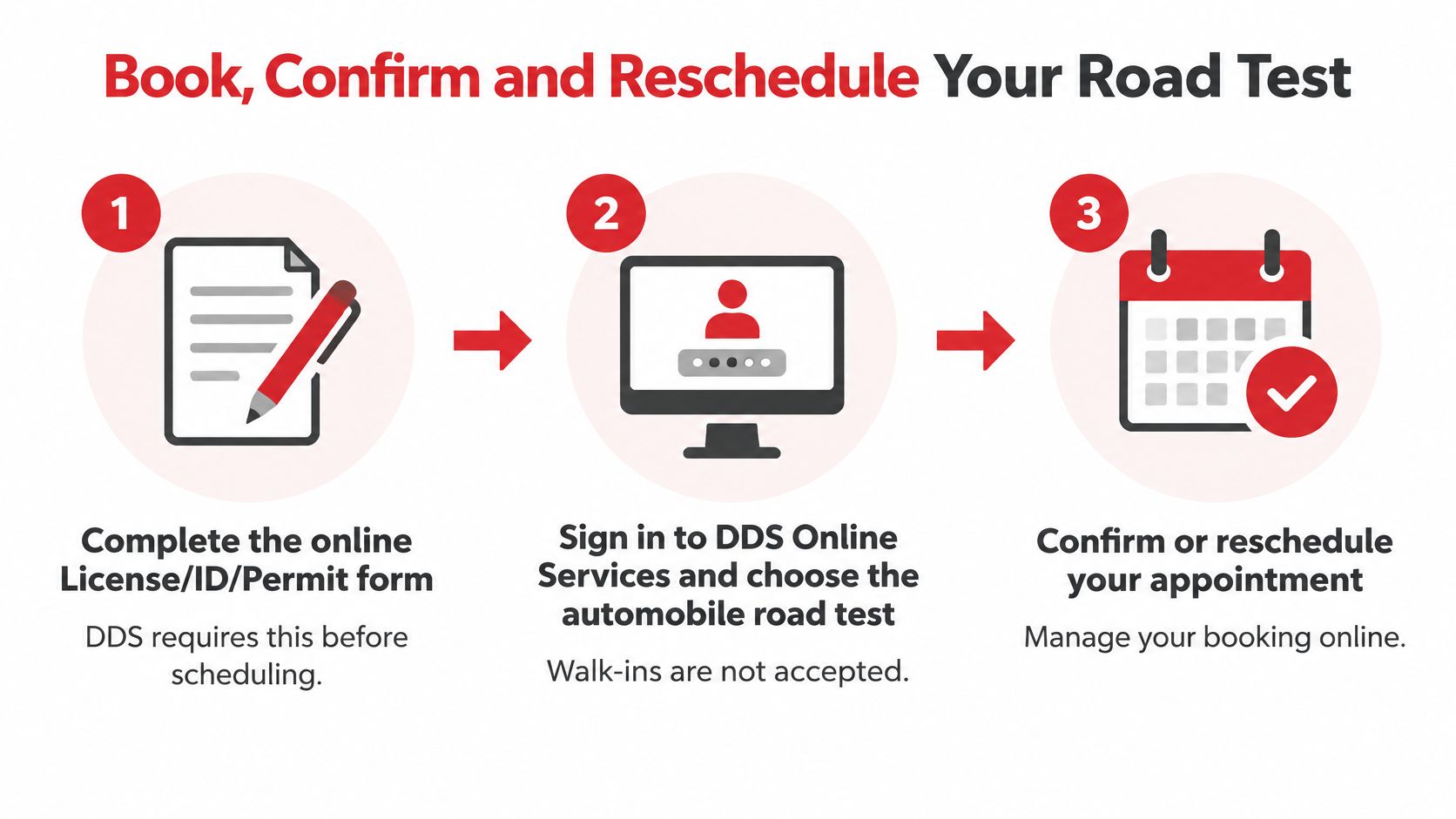
The booking sequence
- File the online License/ID/Permit form first. DDS requires it before scheduling, so a missing form stops the process at step one.
- Sign in to DDS Online Services and select the automobile road test. The slot is the only way in.
- Lock the logistics before you click. Test center, date, time, an accompanying adult who can attend, and registration and insurance that stay valid on that day.
- Check the current test fee and accepted payment method on DDS Online Services. The amount can change, so verify it on the official page rather than trusting a blog post or an old family memory.
- Save the confirmation with name, date, time, location and test type, then set reminders one week out and one day out.
Arrival matters as much as booking. DDS asks applicants to arrive 20 minutes early, because late arrivals may require rescheduling and only the applicant and the accompanying driver may be inside the vehicle during testing. Plan to arrive with time to park, use a restroom, and settle nerves.
When the date has to move
Log back in to DDS Online Services, choose a new slot, and save the new confirmation. Check the current notice period and any charge attached to a change before you cancel anything. The usual rebook triggers are a failed vehicle inspection, a registration that expired, an accompanying adult who can't attend, or illness. Each has a clean fix: repair and recheck the car, print a fresh insurance card, move the date to one the adult can make, or reschedule rather than test a sick driver.
Here's the appointment walkthrough if you want to see the flow before you start.
Decide 48 hours before whether you can attend. Open slots fill fast in Atlanta, and a decision made two days out leaves time to find another date or another location.
A-1 Driving School has taught Georgia drivers since 1987, and our Georgia DMV-approved Joshua's Law courses include all education and road testing, so you're not coordinating a classroom vendor and a test day separately. If you'd rather not gamble a hard-won DDS slot on a driver who isn't ready, book a teen or adult lessons package and let an instructor confirm the skills before the examiner does, or ask us about road testing at one of our locations. Visit A-1 Driving School to pick a course or lesson package and get on the calendar this week.