

What decides the date a Georgia teen can drive alone? Most families answer with a birthday. The answer that matters is a date stamped on a small plastic card, plus a folder of paper that proves the hours behind it.
Two things delay licensing more often than any road skill: the one-year-and-one-day clock and paperwork that doesn't match the rule. A teen can pass the knowledge test on the first try, finish driver education early, and still lose weeks because a school form was signed too long ago or a log went unrecorded. Georgia's learner's permit rules are not complicated. They are just specific, and the specifics are where people trip.
Georgia Learner's Permit Rules at a Glance
Georgia issues a Class CP instructional permit at age 15, charges $10, and keeps it valid for two years, according to the Georgia DDS fees and terms page. Every other rule is a condition attached to that card: who had to sign for it, who must sit beside the driver, and how long the card must stay active before the state issues a Class D provisional license.
| Requirement | Georgia rule | Why it matters |
|---|---|---|
| Permit class | Class CP instructional permit | The only permit type for learners |
| Minimum age | 15 years old | Earliest age to apply |
| Permit fee | $10 | Paid at application |
| Permit validity | Two years from issue | Plan the Class D timeline around it |
| Knowledge and vision tests | Vision exam and knowledge test on road rules and signs | Must pass both before issue |
| Under-18 signature | Parent, guardian or authorized driver-training instructor signs | Required for applicants under 18 |
| School proof (under 18) | Notarized Certificate of School Enrollment signed within 30 days, or high school diploma or GED | Dated proof is checked at application |
| Supervising driver | Licensed driver at least 21, valid Class C license, fit to take control, in the adjacent front seat | Required every time you drive |
| Holding period for Class D | One year and one day with a valid Class CP | Sets the earliest Class D date |
| Supervised driving for 16-year-olds | 40 hours, including 6 at night | Part of Joshua's Law |
The row families underestimate is the holding period. DDS requires Class D applicants to hold the instructional permit for one year and one day before the provisional license is issued, as the Georgia DDS teen drivers page explains. That clock starts on the issue date. It doesn't start on the first lesson, and no amount of extra training shortens it.
Applicants under 18 carry two rows that adults don't: the parent or guardian signature and the dated school enrollment proof. Those are the two most likely to send a family home without a permit. Find the rows that match your age, then read the sections that take each one apart before you book anything.
Who Qualifies and What to Bring to Apply
Are you ready to apply, or could a missing document mean another trip to the DDS? Georgia sets the minimum application age at 15. Applicants must pass a vision examination and a knowledge test on road rules and signs before a learner's permit can be issued, according to the Georgia DDS learner's permit guide.
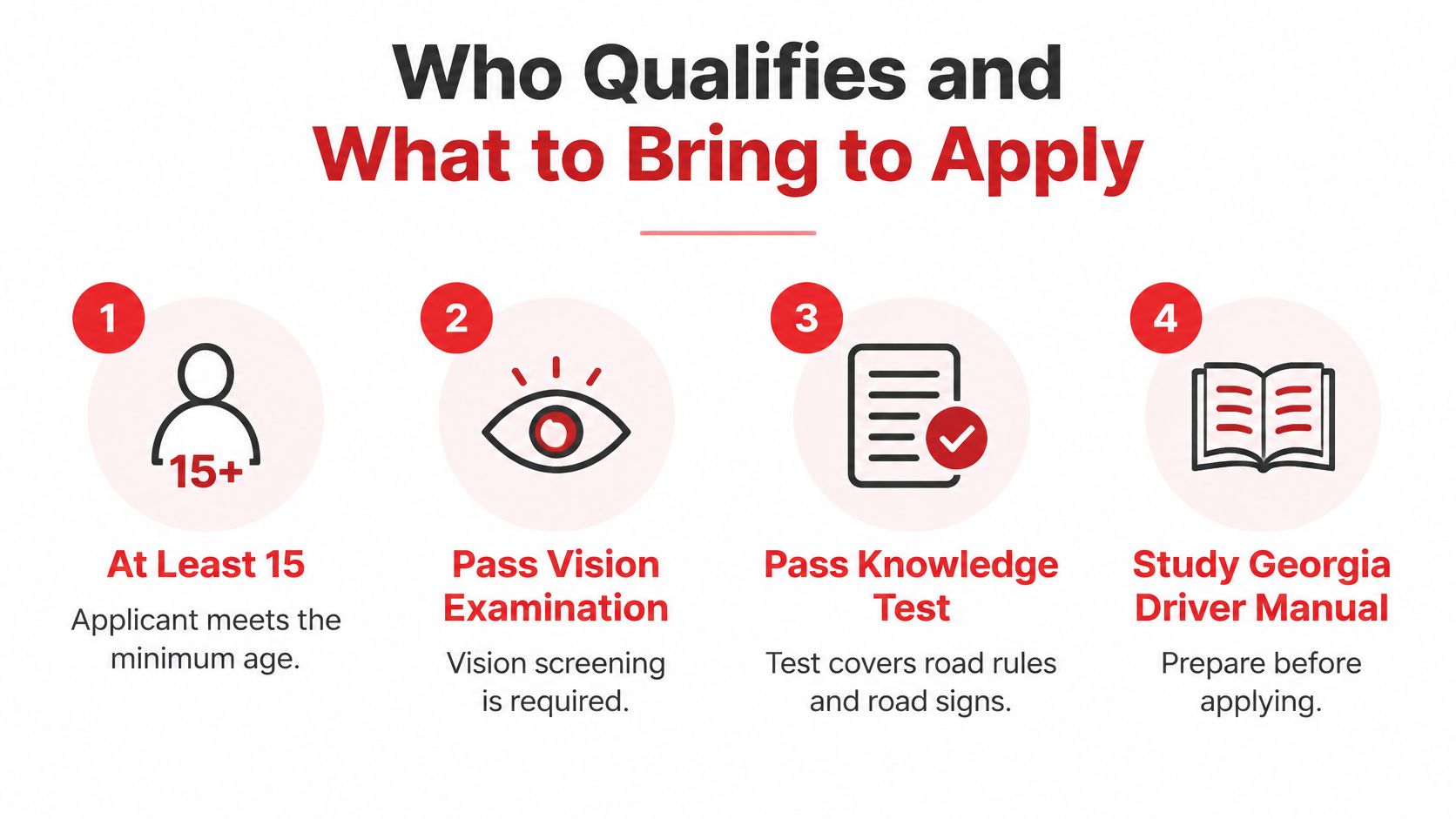
For applicants under 18, paperwork can be the sticking point. Gather the required items before scheduling the visit:
- Confirm the applicant's age. The minimum is 15.
- Prepare for the vision exam. If the applicant uses glasses or contact lenses, bring them for the exam.
- Study for the knowledge test. It covers road rules and signs. Use the Georgia driver manual to prepare for both parts.
- Arrange the required signature. Applicants under 18 need a parent, guardian, or authorized driver-training instructor to sign the application.
- Bring proof of school enrollment or completion. The DDS guide explains the accepted documentation, including the Certificate of School Enrollment and proof of a high school diploma or GED. Check the guide for current document and date requirements before the appointment.
- Check the application fee and identification requirements. Confirm the current fee and what identification to bring in the DDS guide rather than relying on an older checklist.
Check the School Document Before You Go
A school certificate can become outdated, so check its signature date against the current DDS requirements before the appointment. If it does not meet them, request an updated document in time. This small check can prevent a delay at the counter.
Studying for the rules and signs test can start well ahead of the visit. To know what to expect on test day, read about booking a learner's permit test appointment.
After the permit is issued, keep it with its issue date visible. That date is the starting point for tracking the permit period, while a dated driving log helps keep practice records organized.
Who Can Supervise You and When You Can Drive
Here's the rule that decides almost every question a new driver asks. A Class CP permit holder may drive only when a licensed driver who is at least 21, holds a valid Class C license, is fit and capable of taking control, and occupies the adjacent front seat rides along. DDS states those four conditions together, and they apply to every trip.
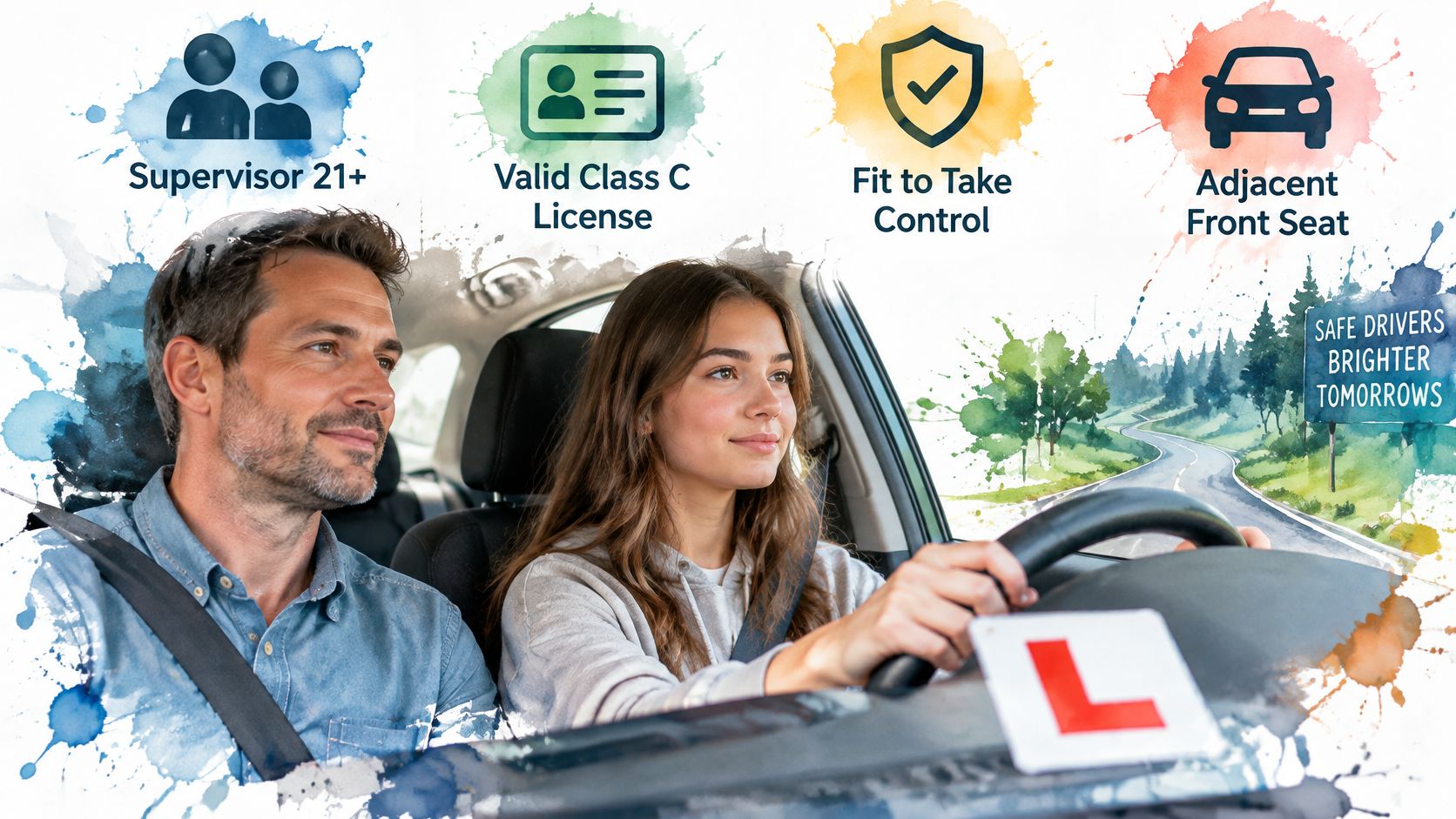
The seat is part of the rule, not a suggestion. A licensed adult in the back seat does not satisfy it. Neither does a 20-year-old sibling with two clean years of driving, because the age floor is 21. And the person beside the teen doesn't have to be a parent: a grandparent, an aunt, or an instructor can supervise, as long as all four conditions hold.
The rule to memorize: no qualifying adult in the seat beside you means no permitted driving. Not to school, not to practice, not around the block.
Building a Driving Log That Survives Scrutiny
The 40-hour record is what a parent later verifies for Joshua's Law, so build it as you go, not the week before the road test. A log that holds up under review has a date, a start and end time, day or night marked in its own column, weather and road conditions, the supervisor's name, and a signature line.
Keeping night hours in a separate column matters because only 6 of the 40 supervised hours need to be after dark, and pulling them out of a flat list later is guesswork. Record the odometer reading if you want a second check on time.
Practice at night once daytime habits settle. Reduced visibility and headlight glare are their own skill set, and a teen who has only driven at noon is not ready for a two-lane road after sunset.
Three Checks Before Every Drive
- The supervisor qualifies. Age 21 or older, valid Class C license, alert and able to take the wheel.
- The seat is the adjacent front seat. Rear seats and third rows don't count.
- The log entry is made before the engine turns off. Date, times, light condition, name.
One practical note for the professional side: a driving lesson requires a valid learner's permit or driver's license first, so the permit is also the doorway to instructor-led practice. Families can track progress and print a clean record using this driving practice log.
Joshua's Law Requirements for 16 and 17 Year Olds
A 16-year-old in Georgia follows Joshua's Law, and the law gives a choice at one fork: how the behind-the-wheel training happens. The Georgia driver's manual sets out both routes, and the classroom requirement is identical on each. What changes is who provides the practical hours and how they're verified.
| Requirement | Certified school path | Parent-taught path |
|---|---|---|
| Driver education | 30 hours in a classroom or certified virtual program | Same 30 hours required |
| Behind-the-wheel training | 6 hours with a certified school | 40 hours of parent-taught training using the Parent/Teen Driving Guide |
| Supervised driving | 40 hours in total, including 6 at night | Same 40 hours, including 6 at night |
| Permit holding period | One year and one day | Same one year and one day |
| Verification | Certified school records | Parent or guardian sworn or written verification |
What Changes at 17
A teen who hasn't completed an approved driver-education course is generally not eligible for a Class D license until at least age 17, as the DDS explanation of Joshua's Law notes. The supervised-driving requirement doesn't relax with age: 40 hours, including 6 at night, still applies. DDS also confirms that an approved course means training from a certified driver-training school or a certified virtual program.
The Order That Works
- Get the permit at 15 or older. Everything else keys off that issue date.
- Choose the course path. Classroom or certified virtual for the 30 hours.
- Log the 40 supervised hours, with 6 of them after dark.
- Complete the behind-the-wheel or parent-taught hours with the certified school or the Parent/Teen Driving Guide.
- Hold the permit for one year and one day. It runs alongside the training, not after it.
- Schedule the road test once every record is dated and signed.
A parent or guardian must provide sworn or written verification that the driving requirement is complete. That signature is why the order matters: the records have to exist before anyone attests to them.
How Long You Must Hold Your Permit and Moving to Georgia
Picture a 15-year-old who earned a learner's permit in another state and drove on it for seven months. The family relocates to metro Atlanta in the middle of that year. The natural assumption is that the clock restarts and the teen waits another twelve months.
It doesn't. The Georgia DDS guidance for new residents with out-of-state credentials states that time held on an out-of-state learner's permit counts toward Georgia's one-year-and-one-day requirement, provided the applicant meets Georgia's permit requirements. Seven months of practice in another state still counts as seven months.
The caveat is documentation. The transfer isn't automatic, and DDS may require an official certified motor-vehicle record, particularly when a prior credential was lost or stolen. A teen whose original issue date can't be proven is treated like a new applicant.
Practical rule: photograph the front of every permit on the day it's issued. The photo is a backup, and the certified record request is the proof.
Georgia's waiting period is longer than most. DDS reports that the National Highway Traffic Safety Administration found, as of November 2021, that 48 states plus the District of Columbia required learner permits to be held at least six months, and that seven of those jurisdictions required a full year, per the DDS teen driving laws FAQ. Georgia's year and a day puts it in the strictest group.
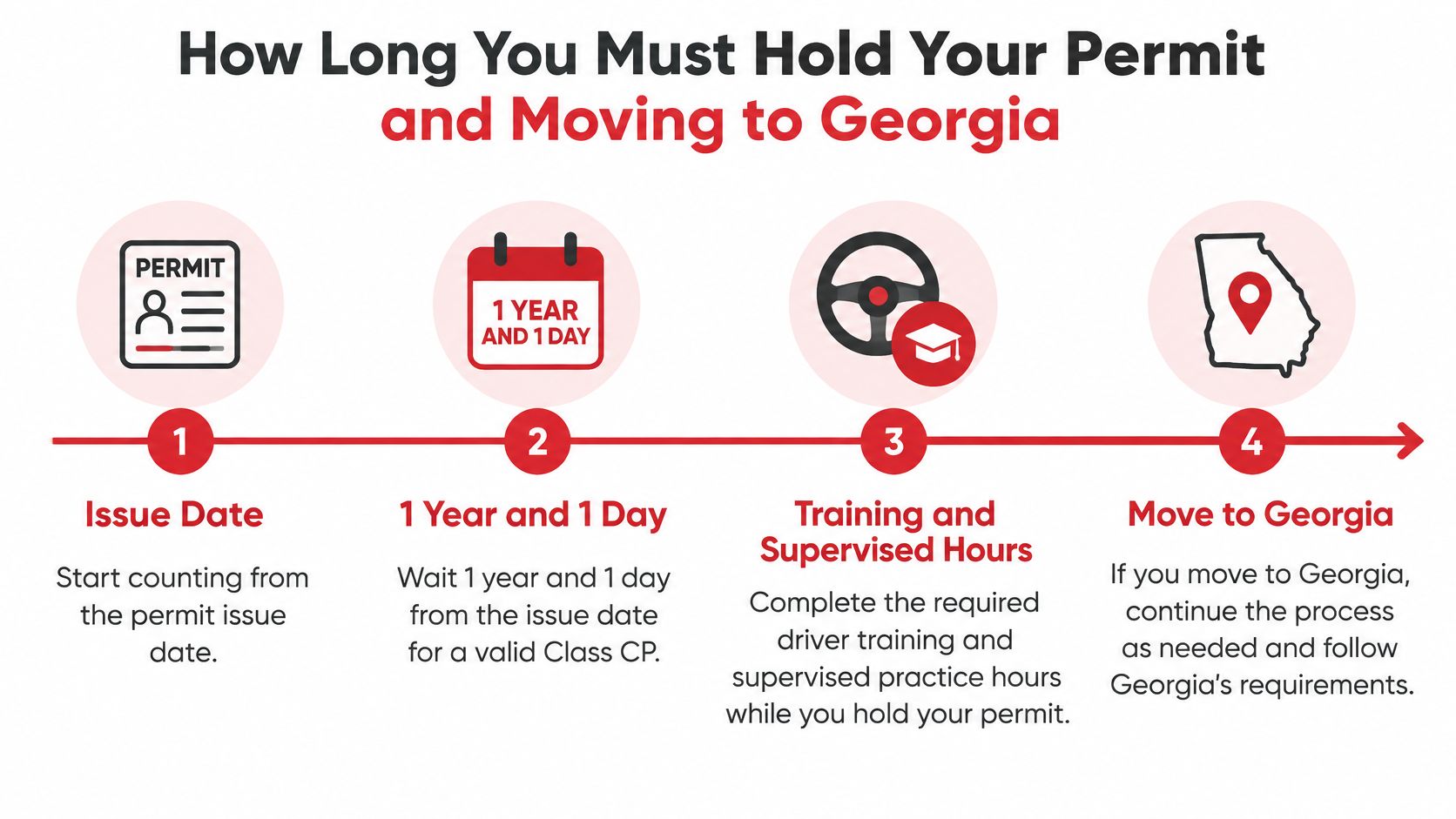
Read the timeline in three points: day zero is the original issue date on the earliest permit, the halfway mark is when training and the 40 supervised hours should be complete or close, and the earliest Class D date is one year and one day after day zero. Keep issue dates, prior permit documents or photos, certified record requests, and the signed log in one folder. A relocating family's whole timeline depends on being able to prove that first date.
What Happens If You Break Permit Rules
The most common violation isn't speeding or a bad turn. It's a teen driving with someone beside them who doesn't qualify, most often a 19-year-old friend or a 20-year-old sibling, on a short trip that felt harmless. The second most common is driving alone, which happens more than parents expect on quick errands.
The consequences are administrative before they're dramatic. Supervised hours that don't meet the rule may not count, which pushes the earliest Class D date back. An application can stall at the counter until records are corrected, and that stall costs weeks. In serious cases, DDS can suspend or cancel the permit itself. The Georgia DDS site is the place to confirm exact penalties rather than a forum thread.
Signing the application carries real weight. A parent or guardian who signs and later verifies the driving record is responsible for its accuracy, so an invented log puts the whole family in a bad position, not just the teen.
Three habits prevent almost all of this:
- Log every drive the same day, before the car is turned off, including the supervisor's name.
- Check the supervisor against the four conditions every time, not just the first time.
- Call DDS before assuming a waiver applies. Hardship and transfer situations exist, and guessing at them delays licensing.
Booking Your Joshua's Law Course and Driving Lessons
Before choosing a course, check the permit issue date, school enrollment proof, and supervised-hour log. These records help keep the next licensing steps on track.
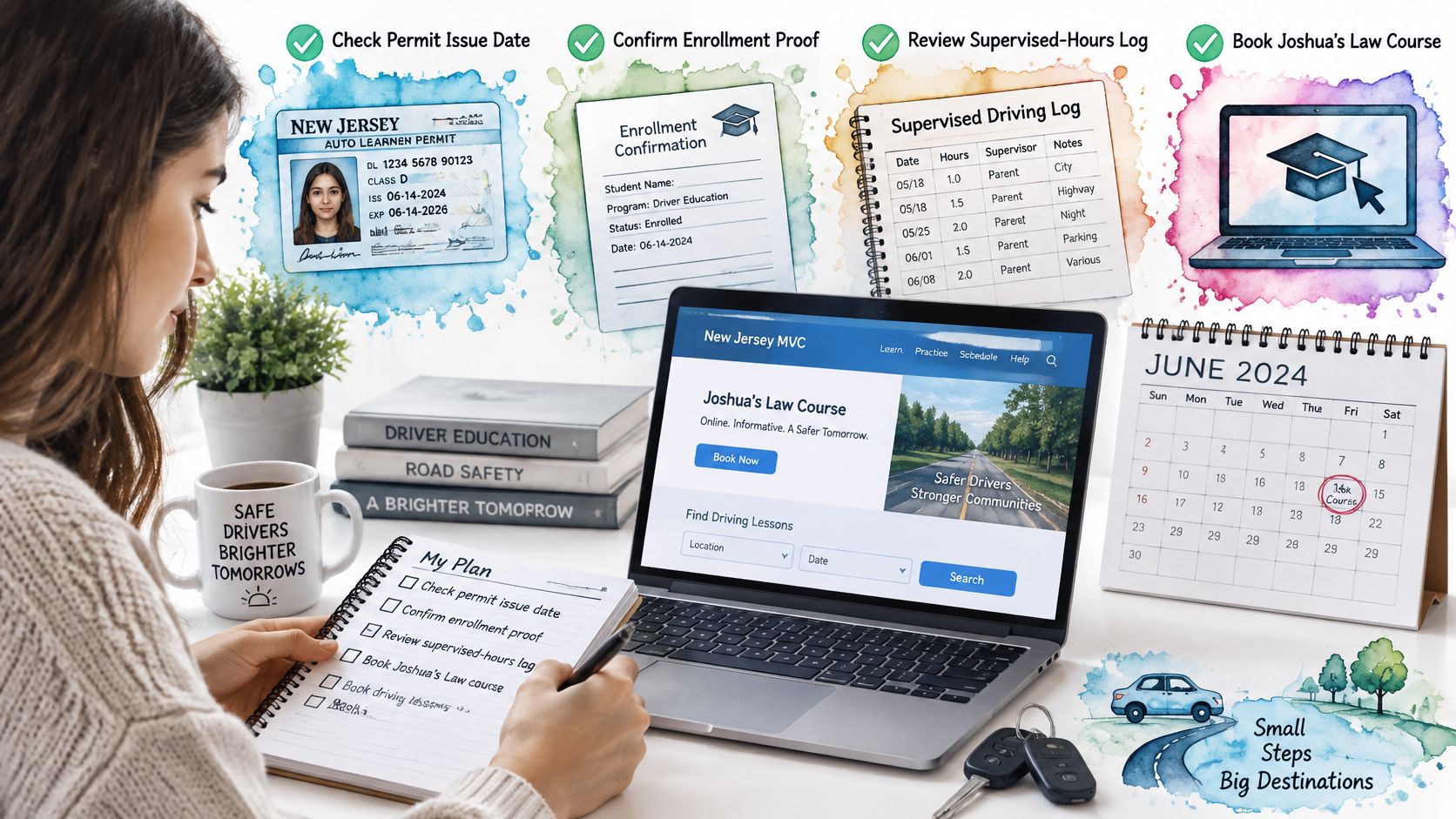
A-1 Driving School offers both an instructor-led and an online Drivers Education Joshua's Law Course. For the certified-school route, the course covers 30 hours of driver education, followed by 6 hours of behind-the-wheel instruction. A-1 also offers teen and adult driving lessons, which provide supervised practice with an instructor. Families who qualify can ask about the Scholarship Grant Program when enrolling.
Keep course enrollment and lesson scheduling together if that helps your family plan. The road test has separate vehicle requirements: the applicant must supply a four-wheel vehicle with valid registration and a license plate, and the passing score is 75%, according to the DDS road test requirements.
Road Test Prep and Your Booking Checklist
A test-ready car and complete paperwork help keep test day on track. Before booking, confirm the DDS requirements for the vehicle and its documents. The applicant provides a four-wheel vehicle with valid registration and a license plate. If the vehicle has a temporary dealership tag, check the DDS rules for the required sales paperwork. The road test page also explains how DDS evaluates the test and determines whether an applicant passes.
Driving skill and vehicle readiness are separate checks. Practice in the vehicle you plan to use, and make sure its registration and plate are in order. The road test scheduling guide covers the appointment process.
A-1 Driving School offers road testing, including the Georgia Road Test. Before leaving for the appointment, check your permit and required documents:
- Permit number and issue date, so you can confirm your eligibility date.
- Notarized school enrollment proof, or a high school diploma or GED.
- Signed supervised driving log, with required night hours clearly marked.
- Vehicle registration and plate, plus sales paperwork if the car has a temporary tag.
- Earliest Class D date, calculated from the permit issue date.
The permit clock and missing paperwork can both delay licensing, so check them before booking. A-1 Driving School offers instructor-led and online Joshua's Law courses, teen and adult driving lessons, road testing, and a Scholarship Grant Program. Visit A-1 Driving School to check course options and schedule training.