Earning a Class A license in Georgia is your ticket to a promising career driving tractor-trailers and other big rigs. It’s the highest commercial license you can get, and it opens up a ton of opportunities in Georgia’s massive logistics industry.
Your Roadmap to a Georgia Trucking Career
Thinking about becoming a professional truck driver? It's a smart move, especially in Georgia. We're a huge hub for the entire Southeast, and the demand for qualified drivers has never been higher.
Getting your Class A Commercial Driver's License (CDL) is a clear, step-by-step process. It's designed to make sure you have the knowledge and skills to handle a large vehicle safely and professionally. You'll start with meeting the basic requirements and end with mastering your skills behind the wheel. It’s not just about passing a test—it's about becoming a pro.
This flowchart gives you a good look at the main stages for earning your Class A license here in Georgia.
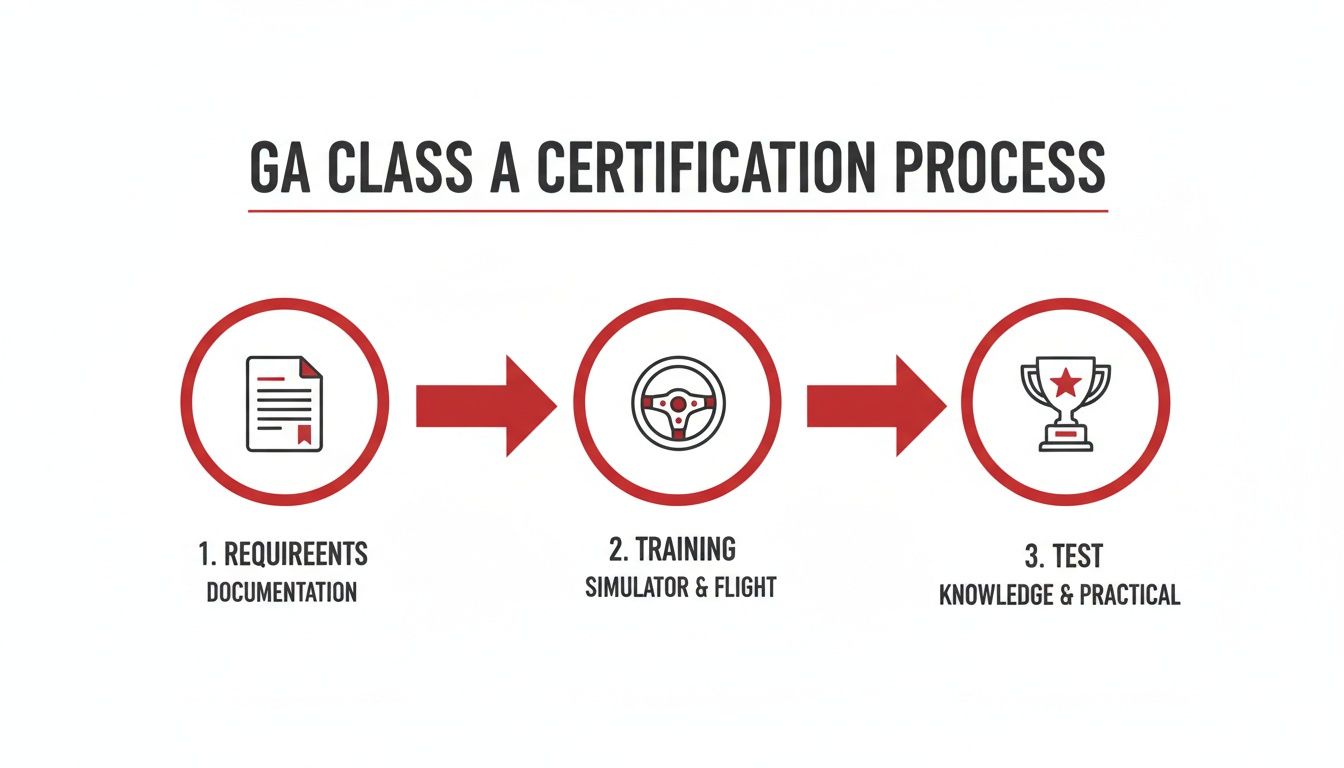
As you can see, the path is straightforward. You start with the basics and paperwork before moving on to the hands-on training and final skills tests.
Why Your Training School Matters
State and federal rules set the minimum standards, but being truly ready for the road comes from expert training that goes beyond just checking boxes. This is where picking the right school is a game-changer. Some programs will teach you just enough to pass the test, but a great program builds your confidence for real-world driving.
At A-1 Driving School, we know that the best training is personal. We focus on one-on-one driving lessons that are built around you. This makes sure you truly master everything from tricky maneuvers to navigating real traffic.
Our focus on driving lessons and driving lesson packages is what sets us apart. We don't just prep you for an exam; we get you ready for a long career. Here’s what that looks like:
- Instruction Built For You: We adjust our teaching to how you learn best, spending extra time on the areas where you need the most practice.
- Guidance from Real Experts: Our instructors have years of professional driving experience, so they can offer practical tips you just can't get from a book.
- Total Road Test Support: We offer specialized road testing services to make sure you walk into your test feeling completely prepared and confident.
Starting the journey for your Class A license in Georgia means understanding the process, but success comes from choosing a training partner that’s invested in you for the long haul. Ready to get started? Explore our CDL and Driving Lesson Courses today.
Meeting the Initial Georgia CDL Requirements
Before you can even think about climbing into the cab of a big rig, you have to get your ducks in a row. Earning a Class A license in Georgia doesn't start behind the wheel—it starts with checking off a list of crucial state and federal requirements.
Think of these as the foundation of your professional driving career. They’re designed to make sure you have the stability and physical fitness to handle the job.
First things first: your age and current license. To drive a commercial vehicle inside Georgia (intrastate), you need to be at least 18 years old. If you plan on hauling freight across state lines (interstate), the minimum age is 21. You also must already have a valid Georgia Class C driver's license.
Your Driving Record and Medical Certification
A clean driving record isn't just a suggestion; it's a must. Both the Georgia Department of Driver Services (DDS) and federal authorities have strict rules that can disqualify you right from the start.
Next up is your health. You’re required to pass a Department of Transportation (DOT) physical exam. This isn't just any doctor's visit—it has to be done by a certified medical examiner listed on the FMCSA's National Registry.
During the exam, they’ll check:
- Vision and Hearing: Can you see and hear well enough to operate an 80,000-pound vehicle safely?
- Blood Pressure and Urinalysis: This screens for conditions like high blood pressure or diabetes that could affect your driving.
- General Physical Health: The examiner will go over your medical history and assess your overall fitness for the job.
Once you pass, you'll get your DOT Medical Examiner's Certificate. This little card is one of the most important pieces of paper you'll need.
Understanding the Georgia Trucking Landscape
Getting your Class A CDL in Georgia is a smart move. The demand for qualified drivers here is booming, especially around the Atlanta metro area, which is a massive logistics hub for the entire Southeast.
Georgia actually ranks #21 in the nation for drivers per capita. We have one CDL driver for every 148 residents—that's 10% higher than the national average! This just goes to show how vital professional training is to stand out from the crowd.
A Class A license is your ticket to operating the biggest vehicles out there, including tractor-trailers with a gross combination weight rating (GCWR) of over 26,001 pounds, pulling a trailer that weighs more than 10,000 pounds. It's the most powerful commercial license you can get.
Assembling Your Documentation
With your medical certificate ready, it's time to gather your ID. The DDS is very specific about the documents you need to prove your identity, residency, and U.S. citizenship or lawful status.
Showing up with the wrong paperwork is a surefire way to waste a whole day at the DDS. Do yourself a favor and get everything in order first. For a complete list of what to bring, check out our guide on Georgia ID requirements for 2026.
Getting these initial steps done correctly makes the rest of the process so much smoother. Once you’ve confirmed you're eligible, passed your physical, and have your documents organized, you're ready for the next big step: getting your Commercial Learner's Permit (CLP).
Your Permit and the Knowledge Tests
Once you've confirmed you're eligible and have your paperwork ready, it’s time to tackle the first real hurdle for your Class A license in Georgia: getting your Commercial Learner’s Permit (CLP). Think of the CLP as your ticket to start training behind the wheel, but first, you have to prove you know your stuff.
This all begins at a Georgia Department of Driver Services (DDS) center. You’ll fill out the CDL application and pay the fees—typically a $35 application fee plus $10 for the CLP itself. After that’s handled, you’ll face the written knowledge tests.
What the Knowledge Tests Cover
For a Class A license, you don't just take one exam. You have to pass three separate tests, and you'll need to score at least 80% on each one.
These are the three tests you'll face:
- General Knowledge: This is the big one. It covers everything from vehicle inspections and basic control to federal rules and what to do in an accident.
- Combination Vehicles: This test is all about the unique aspects of driving a tractor-trailer. You'll be tested on coupling and uncoupling, managing air lines, and preventing dangerous rollovers.
- Air Brakes: You must prove you understand exactly how air brake systems function, how to properly inspect them, and how to use them to safely stop a vehicle that weighs up to 80,000 pounds.
Fair warning: these tests can be tricky. They often use specific phrasing pulled directly from the Georgia CDL Manual, so you really need to learn the key terms and concepts inside and out.
Smart Ways to Study and Pass
Don't make the mistake of just skimming the manual. We see it all the time—students get so focused on the driving part that they blow off the bookwork. Passing these tests on your first try will save you a ton of time, money, and frustration.
The most common mistake we see is students underestimating the knowledge tests. They focus so much on the driving portion that they neglect the bookwork. Passing these exams on the first try saves you time, money, and a lot of frustration.
Your best bet is to mix up your study habits. Read a chapter, then put the book down and try to explain the main ideas out loud. Use practice tests to get comfortable with the types of questions they'll ask and pinpoint where you're struggling. Pay special attention to the sections on vehicle inspections, safe following distances, and emergency maneuvers—those topics are always heavily featured.
Why It's Worth the Effort in Georgia
Putting in the work now really pays off, especially with Georgia's logistics industry booming. Since 2021, the number of people getting their Class A CLP has jumped by an incredible 33%. We've also seen a 32% spike in applicants between 18 and 20 years old.
This shows a huge wave of new talent entering the field as Georgia becomes a major transportation hub. In fact, our state's trucker density is 10% higher than the national average. When you pass these tests, you’re getting ready to join a workforce that is absolutely essential. You can explore more detailed state-specific statistics to see the full picture.
Once you pass all three knowledge tests, the DDS will hand you your CLP. But hold on—you can't start driving just yet. There's a mandatory 14-day waiting period before you can take your final skills (road) test.
This isn't just downtime; it's prime training time. Your CLP is the key that unlocks real, on-the-road practice with a qualified instructor. That 14-day window is the perfect chance to turn what you learned in the book into actual driving skills. A-1 Driving School has flexible driving lesson packages to help you make the most of this critical period and get you ready for the road.
Tackling Your Behind-the-Wheel and Driver Training
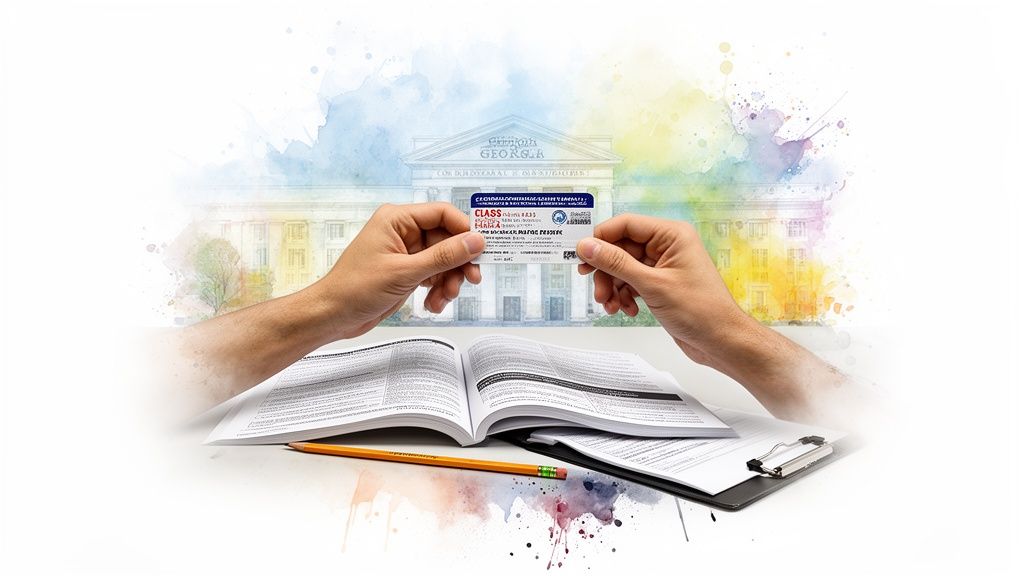
Passing the written tests for your Commercial Learner's Permit (CLP) is a huge step, but the real work starts now. It’s time to get out of the classroom and onto the road for the most critical part of earning a Class A license in Georgia: hands-on, behind-the-wheel training.
This is where all that book knowledge gets put to the test on the asphalt. Federal law now requires all new Class A applicants to complete Entry-Level Driver Training (ELDT) from a school listed on the official Training Provider Registry. This ensures every new driver hits a national standard for safety before they can even book their final road test.
What is Entry-Level Driver Training (ELDT)?
ELDT isn't just about driving around a parking lot. It’s a formal program that covers both theory (classroom work) and behind-the-wheel (BTW) practice. While many schools offer online options for the theory portion, the BTW training is where you get in the truck with a certified instructor.
Your BTW training is broken into two key settings:
- Range Training: This happens on a closed course, away from other cars. It’s a low-pressure environment where you can master the fundamentals of handling the truck.
- Public Road Training: After you’ve got the basics down, you’ll head out onto public roads to learn how to manage the truck in real traffic.
One of the biggest misconceptions is that ELDT requires a certain number of hours. That's not how it works. Instead, it’s all about proving you are proficient in a specific set of skills. Your instructor signs off on each skill only when you've truly mastered it.
You don't pass ELDT by just showing up. You have to prove to your instructor that you can safely and consistently perform every required maneuver. Only then will you be certified to take the final CDL skills test.
This proficiency-based system is why picking the right driving school is so important. A good school won't just check boxes; they'll invest the time to make sure you’re truly confident and road-ready.
Before you get started, it's a good idea to understand the full scope of what's involved, both in terms of money and time.
Georgia Class A CDL Costs and Timeline Overview (2026 Estimates)
This table gives you a general idea of what to budget and plan for. Keep in mind that costs for training can vary significantly based on the school and the level of instruction you choose.
| Item/Step | Estimated Cost | Estimated Timeline |
|---|---|---|
| DOT Medical Exam | $85 – $150 | 1 Day |
| CLP Application & Tests | $45 ($10 application + $35 tests) | 1-4 Weeks (for study) |
| ELDT & CDL Training School | $4,000 – $8,000+ | 3-7 Weeks |
| CDL Skills Test Fee | $50 (DDS) or $100+ (Third-Party) | 1 Day |
| CDL License Fee | $32 | 1 Day |
| Total | $4,200 – $8,300+ | 4-12 Weeks |
Ultimately, your total investment will depend on the school you choose and how quickly you master the required skills.
Why Go Beyond the ELDT Basics?
ELDT sets the minimum standard, but if you want to be a top-tier professional driver, meeting the bare minimum isn't enough. Think of it this way: the ELDT curriculum is the same for everyone, but no two students learn at the same pace. You might nail your backing maneuvers on the first try but find it tough to manage your speed on steep downgrades.
That’s where personalized, one-on-one driving lessons make all the difference.
At A-1 Driving School, we focus on building driving lesson packages that go well beyond just passing the test. Our instructors work with you to pinpoint your weak spots and tailor your training to build confidence where you need it most. This approach helps you understand not just how to do something, but why it's done that way.
Our goal is simple: prepare you for a long, safe career, not just the exam.
Here’s what sets our approach apart:
- One-on-One Coaching: You get the full attention of your instructor, which means you get instant feedback.
- Mastering Tough Skills: We dedicate extra time to the things new drivers struggle with most, like alley docking and navigating tight city streets.
- Real-World Practice: We put you in situations you’ll actually face on the job, like dealing with busy loading docks or unpredictable drivers.
- Building a Defensive Mindset: We work to instill the proactive habits that keep you and everyone else on the road safe.
This kind of in-depth training is more important than ever. With a 32% increase in young drivers aged 18-20 entering the field, competition is growing. Superior skills learned from a quality program will give you a real edge.
Choosing a school that offers more than the bare minimum is an investment in your career. It's the difference between being someone who can pass a test and becoming a professional driver who can handle anything.
If you’re ready to build real-world skills, you can explore our expert-led driving lessons to find a program that fits your goals.
Passing Your CDL Skills Test and Getting Licensed
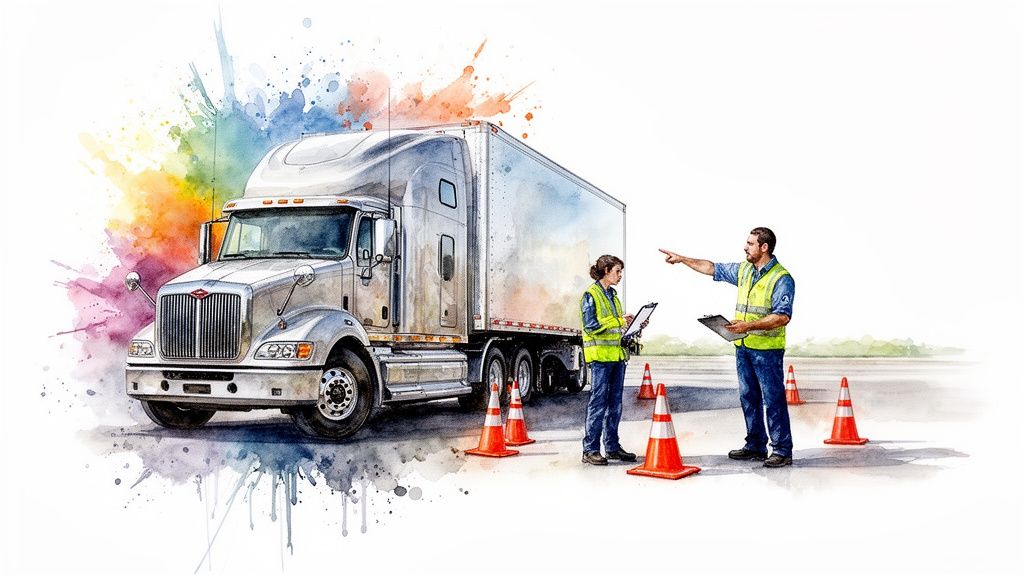
Alright, this is the final hurdle. You've put in the hours studying and practicing, and the CDL Skills Test is all that’s left between you and that Class A license in Georgia. Don't think of it as one single test, though. It's a comprehensive, three-part exam designed to make sure you have the real-world skills to handle a big rig safely.
Knowing exactly what’s coming in each section is the best way to walk in feeling prepared. The whole thing is designed to test you from the ground up, starting with knowing your truck inside and out and ending with how you handle yourself in traffic.
The Pre-Trip Vehicle Inspection
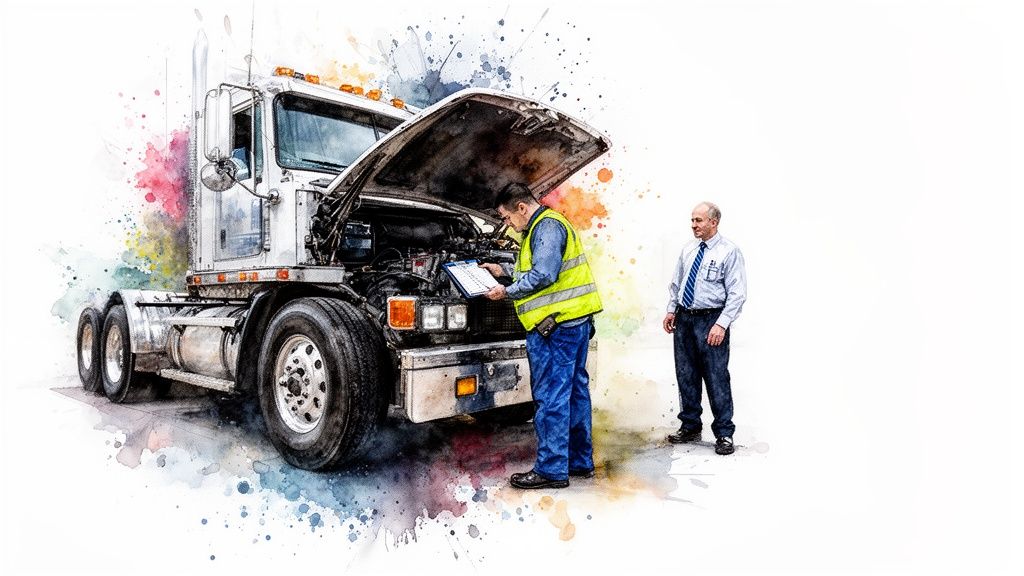
The test starts before you even fire up the engine. The Pre-Trip Vehicle Inspection is where you prove to the examiner you know how to do a full safety check on your tractor-trailer. You won't just be pointing at things; you'll have to explain what you're checking and why it matters for safety.
You’ll need to walk the examiner through a methodical inspection of key systems, including:
- Braking Systems: You'll check for worn pads, make sure air lines are secure, and confirm the air compressor is working as it should.
- Coupling System: This means showing you can inspect the fifth wheel, the locking jaws, and the entire connection between your tractor and trailer.
- Tires and Wheels: Point out proper tread depth, look for any damage, and check that the lug nuts are tight.
- Lights and Reflectors: You have to verify every required light and piece of reflective tape is present and working correctly.
This part is all about muscle memory and being able to talk through your process. Examiners want to see a system. A common mistake we see is people rushing or completely forgetting to mention a critical safety item. Take your time.
Mastering the Basic Control Skills
Next up is the Basic Control Skills test, which most drivers just call the backing test. This happens on a closed course laid out with cones and lines. The whole point is to see how well you can maneuver that truck and trailer with precision when space gets tight.
The specific exercises can vary, but you can count on being tested on a few core maneuvers:
- Straight-Line Backing: The most fundamental skill. You have to back the trailer straight without wandering outside the lines.
- Offset Backing: This involves backing into a lane that's off to your left or right, not directly behind you.
- Parallel Parking (Driver or Conventional): Just what it sounds like. You’ll simulate backing into a spot at a loading dock or next to a curb.
These drills are all about using your mirrors, understanding your pivot point, and making small, smooth steering corrections. A huge mistake is over-correcting. Slow and steady really does win the race here.
The On-Road Driving Test
The last piece of the puzzle is the On-Road Driving test. You'll take the truck out onto public streets with the examiner riding shotgun. They're going to be watching how you operate the vehicle in all kinds of real-world traffic scenarios.
The road test isn't about just following traffic laws—it's about showing you think like a professional. The examiner is looking for your ability to see and react to hazards, manage the space around your truck, and drive defensively.
You’ll be scored on your performance in several key areas, such as:
- Making right and left turns without hopping curbs or drifting into other lanes.
- Handling intersections and traffic lights correctly.
- Changing lanes and merging onto highways safely.
- Keeping a proper speed and safe following distance.
There are things that will fail you on the spot, like running a red light or causing an accident. To get a better feel for what examiners focus on, check out our guide on what to expect during the Georgia road test.
At A-1 Driving School, we offer comprehensive road test services to give you that final polish. We can provide the test vehicle and give you last-minute coaching to make sure you’re ready for every single part of the skills exam. It’s that extra support that helps our students go into their test with the confidence they need to succeed.
Frequently Asked Questions About the Georgia Class A License
Starting a career in trucking is exciting, but we know the process can bring up a lot of questions. From the costs involved to how long it all takes, getting clear answers is the first step. Here are some of the most common questions we get from aspiring drivers in Georgia.
How Much Does It Cost To Get a Class A License in Georgia?
The total cost is a mix of state fees and your training investment.
The DDS fees for the permit and license itself are pretty minimal, usually totaling less than $200. The main expense is your Entry-Level Driver Training (ELDT), which is required by federal law.
Depending on the school and how extensive the program is, you can expect ELDT to cost anywhere from $4,000 to over $8,000. Think of this as the foundation of your new career. A quality program with plenty of behind-the-wheel hours is an investment in your safety and confidence on the road.
How Long Does It Take To Get a Class A CDL in Georgia?
If you can attend full-time, you can realistically complete the entire process in four to eight weeks.
This timeline covers everything: studying for your permit, the mandatory 14-day waiting period after you get your CLP, and completing your ELDT course.
Many people can't commit to a full-time schedule, and that's okay. Schools like A-1 offer part-time and flexible programs so you can learn at a pace that works for you. Consistency is what matters most.
A key point: You can do the theory or classroom portion of your ELDT online. However, the hands-on, behind-the-wheel training must be done in person with a certified instructor. There's no substitute for real-world driving experience.
Can I Use a Scholarship for CDL Training?
This is a common point of confusion. The Georgia Driver's Education Scholarship Grant Program, often associated with Joshua's Law for teen drivers, is only for those seeking a regular Class D license. It does not apply to any Commercial Driver's License training.
Don't let that stop you. Many CDL schools have their own financing options or can point you toward grants and loans specifically for vocational training. Always ask the admissions office what financial resources are available.
What Happens if I Fail the CDL Skills Test?
Failing any part of the three-part skills test (pre-trip inspection, basic controls, or the on-road test) means you have to wait at least one business day before you can try again. This can be frustrating and add extra costs.
A failed test is usually a sign that you just need more practice in a specific area. This is where professional coaching makes a huge difference.
Our road testing services at A-1 Driving School are designed for this exact scenario. We not only provide a proper vehicle for your test but also offer focused coaching to fix any weak spots, giving you the best possible chance to pass.
At A-1 Driving School, our goal isn't just to help you pass the test—it's to build safe, confident drivers for life. From our comprehensive CDL courses to personalized road test prep, we have a program to get you on the road.
Explore our CDL and Driving Lesson Courses to start your journey today.