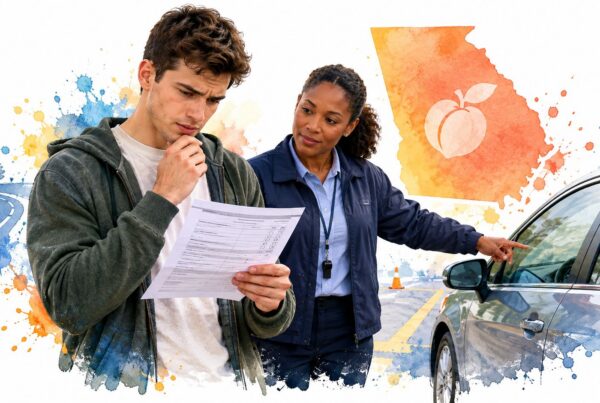
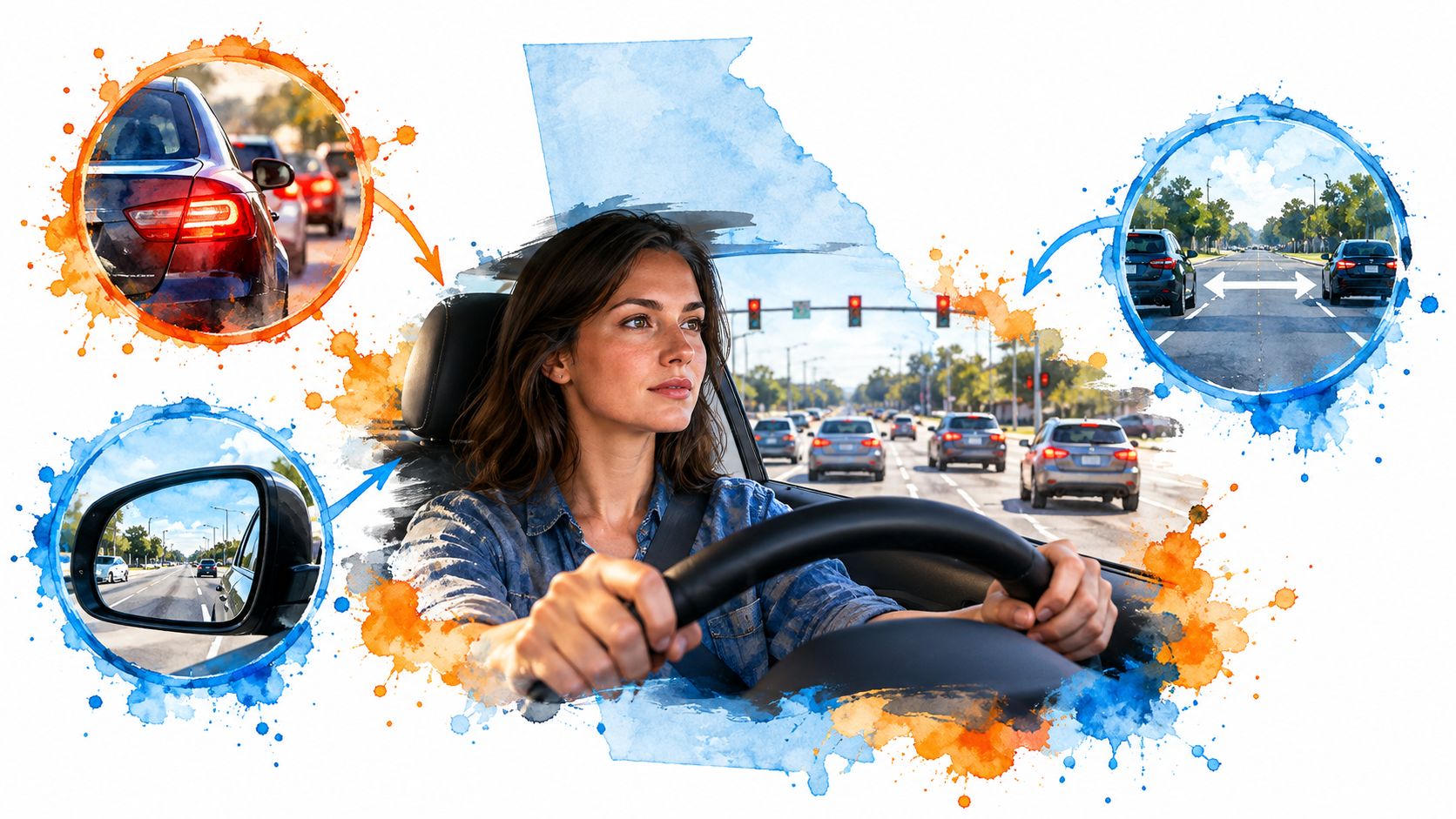
A new driver approaches a busy Georgia intersection and notices a vehicle edging toward the merge lane. Instead of waiting for the other driver to make a sudden move, the driver eases off the accelerator, checks the mirrors and blind spot, watches surrounding traffic, and leaves enough room to respond. Nothing dramatic happens. That's the point. Good driving often looks like a series of small decisions made early.
Defensive driving practices are learned behaviors, not just emergency reactions. They begin with understanding Georgia's rules, continue through supervised practice, and become reliable when a student receives feedback behind the wheel. For Georgia teens, the path can include Joshua's Law education, an in-person or online course, customized driving lessons, lesson packages, scholarship guidance, and road test preparation.
A-1 Driving School connects those steps for students and families across Georgia. The focus here is practical driver's education, not lengthy DUI or defensive-driving theory. Each practice below shows how a student can move from knowing what to do to applying it confidently in Atlanta traffic, school zones, highways, and neighborhood streets.
1. Joshua's Law Driver's Education Program
Georgia students need a clear foundation before they begin making independent decisions behind the wheel. For eligible 16- and 17-year-olds seeking a Class D license, Joshua's Law requires 30 hours of driver education, 6 hours of behind-the-wheel training at a certified school or 40 hours of parent-taught training, and 40 hours of supervised driving that includes 6 hours at night. The requirements are listed by the Georgia Department of Driver Services.
That classroom foundation helps students understand traffic laws, signs, right-of-way decisions, hazard recognition, and responsible vehicle operation. A Fulton County student preparing for a Class D license, an Atlanta teen working toward a learner's permit, and a homeschooled student may all need a different schedule, but each benefits from learning the rules before handling busy roads.
A-1 Driving School offers instructor-led and online driver's education options connected to Joshua's Law. Its service area includes 18+ locations across metro Atlanta and Athens, making it practical for families comparing location, timing, and lesson availability.

Turn classroom knowledge into road habits
Students should enroll early enough to choose a suitable course date. Those balancing school, sports, work, or family responsibilities may prefer online learning, while others learn better in a classroom with an instructor. Keep the completion certificate in a safe place for permit and licensing steps, and consider teen car insurance guidance when planning the full cost of becoming a driver.
Joshua's Law education is only the first stage. Pairing it with professional driving lessons gives students an opportunity to apply concepts such as scanning, signaling, speed control, and space management under supervision.
2. Professional Driving Lessons and Customized Training Packages
A classroom can explain how to merge, turn, brake, and position a vehicle. It can't reproduce the pressure of a crowded Atlanta intersection or give immediate feedback when a student checks a mirror too late. Professional driving lessons close that gap through one-on-one instruction and repeated practice.
A nervous teen might begin with seat position, mirror adjustment, smooth acceleration, controlled braking, and basic turns. After those skills become more comfortable, the instructor can introduce lane changes, multilane intersections, highway entry, and heavier traffic. An adult driver returning to the road may need a refresher, while an international driver may need help adapting to Georgia road markings, right-of-way expectations, and local traffic patterns.
A-1 Driving School's customized lessons and driving lesson packages support that progression. A package can provide continuity between sessions, so the student works on the same skill repeatedly rather than treating every appointment as an isolated experience.
Build a progression that matches the driver
A useful lesson sequence may look like this:
- Start with control: Practice steering, braking, turns, lane position, and basic vehicle controls in a manageable environment.
- Add traffic decisions: Work on intersections, merging, yielding, traffic signals, and recognizing what other road users may do next.
- Increase complexity: Introduce highways, varied traffic, unfamiliar roads, and situations that require earlier planning.
- Prepare for the test: Focus on the maneuvers and habits the student still performs inconsistently.
Instructor feedback matters: A student may believe a turn was smooth while an instructor notices late braking, an incomplete mirror check, or poor lane position.
Book lessons early during busy school and summer periods when possible. Ask the instructor to vary conditions and identify the intersections or maneuvers that create the most uncertainty. Consistent practice helps a student build judgment instead of memorizing a single route.
3. Georgia Road Test Preparation and Testing Services
Road test preparation should begin before test day, not when the appointment is already approaching. Students who have completed Joshua's Law and accumulated supervised practice can use targeted lessons to identify gaps in vehicle control, observation, signaling, lane changes, and low-speed maneuvers.
A-1 Driving School provides Georgia road test preparation and testing assistance. The preparation process can help a student understand what to expect, practice test-specific maneuvers, and become more comfortable with the vehicle used during the appointment. That's useful for a high school senior hoping to complete licensing before graduation, a teen following the sequence from Joshua's Law to lessons to testing, or a parent who wants an objective assessment before the official test.

Practice the details that expose weak habits
Parallel parking and three-point turns often reveal whether a student can control speed, steer smoothly, check surroundings, and follow a sequence without rushing. They deserve deliberate practice, not a quick review immediately before the appointment. Students should also rehearse ordinary road behavior, including complete stops, safe turns, lane positioning, and following examiner instructions.
Schedule preparation with enough time to address feedback. A student who drifts toward the curb during turns may need additional spatial-awareness work. Someone who brakes late at intersections may need more scanning and speed-management practice. The right response isn't just repeating the entire test route. It's isolating the habit that causes the mistake.
Arrive early for the official appointment with the required documents and a familiar vehicle. If the student doesn't pass, feedback can guide the next lesson rather than turning the result into a vague judgment about driving ability.
4. Online Driver's Education Courses and Virtual Learning Options
Online driver's education gives Georgia students another way to complete the classroom portion of their preparation. It can suit a teen whose sports schedule changes each week, a working student who needs evening study time, or a homeschooled student who wants to manage coursework from home. It can also help students in areas where an in-person classroom isn't convenient.
A-1 Driving School offers online driver's education courses designed to meet Georgia requirements while giving students scheduling flexibility. The student still needs to take the course seriously. Learning from home doesn't remove the need to understand signs, traffic laws, hazard recognition, and safe vehicle operation.

Make virtual learning active
A consistent study routine works better than rushing through material between other commitments. Keep notes on concepts that need reinforcement, especially topics that will matter during supervised driving. A student who understands the definition of a blind spot should still ask an instructor to observe whether the student checks it correctly before changing lanes.
Online education also works best when it connects quickly to behind-the-wheel practice. After studying right-of-way rules, the student can discuss real Georgia intersections with an instructor. After learning about adverse conditions, the student can practice appropriate speed and spacing when conditions safely allow.
Save the completion certificate for permit and license applications. Students with technical questions or uncertainty about course requirements should contact A-1 support rather than guessing. Enrolling early also gives families time to arrange driving lessons and road test preparation after the classroom work is complete.
5. Georgia Driver's Education Scholarship Grant Program
The cost of driver education can affect whether a student receives structured instruction or relies only on informal practice. Georgia's Driver's Education Scholarship Grant Program supports eligible Georgia residents who are 15 to 17 years old and have a valid Georgia instructional permit or driver's license. The program applies to students completing the 30-hour classroom course and 6-hour behind-the-wheel course, as described in the Georgia program rules.
A-1 Driving School participates as an approved provider and can help families understand the relationship between scholarship eligibility, course enrollment, and available training. A single-parent household, a family supporting multiple teens, or a student in an underserved community may benefit from investigating the program before assuming professional lessons are out of reach.
Ask the right questions before enrolling
Scholarship support doesn't mean every service or package is automatically covered. Families should confirm which A-1 courses and services qualify, what documentation the application requires, and how the timeline fits with the student's permit and licensing plans.
- Check eligibility: Confirm the student's Georgia residency, age, permit or license status, and other program requirements.
- Prepare documentation: Gather the information requested for the application before choosing a course date.
- Ask about coverage: Verify whether the grant applies to the specific classroom and behind-the-wheel training being considered.
- Plan around timing: Discuss processing expectations with A-1 staff so the student isn't left waiting until a deadline is close.
Scholarship guidance belongs near the beginning of the planning process. Once funding and course timing are clearer, families can select an online or in-person education option and arrange driving lesson packages that reinforce the classroom material.
6. Defensive Driving Techniques for Hazard Anticipation and Situational Awareness
A Georgia school zone can change in seconds. A stopped bus, brake lights, children near the curb, or a vehicle leaving a driveway may each signal a developing hazard. Defensive driving starts by noticing these clues before a conflict reaches your lane.
Use the SIPDE process, Scan, Identify, Predict, Decide, and Execute, as a repeatable checklist. Scan beyond the vehicle directly ahead, like watching several pieces of a moving scene rather than focusing on one object. Identify possible conflicts, such as a parked car with its wheels turned toward traffic. Predict what may happen, decide how much space or speed adjustment you need, and execute smoothly.
A-1 instructors can coach this routine during ordinary Georgia driving situations. A student may practice reading a pedestrian's body language near a crosswalk, spotting a cyclist before turning, or leaving extra room around a motorcycle or large truck. Supervised practice helps turn each step into a driving habit.
Keep attention wider than the windshield
Out-of-state driver manuals, such as the New York driver safety manual, recommend frequent mirror checks, including checks every 5–10 seconds, while continuing to scan the road. They also advise keeping phones out of reach or using do-not-disturb settings, because hands-free use can still distract a driver. These habits apply when students drive Georgia roads during lessons or supervised practice.
Clear vision supports wider scanning. Drivers who want to sharpen visual clarity behind the wheel can drive safer with Essilor driving lenses, while remembering that lenses cannot replace attention or sound decisions.
Practice hazard recognition in daylight, darkness, rain, and varied traffic conditions when an instructor considers it safe. Ask whether your eyes move far enough ahead and whether you leave an escape option when traffic tightens. A dedicated hazard perception training lesson can focus that feedback.
Good scanning cannot control every road user. It gives you more time to notice a problem and choose a controlled response.
7. Speed and Following Distance Management
Speed management means choosing a speed that fits visibility, traffic, road surface, curves, and the vehicle's available traction. A posted limit is important, but it doesn't make the same speed appropriate in heavy rain, fog, darkness, a work zone, or a sharp curve.
Following distance creates room for perception and braking. Rear-end collisions are especially relevant to this practice. The National Highway Traffic Safety Administration's 2023 data, cited by Consumer Reports' defensive-driving guide, recorded close to 6 million motor-vehicle crashes and almost 41,000 fatalities in the United States. The same source notes that 4 of every 10 crashes in New York are rear-end collisions, usually connected to following too closely.
Adjust space before conditions force you to
Use the three-second following rule by selecting a fixed road marker. When the vehicle ahead passes it, count “one-thousand-one, one-thousand-two, one-thousand-three.” Reach the marker only after completing the count. Increase the gap when rain, fog, darkness, congestion, or poor traction reduces the time available to respond.
A Georgia student might slow before entering a school zone during dismissal, approach a sharp curve more cautiously than the posted limit, or create additional space on a wet interstate. The exact decision depends on conditions, not on a memorized speed reduction.
Practical rule: If you can't see far enough ahead to identify a developing hazard, reduce speed before the hazard becomes immediate.
Students can practice these decisions during A-1 lessons in light, moderate, and heavier traffic. They can also review how far away to brake so braking becomes an intentional process rather than a last-second reaction. Smooth speed changes help other drivers understand what you're doing and leave more options when traffic changes.
8. Vehicle Control and Emergency Maneuvers
Anticipation reduces risk, but it can't eliminate every sudden event. A car door may open into the lane, a vehicle may stop unexpectedly, or a driver may need to merge into moving traffic. Vehicle control skills help the student respond without panic, overcorrection, or abrupt steering.
Professional lessons should begin with fundamentals. The student needs to understand the vehicle's brake system, steering response, mirrors, and controls before attempting more complex maneuvers. With an instructor in a controlled training vehicle, the student can work on emergency braking, smooth steering, controlled swerving, traction management, and safe merging.
An emergency stop with ABS requires firm braking while maintaining steering control. Recovering from hydroplaning requires calm inputs and avoiding aggressive overcorrection. These skills are difficult to learn from a written explanation alone, which is why supervised practice matters.
Connect emergency skills to test skills
Road test preparation also depends on precise vehicle control. Parallel parking, three-point turns, controlled stops, and lane changes require the same fundamentals as defensive driving: smooth steering, appropriate speed, observation, and communication.
Watch the instructional video below before discussing the techniques with a qualified instructor.
A lesson on handling emergency driving situations should match the student's current ability and the vehicle being used. Don't practice aggressive swerving or braking on public roads without professional supervision. Start with smooth, repeatable control, then progress only when the instructor confirms that the student can manage the vehicle safely.
Defensive Driving: 8-Point Comparison
| Program / Topic | Implementation complexity | Resource requirements | Expected outcomes | Ideal use cases | Key advantages |
|---|---|---|---|---|---|
| Joshua's Law Driver's Education Program | Moderate, structured 30‑hour, state-mandated curriculum | Certified instructors, classroom/online platform, completion certificate | Meets Georgia education requirement; foundational driving knowledge | Teens (15–18) seeking permit/license and legal compliance | State‑approved certification, hybrid delivery, scholarship availability |
| Professional Driving Lessons & Customized Packages | Low–Moderate, flexible, individualized sessions | Dual‑control vehicles, certified instructors, scheduling system | Practical skills, confidence, road‑test readiness | Nervous/new drivers, those needing targeted practice or skill refinement | One‑on‑one feedback, tailored progression, real‑world practice |
| Georgia Road Test Preparation & Testing Services | Low, focused on test standards and maneuvers | Practice routes, instructor assessments, scheduling near DDS dates | Higher first‑pass rates and reduced test anxiety | Students about to take official DDS road test | Targeted maneuver practice, examiner procedure familiarity |
| Online Driver's Education Courses & Virtual Options | Low, self‑paced digital delivery | LMS, internet access, device, instructor support | Joshua's Law completion certificate and theoretical knowledge | Busy students, homeschooled teens, rural or remote learners | Maximum flexibility, accessibility, typically lower cost |
| Georgia Driver's Education Scholarship Grant Program | Moderate, eligibility verification and application process | Financial documentation, administrative support, grant funds | Reduced or covered training costs; increased access to instruction | Low‑income families seeking affordable driver education | Removes cost barriers, state‑funded aid, A‑1 application support |
| Defensive Driving: Hazard Anticipation & Situational Awareness | Moderate, behavioral skills requiring practice | Instructor guidance, on‑road practice, continuous mental engagement | Improved hazard recognition and proactive driving habits | All drivers, especially new teens and those in complex traffic | Broad applicability, reduces accident risk, transferable skills |
| Speed & Following Distance Management | Low, behavior modification and reinforcement | Instructor instruction, real traffic practice, feedback | Safer spacing, reduced collision severity, better control | Highway drives, dense traffic, drivers learning safe spacing | Immediate safety gains, reduced wear/fuel use, insurance benefits |
| Vehicle Control & Emergency Maneuvers | High, hands‑on, motor‑skill development in controlled settings | Dual‑control vehicles, safe practice areas, experienced instructors | Effective emergency responses and reduced loss‑of‑control events | Drivers preparing for emergencies, those lacking hands‑on experience | Builds muscle memory, essential for road test and real emergencies |
Turn Practice Into Road-Ready Confidence
Defensive driving practices become useful when they form a connected learning path. A student first learns the rules and responsibilities through Joshua's Law driver's education. Next, the student applies that knowledge through supervised driving and customized professional lessons. Online education can make the classroom stage easier to schedule, while in-person instruction can provide direct interaction and immediate clarification.
Georgia families should also investigate the Driver's Education Scholarship Grant Program if the student may qualify. The program is available to eligible Georgia residents ages 15 to 17 who hold a valid instructional permit or driver's license and complete the required classroom and behind-the-wheel course. Confirm eligibility and coverage early, then coordinate the course with driving lesson packages so financial planning doesn't delay practical training.
The most useful lesson plan is specific to the driver. A beginner may need to build confidence with vehicle controls and neighborhood turns. A student who has completed classroom work may need more practice with Atlanta intersections, highway merging, lane changes, and hazard scanning. An adult refresher student may need a different package focused on traffic judgment, unfamiliar roads, or returning to regular driving after a long break.
Road test preparation is the final readiness check, not a substitute for learning. Use it to identify weak maneuvers, improve vehicle familiarity, and practice following instructions under reasonable pressure. If parallel parking is inconsistent, spend time on position, reference points, speed, and observation. If the student brakes late, return to scanning and speed management instead of merely repeating the route.
A-1 Driving School offers a pathway that brings together in-person and online driver's education, customized teen and adult driving lessons, lesson packages, Georgia road test preparation, and testing assistance. The school is family-owned and Atlanta-based, with locations across metro Atlanta and Athens. Its Fulton County Board of Education contract also supports driver's education across Fulton County Schools and numerous Atlanta high schools.
The objective isn't to make a new driver fearless. It's to help the driver become observant, predictable, patient, and capable of making an early decision when traffic changes. Complete the classroom requirement, practice with qualified supervision, use professional feedback to correct habits, and prepare deliberately for the Georgia road test. To explore A-1 Driving School's courses, driving lessons, scholarship guidance, and Georgia road test options, visit A-1 Driving School.
A-1 Driving School offers Georgia driver's education courses, online Joshua's Law options, customized driving lessons and lesson packages, scholarship guidance, and road test preparation. Visit A-1 Driving School to choose the training path that fits your schedule and start building safer driving habits before test day.