A parent calls after dinner because their teen wants to drive, but the family is unsure where to begin. Another caller is an adult who had an injury, now asking whether driving is still possible. A third is a student who learns differently and worries that a standard lesson will move too fast.
These are common moments. They are also personal.
For many Georgia families, the question is not just “Can I drive?” It is “Can I get to school, work, appointments, church, and friends without depending on everyone else?” That is why disability driving schools matter. They help turn a big, emotional question into a practical plan.
The Road to Independence Driving with a Disability in Georgia
A disability does not automatically close the door on driving. In many cases, it changes the route.
Some learners need a different teaching method. Some need more time. Some need a vehicle with equipment that matches how their body moves. Others may not need equipment at all, but still benefit from instruction that is slower, clearer, and more structured than a standard lesson.
That is where adaptive driving support comes in. The right program looks at the whole learner, not just a diagnosis. It asks better questions.
What families are often really asking
A teen with autism may understand traffic laws well but freeze when another driver behaves unpredictably. An adult recovering from a spinal cord injury may know the rules of the road but need to relearn how to control a vehicle safely. A student with ADHD may not need a modified car, but may need shorter instruction blocks, more repetition, and fewer distractions during early lessons.
Those needs are different. The goal is the same. Safe independence.
Good driver education starts by matching the lesson to the learner, not forcing the learner into a one-size-fits-all lesson.
Some families hear the phrase “disability driving schools” and assume that means a medical setting, expensive equipment, or a path that is out of reach. Sometimes that is true for more complex physical needs. But in other cases, adaptive support may mean better pacing, clearer coaching, and a school that understands how to teach the person in front of them.
When equipment is part of the plan
For drivers with physical disabilities, vehicle setup may become part of the licensing journey. If your family is trying to understand what that can include, this guide to specialized vehicle modifications for disabled drivers gives a helpful overview of common adaptation options and how they support safer driving.
In Georgia, the path may include standard driver education requirements, specialized evaluations, behind-the-wheel training, or all three. The most reassuring truth is this. You do not have to figure it out all at once.
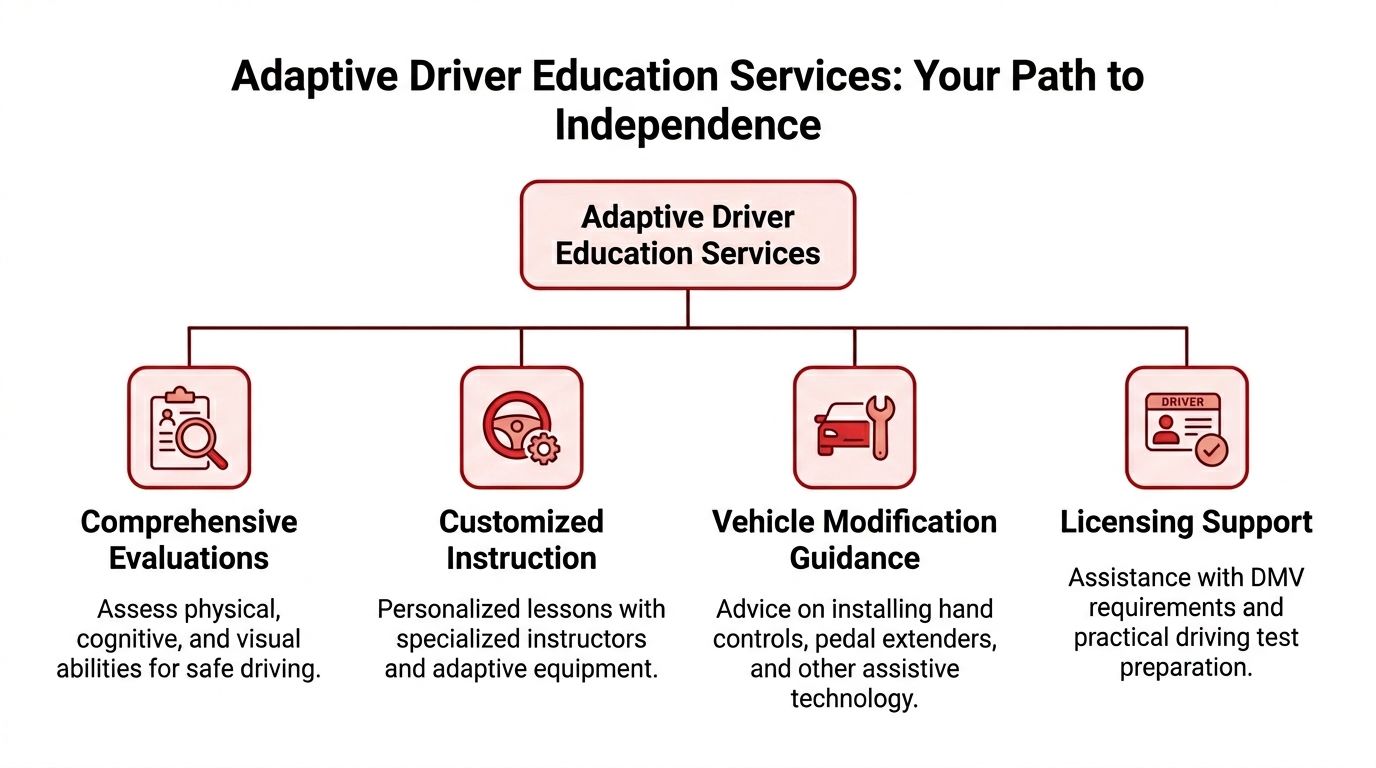
Understanding Adaptive Driver Education Services
A strong adaptive program works like a custom-fit suit. Standard instruction is the off-the-rack version. It works for many people, but not for everyone. Adaptive driver education starts with fit.
Who provides these services
For learners with physical or neurological conditions that affect driving, Driver Rehabilitation Specialists play an important role. Research on adaptive driving explains that disability driving programs combine competency evaluation with vehicle modification assessment, and that specialists certified through ADED conduct standardized evaluations and recommend adaptations such as hand controls, left-foot accelerators, or steering modifications as part of an integrated safety process (Icahn School of Medicine adaptive driving resource).
A simple way to think about a Driver Rehabilitation Specialist is this. They are a bit like a physical therapist for driving. They do not just watch someone drive and give general tips. They evaluate how the person’s body, vision, attention, and reaction patterns affect driving tasks.
What the process usually looks like
The process often includes several parts:
Clinical evaluation
This may look at strength, range of motion, coordination, vision, processing speed, and how the learner handles multiple tasks at once.Equipment recommendations
If needed, the specialist may recommend hand controls, a left-foot accelerator, steering aids, or other changes that make the vehicle manageable and legal to operate.Behind-the-wheel instruction
After the evaluation, the learner practices with the recommended setup and learns how to use it safely in real traffic situations.Licensing support
The training is tied to licensing requirements, restrictions, and approval steps rather than treated as a separate service.
Why families get confused
The biggest point of confusion is the difference between evaluation and lessons.
An evaluation answers, “What does this person need in order to drive safely?”
Lessons answer, “How does this person build the skills to do it?”
Those are related, but they are not the same thing.
| Service | Main purpose | Who usually needs it |
|---|---|---|
| Clinical driving evaluation | Identify barriers and safe supports | Learners with physical or neurological conditions affecting driving |
| Adaptive equipment guidance | Match the vehicle to the driver | Drivers needing mechanical changes |
| Instructional lessons | Build driving skill and confidence | Nearly every learner |
| Licensing coordination | Meet legal requirements | Drivers using restrictions or adaptations |
If a family skips the evaluation when one is needed, they may spend money on lessons that do not match the learner’s actual needs.
Some students need the full rehabilitation route. Others do not. The key is finding out which path fits before paying for the wrong one.
Customized Driving Instruction for Every Learner
Adaptive instruction is not one method. It is a way of adjusting the lesson so the student can learn.
A teen with a physical disability may need to master hand controls. A neurodivergent teen may drive a standard vehicle but need a different teaching style. Those are two very different lesson plans.
A story many families will recognize
An autistic teen may know every road sign before the first lesson. That same teen may struggle when traffic becomes unpredictable, when another driver waves them through, or when several decisions have to happen quickly.
Research shows that approximately 1 in 3 autistic adolescents and young adults without intellectual disability acquires a driver's license by age 21 years, and that specialized instruction can help address challenges such as mental inflexibility and difficulty with social cues while building on strengths like rule-following (autistic adolescents and driver licensing research).
That matters because many autistic learners are not unsafe by default. They often bring real strengths to the car. They may follow road rules carefully, take fewer risks, and pay close attention to details in the environment. The challenge is helping them handle gray areas, not just black-and-white rules.
What specialized teaching can look like
An instructor might break one busy left turn into smaller parts.
- First skill. Identify the lane and signal timing.
- Second skill. Watch oncoming traffic speed.
- Third skill. Notice nonverbal behavior from other drivers.
- Last skill. Complete the turn smoothly.
That teaching method is often called scaffolding. Instead of teaching everything at once, the instructor builds one layer at a time.
Later in training, the student may practice the same route until it feels familiar, then gradually add variation. That is often far more effective than throwing a nervous learner into a complicated road test route on day one.
A helpful starting point for families comparing lesson options is this page on driving lessons.
Here is a useful visual example of instruction in practice:
Different needs call for different lesson design
Some students benefit from:
- Shorter sessions that reduce mental fatigue
- Predictable routines at the beginning of each lesson
- Direct language instead of vague coaching
- Extra practice with social traffic cues such as merges, four-way stops, and yielding
- Anxiety management breaks when the lesson becomes overwhelming
The best instructor for a neurodivergent learner is often the one who can stay calm, teach concretely, and repeat without sounding frustrated.
That is adaptive teaching, even when the car itself is standard.
Georgia Licensing Requirements for Adaptive Drivers
Georgia families often run into one practical question fast. How does specialized training fit with normal state licensing rules?
It fits more often than people expect.
Adaptive training and Joshua’s Law
One of the biggest gaps in disability driving information is practical guidance for teens in Georgia who need adaptive support while still pursuing a standard license under Joshua’s Law. A source focused on special-needs driving notes that this issue is often not addressed clearly, and cites a 2025 IIHS report noting 40% fewer at-fault crashes for neurodivergent teens in adaptive programs compared with standard driver education, while also noting a 2024 to 2025 rise of 18% in learner’s permit applications from teens with disabilities reported by Georgia DDS (special-needs driving guidance).
For a Georgia teen, that usually means two tracks may run together:
- the classroom or online driver education required under Joshua’s Law
- the behind-the-wheel training that matches the student’s physical or learning needs
A student who is neurodivergent may be able to complete the state-required course in a regular online or classroom format, then use more individualized road lessons to build practical skill. A student with physical limitations may need an evaluation first, followed by specialized vehicle training.
A simple Georgia roadmap
Here is the practical sequence many families follow:
Identify the type of support needed
Is the issue physical, cognitive, visual, emotional, or mainly instructional?Ask whether a medical review is likely
Some drivers may need medical paperwork or DDS review, especially if a condition affects safe operation.Complete driver education requirements if applicable
Teens under Joshua’s Law may still need the classroom portion, whether online or in person.Schedule the right kind of training
Standard lessons with accommodations are enough for some learners. Others need an adaptive evaluation and modified vehicle instruction.Prepare for restrictions if needed
A license may include a condition tied to equipment or vehicle type.
A useful overview of the standard state process is available at Georgia driver’s license requirement.
Where restrictions come in
Restrictions are not a punishment. They are a safety tool.
A restriction might limit driving to a properly equipped vehicle, or reflect another approved condition tied to the person’s evaluation. Families often feel nervous when they hear that word. In practice, it can be what allows the driver to move forward legally and safely.
A restricted license can still mean real independence. It defines the conditions that make driving safe.
Road testing also matters. Some families want the convenience of training and testing through one familiar provider, while others may need a referral path because their needs are more clinical. Asking that question early can save time.
How to Fund Adaptive Driving Lessons and Evaluations
Cost stops many families before training even starts. That is understandable. It should not be the end of the conversation.
One source on adaptive driving costs notes that evaluations can range from $500 to $2,000, with lessons costing $100+ per hour, and also notes that families often look for clearer answers on affordability and insurance. The same source cites a 2025 AAA study finding that standard schools with minor accommodations achieved 75% success at 40% lower cost for mild cases, which reinforces the value of matching the level of service to the actual need (adaptive driving cost guidance).
Start by matching the service to the need
Not every student needs the most expensive option.
A learner with mild anxiety, ADHD, or autism may do well with a regular driver education course plus customized lessons. A learner using hand controls or dealing with major physical limitations may need a formal evaluation and a specialist-led plan. The more accurately you place the student at the beginning, the less likely you are to overpay or under-prepare.
Funding options to ask about
Families often piece together support from more than one place.
Georgia Driver’s Education Scholarship Grant Program
This is one of the first places qualifying families should check when cost is a concern. It can help reduce the barrier to starting driver education.Vocational Rehabilitation
If driving supports employment or training goals, state VR programs may be worth asking about.Veterans benefits
Eligible veterans may have access to funding paths tied to rehabilitation or independence needs.Nonprofit grants
Condition-specific organizations sometimes offer local or national assistance.Insurance questions
Lessons are often not covered. In some situations, a clinical evaluation performed by an occupational therapist may be easier to discuss with an insurer than the driving instruction itself.
Questions to ask before you pay
Use these questions to avoid surprises:
- What exactly is included in the evaluation or lesson package?
- Is the vehicle equipped for my specific need?
- Will I need a clinical evaluation first, or can I begin with lessons?
- Does the school help with scholarship paperwork or referrals?
- If my child only needs accommodations, not modifications, is there a lower-cost option?
The most affordable path is not always the cheapest lesson. It is the path that gets the right support in the right order.
If your family is comparing disability driving schools, ask for a written explanation of what level of service the student needs and why. That one step can prevent a lot of confusion.
Finding the Right Support for Your Driving Journey
A Georgia parent often reaches this point after a few frustrating phone calls. One school says they offer “special needs driving lessons.” Another talks about medical driving evaluations. A third can help with Joshua’s Law classes but not adaptive equipment. It can feel like everyone is using similar words for very different services.
The simplest way to sort it out is to match the student’s actual needs to the type of provider.
Some learners need a patient instructor, extra practice, flexible pacing, and help completing standard Georgia requirements. Others need a clinical team to evaluate vision, reaction time, strength, range of motion, or adaptive equipment before regular lessons even begin. Those are two different starting points, much like choosing between a tutor for algebra and a specialist who first checks whether a child needs glasses to read the board.
What to ask a driving school
Clear questions save time and money. They also help families avoid paying for the wrong kind of program first.
Ask the school:
Do you work with my specific condition or functional need?
Can you teach in a standard vehicle with accommodations, or only in a modified vehicle?
Do you help students meet Georgia requirements such as Joshua’s Law while also planning for DDS restrictions or approvals?
If a clinical driving evaluation is needed, do you provide it or refer families to a local specialist?
Can classroom requirements, permit preparation, and adaptive road instruction be handled separately if that lowers cost?
That last question matters more than many families realize. A teen may need specialized help behind the wheel, but not for every part of driver education. Separating those pieces can make the path more affordable.
When equipment and instruction overlap
Families also have to sort out a second layer of confusion. What belongs in the car itself? What belongs in the lesson plan? What belongs in the medical care plan?
A seat cushion, transfer aid, brace, or positioning support may help a student drive more safely, but that does not automatically make it driving equipment in the licensing sense. If you are sorting through assistive items and trying to understand the broader category first, this plain-language overview of Durable Medical Equipment can help clarify what may be medical support versus what may require driving-specific training or approval.
A practical way to choose local support
A standard driving school with accommodations is often the better fit when the student can drive a regular vehicle and mainly needs calmer coaching, more repetition, help with permit steps, or support completing Georgia coursework.
A clinical adaptive driving program is often the better fit when the driver may need hand controls, left-foot acceleration, steering devices, or a formal evaluation tied to DDS requirements.
If you are unsure, ask for a referral path in writing. A good provider should be able to say, clearly, “start here,” or “you need an evaluation first,” instead of leaving your family to guess.
If your family is checking school quality, this page on some driving schools in Georgia do not have certified drivers raises useful questions about credentials and training standards.
Good support is accurate support. The right match helps a student meet Georgia rules safely, avoid unnecessary costs, and build confidence one step at a time.
Your Adaptive Driving Questions Answered
Does my teen need a special permit to practice with accommodations
It depends on the type of accommodation. A teaching adjustment, such as slower pacing or structured coaching, is different from driving with approved adaptive equipment. If equipment or a medical condition affects legal operation, ask early about DDS requirements and whether a formal evaluation is needed.
Can a student use their own modified vehicle for lessons
Sometimes yes, but only if the school, instructor, and licensing rules allow it. Families should ask whether the vehicle meets training and testing requirements and whether the instructor is qualified to teach with that setup.
What if my child needs help but not a full rehab program
That is common. Some students do not need hand controls or a clinical driving rehab program. They may only need a better teaching approach, more practice time, or help meeting Joshua’s Law requirements while learning at a manageable pace.
Can scholarship support help with access
Financial help matters because access is uneven. Research from Children’s Hospital of Philadelphia found that teenagers in lower-income neighborhoods were up to four times less likely to complete driver training, and that geography and access to schools also shape who gets training in the first place (barriers to driver training and licensure). That is why scholarship programs and nearby lesson options matter so much.
How do I know which type of school to call first
Start with the learner’s main barrier. If it is teaching style, confidence, scheduling, or standard licensing support, begin with a school that offers flexible driver education, online options, road testing, and lesson packages. If it is equipment, physical function, or medical clearance, begin by asking for an adaptive driving evaluation referral.
If you are looking for a practical next step in Georgia, A-1 Driving School offers Joshua’s Law courses, online driver’s education options, road test services, and driving lessons packages for teens and adults who need a clear, supportive path to getting licensed. Families who need accommodations can also ask about the Georgia Driver’s Education Scholarship Grant Program and get help finding the training route that fits their situation.