

Your road test is on the calendar, but the borrowed car, paperwork folder, and unfamiliar DDS office are already making you nervous. That reaction is normal. A Georgia DMV road test is not a casual drive around the block. It's the final checkpoint in a licensing process that combines eligibility, supervised practice, driver's education, vehicle readiness, and safe decision-making.
The best way to lower the pressure is to understand what happens before you turn the key. Georgia's Department of Driver Services, or DDS, administers road tests by appointment only, and walk-ins aren't accepted. The process then moves through four practical checkpoints: proving you're eligible, presenting the right documents and a safe vehicle, completing the skills evaluation, and responding calmly to the result.
Walking Into Your Georgia DMV Road Test Day
A Tuesday morning at a busy Georgia DDS customer service center can feel intense. A teen may be sitting in a borrowed sedan with a parent, checking a learner's permit while the parent reviews a folder of documents. An adult retester may be doing the same thing alone, wondering whether the vehicle will pass inspection.
Start by treating the appointment like a sequence rather than one enormous event. First, confirm your eligibility at the counter. Next, present your permit, required records, and vehicle. Then listen carefully to the examiner and drive as you've practiced. Finally, accept the result without arguing or rushing, whether you pass or need another attempt.

Start with a calm arrival
Bring your appointment confirmation and arrive with enough time to settle down. Rushing from the parking lot into the testing area makes small mistakes more likely, such as forgetting where your permit is or discovering that a turn signal doesn't work.
For a Class D road test, the accompanying driver must be licensed and at least 21 years old. Only the applicant and that driver may be in the vehicle, and the vehicle must pass the DDS safety inspection. These rules are part of the Georgia DDS road test requirements, so check them before leaving home.
Practical rule: The examiner isn't looking for theatrical confidence. They're looking for controlled, observant driving that stays safe when you're nervous.
Keep your attention on the next instruction, not on an imagined mistake. If you don't hear a direction, ask the examiner to repeat it. A clear question is safer than guessing.
Who Can Take the Georgia Road Test
A teen arriving for the Georgia road test has already passed several checkpoints. The learner's permit, supervised practice, driver education, and behind-the-wheel training all prepare the student for the final Class D evaluation. A-1 Driving School can support that journey from Joshua's Law coursework through driving lesson packages and the Scholarship Grant Program.
Eligibility depends on age, license class, permit status, and education records. Teen applicants generally follow Georgia's graduated licensing process. Adults follow a different route and do not complete Joshua's Law coursework.
A teen applicant must hold a valid Georgia learner's permit and complete the required supervised driving experience. DDS guidance requires an affidavit confirming 40 hours of supervised driving, including 6 hours at night (Georgia DDS road test guidance). Before making plans, families should check that the permit and education records match the applicant's licensing stage.
Understanding Joshua's Law pathways
Joshua's Law offers four approved combinations, as listed by Georgia DDS:
- Classroom and instructor training: 30 hours of classroom instruction, 6 hours behind the wheel, and 40 hours of supervised driving, including 6 hours at night.
- Classroom and parent-taught training: 30 hours of classroom instruction and 40 hours of parent-taught behind-the-wheel training.
- Online and instructor training: 30 hours of online instruction, 6 hours behind the wheel, and 40 hours of supervised driving, including 6 hours at night.
- Online and parent-taught training: 30 hours of online instruction and 40 hours of parent-taught behind-the-wheel training.
The right option depends on the student's schedule, learning style, and access to an approved instructor. Online coursework may fit around school, while professional lessons provide direct feedback on steering, observation, and vehicle control.
Adults generally do not complete Joshua's Law. They still follow the DDS process for their age and license class, which may include a learner's permit, knowledge test, and road test through DDS or an authorized provider.
Scheduling Your Road Test the Right Way
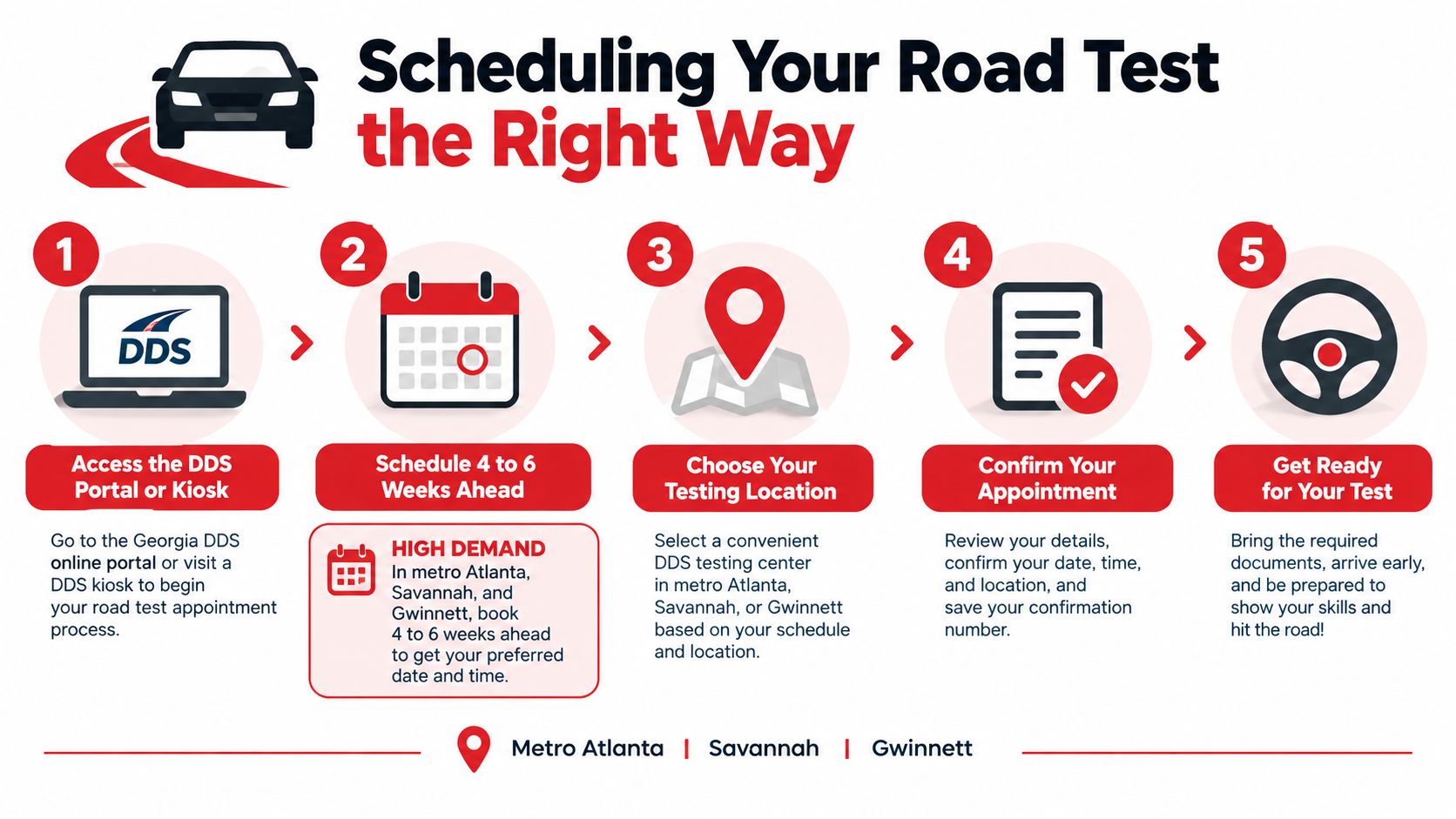
Georgia road testing is appointment-based at DDS locations, so don't plan to arrive and ask for an opening that day. Use the DDS online appointment system or an available kiosk, then confirm the location, appointment time, and license class before you finalize the booking.
Availability can be difficult when many families are trying to coordinate school, work, a parent's schedule, and a vehicle. Start looking early, especially if your preferred location or day is important. A certified driving school can provide another route, because some schools conduct road tests on-site with authorized examiners.
Compare the two scheduling routes
A DDS appointment gives you the standard state testing experience. A certified provider may offer a more familiar vehicle, a convenient location, or the ability to combine preparation with testing. Ask the provider exactly what documents are required and whether the test applies to your license class.
Use this Georgia road test scheduling guide to organize the booking process, then make a simple confirmation list:
- Verify that your learner's permit is valid.
- Save the appointment confirmation.
- Confirm whether you're testing at DDS or through a certified provider.
- Ask which documents must be brought in original or printed form.
- Confirm that the vehicle will be available and inspected before departure.
Don't let the appointment itself become the source of test-day anxiety. Put the confirmation, permit, and paperwork in one folder, and decide in advance who will drive the car to the testing site.
Documents and Vehicle Standards You Must Bring
The vehicle is part of your eligibility for the road test. A student can drive well and still lose the appointment if the car lacks required legal documents or fails the safety inspection.
For a Class C or D road test, DDS limits the test vehicle to a four-wheel vehicle. The car must have valid registration or a temporary tag with proof of purchase within the last 30 days, liability insurance, and a passed safety inspection, according to DDS test and exam information.
Check the paperwork first
Bring a valid Georgia learner's permit. Teen applicants also need the completed driving-experience affidavit and documentation showing that their education and supervised-practice requirements are complete when applicable. If you're unsure which records apply to your situation, confirm directly with DDS before the appointment.
The accompanying driver must bring a valid driver's license and meet the age requirement for the Class D test. Keep all documents organized so the counter staff can review them without searching through a glove compartment.
Inspect the car before test morning
Walk around the vehicle before leaving home. Test the brake lights, headlights, turn signals, horn, mirrors, windshield, tires, and parking brake. Check that the registration, insurance, and tag information are current.
If the turn signals aren't working, DDS says the applicant must demonstrate hand-signal proficiency. That fallback doesn't remove the need for a roadworthy vehicle, so repairing the signals is the safer preparation choice. Use this vehicle inspection checklist several days before the appointment, not while you're already parked outside DDS.
Remove loose items that could interfere with the pedals or visibility. Adjust the seat and mirrors before the examiner enters, then leave the controls easy to reach.
What Happens During the Road Test
The road test feels less mysterious once you treat it as a ride-along focused on control and observation. The examiner gives directions, watches your decisions, and scores how consistently you operate the vehicle.
You may begin with controlled maneuvers. For a turnabout, choose a safe, deliberate sequence and keep checking your surroundings. During straight-line backing, move slowly and maintain a steady path. Parallel parking requires patience, accurate reference points, and careful clearance rather than a rushed steering movement.
Drive the ordinary parts deliberately
After the maneuver area, the examiner may take you into traffic. Signal before turns and lane changes, check mirrors, look over your shoulder when appropriate, and keep the vehicle centered in its lane. At a stop sign or signal, stop completely before the required stopping point and remain stopped until it's safe to proceed.
A nervous student often makes the same mistake in a familiar way. They approach an intersection correctly, then release the brake too soon because they're already thinking about the next turn. Keep your attention on the current instruction until the vehicle is fully settled and the intersection is clear.
Speed control matters even when traffic is light. Follow the posted limit, adjust for conditions, and avoid using acceleration or braking to compensate for late decisions. Smooth control shows that you're observing early.
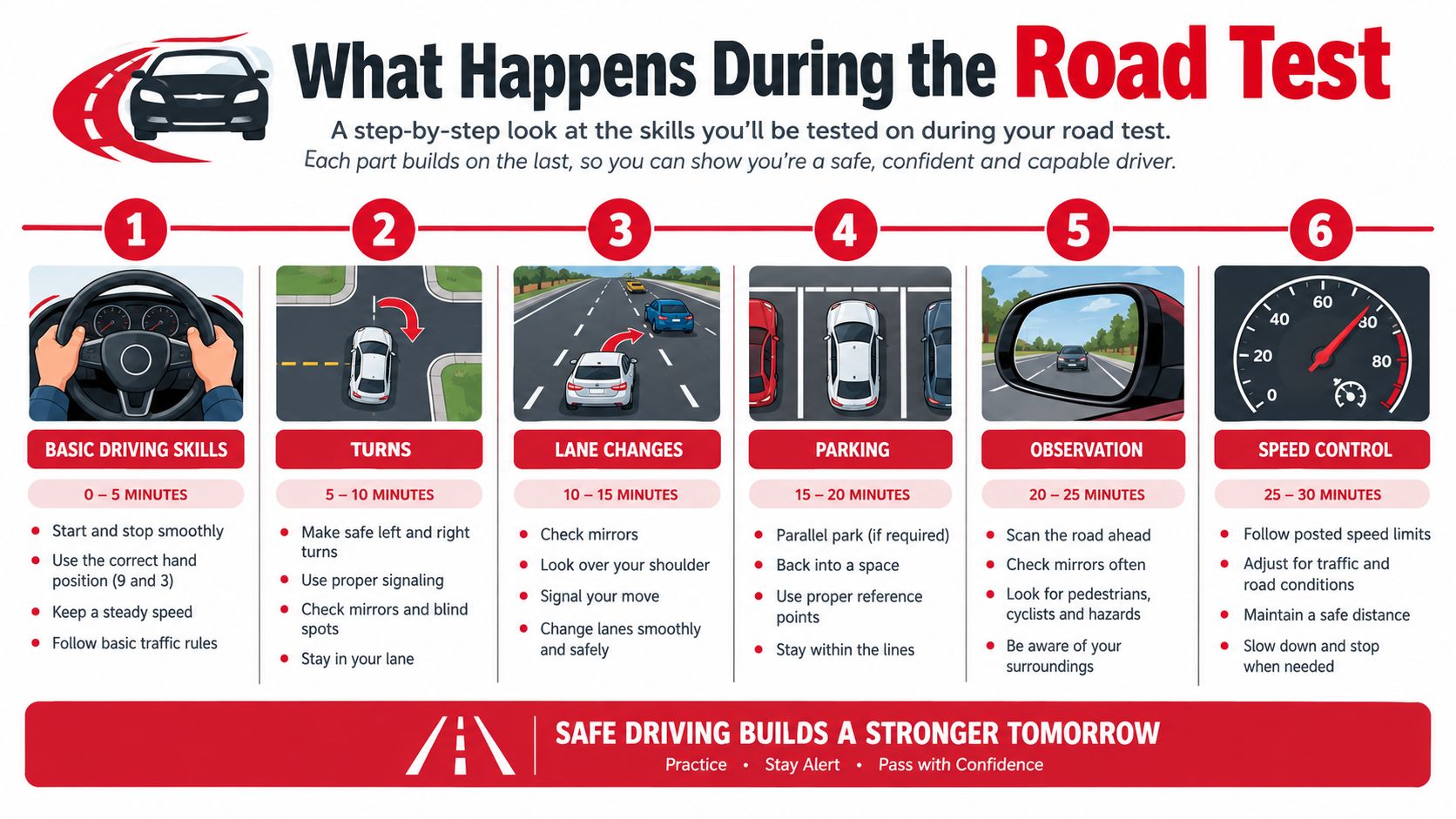
A short visual review can help students connect each maneuver with the habit the examiner is watching:
If you test in a manual vehicle, clutch use may be evaluated. If you test in an automatic, focus instead on smooth braking, acceleration, steering, and observation.
Scoring Rules and Common Reasons People Fail
A student can drive well for several minutes, then lose focus during one rushed stop or turn. Georgia DDS sets the minimum passing score for the driving component at 75% (DDS test and exam information). The test does not require perfection, but an unsafe action, loss of control, or vehicle problem that prevents a safe evaluation can end it immediately.
The examiner makes the final scoring decision. Students should build repeatable safety habits instead of trying to calculate how many errors they can make. A-1 Driving School supports that larger licensing journey, from Joshua's Law coursework to behind-the-wheel packages and the Scholarship Grant Program, so practice can address weak habits before test day.
Risk areas to practice
| Category | Points Off | Common Mistakes |
|---|---|---|
| Vehicle control | Varies by scoring item | Jerky starts, harsh braking, lane drifting |
| Observation | Varies by scoring item | Skipped mirror checks, late attention to surroundings |
| Turns and signals | Varies by scoring item | Late signals, poor lane position, cutting turns |
| Stops and intersections | Varies by scoring item | Rolling stops, stopping too far forward, proceeding too soon |
| Parking and backing | Varies by scoring item | Poor alignment, rushing, striking a boundary, weak visual checks |
| Speed control | Varies by scoring item | Excessive speed, unnecessarily slow driving, late braking |
The table works like a checklist for a practice drive. After each session, identify one habit to repeat until it feels automatic. Before testing, review your driving record so you can build affordable quotes from record while keeping insurance questions separate from the DDS scoring process.
A prior mistake does not have to define the test. Calm decisions, complete observations, and controlled vehicle movement give the examiner clear evidence that the student can drive safely.
The useful question isn't “How many mistakes can I make?” It's “Which habits must remain automatic when I'm nervous?”
How Driving Lessons and Joshua's Law Courses Set You Up to Pass
A nervous student may know the rules yet freeze when an examiner sits beside them. A-1 Driving School helps connect the full licensing path, from Joshua's Law coursework to behind-the-wheel packages and the Scholarship Grant Program. Each stage gives the next one a clear purpose.
Coursework explains why Georgia requires certain driving choices. Lessons then turn those explanations into repeatable actions. A student might discuss right-of-way in class, practice it with an instructor at busy intersections, and later handle the same decision calmly during the road test. That progression makes the test the final checkpoint of preparation, not a surprise event.
Match education with practice
Georgia recognizes pathways involving 30 hours of classroom or online instruction, 6 hours behind the wheel, and supervised driving requirements when that pathway applies (Georgia driver's education and Joshua's Law options). Families can choose online coursework when school, work, or transportation makes a flexible schedule useful. In-person classes may better suit students who learn through live questions and discussion. Either format still needs real practice in a vehicle.
A professional lesson package gives the student guided time to build a steady routine. The instructor can observe how the student responds to directions, correct habits early, and rehearse the sequence used on test day. A pre-drive vehicle check also prepares the student for the examiner's inspection before the car moves.
Eligible students may receive help through the Georgia Driver's Education Grant Scholarship Program. It serves Georgia residents ages 15 through 17 with a valid Georgia Instructional Permit or Driver's License, and applications are due by the last day of the month before class begins (Georgia Highway Safety resources). The approved course includes 30 hours of classroom instruction and 6 hours of behind-the-wheel training under the Georgia rules.
Your Next Step From Permit to License
On the morning of your Georgia road test, a nervous student may wonder whether one missed turn will end the licensing journey. The test is better understood as the final checkpoint in a process that includes coursework, supervised practice, lessons, and vehicle preparation.
Use the examiner's directions as your checklist. Listen fully, signal early, check mirrors before each maneuver, and keep your attention on the next safe decision. A calm routine is more useful than trying to drive perfectly.
A-1 Driving School supports the journey from Joshua's Law coursework to behind-the-wheel packages, road-test preparation, and help with the Scholarship Grant Program. Visit A-1 Driving School to choose the support that fits your needs.
Start by matching a Georgia driver's education course with lesson times and a road-test plan. That clear sequence gives you and your parent a practical next step toward the Class D license.