
Trying to merge onto Atlanta's I-75 during rush hour? You need total awareness, and that all starts with knowing exactly how to check blind spots while driving. We teach a simple but non-negotiable sequence: Mirrors-Signal-Shoulder. It's a quick, lifesaving glance that covers what your mirrors can't show you.
This isn't just a trick to pass the Georgia road test—it's a habit for a lifetime of safe driving.
The Essential Skill for Navigating Georgia Roads
So, what exactly are blind spots? They're the zones around your car that are completely invisible in your rearview and side mirrors. If you rely only on mirrors, you’re driving with dangerous gaps where other cars, motorcyclists, or cyclists can easily hide.
That's a risk you can't afford on busy Georgia highways. As the state's trusted driver's education provider since 1987, we’ve seen it all, and we've turned thousands of anxious new drivers into confident, aware ones by drilling this one fundamental skill.
The numbers don't lie. Nationwide, there are over 840,000 blind spot accidents every year, leading to nearly 300 fatalities. Most of these happen during simple lane changes or merges. You can see the accident statistics for yourself to understand just how critical this is.
A Skill for Life, Not Just the Test
Yes, checking your blind spot is a major point on the Georgia road test. But its real value is in everyday driving. Whether you're changing lanes on GA-400 or just backing out of a tight parking spot at the mall, that quick shoulder check is your absolute best defense against a collision.
It’s a core skill that has to become automatic. That's why it's a huge part of our state-approved driver's ed curriculum, designed to meet all Joshua's Law requirements.
Mastering the shoulder check is about building muscle memory. It should be a quick, automatic reflex performed before any lateral movement—changing lanes, merging, or even pulling away from a curb.
To get you there, we built a simple, repeatable process. This is the sequence every driver should have burned into their brain before making a move.
The 3-Step Blind Spot Check Method
| Step | Action | Purpose |
|---|---|---|
| 1 | Check Mirrors | Get a quick picture of the traffic behind and beside you. |
| 2 | Turn on Signal | Clearly communicate your intention to other drivers. |
| 3 | Shoulder Check | Glance quickly over your shoulder into the blind spot. |
This entire sequence should take just a second or two. It’s a fast, fluid motion—not a long, distracted stare.
Our programs are all about practical application. We don't just tell students what to do; we provide the hands-on experience in our driving lessons and packages to make it second nature. With a professional instructor guiding them, students practice this over and over in real traffic until it’s automatic.
If you or your teen is ready to build a strong foundation for a lifetime of safe driving, take a look at our online and in-person driver's education courses. Qualifying families may also be able to use the Georgia Driver's Education Scholarship Grant Program to make expert training more accessible.
Setting Up Your Car to Eliminate Blind Spots
Your first real defense against a blind spot accident is setting up your car correctly. Before you even turn the key, you can get rid of most dangerous visual gaps just by adjusting your mirrors—and it’s probably not the way you were taught.
The goal isn't to see the side of your own car; it's to see the lane next to you. Proper mirror setup is a foundational skill we teach in all our driver's education programs. It’s a critical first step before getting behind the wheel for real-world practice.
The BGE Mirror Adjustment Method
Forget what you've heard before. The Blindspot and Glare Elimination (BGE) method is the gold standard we teach in our driving lessons and packages. Why? Because it dramatically widens your field of view and practically makes blind spots disappear.
Here’s how you do it:
- Driver-Side Mirror: Lean your head until it touches the driver's side window. Now, adjust your left mirror outward until you can just barely see the rear corner of your car.
- Passenger-Side Mirror: Next, lean your head over the center console. Adjust your right mirror outward until you can just barely see the rear corner of your car on that side.
When you sit back up straight, you won't see your car's sides anymore. Instead, your side mirrors now show you what your rearview mirror misses, giving you a much better picture of the traffic around you.
This setup creates a panoramic view. A car leaving your rearview mirror will almost instantly appear in your side mirror. It gives you a continuous, seamless view of what's happening next to you.
More Than Just Mirrors
Even with perfect mirrors, your car's own frame creates blind spots.
The A-pillars (the posts on either side of your windshield) and C-pillars (the posts behind your rear passenger windows) are thick enough to hide a whole car or a pedestrian, especially when you're turning.
Your seating position is also a huge factor. You need to sit upright with a clear view over the steering wheel. If you’re slouched down or too far back, you're making those structural blind spots even bigger.
While many new vehicles have great safety features, even the best tech is no substitute for a driver's awareness. You can read our guide on cars that have blind spot features to see how technology helps, but it never replaces your own good habits. For better night driving, understanding how auto dimming side mirrors work can also help you keep a clear view in all conditions.
Executing the Perfect Lane Change
Knowing the theory is one thing, but putting it into practice on a busy road is what separates a nervous driver from a confident one. This is where you really learn how to check blind spots while driving—turning that knowledge into pure muscle memory. The goal is a smooth, deliberate sequence that becomes second nature every time you move over.
Picture yourself on a road like I-285, needing to get into the lane to your left. It’s way more than just yanking the wheel. It's a careful system built on communication and safety, and it's a huge focus of our in-car driving lessons and packages. We drill this maneuver until Georgia teens have the confidence to do it right, every time.
Before you even think about changing lanes, your mirrors have to be set up correctly. This diagram shows the process we covered earlier.
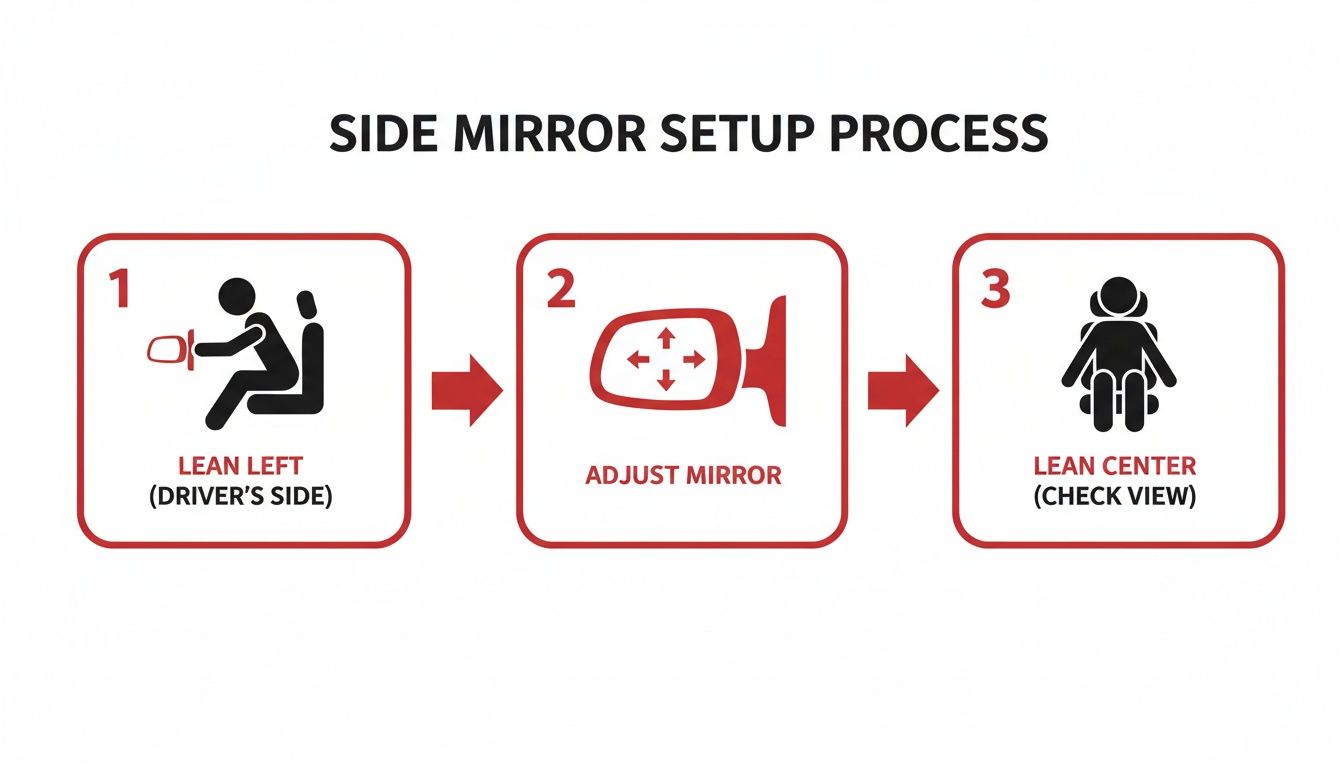
When you lean to adjust your mirrors this way, you’re actively minimizing your blind spots from the get-go. This is the foundation for every safe lane change.
The SMOG Method in Action
Our instructors love a simple acronym to help students remember the steps: SMOG. It stands for Signal, Mirrors, Over-the-shoulder, Go. It’s an easy mental checklist for that perfect lane change.
- Signal: Your turn signal is how you talk to other drivers. Flip it on early—give everyone else at least three to five seconds of notice before you start to move. This lets them know what you’re doing and adjust if they need to.
- Mirrors: Now, do a quick three-part scan. Glance at your rearview mirror to see who’s behind you and how fast they’re approaching. Then, check the side mirror for the lane you want to enter.
- Over-the-shoulder: This is the non-negotiable step. Turn your head quickly—about 90 degrees—and look over your shoulder into your blind spot. It’s not a long stare, just a decisive glance to confirm the space is truly empty.
- Go: If all clear, smoothly guide your car into the center of the next lane. A key part of this is to maintain your speed. Suddenly slowing down can be just as dangerous as not checking your blind spot, as it can surprise the driver behind you.
Executing a safe lane change is a fluid process, not a series of jerky, disconnected actions. The goal is to blend seamlessly with the flow of traffic, and that confidence only comes from guided practice.
Building Confidence for the Road Test and Beyond
That SMOG sequence is precisely what a Georgia DDS examiner will be watching for on your road test. They don’t just watch your car’s position; they watch your head movement to make sure you are physically clearing your blind spots.
Mastering this isn't just about passing a test. It’s about being able to handle tricky merges and everyday driving for the rest of your life. For a deeper dive on that, check out our guide on how to merge lanes safely.
At A-1 Driving School, we break this down into easy-to-learn steps, giving students real-time coaching in a safe car. Whether you’re a teen working on your Joshua's Law course or an adult driver looking to get more comfortable on the road, our instructors are ready to help. Remember that many families can also use the Georgia Driver's Education Scholarship Grant Program to make professional training more affordable.
Checking Blind Spots in Everyday Driving Scenarios
Knowing how to check your blind spots isn't just a highway skill—it’s something you need to do constantly, in every driving situation. Honestly, mastering how to check blind spots while driving in those tricky, everyday moments is what separates a truly safe driver from the rest.
This is a huge focus in our A-1 teen and adult driving lessons and packages. We want our students to build real-world confidence, not just learn enough to pass the test.
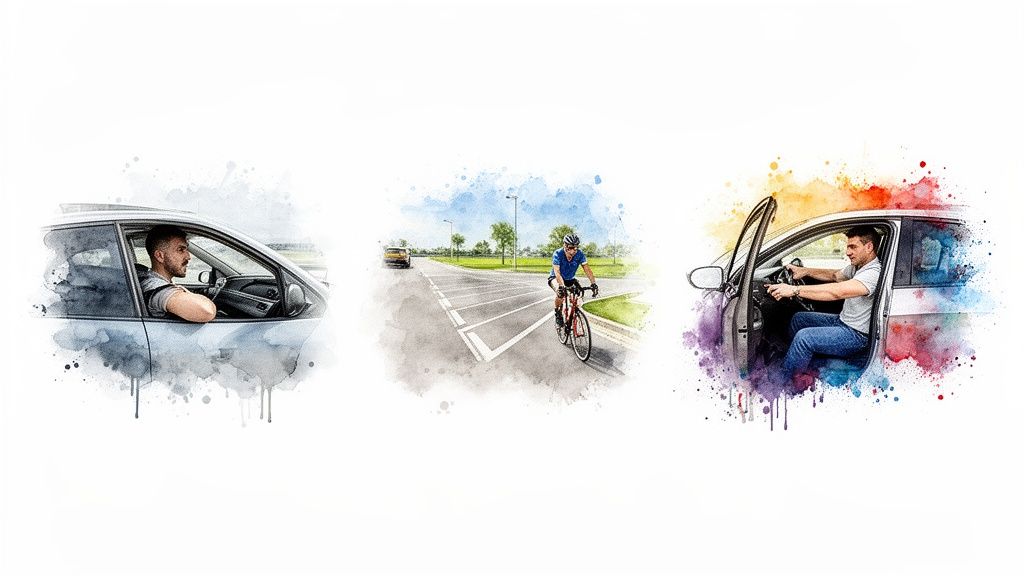
From packed parking lots to narrow city streets, your blind spots are always in play. Getting these scenarios right is key.
Parking Lots And Backing Up
Picture yourself backing out of a space at a crowded shopping center like Lenox Square. That rearview camera is a great tool, but it doesn't show you the whole picture. When you're parked between two big SUVs or trucks, they create huge blind spots that can easily hide a pedestrian, a stray shopping cart, or another car.
Here's what you need to do before you start backing up:
- Walk around the back of your car and check for obstacles before you even get in.
- Start backing up slowly while using your mirrors and rearview camera.
- The most important step: Physically turn your body to look out the rear windows. Scan from left to right, and keep looking until you're clear.
Merging And Right Turns
Merging onto a busy interstate from an on-ramp takes precise timing and a full field of vision. As you get up to speed, you have to nail the full mirror-signal-shoulder check sequence to find your gap in traffic. We practice this exact maneuver over and over in our Georgia road test prep sessions because it's so critical.
Making a right turn in the city brings its own set of challenges, especially with cyclists and pedestrians. A cyclist can pop up in a bike lane out of nowhere. That quick shoulder check to your right just before you start the turn is what confirms the lane or crosswalk is clear. It’s a simple move that prevents serious accidents. Broadening your knowledge with other safety practices, like these safe truck driving tips, can make you a more well-rounded driver.
When you're pulling out from a parallel parking spot, always signal first and then do a full shoulder check into traffic. Cars often approach faster than they look, and that glance is your final confirmation that it's safe to go.
Protecting Cyclists With The Dutch Reach
One of the most common—and dangerous—blind spot mistakes is opening your car door right into the path of an oncoming cyclist. There's a simple, brilliant technique to prevent this called the "Dutch Reach."
Instead of using your left hand to open the driver's side door, reach across your body and use your right hand.
This small change forces your entire upper body to turn. You'll naturally look over your shoulder and into your side mirror, making it almost impossible to miss a cyclist or car coming up behind you.
This is a perfect example of how small, smart habits create a safer road for everyone. It's this kind of practical detail we teach students through our online course options in Georgia and in our cars. We also point eligible families toward the Georgia Driver's Education Scholarship Grant Program to help make professional training more affordable.
How to Pass Your Georgia Road Test
When you’re sitting in the car for your Georgia Driver's License Road Test, the examiner is going to be watching your head just as much as the car. It’s true. One of the single biggest reasons for an automatic fail is missing a shoulder check. This is where all that time practicing how to check blind spots while driving really counts.
Here at A-1 Driving School, our job is to turn that practice into a passing grade. We’re focused on getting Georgia drivers ready not just for one test, but for a lifetime of making safe moves on the road.
From Joshua's Law to Your License
Getting your license in Georgia all starts with building a solid foundation of knowledge. That's exactly why our state-approved Joshua’s Law courses are so important. We offer them both online and in-person, giving every new driver the essential theory they need before ever turning the key.
After the bookwork is done, the real learning kicks in behind the wheel. Our instructor-led driving lessons and driving lessons packages are what make the difference. Our expert instructors don't just teach the rules—they work with you to perfect the exact skills examiners are looking for.
On test day, every single head turn matters. The examiner must see you physically check your blind spot before every lane change, merge, or turn. It's a non-negotiable, and our instructors drill this until it becomes second nature.
Forgetting this skill has serious consequences. Lane-change crashes, which often happen because a driver didn't check their blind spot, make up 4-10% of all wrecks in the U.S. These crashes injure more than 60,000 people every year. You can read the full research about these findings directly from the NHTSA. Our lessons are designed to keep you from becoming one of those statistics.
Your Partner for Road Test Success
We do more than just teach; we guide you on the whole path to getting your license. A-1 Driving School even offers road testing services, which means you can train and test in a familiar setting. Our instructors have a deep understanding of the test criteria and know exactly what little mistakes cause students to lose points.
This is the same expertise that makes us the trusted partner for the Fulton County Board of Education, where we provide driver's education programs for schools across the county. We’re serious about making top-notch instruction available to everyone.
We also know that professional training is a significant investment for families. That's why we always make sure people know about the Georgia Driver's Education Scholarship Grant Program. This state-funded program can cover the entire cost of driver's ed for eligible students, making expert training from A-1 Driving School completely affordable.
Ready to walk into your test with confidence? Get a better idea of what to expect on the big day by reading our guide on the Georgia road test.
Then, take a look at our driving lesson packages and let our team give you the skills you need to earn that license.
Common Questions About Checking Blind Spots
Over the years, our instructors at A-1 Driving School have heard just about every question there is when it comes to mastering blind spots. Here are the answers to some of the most common ones we get from new drivers and their parents.
If My Car Has Blind Spot Monitors, Do I Still Need to Shoulder Check?
Yes, absolutely. Think of blind spot technology as a helpful backup, but never a replacement for your own eyes. It’s a great feature, but it’s not foolproof.
Sensors can get blocked by heavy rain, snow, or even a bit of road grime. They also might not catch a car or motorcycle that’s coming up on you extremely fast. Most importantly, a Georgia DDS examiner will be watching for that physical head check during the road test—skip it, and you won’t pass.
How Long Should I Look Away from the Road for a Shoulder Check?
This is a huge fear for new drivers, but a proper shoulder check is just a quick glance. We’re talking less than a second.
The motion is a swift, 90-degree head turn to confirm the space next to you is clear. It’s not a long, lingering look. The key is practicing until it becomes muscle memory, which is a major focus in our in-car driving lessons. Our instructors work with you until that check becomes a safe, automatic reflex.
A shoulder check should be so quick that your car doesn't have time to drift. It's a "glance, not gaze" philosophy. You're confirming information, not discovering it for the first time.
What Are the Biggest Mistakes People Make with Blind Spots?
The single biggest mistake we see is relying only on mirrors. It’s a dangerous habit that causes thousands of preventable accidents every year.
During our driving lessons packages, our instructors are always on the lookout for other common errors, including:
- Turning the steering wheel along with your head.
- Staring over your shoulder for too long.
- Forgetting to check when pulling out from a curb or backing up.
We drill the "Mirrors-Signal-Shoulder" sequence over and over until these mistakes disappear. It’s what prepares our students to pass the Georgia road test and builds a foundation for a lifetime of safe driving.
How Can I Start Practicing Before My First Driving Lesson?
You can start building the right habits right now, without even turning on the car. Just sit in the driver's seat and practice adjusting your mirrors using the method we covered earlier.
Next, while the car is still parked, practice the quick head-turn motion. Focus on keeping the steering wheel perfectly still as you glance over your left and right shoulders. This simple, off-road practice makes a huge difference, so you’ll feel more confident applying the skill in real traffic during your first lesson. It's a fantastic head start before beginning a Joshua's Law course. And don't forget, the Georgia Driver's Education Scholarship Grant Program may be an option to help with costs for families who qualify.
Ready to move from theory to practice? A-1 Driving School offers a range of online courses and in-person driving lesson packages designed to build confident, safe drivers for life. Enroll today and master the skills you need to ace your road test and navigate Georgia's roads with ease. Learn more and sign up at https://a1drivingschools.com.