
You’ve got the permit. Your phone is full of tabs. One says DDS. Another says Joshua’s Law. A third is some random course page that may or may not be the right one.
That’s where most Georgia families get stuck.
The phrase joshua’s law login sounds simple, but the login is only one small part of getting licensed the right way. What matters is whether the course is approved, whether the account is set up in the student’s name, whether the certificate reaches DDS properly, and whether the teen also gets enough real driving practice before test day. Parents usually figure this out only after they’ve lost time fixing an avoidable error.
A smoother path is to treat the login as the start of a complete process. Get the permit. Enroll correctly. Finish the course. line up driving lessons. Keep your records clean. Then move straight into road test prep.
Your First Step to Getting Your Georgia Driver's License
A lot of teens hit the same moment at the same speed. They pass the permit test, hold that paper in their hand, and immediately start asking when they can get their provisional license.

In Georgia, that next step runs through Joshua’s Law. According to the Georgia Governor’s Office of Highway Safety summary of Joshua’s Law, the law was enacted in Georgia in 2007 through Senate Bill 226 and requires 16- and 17-year-olds to complete a 30-hour approved driver education course plus 40 hours of supervised driving, including 6 hours at night, before getting a Class D provisional license. That same summary explains the law grew out of the 2003 death of Joshua Brown, a 17-year-old from Atlanta, after his parents pushed for stronger teen licensing standards.
That history matters because it explains why Georgia doesn’t treat driver’s ed as a formality. The state expects training before freedom.
Start with the permit, but don’t stop there
If you haven’t earned your learner’s permit yet, start with a solid prep resource for the Georgia permit test. That step is straightforward. The confusion usually begins after.
Practical rule: The permit gets you into the process. Joshua’s Law gets you through it.
Teens often think the hard part is the written material. Parents usually assume the hard part is scheduling. In practice, the biggest issue is piecing everything together in the right order.
What this step is really for
The course requirement gives teens a foundation before they drive independently. The supervised hours force repetition. The night-driving requirement makes families practice in conditions many new drivers would otherwise avoid.
That’s the true starting line. Not the login screen. Not the road test. The training.
Finding and Accessing Your Joshua's Law Login Portal
Search results for joshua’s law login can send you in circles. You’ll see provider pages, DDS references, course ads, and old pages that don’t make the next step obvious.
The easiest way to avoid wasting time is to begin on a clear enrollment page for a Georgia-approved online course, then create the student account carefully from the start.
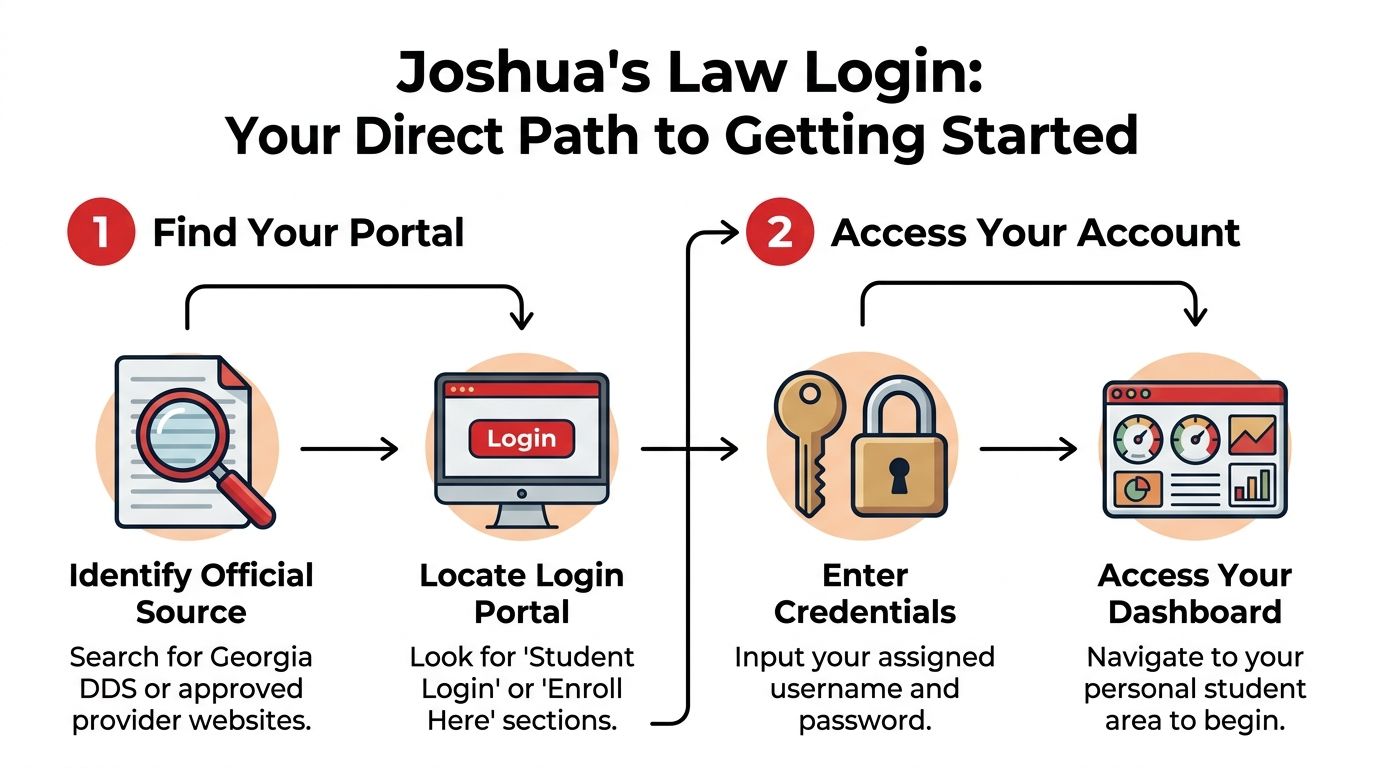
A practical place to begin is a dedicated online driver’s education course page in Georgia, where the path from enrollment to login is easier to follow.
Set up the account the right way
One mistake causes a lot of avoidable trouble. According to the Certus Joshua’s Law certificate course overview, the student account should be created using the teen’s name and a parent’s email for updates. That page also notes a common pitfall: using the parent’s name can interfere with login access and certificate issuance, and provider forums report this affects 20-30% of initial registrations.
That sounds small until you’re the family trying to fix it the night before a DDS visit.
A clean first login usually looks like this
Choose the approved course
Pick the Joshua’s Law option, not a defensive driving or unrelated traffic course.Use the student’s legal name
Match the name the teen uses with DDS records.Enter the parent email carefully
That’s where updates and completion notices often go.Keep the permit number handy
You may need it for the course profile or certificate record.Save the login details somewhere boring
Notes app, family calendar, email draft. Anything you’ll find later.
What works and what doesn’t
| Approach | What happens |
|---|---|
| Student name plus parent email | Progress, records, and certificate details stay aligned |
| Parent name on student account | Login confusion and certificate problems become much more likely |
| Mobile-friendly course access | Easier to complete modules during busy school weeks |
| Waiting to “figure it out later” | Families usually end up chasing passwords, names, or missing details |
If a teen can log in easily on day one, they’re far more likely to keep moving and finish. Friction kills momentum.
The same Certus page also notes that successful online courses often include unlimited practice tests and mobile-friendly access with no downloads. Those details matter because teens don’t finish courses on ideal schedules. They finish them between school, sports, work, and everything else.
Choosing the Right Joshua's Law Course and Driving Lessons
A login gets you access. It doesn’t get you ready.
That’s the part many families miss. They focus on finding the portal, then treat the 30-hour course like the whole requirement. It isn’t.
A good Joshua’s Law course should be easy to access, easy to track, and easy to finish without technical headaches. But the stronger choice is usually the one that also connects naturally to actual driving lessons and a realistic plan for road test prep.
The online course is the academic side
The online portion handles the classroom requirement. It gives the teen the legal framework, road rules, hazard awareness, and basic decision-making structure.
That matters. The Bird Feed article on Joshua’s Law and teen safety states that Drive Smart cites a 60% reduction in teen driver fatalities post-adoption, tied to the law’s 30-hour classroom and 40-hour supervised driving requirements, including 6 night hours.
That’s a strong reminder that classroom learning and practice work together. Not separately.
True confidence comes from lessons
What usually separates a teen who is merely compliant from one who is prepared is behind-the-wheel instruction.
Parents can supervise a lot of the required practice hours, and that’s important. But a trained instructor usually catches issues a parent may not spot right away, such as:
- Turns that start too wide and drift into the wrong lane
- Late braking habits at neighborhood intersections
- Weak mirror checks before lane changes
- Parking technique that falls apart under pressure
- Test-day nerves that show up as rushed decisions
Those things don’t always show up while driving familiar routes to school or practice.
Why bundling usually works better
Families often try to piece this together from different providers. One course here. A lesson there. Road test prep somewhere else.
That can work, but it creates gaps. Bundling your Joshua’s Law course with driving lesson packages usually makes the process cleaner because the training builds in the right order. The student learns the concepts, applies them in the car, then practices the same standards before the road test.
A short video can help set expectations for the process and pace of learning:
Instructor view: The teens who improve fastest aren’t always the most naturally confident. They’re the ones who combine the course with steady driving lessons and repeat the same habits until they become automatic.
If your goal is a license plus actual road readiness, don’t shop for the login alone. Choose a path that includes lessons.
Moving Through Your Course and Getting Your Certificate
Once you’re inside the course, the goal is simple. Keep moving. Don’t create extra problems. Finish cleanly.
Most Joshua’s Law platforms are designed to walk students through modules, short checks for understanding, and a final exam. The best approach is steady progress, not marathon cramming.

How to move through the course without stalling
A practical routine looks like this:
- Log in on the same device when possible so you’re not chasing browser issues.
- Complete a reasonable chunk at a time instead of rushing through multiple modules while distracted.
- Use practice features before the final exam if the platform offers them.
- Check your profile details early so your name, email, and permit information are correct before completion.
Some students do better when the course feels interactive instead of static. If you’re interested in why course design affects follow-through, this guide on Boost Training with gamification in elearning: Engagement and Retention gives useful context on how small interactive elements can keep learners engaged.
What happens after you pass
According to JoshuasLaw.com’s certificate and DDS sync explanation, after a student passes the final exam, compliant platforms auto-sync completion to DDS within 1-2 business days. The certificate is then emailed or made available for printing, and it includes the student’s learner’s permit number.
That timeline is usually smooth when the student record is clean.
The same source notes that mismatched names or emails compared with DDS records can cause an 18% rejection or delay rate. That’s why account setup matters so much more than families expect.
Fast fixes for common problems
Password won’t work
Reset it first. Then make sure the student is logging in under the correct account. A surprising number of “password issues” are really account-name issues caused during registration.
Certificate isn’t showing up yet
Give DDS sync a little time. If you just passed the final exam, waiting the stated processing window is often the right move.
Name on certificate looks wrong
Stop and fix it before showing up for the next licensing step. A small mismatch can create a much bigger delay later.
Don’t wait until the road test week to look for the certificate. Check it as soon as the course is complete.
Accessing Free Driver's Ed with the Scholarship Program
Driver training is important. For many families, cost is still the obstacle that slows everything down.
One of the least clearly explained parts of this process is Georgia’s Driver’s Education Grant Scholarship Program. The Georgia DDS Joshua’s Law requirements page highlights an issue many families run into: lots of resources explain the course requirement, but they don’t give a clear path for scholarship access, even though state funding can make training available at no cost for eligible low-income families.
Why this matters
This isn’t just a payment option. It can be the difference between getting trained now and postponing driver education until the schedule, budget, or transportation situation gets worse.
Parents often spend plenty of time comparing course formats and almost no time checking whether scholarship help is available. That’s backwards. If a student may qualify, check that first.
What to do next
A practical next move is to review a dedicated Georgia driver’s scholarship program page that explains how the process works and what families need to prepare.
Keep your paperwork organized. Use the student’s correct legal information. And ask questions early, especially if you’re trying to combine scholarship support with lessons and road test preparation.
The families who handle this best usually don’t assume the answer is no. They verify.
From Certificate to Road Test Your Final Steps with A-1
Finishing the course feels big because it is. But it’s not the last task.
The final stretch is where teens need calm repetition. That means practicing the same basic skills until they hold up under pressure, not just when driving on familiar roads with no one scoring the drive.
What should happen before the road test
A strong finish usually includes:
Targeted lesson time
Work on turns, lane control, parking, backing, stops, and observation habits.A vehicle routine
The student should know how to adjust mirrors, settle the seat, and begin a drive without rushing.A test-day plan
Know where you’re going, what documents you need, and what skill areas still feel shaky.
Why an all-in-one path helps
Families tend to do better when the course, lessons, and road test prep connect cleanly. It cuts down on repeated paperwork, mixed advice, and last-minute surprises.
That’s also why many students prefer taking the final steps in a setting that feels familiar rather than walking into a DDS appointment already stressed. The more predictable the process feels, the easier it is for a teen to show what they know.
If you’re close to the finish line, don’t treat the road test as a separate event. Treat it as the last part of the same training process you started with that first joshua’s law login.
Joshua's Law Login and Course FAQ
What if my Joshua’s Law completion isn’t showing in DDS yet
Wait through the normal reporting window first. If you recently passed, the platform may still be syncing your completion. After that, check whether the student name, email, and permit details match the DDS record.
Can I complete the course on my phone
Many online Joshua’s Law courses are built for mobile-friendly use. That’s helpful for students who study between school and activities. It’s still smart to use a stable device for the final exam and certificate review.
What if I forgot my password
Use the reset option tied to the student account. If the login still fails, verify that the account was created in the teen’s name, not the parent’s.
Do I still need driving lessons if I finish the online course
Yes. The course teaches rules and judgment, but in-car lessons build control, observation habits, and confidence in real traffic.
When should I book road test prep
Earlier than typically assumed. Don’t wait until the certificate is in hand to start planning the final lessons and test-day practice.
If you want one place to handle the full process, from Joshua’s Law online courses to driving lessons, lesson packages, scholarship guidance, and road testing, take the next step with A-1 Driving School.