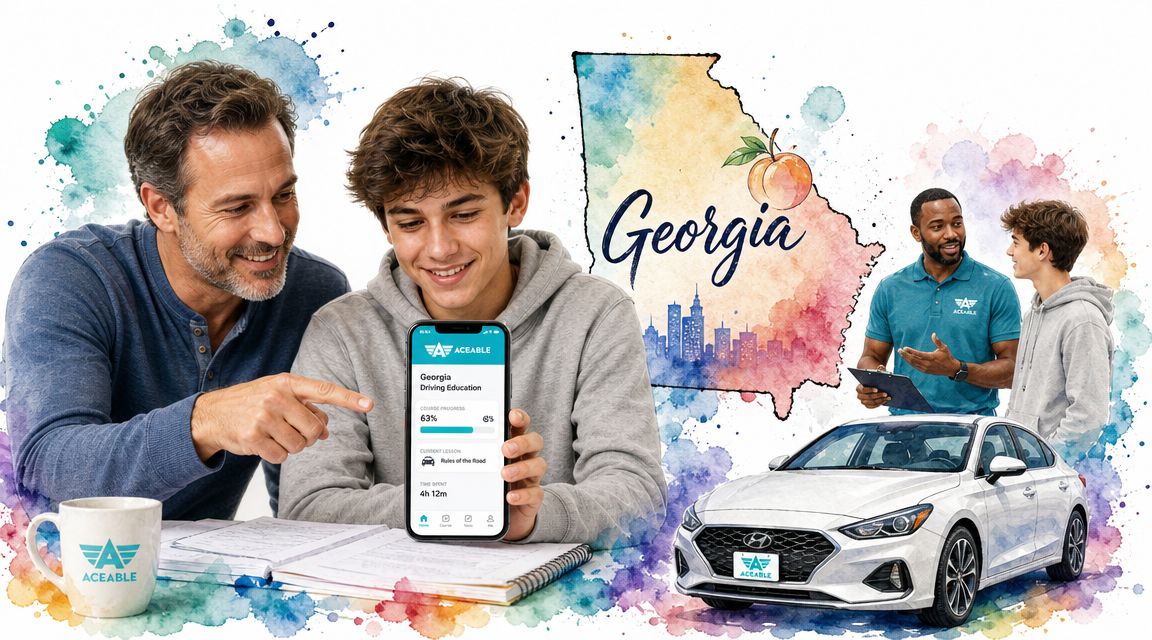
A lot of Georgia families start in the same place. A teen is ready to move toward a permit or license, a parent searches for a convenient online course, and Aceable shows up quickly because it's familiar, app-based, and easy to start.
That convenience is real. But convenience and completion aren't the same thing in Georgia.
If you're looking into online drivers ed Aceable, the main question isn't whether it's legitimate. It is. The question is whether it covers everything your teen needs under Joshua's Law, and whether an online-only provider gets your family all the way from coursework to actual driving skill, paperwork, and road testing without creating extra coordination work.
Is Online Drivers Ed from Aceable Enough for Georgia?
For many Georgia teens, Aceable can cover the 30-hour online classroom portion of driver education. That's the part families usually see first, because it's the easiest piece to shop for online. It feels simple. Sign up, work through lessons, finish the course.
The problem is that parents often assume the course is the whole pathway.
In Georgia, it usually isn't. A teen under 18 working toward a Class D license still has to deal with the full Joshua's Law process, not just the classroom requirement. That's where confusion starts, especially when the online provider is strong on course delivery but lighter on the practical next steps.
A good way to think about Aceable is this. It can be a useful course provider, but it is not automatically a complete Georgia licensing solution. Families still need to understand what remains in person, what must be scheduled separately, what can be done by a parent, and what must be documented correctly.
If you want a broader explanation of how web-based driver education fits into the state process, this overview of online driver's education in Georgia is a helpful starting point.
Bottom line: An online course may satisfy one requirement, but parents still have to manage the rest of the licensing workflow.
That distinction matters because the hardest part for many families isn't buying the course. It's getting everything else done in the right order, on time, and without last-minute scrambling.
What the Aceable Online Course Experience Is Like
Aceable has become a recognizable name because it sells a format that matches how teens already use technology. Its driver education product is described as 100% online and mobile-friendly on its app listing, which means students can work through lessons on a phone or computer rather than attending a fixed classroom session through a local school or community program. The same listing also highlights that the course delivery is built for asynchronous progress, which is the primary appeal for busy families juggling school, sports, and transportation logistics (Aceable app details).

What works well in the format
From a practical standpoint, the strongest part of Aceable's model is access. A teen doesn't need to wait for a classroom date, get dropped off at a school, or block off a big chunk of time every evening. They can log in, complete a section, stop, and return later.
That structure fits modern learning habits better than a rigid lecture format. Shorter segments, frequent interaction, and mobile-first layouts tend to reduce resistance. If you're interested in why those choices matter, VideoLearningAI's design principles offer a useful look at how pacing, interaction, and screen-friendly presentation affect online instruction.
Here's where Aceable makes sense for the right student:
- Flexible scheduling means teens can work around school and activities.
- Phone-friendly access lowers the barrier to getting started.
- Self-paced progression gives families more control over timing.
- State approval matters because the course has to meet legal education requirements, not just look polished.
Where the online experience has limits
The same strengths can become weaknesses for some students.
Self-paced learning only works well when the student is consistent. A motivated teen may finish steadily. Another may drag the course out, click through with minimal retention, or keep postponing the harder parts because nobody local is tracking the full process from course completion to in-car training.
That doesn't mean online learning is a bad choice. It means online coursework is best understood as instructional delivery, not full driver preparation. A phone can teach rules, signs, risk awareness, and permit-test concepts. It can't watch a student merge into traffic, correct a late brake, or coach mirror habits in real time.
The classroom part of driver education and the driving part are related, but they are not interchangeable.
That's the key trade-off with online drivers ed Aceable. The course can be convenient and legitimate while still leaving the family to solve the hardest operational parts elsewhere.
Understanding Joshua's Law and the Online Course Gap
Georgia parents usually discover the gap after the teen has already started an online course. They assume they're close to done, then realize the state process still has moving parts that haven't been arranged.
The first piece is easy to understand. A teen takes the required classroom instruction. The second piece is where many families get stuck, because the legal requirement doesn't end with online coursework.
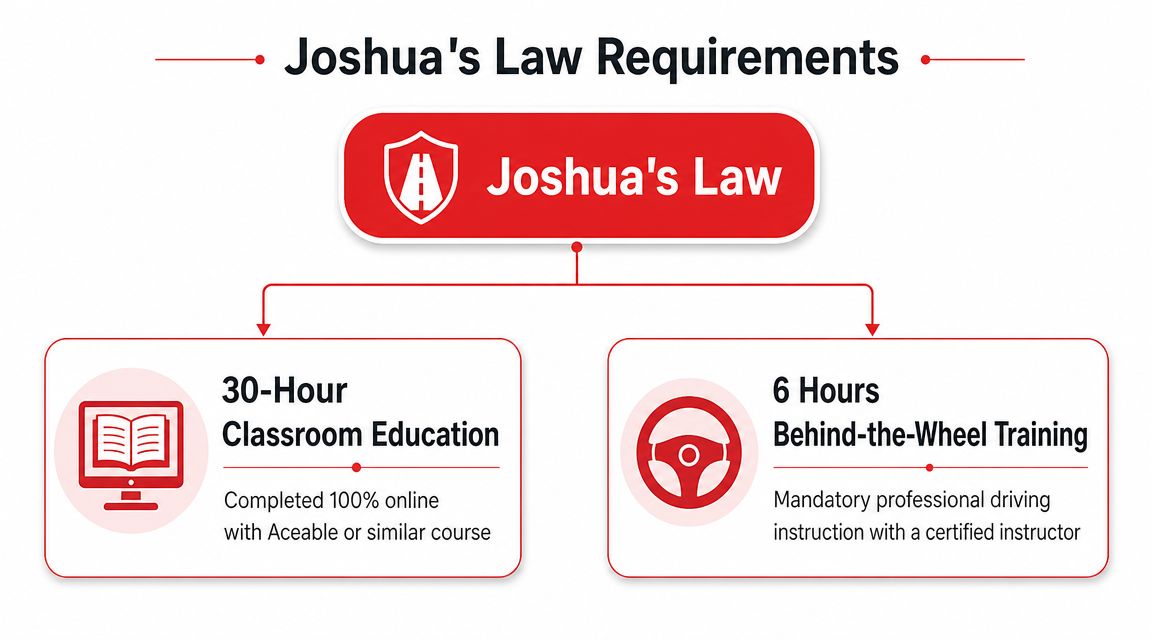
The two parts families need to separate
Under Georgia's process for teen drivers, the online course is only one part of compliance. Aceable's own Georgia page makes this clear. It explains that while the course can satisfy the classroom requirement, teens still need to complete in-car requirements through either a certified school path or the parent-guided option, and they still have to move through the state licensing steps after that (Georgia driver education requirements through Aceable).
In plain language, the split looks like this:
Classroom education
This is the online portion most families compare first.Behind-the-wheel training and licensing steps
The family still has to arrange practical driving instruction, supervised driving, documentation, and the road test process.
If you want the background behind the law itself, this explanation of who Joshua was and why Joshua's Law exists helps put the requirements in context.
What the gap looks like in real life
The practical question most parents ask is simple. “If my teen finishes the online class, what's left?”
The answer is not one small item. It is a chain of follow-through tasks. Families still have to coordinate the in-car side, track driving practice, and make sure the student is prepared for the road test environment, not just the knowledge portion.
A short video can help clarify the workflow:
What often goes wrong is not misunderstanding the law in theory. It's underestimating the logistics. Parents finish shopping for the online course and think the biggest decision is behind them. In reality, the scheduling and accountability burden often starts after the course is complete.
Why this matters for Georgia families
An online-only provider can leave you with a fragmented plan:
- One vendor for the online course
- Another provider for driving lessons
- Separate preparation for the road test
- Independent tracking by the parent
That fragmentation isn't always a deal-breaker. Some families manage it well. But it does create more handoffs, more room for delay, and more chances to miss a step.
Practical rule: If a program handles the screen time but not the seat time, the parent still has to build the rest of the system.
That's the actual compliance gap. It isn't that the online course is wrong. It's that families often buy one piece and mistake it for the full process.
The A-1 Advantage An Integrated Path to Your License
The main difference between an online-only provider and a local driving school isn't branding. It's workflow.
An online-only company typically solves one task well. It delivers the classroom portion in a convenient format. After that, the family still has to find a certified school for driving lessons or decide whether to use the parent-guided route, manage documentation, and line up the final testing steps.
A local provider with an integrated model reduces those handoffs. That matters more than most families expect.
Why integrated beats pieced together
Aceable's own broader driver education content reflects a real issue with self-paced online learning. Flexibility is attractive, but public completion-rate data is often unavailable, and a hybrid model with local structure can help students stay on track for both coursework and in-person requirements (Aceable driver education overview).
That point lines up with what Georgia families deal with every day. The obstacle usually isn't access to information. It's follow-through. Teens need nudges. Parents need schedules they can manage. In-person lessons need to connect to what the student learned online, not feel like a separate project.
Aceable vs A-1 Driving School for Joshua's Law
| Feature | Aceable (Online-Only) | A-1 Driving School (Integrated Solution) |
|---|---|---|
| 30-hour classroom course | Yes, through a state-approved online format | Yes, through a Georgia-focused program pathway |
| Mobile-friendly access | Yes | Yes, depending on course format selected |
| In-person driving lessons | No, must be arranged separately | Yes |
| Help coordinating Joshua's Law steps | Limited to course guidance | Yes, through a single provider workflow |
| Road test support | Not the core offering | Yes |
| Parent workload | Higher, because services are split | Lower, because fewer handoffs are involved |
| Accountability and scheduling structure | Mostly self-managed | More direct local support |
What works better for different families
An online-only course can still be the right first move for a self-directed student who already has a clear plan for lessons and testing. If a family is organized, has time to compare local schools, and doesn't mind stitching the process together, Aceable can fit that approach.
A local integrated program makes more sense when the family wants fewer moving parts.
That usually includes:
- Parents with limited time who don't want to coordinate multiple vendors
- Teens who need structure beyond an app and a login
- Students nervous behind the wheel who need instruction tied directly to real driving situations
- Families who want a clearer path from coursework to road readiness
The hidden cost of fragmentation
When comparing programs, individuals often focus on the upfront course experience. They should also compare the number of decisions left after checkout.
With online-only driver education, the family still has to answer practical questions:
- Which school will handle the driving lessons?
- How quickly can those lessons be scheduled?
- Who prepares the student for the road test?
- Who checks whether the student is ready?
- What happens if the teen finishes the class but stalls on everything else?
Those questions are where a complete local program earns its value. Not because online learning is bad, but because learning to drive in Georgia is part education, part scheduling, part coaching, and part compliance management.
Families usually don't struggle to buy the course. They struggle to keep momentum through the in-car phase and final testing stage.
That's why the integrated path tends to feel easier in practice. It closes the space between “course completed” and “license earned.”
Why Professional Driving Lessons Are Non-Negotiable
Parents sometimes treat the in-car requirement as the last box to check. That's backwards. The behind-the-wheel portion is where a teen starts converting rule knowledge into judgment, timing, scanning habits, lane control, and calm decision-making under pressure.
That shift matters because passing a course and driving safely aren't the same skill.
Research cited in Aceable's safety summary supports the value of formal driver education. It references an AAA study finding that driver's education reduced crashes by 4.3% and traffic incident convictions by nearly 40%. The same article also cites a University of Nebraska-Lincoln study of 150,000 teen drivers over eight years, reporting that teens who did not take driver's ed were 75% more likely to receive a traffic ticket and 24% more likely to be in a crash involving fatalities or injuries (driver's education safety findings summarized by Aceable).
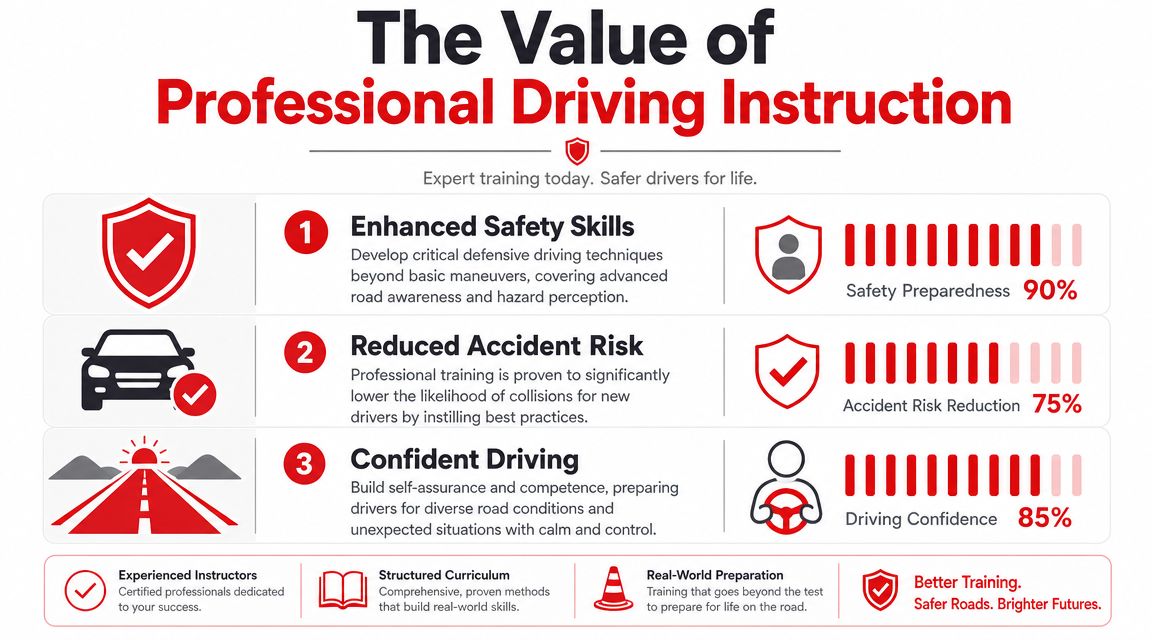
What a professional instructor sees that an app cannot
A student can score well on quizzes and still make poor decisions in traffic. Instructors catch the gap immediately.
They see things like:
- Late scanning at intersections
- Overcorrection after a small steering mistake
- Weak lane positioning
- Delayed braking judgment
- Unsafe speed choices in changing conditions
- Hesitation that creates new risk during turns or merges
A parent may notice some of that. A trained instructor usually notices it faster and corrects it more systematically.
Why lessons improve transfer, not just compliance
The core benefit of professional instruction is transfer. The student has to carry what they learned in the course into real traffic with consistency. That transition is where many new drivers struggle, and it's why the teaching method matters.
If you want a useful general framework for how students retain and apply skills across settings, LearnStream's guide to lasting student success is worth reading. The same principle applies in driver training. Knowing a rule in theory isn't enough. The learner has to retrieve it under stress, in motion, at the right moment.
That's also why instructor-led lessons tend to focus on scenarios that make new drivers uncomfortable, such as:
- Parking and backing
- Lane changes in active traffic
- Left turns across traffic
- Speed management on larger roads
- Mirror checks and blind spot routines
- Driving with steady control instead of panic reactions
For a closer look at what students gain from structured coaching, this article on the benefits of taking driving lessons from an instructor breaks down the practical side well.
Good in-car instruction doesn't just teach maneuvers. It builds a repeatable process for observation, decision-making, and correction.
Safety is the real standard
A lot of teen drivers can eventually get the car from point A to point B with parent practice alone. That is not the best standard.
The better standard is whether the student has developed safe routines before solo driving starts. Professional lessons push students into controlled practice with feedback. That's what gives the legal requirement its real value. Not the paperwork. The repetition.
When parents ask what matters most, the answer isn't the app design, the login experience, or how entertaining the course feels. Those things can help engagement. But the most important work still happens in the car.
Enrollment Pricing Scholarships and Your Next Steps
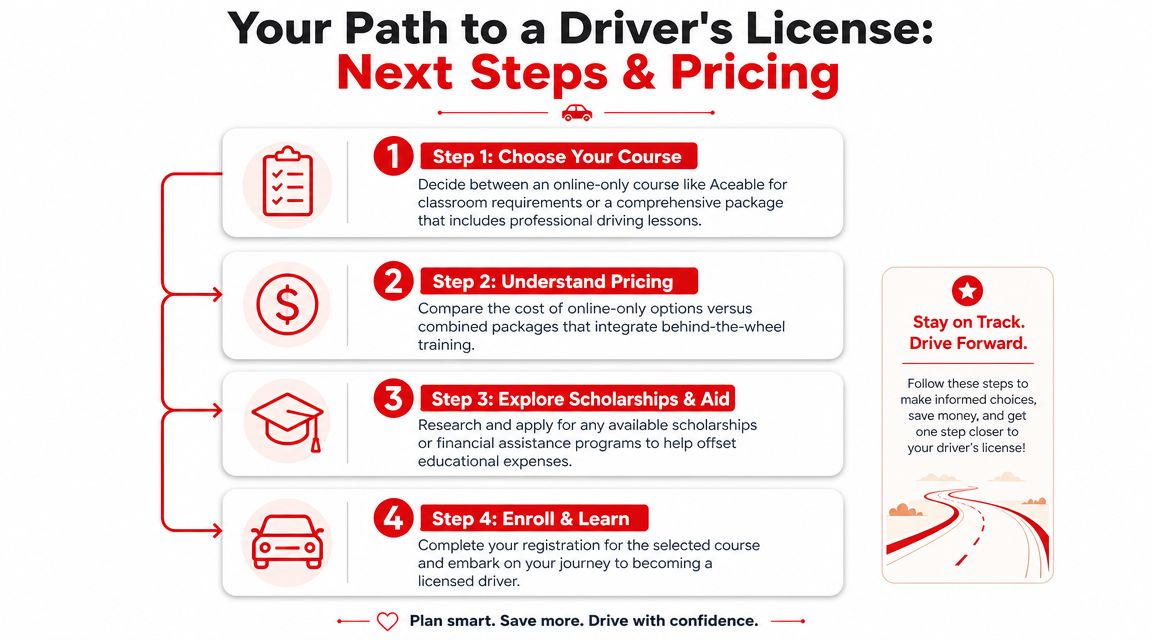
Price matters. Families should compare options carefully. But the smartest comparison isn't just online course price versus online course price. It's single-piece purchase versus complete pathway.
Aceable is a known online brand, and its app marketplace listing says it has helped over 1 million students earn a driver's license or permit. That scale shows how mainstream online learning has become, but it also reinforces a separate reality. Large national providers don't remove the need for Georgia-specific instruction, scheduling, and in-person testing support (Aceable app marketplace listing).
How to compare the real cost
When you evaluate choices, compare them by total pathway, not just initial checkout total.
Consider these questions:
- Does the price include only classroom instruction, or also driving lessons?
- Will you need to book a separate school later for the in-car requirement?
- Does the provider help with road test readiness, or do you have to find that elsewhere?
- Is the student likely to finish a self-paced course quickly, or will they need more accountability?
A cheaper online course can become the less efficient choice if it creates delays, duplicate scheduling, or extra stress later.
Don't overlook scholarship support
For Georgia families, the Georgia Driver's Education Scholarship Grant Program is one of the most important pieces to check early. It can help qualifying students access driver education and in-car training that might otherwise feel out of reach.
The practical move is to look at scholarship eligibility before choosing based only on sticker price. Many families focus on finding the cheapest classroom option first, then learn later that support may have been available for a fuller training package with actual driving lessons included.
A simple next-step checklist
If you're deciding what to do next, keep it straightforward:
Choose your classroom path
Decide whether you want an online-only provider or a local program that pairs coursework with lessons.Map the in-person requirements now
Don't wait until the online class is done to figure out driving lessons and testing.Check scholarship eligibility early
That can change what package makes the most sense.Prioritize driving lesson packages
For most families, that's the part that determines whether the process feels organized or chaotic.
If you're looking for Georgia-specific enrollment options, it makes sense to review a local school's Joshua's Law course options, driving lesson packages, road testing services, and scholarship information in one place before deciding.
Georgia Driver's License FAQ
Can a teen take Aceable for the class and still use a local school for driving lessons?
Yes. That's a common setup. A family can complete the online classroom portion through Aceable and then use a Georgia driving school for the in-car requirement, lesson packages, and road test preparation.
Is an online course enough by itself for a Georgia teen license?
No. The online course can satisfy the classroom portion, but it doesn't replace the behind-the-wheel training, supervised practice, or final testing steps required in the licensing process.
Is the parent-taught route always the best option?
Not always. It may look simpler on paper, but some families prefer professional instruction because it adds structure, scheduling, and outside coaching. That's especially useful when the teen is anxious, inconsistent, or difficult to coach at home.
Why do road test support and lesson packages matter so much?
Because they're where most delays happen. The classroom course is usually the easiest part to start. The practical driving stage is where students either build confidence and momentum or lose both.
Should families choose based on the app experience alone?
No. A smooth app is nice, but it shouldn't be the deciding factor. The better question is whether the full path from coursework to license is clear, supported, and realistic for your household schedule.
If you want a smoother path than piecing together an online course, separate driving lessons, and road test prep on your own, A-1 Driving School is worth a close look. Georgia families can explore Joshua's Law course options, driving lesson packages, road testing, and scholarship guidance in one place, which makes it much easier to move from classroom learning to real driving skill without losing time between steps.