
You’ve studied. You’ve practiced. Test day is on the calendar. Then one question starts nagging at you: is your road test car ready?
That worry is more common than most new drivers admit. A lot of people think the road test is only about turns, stops, and lane changes. It isn’t. The car matters from the first minute, because the examiner needs to see that the vehicle is legal, safe, and easy for you to control.
That makes sense when you look at how driving works in practice. In a 2023 survey, 95.3% of people age 16 and older said they drive occasionally, but teens 16 to 19 were the least experienced group at 88.3%. The same survey found common risky habits such as speeding and running red lights, which helps explain why the road test is such an important checkpoint for safe driving habits from the start, according to driving behavior data summarized by Driving-Tests.org.
A good road test car does more than meet the rules. It helps you stay calm. When the seat feels right, the brakes feel predictable, and the turn signals work exactly the way you expect, your brain has one less thing to worry about.
Passing Your Georgia Road Test Starts Before You Turn the Key
Most test-day stress shows up before the engine even starts. Students worry about paperwork, lights, mirrors, or whether a small car problem could ruin the appointment. That’s why smart preparation starts with the vehicle, not with the first right turn out of the parking lot.
Georgia road testing is about safe control, not flashy driving. The examiner wants to see that you can operate a road-legal vehicle, follow instructions, and make steady decisions. If the car creates distractions, your confidence drops fast.
Why the car affects your confidence
A familiar road test car helps in simple ways:
- Pedals feel predictable: You brake more smoothly when you already know how the car responds.
- Visibility is easier: Mirrors that are already adjusted and a seat that fits your height reduce second-guessing.
- Controls become automatic: Turn signals, wipers, and hazard lights shouldn’t require a search.
A nervous driver in a familiar car usually does better than a nervous driver in an unfamiliar one.
That’s one reason students often struggle when they borrow a relative’s vehicle at the last minute. Even if the car is legal, it may not feel natural. A wide SUV, a touchy brake pedal, or a different blind-spot view can make basic maneuvers feel harder than they really are.
Start with Georgia-specific thinking
Generic online checklists can help, but they don’t always match Georgia testing expectations. What matters at one DMV in another state may not line up with what Georgia examiners look for, especially if you’re a teen working through the licensing process after driver education.
Your goal isn’t to guess. Your goal is to show up with a road test car that is legal, safe, and comfortable for you to drive.
Georgia's Official Vehicle Requirements for the Road Test
The first job of your road test car is simple. It has to qualify for the test before anyone evaluates your driving. If the vehicle or documents don’t meet Georgia requirements, the appointment can stop before you leave the parking space.
General online advice often misses state-specific details. Georgia road test expectations, including what matters for Joshua’s Law completers and how testing can vary in metro traffic, call for local knowledge. A-1’s role with Fulton County Schools is part of why it has direct Georgia-specific insight, as noted on A-1’s Georgia road test guidance.
What examiners usually verify first
Bring a road test car that is legally ready to be on the road. That means the examiner may look for:
- A valid license plate: It should be attached properly and clearly visible.
- Current registration: The vehicle must be properly registered.
- Proof of insurance: You need valid insurance documentation.
- A safe, operable vehicle: The examiner must be able to see that the car is suitable for testing.
If any of that is missing, the problem isn’t your driving. It’s eligibility.
Why these rules matter
Students sometimes think paperwork checks are just red tape. They’re not. Georgia wants to know that a new driver can operate a vehicle that meets the same basic legal standards required for everyday driving.
Here’s the practical reason behind each item:
| Requirement | Why it matters on test day |
|---|---|
| License plate | Confirms the vehicle is identifiable and road-legal |
| Registration | Shows the vehicle is properly recorded |
| Insurance | Confirms legal financial responsibility |
| Safe condition | Protects you, the examiner, and everyone around you |
A road test is a safety evaluation. The state can’t separate your driving from the condition of the car you bring.
Don’t guess from another state’s rules
A lot of students search for “road test car requirements” and land on advice written for California, Texas, or New York. Some of it overlaps. Some of it doesn’t. That’s where confusion starts.
Practical rule: If you’re testing in Georgia, prepare for Georgia. Don’t rely on a viral checklist made for another state.
That same local focus matters if you’re taking driver education, completing Joshua’s Law, or planning road test practice around Atlanta traffic patterns. The closer your preparation matches the actual test setting, the steadier you’ll feel when it counts.
Your Pre-Test Inspection Checklist From Brakes to Blinkers
A legal car still has to be a working car. Many students lose confidence at this stage. They assume, “It drives fine, so it should be fine.” But test-day vehicle checks are often about small things that reveal whether the car is safe and whether you know how to use it.
Research on on-road testing found examiners agree on total scores about 80% of the time, with some scoring variation on subtests. The same research found stronger drivers tend to show smoother control with fewer steering corrections and better tracking, which is one reason a familiar, well-maintained road test car can help your performance feel more consistent under pressure, according to the Federal Highway Administration research archive.
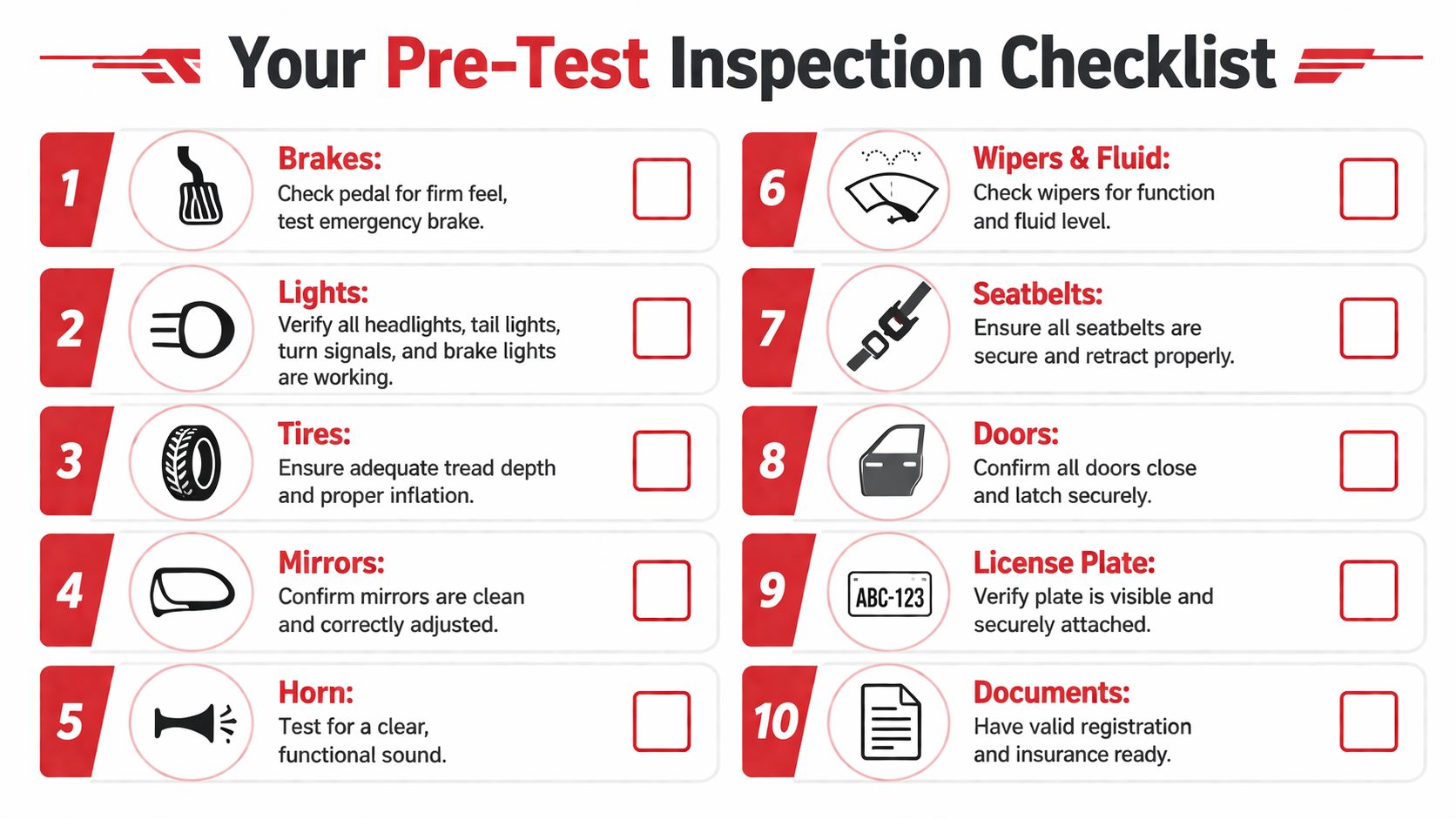
What to check the day before
Go through the car slowly. Don’t do it while you’re already late.
Brakes
Press the brake pedal while parked. It should feel firm, not soft or spongy. Test the parking brake too.Turn signals and brake lights
Ask someone to stand outside while you test them. Don’t assume they work because an indicator flashes on the dashboard.Headlights and tail lights
Check low beams and high beams if your vehicle has them easily accessible.Horn
A working horn is basic, but students forget it all the time.Tires
Look for visibly low air, worn tread, or obvious damage. If you want a broader maintenance reference beyond road testing, this guide on ensuring vehicle safety for Texas roads gives a useful general inspection mindset.
What to check the morning of the test
This second pass is about visibility and comfort.
- Mirrors: Clean them and adjust them before the examiner gets in.
- Windshield and windows: Make sure your view isn’t blocked.
- Seatbelts: Confirm they latch and retract properly.
- Doors: Test that they close securely.
- Wipers and washer fluid: These matter more than students think.
If you notice a tire issue, don’t wait until test day to learn what to do. A practical primer on fixing a flat tire safely can help you understand the basics before a small problem becomes a bigger one.
What the examiner notices even before scoring
Examiners notice whether you fumble with the car. That doesn’t mean they expect perfection. It means they can tell when a student knows the vehicle and when the student is improvising.
Smooth setup leads to smoother driving. Adjusting the seat, checking mirrors, fastening the belt, and using signals without hesitation all communicate readiness.
That’s why road test prep shouldn’t be only about parallel parking or turns. It should include repeated practice with the same controls in the same vehicle until basic actions feel automatic.
Common Vehicle Issues That Lead to Automatic Failure
Some car problems don’t just make the test harder. They can stop it outright.
The national average pass rate for driver’s tests is 46%, while students who receive structured preparation from a reputable driving school reach over 80% first-attempt pass rates, according to Coastline Academy’s pass-rate analysis. That gap says something important. Preparation reduces avoidable mistakes, and many of those mistakes start with the vehicle.

Problems that can end the test early
Some issues are obvious. Others catch people by surprise.
- Broken brake lights or turn signals: If the car can’t communicate basic driving intentions, it may not qualify.
- A cracked windshield in the driver’s view: If visibility is blocked, that’s a safety issue.
- Doors that don’t latch properly: The examiner has to be able to enter and exit safely.
- Bad mirrors: If a mirror is missing, loose, or unusable, the test can become a no-go.
If your side mirror is damaged, fix it before the appointment, not after. This walkthrough on how to replace car side mirrors gives a helpful overview of what that repair involves.
The common last-minute mistake
A student borrows a car the night before. It starts. It moves. Everyone assumes it’s fine. Then the examiner spots a nonworking signal or a visibility issue, and the whole plan falls apart.
That kind of failure feels terrible because it had nothing to do with your ability to drive.
If you’re unsure about your road test car, treat that uncertainty as a warning sign, not a minor detail.
Why practice matters here
Students who prepare with structure usually catch these issues sooner. They also learn how the examiner sees the vehicle. That’s different from casual family practice, where everyone focuses on driving and nobody checks whether the horn works or whether the registration is in the glove box.
A road test car shouldn’t be a mystery on test day. It should be a solved problem.
The A-1 Advantage Driving Lessons and Road Test Cars
The biggest confidence gap usually comes from one of two problems. You either don’t have a suitable road test car, or you don’t trust the one you have.
That’s where a structured training path helps. A school-based approach gives you more than driving time. It gives you a repeatable process: classroom or online driver education, behind-the-wheel lessons, test-focused practice, and a car that fits the testing moment.
Why lessons help beyond the basics
A common assumption is that driving lessons are only for students who don’t know how to drive yet. That’s too narrow. Lessons are also for students who can drive but still feel shaky under test pressure.
Most road test guides focus on technical skills and miss the role of anxiety. Confidence, recovery after a minor mistake, and calm decision-making are psychological skills built through repeated guided practice with an experienced instructor, as discussed qualitatively in A-1’s training content.
That’s why behind-the-wheel instruction matters so much. You’re not just learning maneuvers. You’re building muscle memory.
A helpful place to start is this explanation of the benefits of taking driving lessons from an instructor. It connects practice, feedback, and confidence in a way that casual driving often doesn’t.
What a complete preparation path can include
If you’re a Georgia teen or parent planning the full licensing journey, your prep may involve several pieces working together:
- Joshua’s Law courses: These help teens complete Georgia driver education requirements.
- Online course options in Georgia: Useful for families who need flexible scheduling.
- Driving lessons packages: Best for building real control, repetition, and test readiness.
- Road test packages: Helpful if you need a qualifying vehicle and a more predictable testing setup.
- Scholarship grant options: The Georgia Driver’s Education Scholarship Grant Program can make training more accessible for qualifying students.
When the car itself is the main obstacle
Sometimes the issue isn’t skill at all. It’s logistics.
You may be asking:
| Concern | Why it matters |
|---|---|
| “We only have one family car.” | Scheduling can become difficult and stressful |
| “Our car is old.” | Students worry about lights, mirrors, or paperwork |
| “I’ve practiced in one car and test in another.” | Familiarity drops and nerves rise |
| “I’m nervous about the examiner riding in the car.” | Stress increases when the setup feels unfamiliar |
In that situation, using a school-provided road test car can simplify everything. Students can practice in a vehicle that is already part of a testing routine, then show up knowing the controls, visibility, and general feel of the car.
A-1 Driving School offers driver education, Joshua’s Law options, behind-the-wheel lessons, driving lesson packages, road test support, and school-based training in Georgia. For many students, the most useful part is simple: they get guided practice and a clearer plan instead of trying to patch everything together at the last minute.
Confidence comes from fewer surprises
Students often say they want to “feel more confident.” What they usually mean is this: they want fewer unknowns.
A better road test plan reduces unknowns in four places:
- The vehicle
- The route environment
- The examiner’s expectations
- Your own reactions under stress
Confidence isn’t a speech you give yourself in the parking lot. It’s the result of repetition in a car you trust.
That’s why driving lessons packages are so useful. Repetition turns uncertainty into routine. Routine calms nerves.
Beyond the Vehicle Building Your Test Day Confidence
By test day, the car should already be handled. Then your job is to manage your mind.
Most road test advice stays technical. Real students know the harder part is often emotional. You can know how to make a turn and still tighten up because someone is writing notes on a clipboard beside you.

What helps the night before
Keep the routine simple.
- Sleep enough: A tired driver overthinks basic choices.
- Eat something light: Don’t show up shaky or distracted.
- Lay out documents early: Last-minute searching creates panic before the test starts.
- Arrive with time to spare: Rushing makes your first few minutes worse.
How to recover from a small mistake
Students often think one imperfect moment means they’ve failed. That belief causes bigger problems than the original mistake.
If you park a little wide, take a breath and keep driving safely. If a turn feels awkward, don’t start apologizing or mentally quitting. The examiner is watching how you continue.
One small error does not have to become five more.
Build calm before test day
The best way to reduce nerves is repeated, guided practice. That’s because calm isn’t just an attitude. It’s physical familiarity. You’ve already felt the brake pressure. You’ve already practiced mirror checks. You’ve already handled traffic, turns, stops, and lane position enough times that your body knows what to do.
That’s also why students do better when they practice in realistic conditions. Metro Atlanta traffic feels different from a quiet side street. A student who has only practiced in easy conditions can feel rattled when the environment gets busier.
A simple test-day mindset
Use this three-part reminder:
- Set up the car carefully
- Listen fully before moving
- Drive one decision at a time
Don’t try to predict the whole test. Just handle the next safe action. That keeps your attention where it belongs.
Your Partner on the Road to a Georgia License
A road test car can help you pass, or it can create problems before the test even begins. That’s why the smart approach is simple. Use a legal, well-maintained vehicle, check it early, and practice until the controls feel familiar.
If you’re still unsure, don’t leave it to chance. Build confidence with driver education, Joshua’s Law training, online course options, road test preparation, and driving lessons that give you more repetition before test day.
If you want a clearer plan for your Georgia license, explore A-1 Driving School for driving lessons, Joshua’s Law courses, online driver education, road test support, and lesson packages that help you practice in a test-ready vehicle with less stress.