
You’re probably here because the ga road test feels bigger than it should. Maybe your permit has been sitting in your wallet for months. Maybe your teen is ready to schedule the test, but you’re worried about paperwork, parking, or showing up with the wrong car. That’s normal.
The fear isn't of driving itself; rather, it's of surprises. The good news is that the Georgia road test is predictable once you know what the examiner is checking, what your vehicle must have, and how to practice the exact moves that matter.
Your Guide to the Georgia Road Test
The first thing to know is that passing the ga road test is realistic. Georgia ranks among the top states for driver’s license skills test success, with a 94.9% pass rate from 2020 through 2023, tying for the nation’s highest and sitting well above the U.S. average of 78.8%, according to Auto Body News reporting on national skills test pass rates.
That doesn’t mean the test is easy. It means people pass when they prepare for the right things.
A lot of anxiety comes from treating the road test like one big mystery. It isn’t. It’s a short, structured evaluation of whether you can control the car, follow directions, observe traffic, and make safe choices without constant coaching. The examiner isn’t looking for perfection. They’re looking for consistency.
Practical rule: The road test gets easier when you stop asking, “Will I mess up?” and start asking, “What exactly will they score?”
The strongest preparation usually starts long before test day. For teen drivers, that foundation often begins with Joshua’s Law, a formal driver’s education course, and enough supervised driving to make the basics feel automatic. For adults, it usually means focused practice on the maneuvers and traffic habits that examiners notice first.
If you build your preparation in the right order, paperwork first, vehicle second, maneuvers third, road driving last, the whole process becomes much calmer. That’s how experienced instructors approach it, and it’s how students usually walk in feeling ready instead of rattled.
Eligibility and Paperwork A Checklist for Success
A student can practice for weeks, drive well, and still go home without taking the test. The reason is often simple. A missing document at the counter.
That is why experienced instructors handle paperwork like a pre-drive safety check. If one item is missing, the whole plan stops.
For the ga road test, eligibility comes first. Then the driving test can begin. Families who treat this step early usually avoid the last-minute scramble that creates most test-day stress.
What teen drivers usually need
For teens in Georgia, the road test is the final checkpoint in a longer process. You may need a valid learner’s permit, proof that Joshua’s Law requirements are complete, supervised driving records, and identity documents that match exactly.
Small details matter here. A permit that expired last week, a certificate with a name mismatch, or an affidavit left unsigned can delay the appointment even if the student is fully ready to drive.
A-1 Driving School has seen this pattern for decades. Students are rarely turned away because they cannot steer or stop. They are turned away because no one built a simple document system before test day. That is one reason many families benefit from reviewing the full Georgia driver’s license requirements before they schedule.
Here is a checklist you can use.
| Document | Required for Teens (16-17) | Notes |
|---|---|---|
| Learner’s permit | Yes | Bring the valid permit and check the expiration date early. |
| Joshua’s Law course completion | Yes | Keep the certificate in one folder, not buried in email. |
| Behind-the-wheel training proof | Yes | Make sure the form is complete and easy to read. |
| Supervised driving affidavit | Yes | Check signatures and dates before the appointment. |
| Parent or guardian presence if needed | Yes | Some steps require a parent or guardian to sign in person. |
| Identity and residency documents | Yes | Names and addresses should match your other records. |
| Insurance and registration for the test vehicle | Yes | Keep both in the test car, not at home or in another vehicle. |
Where families get tripped up
The common mistake is assuming completion and proof are the same thing. They are not. You may have finished the course, logged the hours, and practiced enough to pass, but the testing location still needs the right records in the right form.
Another problem is scattering documents across the house. One paper is in a desk drawer. Another is in a parent’s glove box. The insurance card is sitting in a different car. A single folder fixes a lot of stress.
Call the testing location if anything is unclear. Questions about guardianship, document format, or whether a third-party site can test you are much easier to solve two days early than ten minutes before your appointment.
Bring originals, or the exact version your testing site accepts. A photo on your phone may not fix a paperwork problem at the counter.
A simple way to prepare
Use a three-part routine the night before.
- Confirm eligibility. Make sure permit, course, and supervised driving requirements are complete.
- Build one folder. Put every required paper in the same place.
- Check the car documents too. Registration and insurance should already be inside the vehicle.
That last step helps more than people expect. Paperwork and vehicle readiness work together. A quick review of what mechanics check during inspections can also help families understand the difference between a car that runs and a car that is test-ready. This guide on how to pass your annual safety checkup is a useful comparison.
If you want the calmest path, treat paperwork like part of driver training, not a separate chore. That is one of the practical lessons A-1 has taught families for more than 38 years. The students who arrive organized usually start the test more relaxed, and relaxed drivers make better decisions.
Your Vehicle The First Thing the Examiner Inspects
You arrive on time, your documents are ready, and your driving feels solid. Then the examiner walks to the car and notices a brake light is out. The test can stop before you ever leave the parking lot.
That is why vehicle prep deserves its own practice session.

What the examiner checks first
The car has to be safe, legal, and easy to operate. A road test vehicle is a lot like a student walking into class with the right materials. If something basic is missing, the lesson cannot begin.
Start with the items examiners notice quickly:
- Brake lights and turn signals: Front and rear lights should all work.
- Horn: It should sound clearly.
- Brakes: The pedal should feel normal, and the car should stop smoothly.
- Windshield visibility: The driver’s view should be clear, without anything blocking it.
- Registration and insurance: Keep both in the vehicle and easy to reach.
- General condition: Tires, mirrors, doors, and the inside of the car should all be in usable condition.
Students often focus on what feels hard, like parallel parking, and overlook what feels ordinary. The examiner does the opposite at first. They check the ordinary things because those are the foundation of safe driving.
Some families like to review a general maintenance checklist before test week. If you want a plain-language refresher on vehicle inspection habits, how to pass your annual safety checkup offers a helpful overview.
Problems students do not expect
Borrowed cars create trouble more often than students expect. A different car can change your timing, your sight lines, and even how confident you feel at low speeds. A taller SUV, a small sedan, and an electric vehicle can all respond differently when you brake, reverse, or judge space near a curb.
That is one reason A-1 Driving School spends time on practical preparation, not just the rule book. After more than 38 years working with Georgia drivers, the pattern is clear. Students do better when they practice in the same vehicle they plan to test in, or at least spend time adjusting to the one they will bring.
Check the small controls too. Know where the hazard button is. Know how the gear selector works. Know whether the parking brake is a hand lever, a pedal, or an electronic switch. Under stress, familiar details matter.
If you are borrowing a car, drive it ahead of time in a quiet area and in a parking lot. Ten calm minutes of practice can prevent a very preventable mistake.
A simple vehicle check that works
Use a two-round inspection.
A few days before the appointment, test every light, check the horn, look at the tires, clear out the windshield area, and confirm the registration and insurance are inside the car. Then do the same check again the day before. This works like a preflight check for a pilot. It catches problems early, while there is still time to fix them.
If a tire looks low, a light is out, or the car has another basic issue, handle it before test day. Students building overall car confidence may also find this guide on how to fix a flat tire helpful, because being a prepared driver includes knowing how to respond when ordinary vehicle problems show up.
A test-ready car helps you start calm. And calm drivers usually show their real skill.
Mastering the Maneuvers What the Examiner Is Scoring
You pull into the test lot, and the quiet part can feel harder than the road. No traffic to blame. No flow to follow. Just you, the car, and a few maneuvers that show how well you control the vehicle at low speed.
That pressure is real. It also becomes much easier to handle once you understand what the examiner is watching.
What the score is really measuring
The off-road portion of the ga road test is not a talent show. It is a control test.
The examiner is looking for accuracy, observation, and calm decision-making during a small set of required maneuvers. A student can feel shaky and still do well if the process is steady and deliberate. A student can also feel confident and lose points by rushing, skipping checks, or setting up the car poorly.
After more than 38 years of working with Georgia drivers, A-1 Driving School has seen the same pattern again and again. The maneuver itself is rarely the whole problem. Setup, speed, and where the student looks usually decide the result.
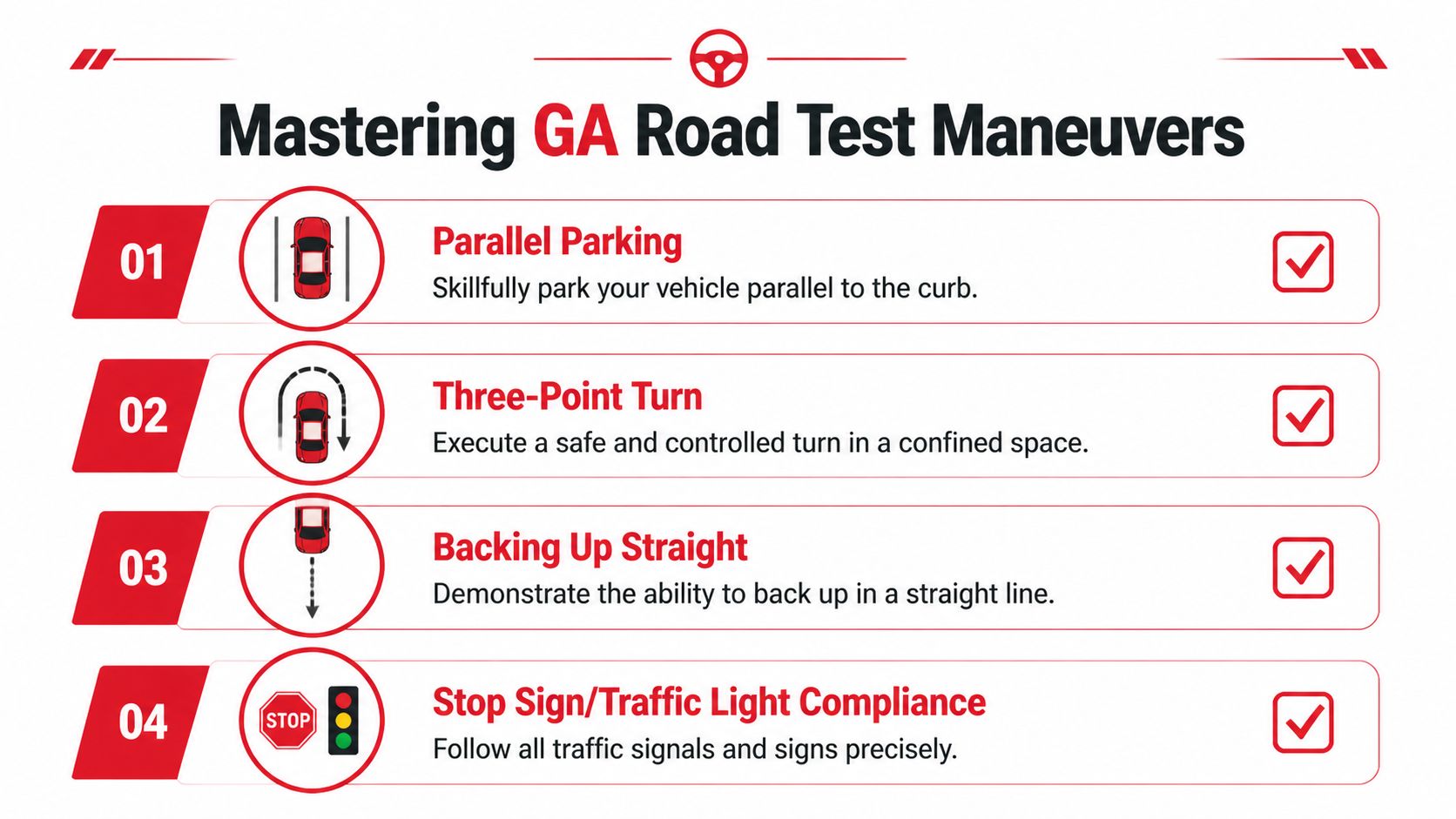
The four maneuvers that deserve your practice time
Parallel parking
This is the one that gets into students’ heads, but it follows a repeatable pattern. The examiner watches how you position the car before you start, whether you move slowly enough to make small corrections, and whether you finish neatly near the curb without climbing it. If you want a step-by-step method you can rehearse, this guide on how to parallel park for a road test breaks it into simple checkpoints.Straight-line backing
Backing up in a straight path sounds simple until nerves show up. The skill being scored is not just whether the car stays straight. It is whether you check properly, keep the vehicle creeping at a controlled pace, and correct gently instead of sawing at the wheel.Three-point turnabout
This maneuver shows planning in a confined space. The examiner wants to see that you stop fully between movements, look before each change of direction, and place the car carefully instead of trying to force one fast turn.Stopping and basic compliance
Even in the lot, your habits count. A missed signal, a rolling stop, or moving before checking your surroundings can cost points quickly because those mistakes show weak awareness.
Slow hands and slow speed solve a lot of maneuver problems.
What often causes point loss
Students usually do not lose points because the maneuver is impossible. They lose points because one small step gets skipped.
Common examples include starting parallel parking from the wrong spot, backing while looking only at the mirrors, turning the wheel too late, or correcting too fast after drifting. It works like handwriting. If the first line starts crooked, every line after it becomes harder to keep neat.
That is why random practice often leads to random results.
A practice method that works better
Use short, focused repetitions. Pick one maneuver and run it several times in a row under the same conditions. Keep the setup consistent. Stop after each attempt and name one specific thing to fix on the next one.
A-1 instructors use this kind of practice because it gives students a pattern they can trust under pressure. That matters even more if you plan to test at a specific location. Professional lessons near your test area can help you match the space, pacing, and expectations you are likely to face, instead of practicing in a way that feels too loose or unrealistic.
One more point helps many nervous drivers. The examiner is not waiting for perfection. The examiner is checking whether you handle the car safely, follow directions, and recover calmly if a maneuver needs a small correction. That is a skill you can build.
Proving Your Road Skills Beyond the Parking Lot
Once the lot work is done, the ga road test shifts into something more realistic. Now the examiner wants to see how you behave around other people, moving traffic, traffic lights, lane markings, and the small surprises that show up on ordinary roads.
That’s where many students either settle down or tighten up.

What the examiner notices on the road
The on-road part of the test is less about special tricks and more about good habits under light pressure. Examiners usually watch for the same cluster of behaviors:
- Lane position: Stay centered and stable.
- Turns: Brake smoothly, signal in time, and finish in the proper lane.
- Intersections: Come to a real stop and look both directions.
- Following distance: Don’t crowd the car ahead.
- Yielding: Give the right-of-way when required.
- Speed management: Match posted limits and conditions without drifting too slow or too fast.
A student can be excellent at parking and still lose points on something simple like a rushed right turn or a late signal.
Why location matters
Road tests don’t feel the same at every site. Some areas are calmer. Others involve denser traffic, odd intersections, school-zone pressure, or awkward exits from the testing center. That local variation matters more than most online checklists admit.
According to a summary of this information gap in Georgia road test prep, official location-specific data is limited, but anecdotal reports and driving school experience suggest that first-time pass rates at busy metro Atlanta DDS centers can fall in the 40% to 60% range because of heavier traffic and more complex routes, as discussed in this Georgia checklist and location-variability article.
That doesn’t mean a site is “bad.” It means route familiarity can change how calm you feel behind the wheel.
A difficult route usually exposes hesitation, not ignorance. Students often know the rule. They just haven’t practiced it in that environment.
A short visual walkthrough can help you think about what examiners are watching in live traffic.
The habits that steady nervous drivers
Nervous drivers often improve when they narrow their attention to a simple sequence:
- Scan early
- Signal on time
- Brake smoothly
- Stop fully if required
- Look again before moving
That sequence works at stop signs, right turns, left turns, and lane changes. It gives your brain something useful to do instead of spiraling over whether the examiner liked your last move.
The on-road portion rewards calm observation. If you can make safe, ordinary decisions consistently, you’re doing what the test is designed to measure.
A-1 Driving School Your Partner for Road Test Success
You have the permit. You have practiced. Now the pressure shifts from learning to proving what you can do in a short test, on a specific route, in a specific car.
That is the point where many families start looking for more than general advice. They need a plan that connects the whole process. A-1 Driving School brings that together through Joshua’s Law classes, behind-the-wheel lessons, road test preparation, and the ability to offer the road test at its locations. After 38 years of working with Georgia drivers, the school’s value is not mystery or hype. It is structure.

What students usually need most
Teens usually start with two jobs at once. They have to meet Georgia’s training requirements, and they have to build enough real skill to drive calmly with an examiner in the car. Adults often come in with a different problem. They may already understand the rules, but one or two weak spots keep showing up under pressure.
That pattern is common.
A student might do fine on ordinary neighborhood drives, then tense up during backing, drift wide on turns, or rush a gap in traffic. Those are not always knowledge problems. They are often habit problems, and habits improve faster when practice follows a clear sequence.
Where driving lessons make the real difference
A good lesson works like coached repetition in sports. You do not improve by hearing “keep your eye on the ball” once. You improve by repeating the motion, getting corrected, and repeating it again until the movement becomes natural.
Road test preparation works the same way. Instructors can spot the small errors students miss on their own, such as stopping a little too late, steering one-handed during a turn, or checking mirrors without making that observation obvious enough for the examiner to see.
At A-1, that practical coaching is especially useful because it can be tied to the place the student expects to test. Route familiarity does not replace skill, but it lowers the mental load. If a student already knows the speed changes, common turn points, and traffic patterns near a test site, more attention stays available for safe driving decisions.
Targeted practice often includes:
- Maneuver work: parallel parking, backing in a straight line, and turnabouts until the steps feel repeatable
- Traffic decisions: gap judgment, lane position, speed control, and right-of-way choices
- Location-specific preparation: practice near likely testing areas so the student is not processing every road feature for the first time
- Vehicle familiarity: learning in a car that feels predictable and is ready for testing
For families comparing providers, organization matters too. Lesson scheduling, instructor consistency, and progress tracking affect how quickly a student improves. In education businesses more broadly, tools built for test prep center software show the same principle. Students do better when training is scheduled, documented, and easy to follow.
Why an all-in-one path helps
A scattered process creates avoidable stress. One company handles the class. Another handles lessons. A third location handles testing. Papers get misplaced. Skills get practiced out of order. The student ends up feeling less prepared than they really are.
A connected process is easier to manage.
A-1 offers driver education, Joshua’s Law courses, online options for Georgia students, driving lessons, lesson packages, scholarship-grant guidance, and road testing support through its metro Atlanta locations. That matters because each step can build on the last one. The classroom explains the rule. The lesson turns the rule into a habit. The road test checks whether the habit holds under pressure.
Some students also perform better in a setting that feels more familiar and less hectic than a crowded state office. For them, testing through an approved school can remove distractions that have nothing to do with driving ability.
Good instruction clears out extra noise so the student can focus on the driving task in front of them.
Don’t overlook the scholarship path
Cost can slow down training, even for families who are ready to start. Georgia’s Driver’s Education Scholarship Grant Program can help eligible students afford approved instruction, and A-1 provides guidance on that process.
Parents should check that option early. It is much easier to line up forms, course dates, and lesson availability before the permit-to-license timeline feels rushed.
The strongest preparation plan is usually straightforward. Complete the required coursework. Get enough professional practice to correct the weak spots. Practice near the test environment when possible. Then schedule the road test when the student’s performance is steady, not just when the calendar has an opening.
Test Day and What Comes Next
You pull into the lot, shut off the car, and suddenly the simple things feel louder than usual. Where do your documents go? Did you remember to silence your phone? Why do your hands feel different on the steering wheel today?
That reaction is common. Test day feels big because it compresses several tasks into a short stretch of time. The best way to handle it is to treat it like a familiar routine, one step at a time.
Before the test begins
Arrive early enough that you do not have to hurry. A rushed start puts your brain in the wrong gear.
Use those extra minutes for a short reset. Check your paperwork, do one calm walk-around of the vehicle, and settle into the driver’s seat before the examiner arrives. Students who train with experienced instructors often do better here because they have practiced this exact sequence already. After 38 years of helping Georgia drivers prepare, A-1 has seen the same pattern again and again. Calm routines reduce careless mistakes.
Listen closely to each instruction. If a direction is unclear, ask for it to be repeated before you move the vehicle. Examiners want safe, controlled driving. Guessing helps no one.
If you pass
Take a breath and enjoy it. You earned that result through preparation, not luck.
Then switch from celebration to follow-through. Keep every paper you are given and pay attention to the next licensing step. Many students relax so fast after the test that they become sloppy with the administrative part.
Passing the road test is a major step, but your license is not fully handled until the remaining paperwork is finished correctly.
If you do not pass
A failed attempt feels personal, but it usually points to a specific driving problem, not a permanent weakness. Instructors see this all the time. A student may be solid in practice, then lose points from one rushed turn, one backing mistake, or a few smaller errors caused by nerves.
Georgia generally requires a waiting period before a retest, as noted earlier in the article. Use that time well. Do not just practice more. Practice the right thing more.
If your turns were too wide, work on turns until the car consistently finishes in the correct position. If backing caused trouble, repeat backing slowly until your steering and speed stay controlled. If traffic pressure made you tense, practice with a calm coach in real traffic so the situation feels familiar instead of threatening. A focused lesson after a failed test often helps more than several unfocused practice drives.
That is one reason many families use a school like A-1 Driving School. A student can complete Joshua’s Law requirements, take lessons, get help identifying weak spots, and in some locations even take the road test through the same provider. That kind of continuity makes the process easier to manage and easier to improve.
The best next move
Ask yourself two plain questions after the test:
- What felt steady from start to finish?
- What still felt uncertain under pressure?
Those answers give you your next assignment.
Some drivers are ready to finish the licensing process. Others need a few targeted lessons before the next attempt. Both are useful outcomes if you are honest about what happened behind the wheel.