A lot of older drivers come to this question in a quiet way. There usually isn’t one dramatic moment. It’s more often a collection of small signs. A left turn across busy traffic feels more tiring than it used to. Night driving takes more concentration. A new intersection, a faster highway merge, or an unfamiliar car feature can make a capable driver think, “I’d like a little help getting fully comfortable again.”
That feeling is normal.
Driving lessons for seniors aren’t about starting over. They’re about staying current, adjusting to change, and protecting the independence you’ve built over a lifetime. For many families, that shift in perspective changes everything. Lessons stop feeling like a judgment and start feeling like smart upkeep for an important life skill.
Staying Independent and Confident on the Road
A driver in later life often knows more about the road than anyone in the car. They’ve handled weather, traffic, construction, detours, impatient drivers, and every kind of parking lot surprise. But experience doesn’t erase the fact that driving can feel different over time.
Maybe you still drive comfortably during the day, but avoid rush hour now. Maybe backing out of a crowded lot feels less simple than it used to. Maybe your family has started asking questions that feel loaded, even when they mean well.
None of that automatically means you should stop driving. It may only mean you need a fresh set of strategies.
A refresher lesson can be a maintenance step, much like updating your eyeglass prescription or learning a new feature on your phone.
Physical comfort plays a role too. If your neck, shoulders, hips, or knees feel stiffer, basic movement in the driver’s seat can become more tiring. Better flexibility and strength can support better driving posture and smoother head turns, which is one reason some families also look at Family Caregiving Kit's senior fitness advice alongside driving support.
For drivers who notice worry building before they even leave the driveway, it helps to address the anxiety directly rather than pretend it isn’t there. A practical starting point is learning how other adults work through stress behind the wheel, such as the ideas in this guide on overcoming driving anxiety.
What confidence actually looks like
Confidence doesn’t mean forcing yourself to drive everywhere.
It means knowing your limits, understanding your vehicle, and having a plan for situations that feel harder than they once did. A lesson with a patient instructor can help you rebuild that confidence in a calm, private setting. Many seniors find that once they practice a few specific trouble spots, the fear shrinks quickly.
That’s the ultimate goal. Keep control. Keep mobility. Keep the freedom to get where you need to go without feeling uncertain every time you turn the key.
Why Consider Senior Driving Lessons
Older drivers are often judged unfairly. In reality, many have strong safety habits and a healthy respect for the road. According to senior driving statistics collected by SeniorLiving.org, by 2030, an estimated 53 million Americans will be over 70, and an IIHS study covering 1995 to 2018 found a 43% decline in fatal crash rates for drivers 70+, compared with a 21% drop for ages 35 to 54.

That matters because it changes the conversation. Driving lessons for seniors aren’t a response to failure. They’re often part of the same self-awareness that already makes many older drivers careful and thoughtful.
Common reasons drivers seek instruction
Some people come in after a long break from driving. Others are still active drivers but want a professional eye on a few sticking points. The most common concerns tend to sound like this:
- Busy intersections feel rushed: Left turns, short yellow lights, and heavy traffic can create pressure.
- Body movement isn’t as easy: Turning to check blind spots or backing out may feel less smooth.
- Modern cars feel unfamiliar: Backup cameras, lane alerts, and other features can be helpful once you know how to use them well.
- Family concerns are creating tension: A neutral instructor can evaluate skills without the emotion that often comes with family conversations.
- A road test or renewal issue is coming up: Practice reduces uncertainty.
Some of these concerns overlap with broader risks associated with older drivers, but risk isn’t the whole story. The better question is whether training can help you adapt. In many cases, it can.
Lessons support ability, not just rules
A good lesson does more than review signs and signals. It helps drivers match their habits to how they feel today.
For example, a driver with reduced neck mobility may learn a better mirror setup and a more deliberate scanning routine. A driver who feels overloaded in Atlanta traffic may practice route planning, lane choice, and timing rather than trying to “push through” stress. A driver who dreads parking lots may work on speed control and backing technique until the motion becomes predictable again.
A short look at the kind of instruction older adults often benefit from can help make that concrete.
Practical rule: If you’ve started changing where, when, or how you drive, that doesn’t mean you’re done driving. It may mean you’re ready for targeted coaching.
The emotional side matters too. Families often feel relief when a parent or grandparent chooses lessons voluntarily. And seniors often feel relief when they realize instruction can be respectful, calm, and focused on preserving independence rather than taking it away.
What to Expect from Senior-Focused Instruction
Many seniors worry that a lesson will feel like a driving test with constant criticism. A senior-focused lesson should feel very different. It should feel calm, specific, and built around your goals.
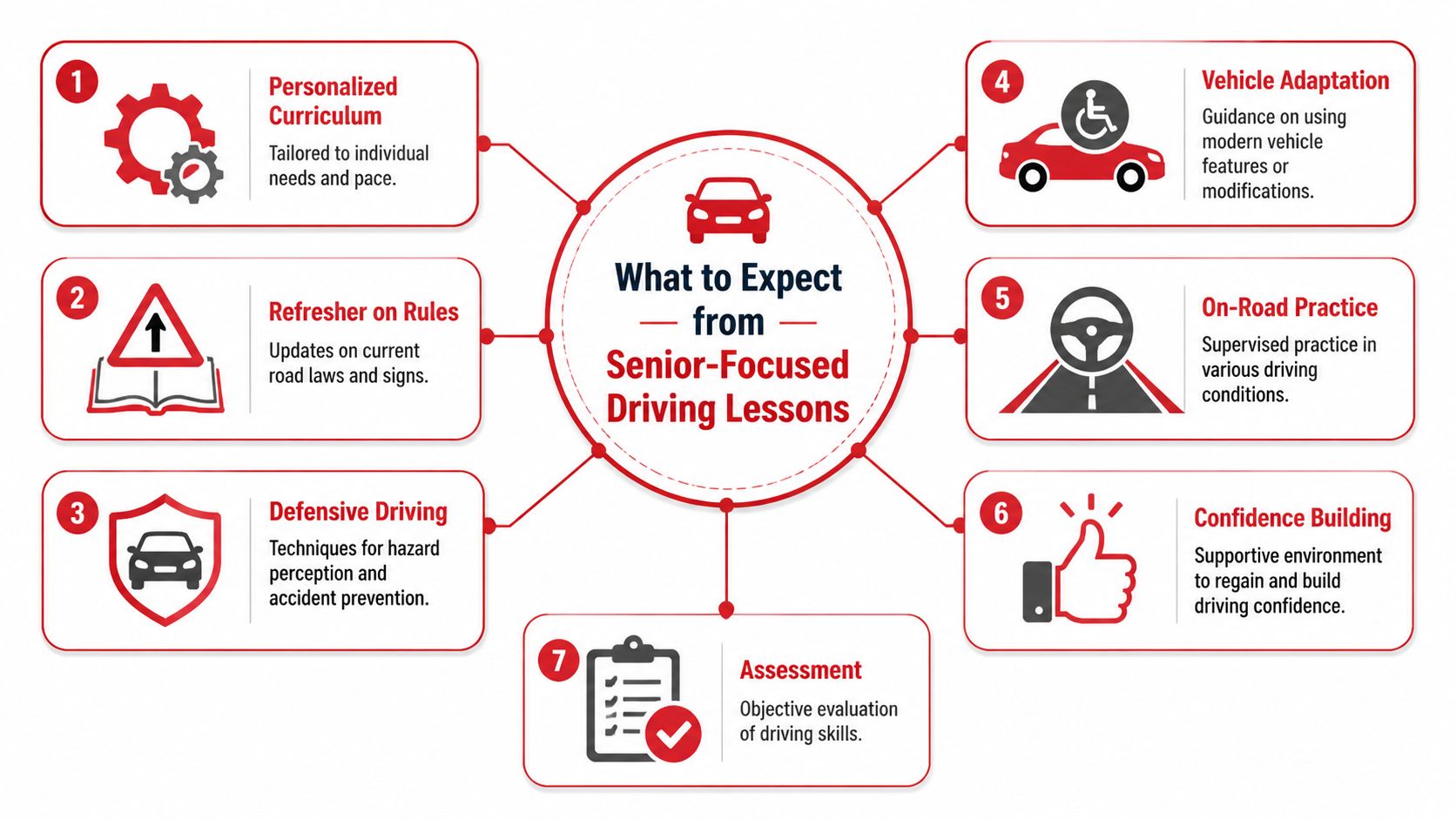
The strongest programs combine review with active practice. The National Highway Traffic Safety Administration notes in its older-driver behavior change guidance that 6 to 10 hours of classroom instruction on age-related changes plus on-road feedback is rated “proven” (4 stars) for improving driving performance, and that active training works better than passive methods for skills such as side-to-side threat scanning.
The first lesson usually starts with observation
An instructor doesn’t need to guess what you need. They can watch how you already drive.
That first session often answers practical questions:
- Are turns too wide or too tight?
- Is scanning thorough at intersections?
- Are mirrors set in the most useful way?
- Does the driver brake early, late, or abruptly?
- Is highway merging a skill issue, a timing issue, or mostly a confidence issue?
That matters because the best training for older adults is rarely one-size-fits-all.
Skills that often get attention
A senior lesson plan may include a mix of review, coaching, and repetition. Here are some areas instructors commonly work on:
- Complex intersections: Practicing protected and unprotected left turns, reading signal timing, and avoiding rushed decisions.
- Lane changes and blind spots: Building a repeatable sequence using mirrors, shoulder checks, and steady speed control.
- Parking lot movement: Backing out, choosing lower-stress spaces, and handling pedestrians and carts.
- Highway driving: Entering, merging, judging gaps, and planning lane position before exits.
- Roundabouts and multilane roads: Understanding who yields, where to look, and when to commit.
- Vehicle technology: Learning what backup cameras, blind spot warnings, lane departure alerts, and forward collision systems can and cannot do.
Comfort and adaptation matter
Sometimes the issue isn’t “bad driving.” It’s discomfort interfering with good habits.
An instructor may suggest small practical changes such as adjusting seat height, steering wheel distance, mirror angle, or hand position. If arthritis, reduced flexibility, or medication side effects are part of the picture, the lesson can slow down and focus on simpler route choices, better spacing, and routines that reduce mental load.
Good instruction should never leave a senior feeling talked down to. It should leave them with a clearer routine than they had before.
What a supportive lesson can look like
A helpful session often includes these elements:
| Lesson element | Why it helps |
|---|---|
| Short discussion before driving | Identifies concerns before they show up on the road |
| One-on-one coaching | Keeps the pace comfortable and personal |
| Real-time feedback | Fixes habits while the situation is fresh |
| Practice on familiar roads | Builds confidence where the driver actually travels |
| Review of newer car features | Reduces confusion and overreliance on technology |
| Clear follow-up plan | Gives the driver a simple next step |
Some seniors want just one objective refresher. Others benefit from a package of lessons spaced out over time. In both cases, the goal is the same. Improve the specific skills that support safe, comfortable driving in daily life.
Navigating Georgia's Driving Rules and Resources
Georgia drivers often have questions that national articles don’t answer well. They don’t just want general senior driving advice. They want to know what applies here, what help is available, and how to prepare without added stress.
A practical starting point is to treat any renewal, evaluation, or road test concern as something you can prepare for. That’s especially helpful if a driver feels fine in familiar routines but gets nervous when official requirements are involved.
Courses can help with adaptation
As explained by AARP Driver Safety, age-related physical changes can raise risk in more complex driving situations, but targeted courses can help drivers adapt. AARP’s updated curriculum includes modern safety topics such as anti-lock braking and distraction prevention, and it notes that insurance discounts are often available in states like Georgia for completing such courses.
That kind of course can be useful if you want a structured review of safe driving concepts. It may also be a good companion to in-person lessons if you want both knowledge review and practice behind the wheel.
Georgia questions seniors often have
Some of the most common concerns are practical, not technical:
- Will I need help preparing for a road evaluation? Many drivers want guided practice before anything official.
- Can I take lessons even if I’ve driven for decades? Yes. Refresher training is for experienced drivers too.
- What if I’m uncomfortable in unfamiliar traffic patterns? Local practice matters because real roads create real stress.
- Are there online options for learning? Yes. Some drivers prefer to review rules and road concepts online first, then add in-person lessons.
- What about family members who are worried? A neutral driving instructor can give more objective feedback than a tense conversation at home.
Georgia families may also be balancing questions about driver education for younger relatives, online coursework, road testing, and scholarship eligibility all at once. That can make the system feel cluttered. It helps to separate the needs. A senior refresher lesson is one thing. A Joshua’s Law course for a teen is another. A road test appointment is its own step.
Keep legal concerns in the background, not the center
This topic doesn’t need to become a legal article. Still, some families dealing with driving concerns also run into questions about alcohol-related charges or other conflict-heavy matters. If that comes up, a straightforward explainer such as this overview of DUI and business disputes can help people sort out terminology and next steps without pulling focus from the core issue of safe driving instruction.
When Georgia drivers feel overwhelmed, the best move is usually to simplify. Handle the learning piece first. Then handle the paperwork and testing piece with a clear plan.
For seniors, that plan often works best when it combines current rule review, calm on-road coaching, and practice in the places they drive.
How to Choose the Right Local Driving Program
Not every driving school is built for adult learners. That’s why choosing a local program takes more than comparing prices or picking the closest office. The key question is whether the school can teach an experienced adult with respect, patience, and flexibility.
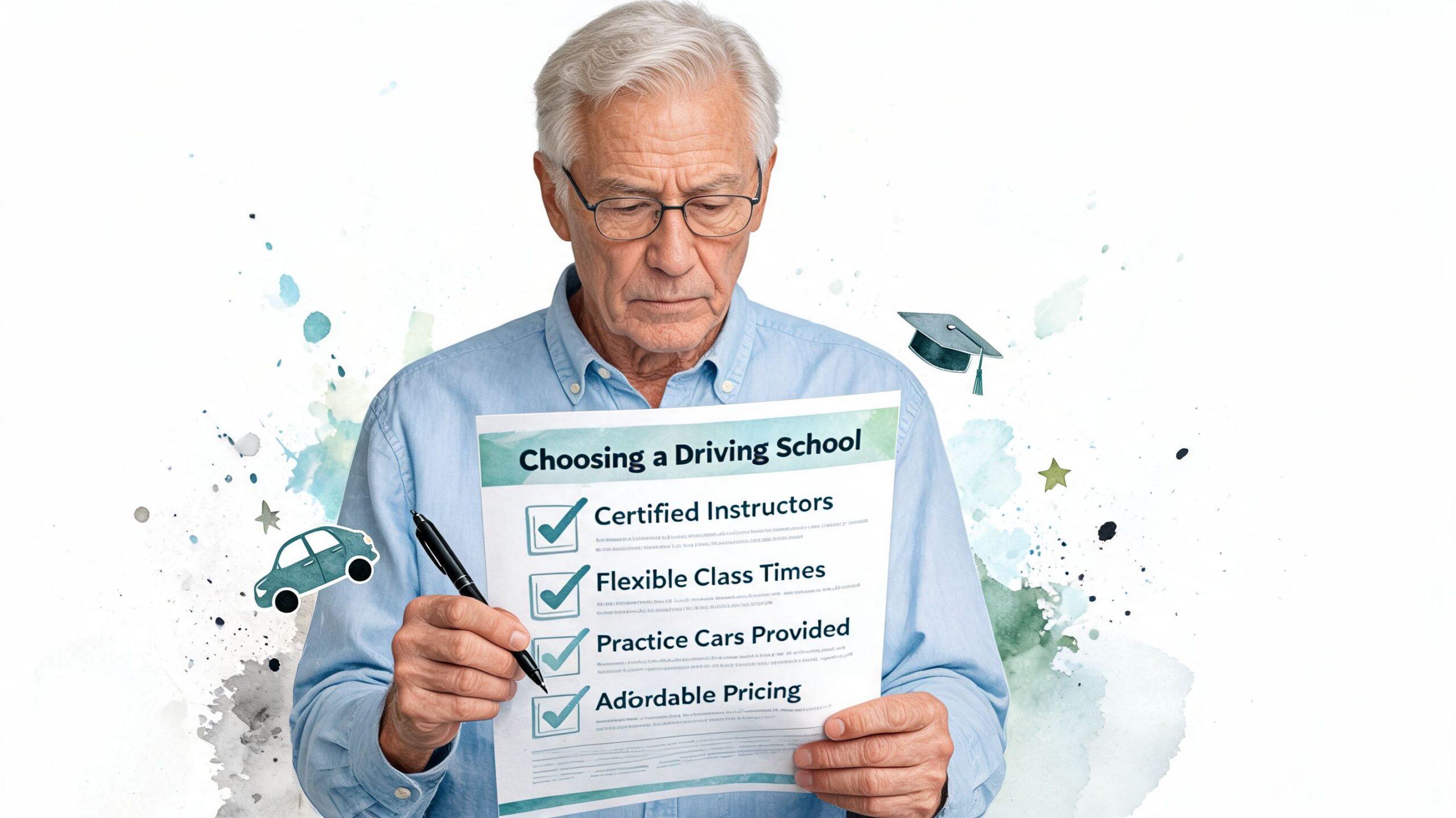
One major gap in the market is that many resources for older adults still focus on generic refreshers. As noted in this guide discussing senior defensive driving content gaps, much of the online advice aimed at seniors doesn’t address the need for customized, in-person, behind-the-wheel training for Georgia drivers who need road test preparation, local traffic practice, or confidence rebuilding.
Questions worth asking before you enroll
A strong program should be able to answer these without sounding vague:
- Do you work with adult and senior drivers regularly? Teaching an older adult is not the same as teaching a brand-new teen driver.
- Are lessons one-on-one? Personalized coaching matters when the goals are specific.
- Can we practice on local roads I use? Familiar routes reduce stress and make the lesson more relevant.
- Do instructors help with modern vehicle features? Many seniors want help with real technology, not just rules from a handbook.
- Are road test services available if needed? Convenience can lower anxiety.
- Do you offer lesson packages? Packages often work better than isolated sessions because skills can build over time.
What to look for in practice
A useful way to compare schools is to focus on fit, not hype.
| What to compare | What a good answer sounds like |
|---|---|
| Instructor style | Patient, clear, and comfortable with adult learners |
| Lesson structure | Flexible and based on driver goals |
| Vehicle options | Safe, easy to use, and appropriate for practice |
| Scheduling | Enough choices to avoid rushed appointments |
| Scope of help | Lessons, road test prep, and related driver education support |
Some families also need to think about medical or physical changes. If a driver may need more specialized support, it can help to understand how schools and related programs approach adaptive needs. A broader resource on finding top disability driving schools can be useful when evaluating whether a provider understands mobility differences and individualized instruction.
Packages often make more sense than single lessons
One lesson can identify issues. A small package can change habits.
That difference matters because many senior concerns involve repetition. A driver may understand what to do after one session, but still need more practice to make the new routine feel natural. Packages also let instructors tackle one concern at a time. Mirrors and scanning in one lesson. Parking and backing in another. Highway merges or heavy traffic in a later session.
Key takeaway: For seniors, the best local driving program usually isn’t the one with the broadest promises. It’s the one that can calmly address the exact situations that make the driver uneasy.
That’s especially true in Georgia, where local traffic patterns, suburban growth, multilane roads, and unfamiliar intersections can vary widely from one area to the next.
Your Next Steps with A-1 Driving School
For many older drivers, the hardest part is getting started. Once the first lesson is scheduled, the process usually feels much more manageable.
There’s real value in choosing a school that can support more than one need. A senior driver may want private driving lessons first, then road test preparation, then a testing option that feels less stressful than figuring everything out alone. Some families also want access to online course options in Georgia for household members handling separate needs, such as driver education or Joshua’s Law requirements for teens.
A-1 Driving School is well positioned for that broader support. It’s a family-owned Georgia school that has served drivers since 1987, with 38+ years of experience, 18+ metro Atlanta locations, 15,000+ classes annually, and 100,000+ satisfied drivers according to the publisher’s business information provided for this article. For senior drivers, the most relevant services are the customizable adult driving lesson packages, road test preparation, and road testing assistance.
There’s also a strong reason to take skill maintenance seriously. The Federal Highway Administration notes in its older road user conference summary that the U.S. has 37.2 million licensed drivers age 60+, and it highlights national safety trends showing a 43% decline in fatal crash rates for drivers 70+ since 1995 in connection with ongoing adaptation and safer driving practices through older road user safety efforts.
A simple path forward
If you’re helping a parent, grandparent, spouse, or yourself, start with the practical service that matches the actual concern:
- Need confidence behind the wheel again: Look at adult driving lessons.
- Need practice before a test: Add road test preparation.
- Need a Georgia testing option: Ask about road testing support.
- Need help for another family member too: Explore online driver education and Joshua’s Law options separately.
- Need affordability guidance: Check whether the Georgia Driver’s Education Scholarship Grant Program applies to someone in your household.
The easiest next step is to review the school’s adult driving lessons and lesson package options and choose the format that fits your current comfort level. For some seniors, that’s one refresher session. For others, it’s a package with enough time to rebuild comfort gradually and prepare for testing with less pressure.
Frequently Asked Questions About Senior Driving Lessons
Are driving lessons for seniors only for people who are unsafe drivers
No. Many seniors take lessons because they want an expert refresh, not because they’ve been told to stop driving. A lesson can help with confidence, newer vehicle technology, parking, highway merging, or preparation for a road test.
Will the instructor report me to the state
A standard driving lesson is not the same thing as a formal state action. Many people use lessons to get objective feedback in a private setting. If you’re worried about how instruction works, ask the school directly how evaluations and road test services are handled.
Should family members come to the first appointment
That depends on the driver. Some seniors like having a family member present for the first conversation, especially if everyone is trying to get on the same page. Others do better when they can talk privately with the instructor and drive without feeling watched.
Are lesson packages better than booking one lesson at a time
Often, yes. Packages can be helpful when the goal is habit change rather than a quick check-in. They also make it easier to spread out learning so the driver can practice between sessions.
Can seniors use online learning too
Yes. Online learning can be a good fit for reviewing rules, signs, and general driving concepts from home. It works best when paired with in-person driving lessons if the driver also needs help with confidence, physical adaptation, or real-world road situations.
Can I use the school’s vehicle for a road test
Many schools offer road test support and may allow use of a school vehicle, depending on the service. Ask about that early, especially if using a familiar car and instructor would reduce stress for the driver.
If you’re ready for calm, respectful help with driving lessons, road test preparation, online driver education, or Georgia road testing support, A-1 Driving School offers flexible options for seniors and families across metro Atlanta. Start with the service that matches your need today, whether that’s a single refresher lesson or a full lesson package designed to rebuild confidence step by step.