
Getting a Georgia license for the first time can feel confusing fast. A teen hears “permit,” “Joshua's Law,” “road test,” and “practice hours,” while a parent is trying to figure out what has to be done online, what has to happen in the car, and what can wait until later.
The simplest path is a hybrid path. Learn the rules online, then put those rules into motion with real behind-the-wheel lessons and supervised practice. That model fits how most beginners learn. They need flexibility for the coursework, but they also need a clear plan for turns, parking, lane changes, and road-test habits.
That's why online driving lessons for beginners work best when they're treated as the first step, not the whole journey.
Your Starting Line for Earning a Georgia Driver's License
Most Georgia beginners start in the same place. You want the freedom that comes with driving, but the process feels bigger than expected. There are state rules, permit testing, class options, practice requirements, and a road test at the end. If you don't have a roadmap, it's easy to do pieces out of order.

Why online learning makes sense first
For most teens, the cleanest starting point is the knowledge side of driving. Before a student works on steering control or parking, they need a firm grip on signs, right-of-way, scanning habits, spacing, and how Georgia road rules fit together in real situations.
That's where online coursework has a real advantage. It lets a beginner slow down, replay material, and move at a pace that matches how they learn. Research from California's DMV found that students in interactive, computer-based driver education achieved higher pass rates on exit exams than students in traditional classrooms because videos and simulations improved knowledge retention, according to the California DMV driver education study.
A strong online course isn't just digital reading. It should feel active. Students should be making choices, spotting hazards, and connecting traffic rules to real driving situations.
Practical rule: If an online course teaches the law clearly but doesn't help a teen picture what happens at an intersection, during a lane change, or while entering traffic, it's incomplete.
What beginners should do first in Georgia
Start with the part that creates clarity. A beginner usually needs to:
- Prepare for the permit by studying Georgia road rules and testing knowledge.
- Choose a state-approved driver education path if Joshua's Law applies.
- Schedule behind-the-wheel training early instead of waiting until the online work is finished.
- Build a parent practice plan so private driving time supports what the student is learning professionally.
If you're still at the permit stage, it helps to review the steps and testing basics through a Georgia-focused permit test guide.
What works and what usually doesn't
Online driving lessons for beginners work well when the student treats them as preparation for action. They don't work as well when a teen clicks through modules, finishes the course, and only then starts thinking about driving a real car.
The families who move smoothly through licensing usually keep the process connected. The online course builds vocabulary and judgment. The first driving lesson turns that knowledge into habits. Parent practice keeps those habits from fading between lessons.
That's the starting line. Not rushing. Not guessing. Just putting the pieces in the right order.
Meeting Joshua's Law Requirements with Online Courses
A Georgia teen can finish an online course, print the completion record, and still be nowhere near ready to finish the license process. I see that mistake a lot. Families assume the course itself handles Joshua's Law, then find out later they still need the right in-car instruction, the right timing, and the right paperwork.

What the law requires in practice
For most Georgia teens under 18, Joshua's Law means completing a state-approved driver education program that includes 30 hours of coursework and 6 hours of behind-the-wheel instruction. The online portion can satisfy the classroom requirement. It does not replace the driving time with an instructor.
That distinction matters.
Parents should verify two things before enrolling. First, the course must be approved for Georgia. Second, the student needs a plan for the in-car portion before the online lessons are done. Waiting until the certificate arrives usually slows everything down and creates gaps between what the student studied and what they can do in traffic.
What an online course should actually teach
A useful Joshua's Law course gives a beginner a framework for what they will see on the road and how Georgia expects them to respond. It should cover:
- Traffic laws and road signs tied to permit and licensing requirements
- Right-of-way decisions at intersections, turns, merges, and four-way stops
- Hazard recognition so the student notices problems early instead of reacting late
- Safe driving choices involving speed, following distance, and distracted driving
- Common test situations that show up during supervised driving and the road test
Families looking for the classroom portion can start with a state-approved Georgia driver's education course for Joshua's Law. The key is choosing a course that fits the legal requirement and lines up with the in-person training your teen will need next.
Where online learning helps, and where it stops
Online instruction is good at building rule knowledge and decision-making language. A teen can learn who yields, what a sign means, and how to spot a developing risk.
What online learning cannot do is teach pedal pressure, turning control, lane placement, or the timing of a safe lane change in live traffic. Those are physical skills. They have to be coached in the car.
That is usually where students get stuck. The rule is familiar, but the execution is late, rough, or uncertain.
The weak points are predictable:
- Parking control
- Smooth lane changes
- Right-of-way timing at intersections
- Turning accuracy
- Speed control in live traffic
I tell parents to treat the online course as the academic half of Joshua's Law, not the whole job. The teens who make steady progress are the ones who pair the course with scheduled driving lessons and regular parent practice, instead of letting the certificate sit while confidence fades.
A short video overview can help families understand how the process fits together before they enroll.
Finish the online course with your in-car instruction already scheduled. That is how Georgia families stay on track with Joshua's Law and avoid last-minute delays before the road test.
From Screen to Steering Wheel The A-1 Hybrid Method
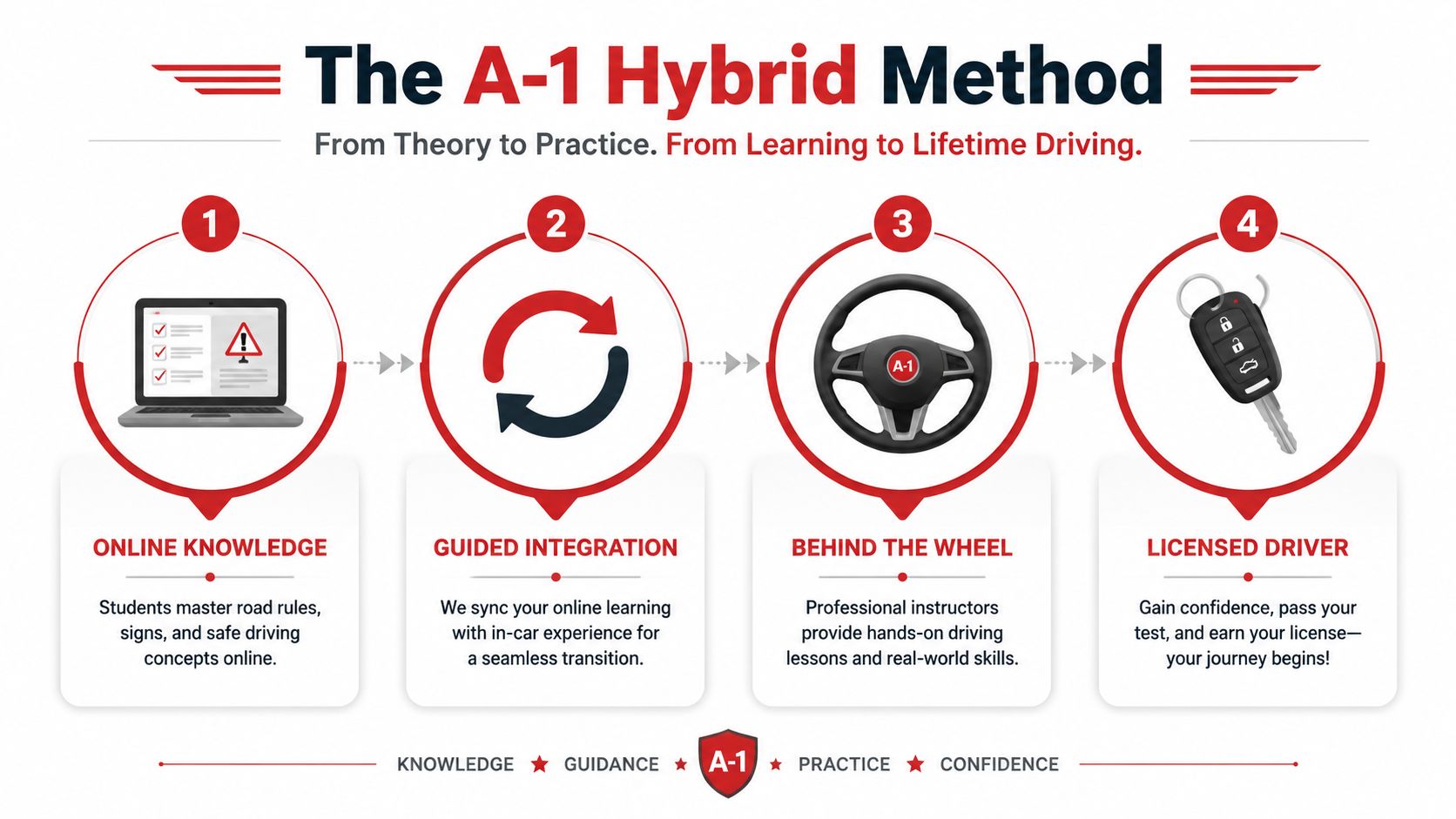
A Georgia teen finishes an online module on intersections Tuesday night, then shows up for an in-car lesson on Saturday having forgotten half of the timing details. I see that pattern all the time. The rule sounds familiar, but the hands, eyes, and feet are not working together yet.
That gap is why the hybrid model works so well for beginners. Online study handles the knowledge piece. In-car lessons turn that knowledge into repeatable habits. Parent practice keeps those habits from fading between lessons.
A practical hybrid sequence
For online driving lessons for beginners, I recommend a sequence that keeps the course work tied closely to what happens in the car.
Start the online coursework with a purpose
Focus first on topics the student will use right away, signs, scanning, lane position, turns, and right-of-way. Slow down enough to absorb the material. Teens usually remember more when they study in short sessions and connect each topic to a real driving situation they expect to face that week.
Schedule in-car lessons before the course ends
Families make better progress when lesson slots are booked early, not after the certificate is finished. That matters in Georgia, especially for teens working through Joshua's Law on a real deadline. If a learner waits too long, the course gets completed but the driving routine never starts.
Line up each lesson with the current topic
If the online course covered intersections, the next drive should focus on approach speed, gap judgment, stopping position, and turning path. If the course covered backing and parking, use the lesson to practice setup, steering timing, and slow-speed control. Students improve faster when each drive has one main job.
Use parent practice to repeat the same skill
After a professional lesson, repeat that same skill in a calmer setting before adding something new. One solid parking lesson should be followed by more parking. One lesson on lane changes should be followed by more lane changes. Repetition builds control.
What this method fixes
Beginners rarely struggle because they have never heard the rule. They struggle because they cannot apply it on time.
A teen may answer a right-of-way question correctly online and still freeze at a four-way stop. Another may know the lane-change steps from memory and still miss mirror timing once traffic starts closing in. Those are normal early-stage problems. They get corrected fastest when the online course, the in-car lesson, and the parent practice all reinforce the same skill in the same week.
That is the value of the A-1 Driving School hybrid process. A Georgia family can complete the online portion for Joshua's Law, move directly into behind-the-wheel lessons, and continue building toward road test readiness with one plan instead of patching together separate pieces at the last minute.
A beginner needs focused repetition on the same driving task until the motion and timing feel familiar.
Why a structured training plan saves time
Structured lesson plans usually produce steadier drivers than random practice drives. Instructors see it every day. A student who works through basic observation, steering, braking, turns, lane position, and parking in order tends to improve faster than a student who just drives around without a goal.
As noted earlier, entry-level driver training programs often build around foundational skill blocks before moving into heavier traffic. That approach fits Georgia teens well. It also helps parents know what to practice at home instead of guessing.
Georgia's minimum requirements get a teen started. They do not guarantee confidence. Many new drivers still need extra coaching on parking, traffic flow, and test-day consistency even after they have satisfied the state rule.
A weekly rhythm that works
A realistic schedule for many families looks like this:
- Two or three short online study sessions during the week
- One professional lesson tied to the current topic
- One or two parent-supervised practice drives on that same topic
- A short review afterward, including what improved and what needs another round
That rhythm keeps the student from feeling overloaded. It also gives parents a clearer job. Instead of taking a teen out for vague "practice," they can work on one specific task, left turns in neighborhoods, parking setup, lane changes on a low-stress road, or speed control on busier streets.
For Georgia teens, that kind of steady progression matters. It keeps Joshua's Law training on track, makes better use of scholarship-funded coursework when available, and creates a cleaner handoff from online study to in-person lessons to the road test.
Choosing Your Ideal Driving Lesson Package
Georgia's required in-car hours are a floor, not a guarantee of confidence. Some teens are calm, coordinated, and ready to build quickly. Others need more repetition before traffic, parking, and test-day maneuvers feel steady. That's normal.
The right lesson package depends less on age and more on starting point. A teen who has never driven in traffic needs a different plan than one who already handles neighborhood driving but struggles with parking or lane changes.
How to think about lesson value
Families often ask whether the required hours are enough. Sometimes they are enough to satisfy the rule. They aren't always enough to create a relaxed, road-test-ready driver.
Extra lessons usually pay off in three ways:
- Skill consistency because the student repeats core actions until they stop feeling rushed.
- Lower stress because the learner has already seen the situations that create panic on test day.
- Better parent practice because a professional has set the method and corrected the basics first.
A package should solve a driving problem, not just add hours.
A-1 Driving Lesson Package Comparison
| Package Name | Total Hours | Best For | Road Test Service Included? |
|---|---|---|---|
| Confidence Builder | 10 | Beginners who need a stronger foundation after the minimum state training | Available on request |
| Road Test Ready | 12 | Students who know the basics but need work on parking, turns, and test habits | Yes |
| Skills Plus | 16 | Teens who want more traffic exposure, lane changes, and repeated maneuver practice | Yes |
| Master Driver | 20 | Nervous beginners or families who want broader preparation before independent driving | Yes |
Which package fits which student
Confidence Builder works well for a student who still feels busy inside the car. Steering, mirrors, braking, and turning may all be happening at once in their head. More guided repetition usually settles that down.
Road Test Ready fits the student who can drive but still makes test-style mistakes. Rolling stops, inconsistent observation, wide turns, parking setup, and lane-position errors often show up here.
Skills Plus is useful when a teen needs more real-world range. That can include busier roads, complex intersections, repeated lane changes, and more work on judgment.
Master Driver makes sense for a student with high anxiety or limited practice opportunities at home. It also helps when parents want more of the teaching handled by an instructor before independent driving begins.
Buy enough instruction to remove the weak spots, not just enough to satisfy the requirement.
What to ask before booking
Before choosing a package, ask a few direct questions:
- What situations make the student tense? Parking lots, left turns, traffic, speed control?
- How much parent practice is realistically available?
- Is the goal just legal completion, or true road-test readiness?
- Will the student test in an unfamiliar setting, or where they trained?
That usually makes the decision easier. The right package is the one that fills the gap between “I can drive” and “I can drive without falling apart when something changes.”
A Parent's Guide to Supporting Your New Teen Driver
Parents are often the bridge between professional lessons. That's a big job. You're the one sitting beside your teen for repeated practice, helping them log hours, and trying not to turn every drive into an argument.

That stress is common. Verified data notes that 60% of online discussions about beginner driving lessons mention parent-teen conflict during practice, based on the referenced 2025 discussion analysis. The issue usually isn't that the teen refuses to learn. It's that the adult and the learner are reacting to pressure in different ways.
Keep practice narrow and predictable
The biggest mistake parents make is trying to cover too much in one drive. A teen who is still learning steering control and observation doesn't need a surprise trip into dense traffic.
Use a progression instead:
- Start in quiet areas to build control, braking, and turning accuracy.
- Move to simple neighborhood routes for stop signs, scanning, and lane position.
- Add slightly busier roads only after the basics stay consistent.
- Save test-style maneuvers for focused sessions, not rushed errands.
Short, specific drives work better than long stressful ones.
Say less, earlier
Most parent instructions come too late. By the time you say “turn here,” the teen is already at the corner. By the time you say “slow down,” they've realized it too.
Try this instead:
- Give direction early
- Use one instruction at a time
- Correct the main error, not every small issue
- Debrief after the car is parked, not in the middle of a tense moment
“Give the next instruction before your teen needs it, not when they're already reacting.”
That one change cuts down a lot of panic.
Reinforce what the instructor taught
If your teen had a professional lesson on lane changes, don't spend the next family drive introducing five new skills. Repeat the same process they were taught. Use the same mirror routine. Use the same parking setup. Keep the language consistent.
A simple practice log helps. Write down:
- What skill was covered
- What improved
- What still needs another session
That way each drive has a purpose, and your teen can see progress instead of only hearing criticism.
Know when to hand a problem back to an instructor
Some issues are better fixed by a professional. If your teen freezes in traffic, argues through every correction, or keeps repeating the same parking mistake, more parent pressure usually won't solve it.
That's a sign to schedule another lesson focused on that single weakness. Parents help most when they support the training plan instead of trying to replace it.
Funding Your Training and Conquering the Road Test
Driver training is an investment, but Georgia families should know there may be help available. If cost is the main reason a teen hasn't started driver education, it's worth looking into the Georgia Driver's Education Scholarship Grant Program before putting the process off.
How to think about the scholarship
The practical use of the scholarship is simple. It can make approved driver education more accessible for families who qualify. That matters because delaying training often creates a bigger problem later. The teen gets older, still doesn't feel confident behind the wheel, and now the whole process feels heavier.
Check the current eligibility rules, application process, and participating school details directly through the provider before enrolling. Have your paperwork ready and apply early if funding windows are limited.
Why many students prefer a school road test
Once the training is done, the last hurdle is the road test. Many beginners do better when they test in a familiar setting rather than adding extra stress at the end.
Taking the test through a certified school can help because the student often benefits from:
- A more familiar environment
- A vehicle they already know
- A route style that feels less foreign
- Prep that matches the actual test expectations
That doesn't make the test easier. It makes the process more orderly.
What to do in the final stretch
In the last phase before the road test, focus on polish. At that point, the student should stop trying to learn everything and start tightening the habits the examiner will watch most closely.
Use the final preparation period to check:
- Complete stops
- Observation at intersections
- Lane position
- Turn control
- Parking and backing
- Calm response to instructions
A Georgia-specific road test preparation guide can help students organize that last review.
One final point matters more than families expect. Don't schedule the test just because the paperwork is done. Schedule it when the student's driving is repeatable. A good road test drive shouldn't feel like a lucky day. It should feel familiar.
If you're ready to move from research to action, A-1 Driving School offers Georgia driver education, behind-the-wheel lessons, scholarship information, and road test support in one place so teens and parents can follow a clear path from online study to license day.