
Your phone rings. A police officer is on the line. Your teenager was driving without a license.
Most parents go straight to the same place. Fear first. Anger right behind it. Then the practical questions hit. Is my child in legal trouble? Will this delay their license? What happens to my insurance? What do I do today?
If that's where you are, slow down and handle this in order.
Teenage driving without license is serious in Georgia. It creates legal exposure for your teen and financial risk for your family. But it's also fixable if you stop the panic, face the issue directly, and move your child onto the legal path now. A bad decision doesn't have to become a pattern.
What matters next is simple. Take the situation seriously, respond quickly, and replace informal driving with structured training, supervised practice, and a real plan to get licensed the right way.
The Phone Call Every Parent Dreads
The call usually comes at the worst time. A police officer says your teenager was behind the wheel without a license. Maybe they took the car to school, to a friend's house, or to “just make a quick trip.” Now you are dealing with a legal problem, a safety problem, and a trust problem all at once.
Handle it calmly. Handle it fast.
A teen who drives without a license has already shown poor judgment. In many cases, that choice also shows weak supervision, unclear family rules, or a gap in formal training. Parents need to see the full picture so they can fix the right problem.
Teenage driving without license is rarely an isolated mistake. It often shows up alongside other risky habits and a lack of structured driver education.
That is why this moment matters so much. If you respond with anger only, you miss the chance to correct the behavior. If you minimize it, you invite a repeat.
Georgia families need a plan. Stop all unsupervised driving today. Secure access to the vehicle and keys. Then set a legal path with professional instruction, supervised practice, and a timeline your teen can follow. If cost has slowed your family down, ask about A-1 Driving School lesson packages and scholarship options. The goal is simple: resolve the immediate crisis and build a safe, legal driver.
What parents need to do first
- Treat this as urgent: Do not write it off as a short trip or a one-time lapse.
- Shut down access to the car: Remove keys, set clear consequences, and make sure every adult in the home follows the same rule.
- Get facts before the lecture: Find out what happened, whose car was involved, whether there was a citation, and whether anyone was hurt.
- Replace informal practice with formal training: Your teen needs instruction, structure, and accountability.
- Prepare for the insurance side: If you are worried about the financial fallout, read how adding a teen driver can affect your insurance rates.
Your job right now is not to argue about fairness. Your job is to stop the illegal driving, address the immediate risk, and move your teen onto the Georgia licensing path the right way.
The Real Costs of Unlicensed Teen Driving in Georgia
Parents sometimes underestimate this because there wasn't a major crash, or because the teen “only drove a short distance.” That thinking is dangerous. Georgia doesn't care that it was close to home. Insurance companies won't care either if a claim appears.
The risk is bigger than most families think
Teen licensure has fallen sharply. Federal Highway Administration data shows that 25% of 16-year-olds were licensed in 2021, down from 46% in 1983, and young drivers ages 15 to 20 were involved in 5,133 fatal crashes in 2023, according to the Progressive summary of FHWA and NHTSA teen driving data. Delayed licensing doesn't make the need to drive disappear. It often creates pressure for inexperienced teens to drive before they're ready or legally allowed.
That's the part many families miss. A teen who drives without a license isn't just breaking a rule. They're driving without the legal status, training, and accountability that the licensing process is designed to enforce.
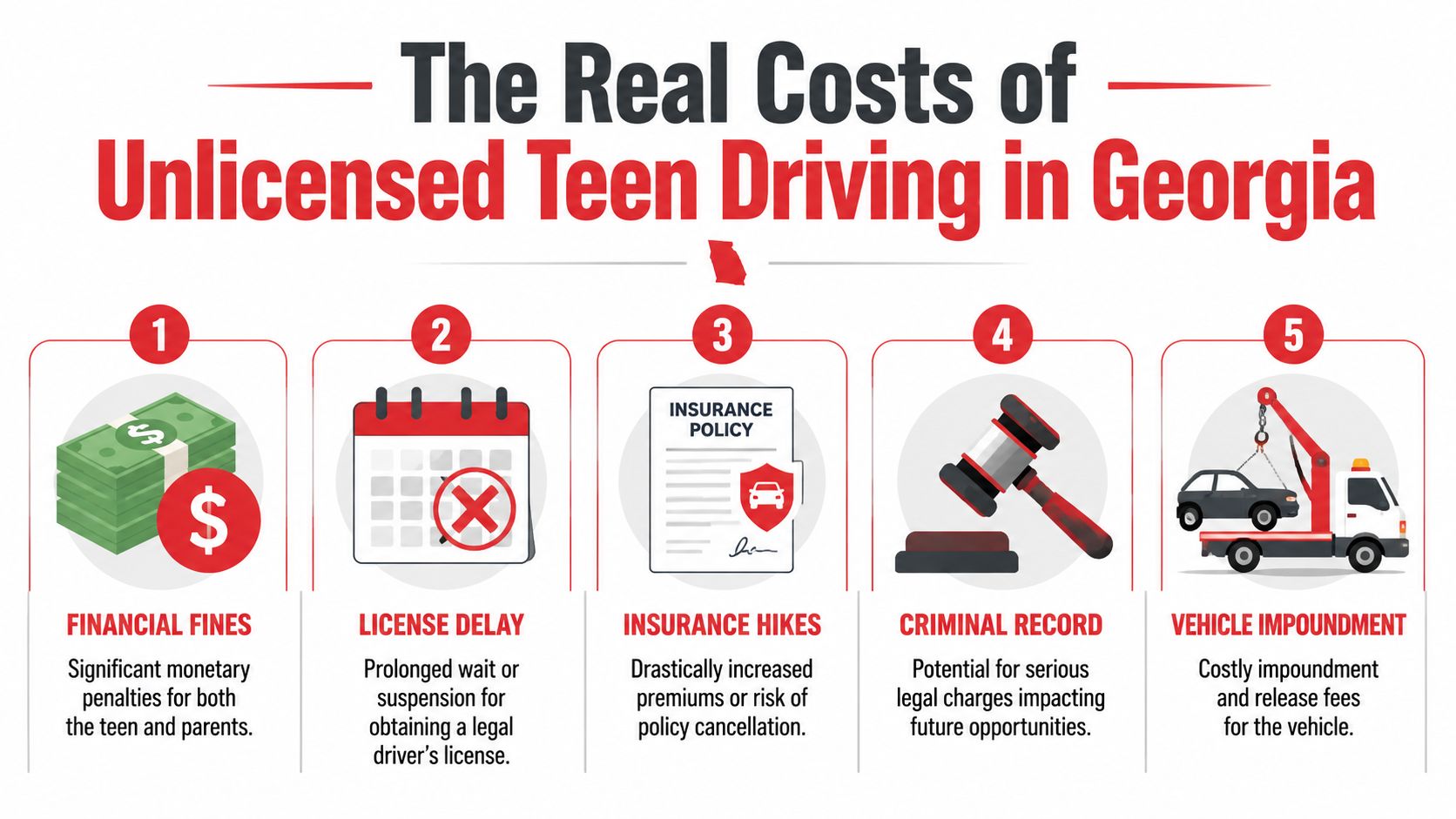
What this can cost your family
- Legal trouble for your teen: Driving without a license can trigger court involvement, citations, and a record of noncompliance that follows them into the licensing process.
- License delays: A teen who cuts corners can make the road to a permit or license longer, not shorter.
- Insurance fallout: If your teen is caught or crashes, your insurer may view your household as higher risk. If you're already wondering what licensed teen driving does to premiums, this breakdown of whether adding your teen to your insurance can raise rates is worth reading.
- Vehicle consequences: Depending on the situation, families may also deal with towing, impound issues, and release costs.
- Civil exposure: If your teen injures someone or damages property, “they were just practicing” won't protect your family from the fallout.
Practical rule: If your teen is not legally cleared to drive, don't let convenience, family errands, or confidence substitute for a license.
The emotional mistake parents make
Some parents react by saying, “Fine, then you're not driving at all until you're 18.” Others do the opposite and keep teaching them in unofficial ways, hoping nobody notices.
Both approaches fail. The first avoids the issue. The second deepens it.
The right move is controlled, legal progress. That means permit requirements, formal driver's education, structured lessons, supervised hours, and a road test. No shortcuts. No “just this once.” No letting a teenager self-certify that they're ready.
Your Teen Was Caught What Should You Do Now
The next 72 hours matter. Don't improvise.

Step one, stop all unsupervised driving
Take away access to keys, not just car privileges “in theory.” If there's a vehicle at home your teen can reach, they still have an opportunity to repeat the behavior.
Be calm and be absolute. No solo driving. No quick trips. No moving the car in a parking lot. No practice on neighborhood roads unless it is legal and properly supervised.
Step two, get the paperwork in order
Read every citation and court notice carefully. Check dates. Confirm whether your teen must appear, whether you must appear as a parent, and what documents the court expects.
If the facts are messy, or if there was a crash, injury, or repeat behavior, get legal advice quickly. Don't guess your way through court procedure.
For a plain-language overview specific to Georgia, review this guide on driving without a license in Georgia.
Step three, find out why this happened
Don't settle for “I don't know.” Usually there is a reason, even if it's a bad one.
Ask direct questions:
- Who gave access to the car
- Where they were going
- Whether this has happened before
- Whether friends were involved
- Whether they felt pressure to help with work, school, or family errands
Accountability matters in this context. If your teen struggles to own what they did, parents often find useful language in Soul Shoppe's guide to child accountability. It's a solid reminder that responsibility is learned through clear consequences and repair, not just lectures.
Step four, replace punishment-only thinking with a corrective plan
Grounding alone won't build judgment behind the wheel. Your teen needs consequences, but they also need a path.
That path should include:
- A written family rule: no driving until legal requirements are met
- A timeline: permit, course, lessons, supervised practice, test
- Restitution if needed: paying part of a fine, towing bill, or related cost
- Ongoing check-ins: not one dramatic talk, but repeated review
A short explanation can help if your teen is minimizing the situation:
Driving illegally tells the court and your family that you wanted the privilege without the process. The fix is to complete the process.
After you've had that conversation, use a practical refresher like this video to reinforce safe teen-driving expectations:
Step five, move quickly toward legal driving status
Delay makes this worse. Teens who sit in limbo often become more frustrated, more secretive, or more likely to rationalize another bad decision.
Start scheduling the legal next steps now. Not “later this semester.” Not “when things calm down.” Now.
The Official Path to a Georgia Driver's License
The only answer to teenage driving without license is a legal license path. Georgia gives families a clear process. Follow it exactly.
Start with the permit, not the steering wheel
If your teen doesn't have the proper legal status to drive, the first goal is eligibility, not practice in secret. They need to enter the system properly and complete each stage in order.
For teens under 18, Georgia's Graduated Driver Licensing framework matters because it sets the conditions for safer learning. Research on GDL systems shows they reduce crashes, but can also create barriers for some families, especially when supervised practice time is hard to arrange. That same research notes the importance of the minimum 40 supervised practice hours required under GA Code 40-5-22 and why structured lessons and scholarship access can help families stay compliant, according to the PMC analysis of unlicensed driving and GDL barriers.
That's the key point. The hours matter. The structure matters. Random practice with an overwhelmed parent isn't always enough.
Joshua's Law is not optional for many teens
If your teen is under 18 and working toward a Class D license, Joshua's Law is central to the process. Parents should treat it as the backbone of training, not a box to check.
The standard path includes:
- Classroom instruction: the required driver education component
- Behind-the-wheel training: real vehicle time with an instructor
- Supervised practice: parent-guided hours after formal instruction
- Road test readiness: skill-building that leads to legal independent driving
If your teen has already made the mistake of driving illegally, this structure becomes even more important. They don't need more casual exposure. They need a formal system that corrects bad habits and teaches decision-making.
For families who need a step-by-step overview, this guide on how to get a driver's license in Georgia is a helpful place to start.
Online versus classroom is a family decision, not a quality verdict
Some teens do better in a physical classroom. Others focus better online because it cuts travel and scheduling friction. What matters is completion, retention, and consistency.
Here's a simple comparison.
| Feature | Online Course | In-Person Classroom |
|---|---|---|
| Scheduling | Flexible for busy school and activity calendars | Fixed class times help teens who need structure |
| Learning environment | Good for self-directed students | Better for students who engage more face-to-face |
| Parent logistics | Less transportation hassle | Easier to separate home life from study time |
| Routine building | Works well when parents can monitor progress | Works well when outside accountability is needed |
| Best fit | Teens who manage time well | Teens who need more direct oversight |
Driving lessons are where confidence becomes skill
This is the part families often undervalue until there's a problem.
A teen may know road signs and still make poor lane choices. They may pass a practice quiz and still panic at four-way stops, merges, left turns, or traffic flow. Professional lessons close that gap because they train observation, timing, judgment, and calm repetition.
That's especially important after a teen has driven without a license. Unofficial practice often teaches the wrong lesson. It tells the teen that “if I can move the car, I can drive.” That's not true. Real driving means hazard recognition, legal compliance, lane discipline, scanning, speed control, and decision-making under pressure.
Lesson packages make more sense than one-off fixes
Parents often ask whether one or two lessons are enough. Usually they aren't, especially if a teen is anxious, overconfident, or has already shown poor judgment.
A package approach is stronger because it lets instruction build:
- Early sessions can correct posture, mirror habits, turns, braking, and scanning.
- Middle sessions can focus on neighborhoods, multilane roads, traffic judgment, and parking.
- Later sessions can target road test skills, weak spots, and independent readiness.
That kind of progression is what turns “my teen has driven before” into “my teen is prepared to drive legally.”
Road testing should come after skill, not before it
Don't rush the road test just to “get this over with.” That mindset causes repeats, frustration, and more family conflict.
Your teen should test after they can consistently show:
- legal compliance
- controlled turns and stops
- safe lane changes
- calm response to corrections
- reliable decision-making without guessing
If your family is trying to repair trust after illegal driving, the road test should mark readiness, not desperation.
Scholarship help matters for real families
Cost, scheduling, and transportation barriers are real. They're also one reason some teens delay licensing or learn informally instead of through structured education.
Scholarship and grant options matter because they can move a family from “we know what we should do” to “we can do it.” If training has felt financially out of reach, look for Georgia driver education scholarship support before assuming your teen has to wait or piece things together informally.
The best time to formalize training was before the first illegal drive. The second-best time is now.
How to Prevent Unlicensed Driving Proactive Strategies
A teen who has already pushed past the rules needs more than another warning. They need structure, supervision, and a clear legal path. Georgia parents need the same thing.
Informal practice is not enough. Earlier research on teen unlicensed driving found that some teens who drove without a license were also more likely to take other safety risks. For parents, the takeaway is simple. A teen who wants to drive needs formal instruction, clear household rules, and adults who enforce both.
Put the rules in writing
Do not leave this to memory, mood, or debate. Write a parent-teen driving agreement and make your teen sign it.
Include:
- Who can approve driving: only a parent or legal guardian
- When driving is allowed: after the permit or license required for that stage is in hand
- Which vehicle can be used: name the car and any limits on time, route, or purpose
- What happens after a violation: loss of keys, delayed privileges, added supervised practice, and professional lessons
Written rules cut down on arguments because the standard is already set.
Fix the reason your teen is tempted to drive illegally
Parents often focus on the act and miss the cause. That is a mistake.
If your teen is driving to get to school, work, or practice, solve the ride problem first. If friends are making illegal driving sound normal, change who has access to your teen and your car. If your teen says, “I already know how,” test that confidence the right way with a professional instructor who can spot weak scanning, poor judgment, rushed turns, and bad lane habits fast.
A-1 Driving School can help families turn that tension into a plan. Flexible lesson packages give parents a way to respond quickly instead of waiting weeks and hoping the problem settles down on its own. Scholarship access can also make formal training realistic for families who are trying to do the right thing without creating a new financial crisis.
Use lessons to rebuild trust
Your teen should connect driving privileges with training, practice, and legal milestones. That message needs to be firm.
Say it clearly: “You earn driving freedom by following the law, showing control, and completing training.”
That approach works better than turning every lesson into punishment. A teenager who feels cornered argues. A teenager who sees a step-by-step path is more likely to cooperate, improve, and accept correction.
Make illegal driving hard to pull off
Access is part of the problem. Remove easy access, and you remove many bad decisions.
- Secure the keys
- Tell grandparents, older siblings, and relatives your teen is not allowed to drive
- Stop asking your teen to move the car in the driveway or parking lot if they are not legal to do it
- Do not make “one short trip” exceptions
- Track where each vehicle key is kept
Parents need to hold the line here. Teens believe the rule is real when it stays real every time.
Build a Georgia plan, not a vague promise
Prevention gets easier when your teen can see the next legal step. Put the plan on paper. List the permit goal, study time, lesson schedule, supervised practice hours, and road test target. Then assign dates.
That kind of roadmap lowers family conflict because everyone knows what happens next. It also turns A-1 Driving School into more than a class provider. The school becomes a partner in getting your teen back on track now, while helping you build the habits that matter long after the license is issued.
Your Next Steps and Georgia Driving Resources
If your teen has been driving without a license, the message is simple. Stop the illegal driving immediately. Handle the court or citation issue carefully. Then move fast toward a legal permit-and-license plan.
This is not a problem you solve with anger alone. You solve it with structure.
Keep these priorities in order
- Address the citation first: Confirm court dates, parent responsibilities, and any immediate legal obligations.
- Remove access to the vehicle: Don't leave room for “one more time.”
- Create a written plan: Permit steps, education, lessons, supervised practice, and road test.
- Use official Georgia information: Check DDS requirements directly before scheduling anything.
- Look into financial help: If cost is slowing you down, scholarship support may open the door to proper training.
Georgia resources worth using
- Georgia licensing information: Review the official Georgia DDS requirements and documents for teen licensing.
- Local court guidance: Check your county court website for appearance instructions or diversion information if applicable.
- Driver education scholarship support: Explore the Georgia Driver's Education Grant Scholarship Program through your training provider before assuming lessons are out of reach.
A teen can recover from this mistake. What they can't afford is a family that ignores it, minimizes it, or keeps letting them drive in the gray area between “not ready” and “not legal.”
Take the keys. Make the calls. Build the plan. Then follow it all the way through.
If you need a practical next step, A-1 Driving School offers Georgia Joshua's Law courses, online driver's education options, road test support, scholarship grant information, and driving lessons packages built for teens who need real structure, not guesswork. If your family is trying to fix a bad start and get back on the legal path, start with their course and lesson options and choose the package that matches your teen's current stage.