

Individuals searching for defensive driving course queens are dealing with one of two problems. They either want relief after a ticket, or they want to stop paying more than they should for insurance. In a place with dense traffic, tight merges, buses, cyclists, delivery vehicles, and impatient drivers, that search makes sense.
The useful lesson is bigger than Queens. Drivers in Georgia want the same outcomes. They want to protect their record, build safer habits, satisfy state requirements, and get on the road with less stress. For teens, that usually means Joshua's Law. For adults, it often means a practical mix of education, road practice, and test prep that fits real life.
A course can help, but a course alone doesn't make someone road-ready. The drivers who improve fastest usually combine the required classroom work with structured behind-the-wheel lessons, repeated practice, and a clear plan for the road test.
Why Drivers Seek a Defensive Driving Course in Queens
A driver in Queens gets cut off on Northern Boulevard, brakes late, and then spends the next week dealing with a ticket, insurance questions, and a record that suddenly matters more than expected. That is usually when the search for a course starts.
In New York, drivers often choose a state-approved class because it can help with point reduction and insurance costs. The New York DMV explains how the Point and Insurance Reduction Program works, and many drivers start by reviewing a New York online defensive driving course option before deciding how to complete the requirement.
Queens makes the need easy to understand. Traffic is tight. Pedestrians step out quickly. Delivery vans stop without much warning. A defensive driving course appeals to drivers who want more than paperwork relief. They want better timing, better spacing, and fewer mistakes in situations that develop fast.
I see the same pattern with Georgia students. The state rules are different, but the motivation is familiar. Drivers want to stay legal, protect their record, and build habits that hold up in real traffic, not just on a quiz.
Practical rule: Trouble usually starts before the hard brake. It starts when a driver stops scanning far enough ahead.
What drivers are actually trying to solve
A course is usually tied to one of a few practical goals:
- Reduce the damage from a ticket or points issue
- Lower insurance pressure where a course qualifies
- Learn safer habits for crowded, unpredictable roads
- Meet a licensing or driver education requirement
- Get clear on what to do next, especially for teens and parents
That last point matters. A general search for defensive driving in Queens often begins with one immediate problem, but it usually leads to a broader question: what kind of training makes someone safer and fully prepared to drive on their own?
That is where the Queens example helps Georgia families. It shows why drivers look for defensive driving in the first place, then points to the bigger solution. In Georgia, that usually means pairing required education with road practice, test preparation, and, for teens, the right path under state law. If you're comparing insurance consequences beyond Georgia and New York, this guide on help for Florida drivers with violations gives useful context on how insurers and violations can interact.
Comparing Defensive Driving Benefits in New York and Georgia
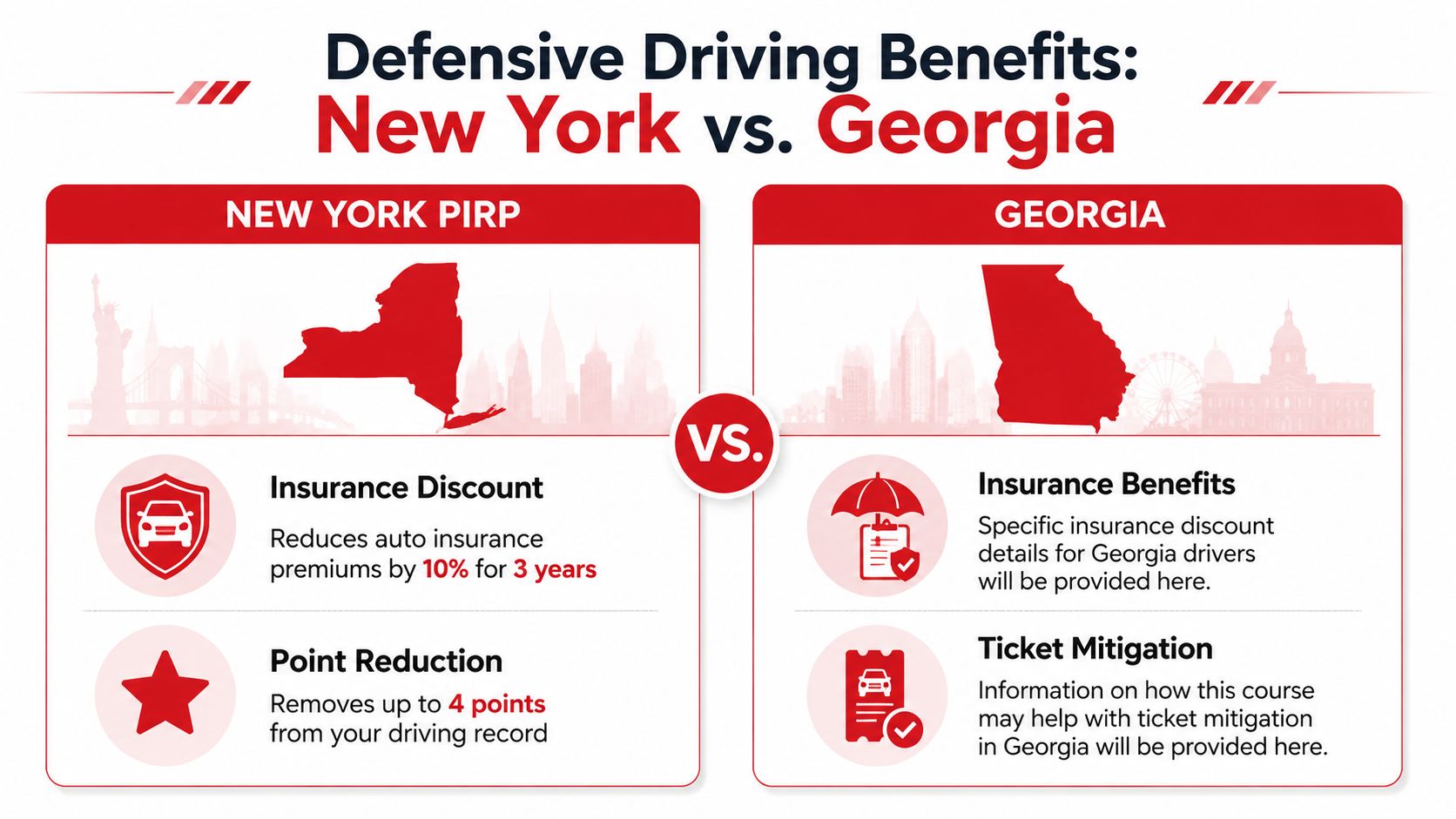
New York gives a clean example of why drivers search for this topic in the first place. A Queens defensive driving course under PIRP provides a 10% insurance premium discount for three years and can reduce up to 4 points, according to New York defensive driving studies and program details. That same source notes that the incentive structure parallels Georgia, where state-approved education and defensive driving requirements also push drivers toward safer behavior and potential insurance benefits.
What New York highlights clearly
New York's structure makes the value easy to understand. The state ties safer-driver training to direct incentives. That gets drivers in the room, but the better outcome is what happens afterward. Good programs teach anticipation, spacing, speed control, and better choices under pressure.
Georgia families should read that as a familiar pattern, not a foreign one. The names are different, but the practical goal is the same. A state wants fewer bad decisions on the road, and drivers want a route that helps them keep moving forward.
Where Georgia becomes more relevant for most readers
For Georgia teens, the bigger issue usually isn't point reduction. It's licensing. Parents want to know what their teen must complete, which format works best, and how to move from course completion to actual road skill.
For adult learners, the question is often different. They may already know the rules well enough on paper, but they need to sharpen lane changes, left turns, parking, highway entry, and calm decision-making in traffic. That's where driver's education and driving lessons matter more than a generic compliance mindset.
A simple way to compare the two states is this:
| State | Main benefit many drivers notice first | What matters most in practice |
|---|---|---|
| New York | Insurance discount and point reduction | Learning to manage dense traffic safely |
| Georgia | Licensing pathway and state-approved education | Building real driving skill before the road test |
Queens shows the universal reason these programs exist. Drivers need a way to reduce risk before the next mistake costs more.
If you're exploring formats and requirements across states, reviewing a provider's online driving course options can help you understand how classroom learning is being delivered now, even if your final path in Georgia includes different state rules.
Online vs In-Person Courses Which Format is Right for You
A driver in Queens may need a defensive driving course for insurance or point-related reasons. A teen or adult in Georgia usually asks a different question first. Which format will they finish, learn from, and use behind the wheel. That is the standard I use when helping families choose.
Online courses fit busy schedules well. They let students work around school, jobs, sports, and family obligations. For organized learners, that flexibility helps. For distracted learners, it can slow everything down because the course keeps getting pushed to later.
In-person classes ask more upfront. You have to show up on time, sit through the material, and stay engaged. In return, you get structure, a real instructor, and the chance to stop confusion before it turns into a bad habit. That trade-off matters, especially for Georgia teens who still need both knowledge and road readiness before the licensing process moves smoothly.
The trade-off a common oversight misses
Convenience is only useful if it leads to completion.
I have seen students choose online because it looks faster, then drag the course out for weeks because home is full of interruptions. I have also seen motivated students do very well online because they set a schedule and treat the course like any other class. The format itself is not the problem. Follow-through is.
That is also why Queens is a useful example for Georgia families. The reason people look for defensive driving in New York and driver education in Georgia is the same. They want fewer mistakes, lower risk, and a clear path to the next step. The delivery method should support that goal, not get in the way.
How to Choose
Use a simple test before you enroll:
- Do you complete self-paced assignments without reminders
- Can you focus at home without your phone, TV, or other tabs pulling your attention
- Do you learn better by asking questions as soon as something is unclear
- Will a fixed class time keep you more accountable than an open calendar
Students who manage time well often do fine online. Students who procrastinate, lose focus on screens, or need direct feedback usually learn more in a classroom.
Pick the format that matches your habits, not the one that sounds easiest.
If a student needs more structure and face-to-face instruction, review this in-person defensive driving course to see how a guided classroom option works before signing up.
A Parent's Guide to Joshua's Law in Georgia
A parent usually feels the pressure long before the teen does. Permit in hand, school and sports on the calendar, and one big question hanging over everything. How do you turn a beginner into a calm, legal, safe driver instead of a nervous one who only knows how to pass a quiz?

That is where the Queens comparison helps. Families in New York often start with defensive driving because they want safer habits and a clearer path after mistakes or violations. Georgia addresses the same safety goal earlier, during teen licensing, through Joshua's Law. The state is not waiting for a crash, ticket, or insurance problem to push a young driver into better training.
Parents should track Joshua's Law in two parts. Keep them separate, and the process gets much easier to manage.
The two parts parents need to track
Classroom learning
The classroom side builds the base. Teens learn road signs, right-of-way, space management, hazard awareness, and the legal responsibilities that come with driving. Some students do fine online. Others need a set class time and an instructor in front of them to stay focused.
A key question is simple. Can the student explain what to do before a risk becomes a problem? If the answer is no, more seat time and better instruction matter more than checking off a completed course.
Professional behind-the-wheel training
Weak habits become apparent quickly. A teen may know the handbook and still brake too late, turn too wide, drift toward the center line, or stare at the hood instead of scanning traffic ahead.
I see the same pattern often. Parents remember whether the drive felt calm. Instructors notice the details that decide whether the student is safe. Late mirror checks. Hesitation at uncontrolled intersections. Poor speed judgment on downhill stretches. Those are coachable problems, but only if someone trained is watching for them.
Early observation prevents more close calls than quick reflexes do.
What parents should look for in training
A good Joshua's Law plan should include:
- A clear schedule: Families need to know when the class requirement will be finished and when road lessons will start.
- Professional feedback: Teens improve faster when a trained instructor points out patterns a parent may miss.
- Practice under varied conditions: Quiet neighborhoods are not enough. Students need experience with busier roads, lane changes, parking lots, and turns under pressure.
- Test preparation tied to real driving: Road test practice should build legal, repeatable habits, not memorized shortcuts.
- A format that fits the student: Online works for organized students. A classroom often works better for students who lose focus or need immediate answers.
This video gives parents and teens a useful starting point for understanding the process and expectations.
Common mistakes parents can avoid
The first mistake is waiting too long to book driving lessons. That usually creates a rush near the road test, and rushed practice produces rushed decisions.
The second is keeping every practice drive too easy. A teen who only drives the same neighborhood roads often looks ready until traffic gets heavier, speeds rise, or a crowded shopping center forces faster judgment.
Joshua's Law sets the requirement. Safe driving takes more than the requirement. Parents who treat the law as the starting point usually end up with a better result: a teen who can handle real Georgia roads with control, awareness, and far less panic.
Master the Road with Driving Lessons and Test Prep
The biggest jump in driver ability usually happens after the classroom requirement is done. That's when students stop talking about driving and start doing it.
A nervous teen may be fine on neighborhood streets but tense up the first time traffic compresses near a busy intersection. An adult learner may know every road sign in the handbook and still struggle to judge when it's safe to merge. That's normal. Real skill grows through coached repetition.
What hands-on instruction fixes
A solid lesson doesn't just tell a student to be careful. It gives them repeatable methods. Effective training includes maintaining a 3-4 second following distance and using the IPDE cycle, Identify, Predict, Decide, Execute, according to this defensive driving training overview. Those habits are much easier to build in the car with an instructor than from a screen.

Common lesson goals for teens and adults
The strongest lesson packages usually focus on the places where students break down under pressure.
- Intersections and turns: Students learn where to stop, when to commit, and how to keep the wheel and speed under control.
- Lane changes and merging: During these, mirror use, blind-spot checks, and timing need to become automatic.
- Parking and low-speed control: Parallel parking, backing, and tight-space corrections matter because they expose steering habits quickly.
- Road test routines: Students need to practice the sequence of observation, signaling, lane placement, and stopping without overthinking each step.
Why road test prep should be practical
Good test prep isn't about memorizing a script. It should expose the same weak points the examiner will see. Rolling stops. Late signals. Turning too wide. Looking once instead of scanning twice.
A student who only practices with a parent sometimes hears the same advice so often that it stops landing. A professional lesson changes that. The instructor can isolate one habit at a time and make the student repeat it until it sticks.
A calm road test usually comes from familiarity, not confidence alone.
The value of lesson packages
Single lessons can help, but packages usually work better because they create continuity. The first session identifies patterns. The next session corrects them. Later sessions push the student into harder environments without losing control of the basics.
For teens, that might mean moving from quiet roads to denser traffic. For adults, it may mean refreshing old skills and rebuilding comfort after years away from driving. In both cases, the goal is the same. Get the student from hesitant and inconsistent to steady and deliberate.
Road testing at a school location can also reduce the stress that comes with unfamiliar environments and long waits elsewhere. For many students, that convenience is more than a perk. It keeps the training process moving while the skills are still fresh.
Accessing the Georgia Driver's Education Scholarship
Cost stops some families before training even starts. That's one reason the Georgia Driver's Education Grant Scholarship Program matters. The broader point is simple. While some for-hire drivers in other cities face training costs over $60, Georgia offers a scholarship route designed to cover training for qualifying students, as noted on this TLC page that contrasts costs and mentions Georgia's scholarship model.
When the scholarship makes the biggest difference
This program matters most for families who want proper training but need help covering it. A teen shouldn't have to rely only on informal practice because budget got in the way of formal instruction.
A scholarship-supported path can make it realistic to complete the educational requirement and the behind-the-wheel portion together, which is where many students improve most.
A simple way to approach the process
Use a checklist, not guesswork.
- Check eligibility early so you know whether the student qualifies before building a schedule.
- Gather documents in one place because delays usually happen when families hunt for paperwork at the last minute.
- Choose training dates that are realistic for school, sports, work, and family transportation.
- Apply before the student is in a rush to test. Students learn better when the calendar isn't forcing every decision.
For families looking into this option, the most efficient starting point is the Georgia Driver's Education Grant Scholarship Program page, which lays out the program details and next steps.
The best use of the scholarship goes beyond saving money. It's turning that financial support into a complete training plan. Course work, driving lessons, and road test preparation work best when they're scheduled as one process instead of treated as separate errands.
If you're ready to move from research to action, A-1 Driving School offers Georgia families a clear path through driver's education, Joshua's Law training, online course options, road testing, and practical driving lesson packages that build real skill behind the wheel.