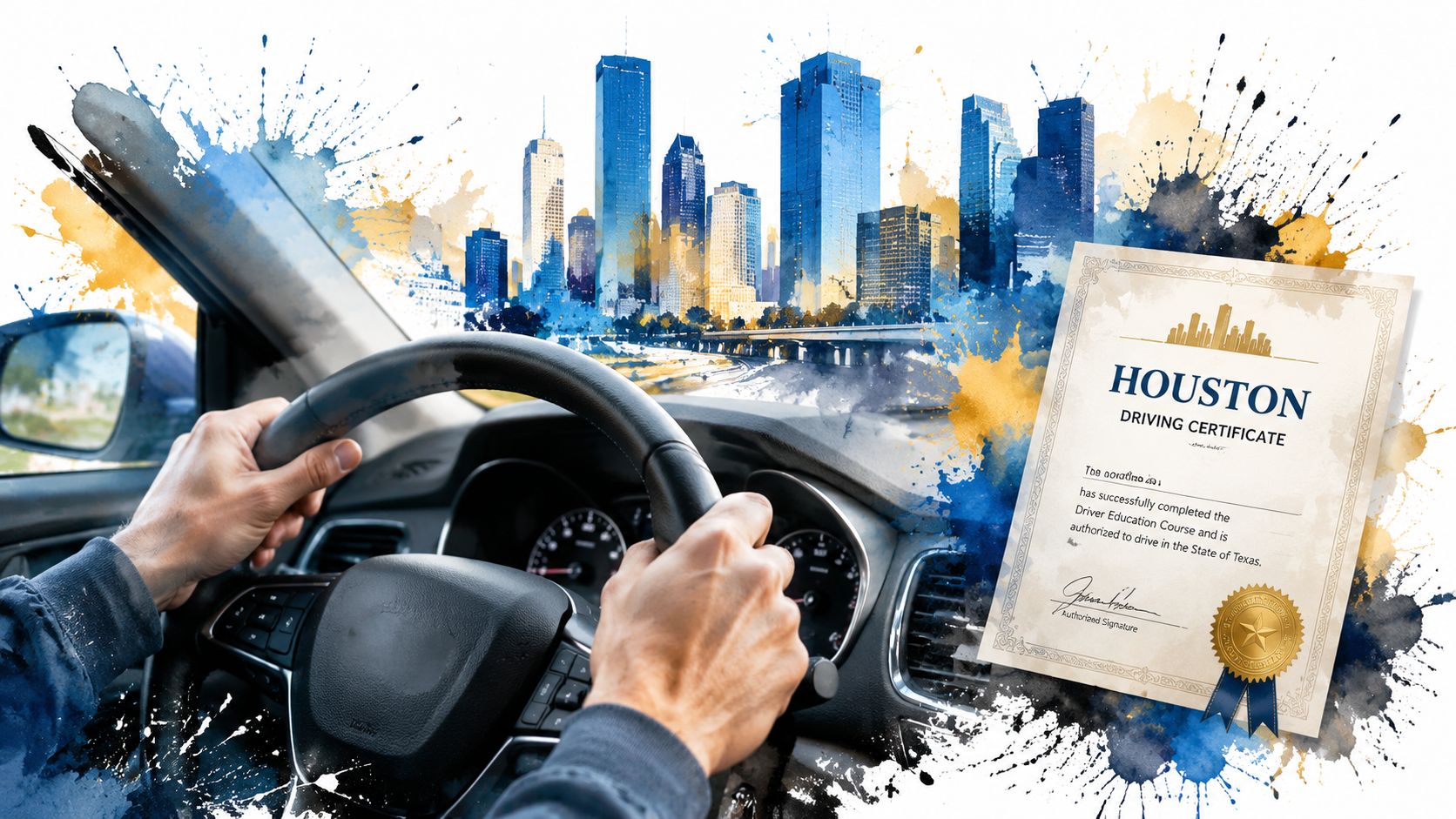
If you're searching for a defensive driving class houston right after getting a ticket, you probably want a simple answer fast. Can this class help you dismiss the citation, protect your record, and get the paperwork right the first time? In many Houston cases, yes. However, the main challenge usually isn't finding a course. It's understanding the court process, your eligibility, and the documents you have to turn in on time.
That's where a lot of drivers get tripped up. They sign up for a class first, then learn later that the court wanted a request filed before the first setting, or that another document was still required. As a driving educator, I always tell people the same thing. A course is only one part of the process. Safe driving education matters, but so does following the court's sequence carefully.
Understanding Defensive Driving for Ticket Dismissal
A traffic stop in Houston often sets off the same chain of questions. Can this ticket be dismissed, what does the court want first, and does a defensive driving class solve the problem by itself? In many cases, the class can help, but only when it fits the court's Driver Safety Course process. The City of Houston framework, summarized in this Houston defensive driving overview, describes a course that typically includes 5 hours of instruction plus 1 hour for breaks.
What the process usually looks like
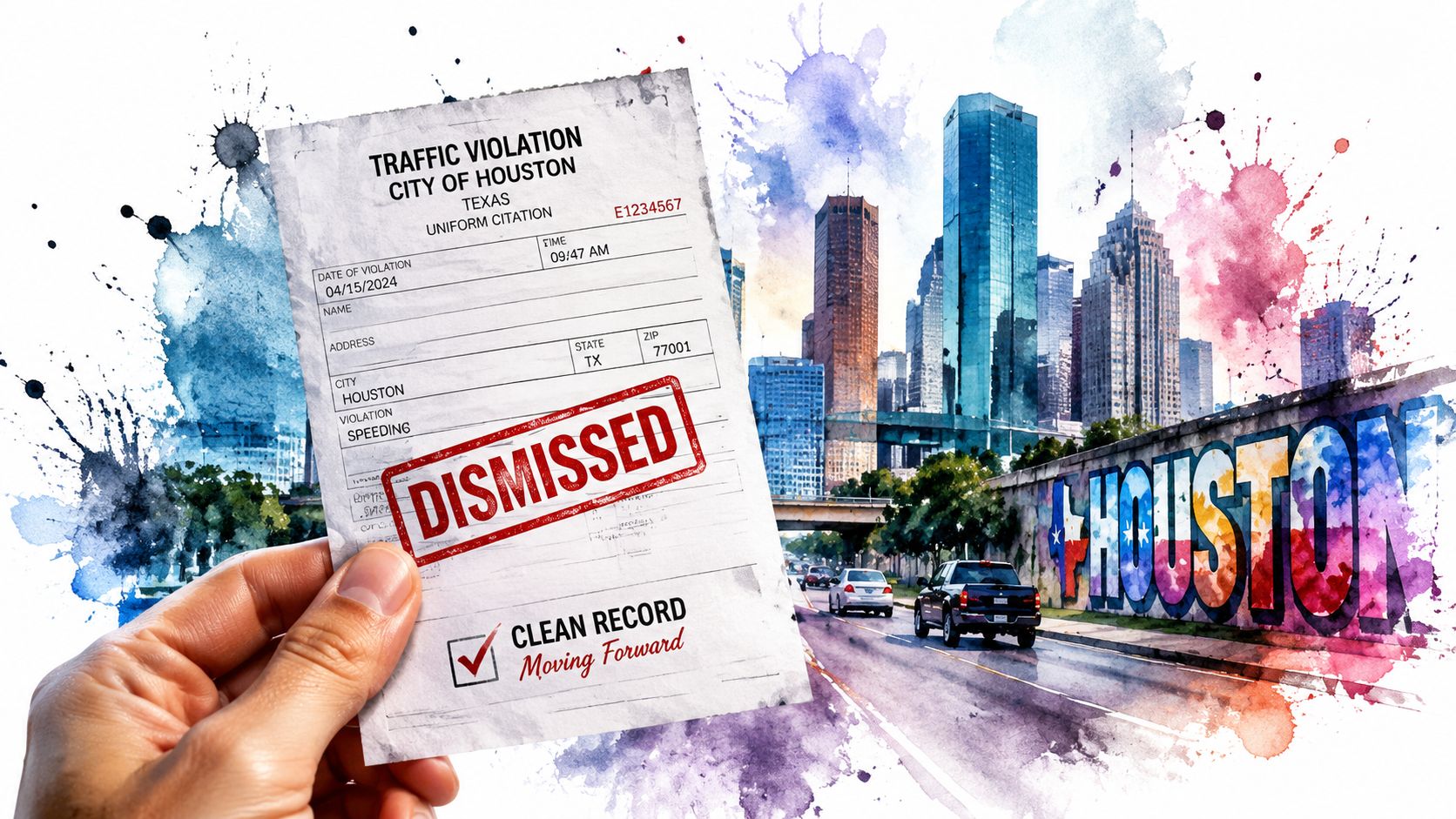
The easiest way to understand ticket dismissal is to view it like a checklist at the start of a road test. Turning the wheel matters, but doing the steps in the right order matters just as much.
Houston court instructions explain that drivers usually must ask for permission before the arraignment or first setting. After approval, drivers generally receive a 90-day period to finish the course, order a certified Texas DPS driving record, and submit both items under the Houston Driver Safety Course instructions.
A practical sequence looks like this:
- Request the Driver Safety Course through the court first.
- Verify that you qualify for the option.
- Complete a state-approved course.
- Order the required driving record.
- Turn in every document by the court deadline.
One missed step can block dismissal, even after you finish the class.
Texas providers commonly explain that eligibility has limits. Drivers generally need a valid license or permit, cannot have used defensive driving recently, cannot hold a CDL, and cannot use this route for certain serious violations, according to this Texas defensive driving eligibility guide.
Where drivers get confused
The main mix-up is simple. Taking a course is education. Using that course for dismissal is a court procedure.
That distinction matters because many Houston drivers rush to register before they confirm approval, deadlines, or required documents. For a plain-language explanation of the court side of the process, this guide on how to get your traffic citation dismissed can help clarify the sequence.
For drivers who need a state-approved format in Texas, A-1 provides a Texas defensive driving class online.
Houston drivers usually arrive here looking for a fast fix after a citation. That is understandable. Still, the bigger lesson is broader. Good driver education should do more than clean up one mistake. It should sharpen attention, spacing, speed judgment, and decision-making before the next problem appears.
That idea applies even more clearly in Georgia, where drivers and parents often focus on skill-building from the start. In the Atlanta area, A-1 Driving School stands out by pairing ticket-related education with long-term training options, including Joshua's Law courses for teens, private driving lessons, and road test services that help new drivers build habits that last.
Beyond Compliance The Power of Proactive Driver Education
A ticket-dismissal course solves an immediate problem. It doesn't always fix the driving habits that caused the problem in the first place.
That's the part many websites skip. They tell you where to register, but they don't spend much time on the decision path that matters most. Should you use defensive driving at all? Do you qualify? What happens after you finish? Houston guides often focus on the shopping step instead of the judgment step, even though Houston Municipal Courts use a formal Driver Safety Course process with eligibility rules and paperwork deadlines, as noted in this Houston defensive driving guide.
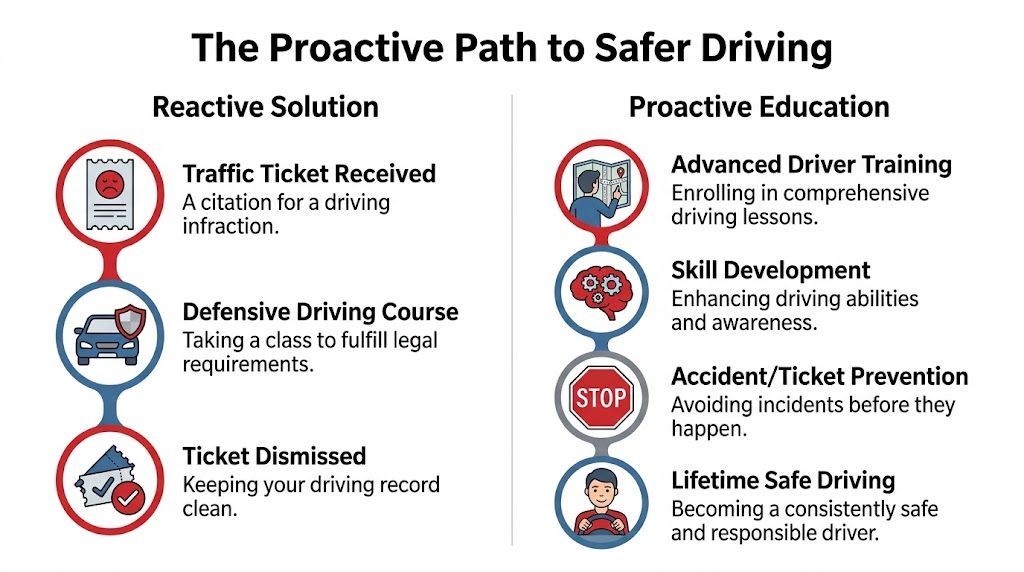
Reactive learning and proactive learning
Here's how I explain it to students and parents.
A reactive course says, “I got a ticket. Now I need to respond.”
A proactive program says, “I want to build judgment, awareness, and control before mistakes become expensive.”
Those are not the same goal.
Most drivers don't struggle because they lack information. They struggle because they haven't practiced enough real decisions behind the wheel.
That's why driver education in Georgia can feel more complete for new drivers. A structured path such as Joshua's Law combines classroom or online learning with professional in-car training. Instead of only meeting a court requirement, the student learns how to scan intersections, manage speed, anticipate other drivers, and recover calmly from small mistakes.
Why this matters for teens and adults
A teen driver needs repetition and coaching. An adult learner often needs confidence, not just rules. Someone moving to Atlanta may know traffic laws well enough, but still freeze during merges, busy left turns, or lane changes in heavy traffic.
A short compliance course can remind you to be careful. It usually can't replace guided practice in situations like:
- Highway merging: judging speed gaps without panic
- Urban intersections: deciding early and clearly
- Parking lot risk: watching pedestrians, carts, and backing vehicles
- Night driving: reducing overreaction and improving scan habits
The better long-term question
If you started with a Houston ticket problem, the bigger question is still useful no matter where you live. What kind of training will help you drive better next month, not just finish paperwork this week?
For Georgia families, that usually points toward a full learning path. Joshua's Law courses, online driver education, private driving lessons, road test prep, and supervised practice all work together. That approach creates safer habits that last longer than any dismissal certificate.
Mastering the Road with Professional Driving Lessons
The fastest way to spot a driver's weak points is to sit beside them for a lesson. One student grips the wheel too tightly and brakes late. Another checks mirrors well but hesitates every time traffic speeds up. Those are two very different drivers, and they need two very different coaching styles.
That's why one-on-one driving lessons matter so much.

Two common student stories
One is the nervous teen. She passed the written material, understands signs, and can repeat the rules back perfectly. Then she gets into real traffic and starts making rushed choices because everything feels faster than it did in a handbook.
The other is the adult who has delayed driving for years. He may know what to do in theory, but crowded roads, lane changes, and unfamiliar intersections still feel overwhelming. He doesn't need more lectures. He needs calm repetition with a skilled instructor.
Both students improve in the same way. They practice specific behaviors until those behaviors become natural.
What private lessons teach better than self-study
A good instructor doesn't just say “be careful.” A good instructor teaches the exact habits that make a driver predictable and safe.
That usually includes:
- Visual scanning: checking farther ahead instead of staring at the car directly in front
- Speed management: choosing a steady pace rather than alternating between rushing and braking
- Lane discipline: making early choices and avoiding last-second swerves
- Decision timing: knowing when to go, when to wait, and when to reset calmly
Behind-the-wheel training provides a significant advantage. Students build muscle memory, but they also build emotional control. They learn how to recover after a rough turn, a missed parking attempt, or a stalled decision at an intersection.
If you want a clear explanation of that value, this article on the benefits of taking driving lessons from an instructor lays out why guided practice changes behavior more effectively than passive learning.
A relaxed correction in the car often teaches more than an hour of reading.
Why lesson packages help
Single lessons can help with a narrow issue. Packages are usually better for lasting progress because they give the student time to repeat, correct, and revisit skills.
A package can be useful for:
| Driver type | Common challenge | Better lesson focus |
|---|---|---|
| Teen beginner | Nerves and inconsistency | Foundational scanning, turns, intersections |
| Adult beginner | Confidence and traffic flow | Lane changes, merging, route planning |
| Test-ready student | Small errors under pressure | Parking, test routes, smooth control |
Here's a quick look at in-car coaching in action:
The students who improve most aren't always the naturally confident ones. They're the ones who get focused feedback, practice regularly, and work through the uncomfortable parts instead of avoiding them.
Your Complete Path to a Georgia Driver's License
For Georgia families, the true goal usually isn't a ticket solution. It's getting from “my teen needs to start” to “my teen is ready to drive safely on their own” without confusion, delays, or unnecessary stress.
That path works better when it's treated as one connected process instead of a pile of separate errands.
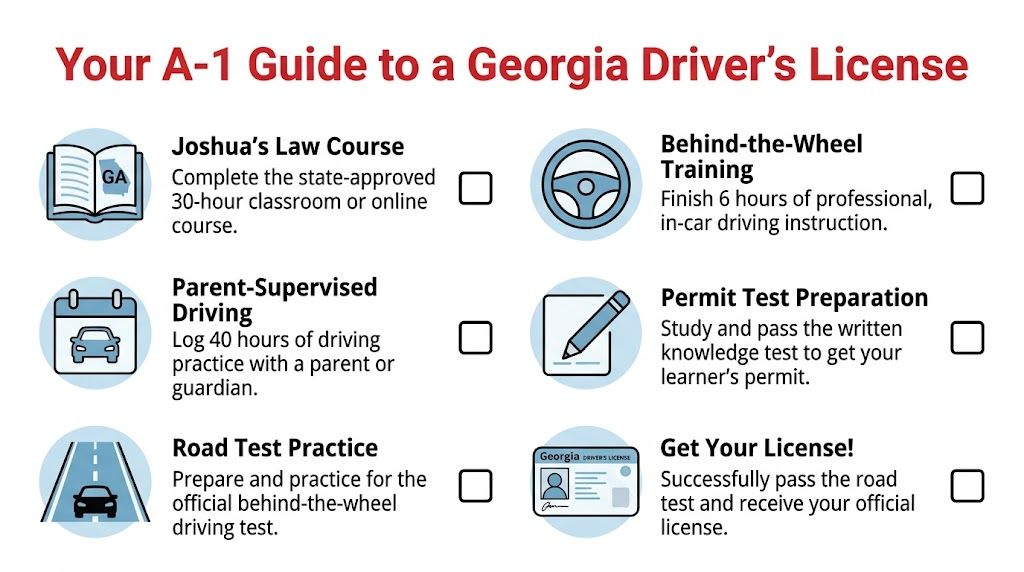
How the pieces fit together
In Georgia, new drivers often need several forms of preparation at once. They may need a Joshua's Law course, professional driving lessons, permit preparation, road test practice, and help understanding state requirements. When those pieces are handled in a coordinated way, families spend less time guessing and more time practicing.
A clean path often looks like this:
- Start with the classroom side. Georgia teens can complete the state-required Joshua's Law course through an online or in-person format.
- Move into in-car instruction. Here, the student turns concepts into habits.
- Add family practice. Parent-supervised driving fills in repetition between lessons.
- Prepare for the road test. Focus shifts from learning basics to performing consistently under test conditions.
Where families usually need help
Most parents don't struggle with motivation. They struggle with logistics. They want to know which course counts, how lessons fit the legal requirement, how to prepare for the road test, and whether there's any financial help available.
That's why an all-in-one school model is useful. Instead of searching for one provider for online education, another for driving lessons, and another for testing, many families prefer one system that keeps everything aligned. A practical place to review that process is this guide on how to get a driver's license in Georgia.
Parent note: Students learn faster when the home practice matches what the instructor is teaching in the car.
Online courses, road tests, and scholarship support
Online learning helps many Georgia students because it gives them scheduling flexibility. That matters for busy school calendars, sports, after-school jobs, and family transportation limits. It also helps parents who want a structured course but can't always work around a fixed classroom schedule.
Road testing is another major pressure point. Students often feel ready to drive but get anxious about the test itself. Practicing with the same standards used in formal evaluation can make that day feel much more manageable.
Some families also benefit from the Georgia Driver's Education Scholarship Grant Program. If cost is a concern, it's worth checking whether scholarship support is available before choosing a training path. That can make professional instruction more accessible and reduce the temptation to rely only on informal practice.
Start Your Journey to Safer Driving in Georgia Today
A Houston driver often starts with a simple problem. There is a ticket, a deadline, and a need to find a defensive driving class fast. That search is practical, but the stronger result comes from building the kind of skill that helps prevent the next close call, the next citation, or the next shaky decision at a busy intersection.
That same idea applies in Georgia. A class can satisfy a requirement, but real driver education does more than check a box. It builds judgment the way regular practice builds muscle memory. The more clearly a driver understands spacing, scanning, speed control, and decision-making, the more natural safe choices become.
For Atlanta-area families, that is why A-1 Driving School stands out as a strong option. It offers Georgia teens and adults a full training path, including Joshua's Law courses, private driving lessons, and road test services. Instead of patching together help from several places, students can follow one clear route from learning the rules to showing they can use them on the road.
A good program should match the driver's real situation. A teen who needs to meet Georgia requirements may need Joshua's Law first. An adult who feels nervous in traffic may need focused driving lessons. A student who knows the basics but freezes under test pressure may need guided road test preparation. Each service solves a different problem, and together they support safer driving for life.
That is the bigger lesson behind the Houston search.
Defensive driving matters, especially when a driver needs a quick answer after a ticket. But the long-term value comes from education that keeps paying off every time a person merges onto the freeway, turns left across traffic, or reacts to another driver's mistake. A-1 Driving School has served Georgia drivers since 1987 and continues to provide structured training for students who want to build real skill with Joshua's Law courses, driving lessons, road test support, and online learning options.