A traffic ticket can turn a normal day into a paperwork problem fast. You start wondering whether the point will hit your record, whether your insurance will go up, and whether taking traffic school is worth the time.
That's usually where people start searching for defensive driving course california options. The confusing part is that California traffic school is mostly a fix-after-the-fact tool, while driver's education in places like Georgia is often about building safe habits before a mistake happens. Both matter. They just serve different drivers at different moments.
Your Guide to Driver Safety and Education Options
California drivers often look into defensive driving after a citation. That makes sense. The state's road environment is demanding, and the safety backdrop is serious. The California Office of Traffic Safety reports 4,061 traffic fatalities in 2023, down nearly 11% from 4,539 in 2022, which helps explain why defensive driving remains an important safety tool in the state's high-volume traffic system (California Office of Traffic Safety score card).
A defensive driving course usually focuses on the same practical question: how do you spot trouble early enough to avoid making a bad situation worse? If you want a simple overview of that idea, this guide on what defensive driving means in everyday driving is a useful starting point.
Why people get mixed up
Many drivers blend together three separate topics:
- Traffic school for a ticket means a court-related process tied to an eligible citation.
- Insurance savings means a possible discount, but only if your carrier accepts the course.
- Driver's education means foundational training for new drivers, especially teens.
Those categories overlap in safety goals, but they aren't the same program.
Practical rule: If you got a citation, always check the court paperwork first. If you're trying to save money on insurance, check with your insurer first. If you're training a new teen driver, look at full driver's education, not just a short safety class.
Another area that creates confusion is alcohol-related driving rules. Defensive driving courses may mention impaired driving, but if you need a plain-language legal overview, LA Law Group explains alcohol limits in a way that helps drivers understand the issue without guessing.
Using a California Defensive Driving Course for Ticket Dismissal
Many California drivers view a defensive driving course primarily as traffic school following a moving violation. The critical step is straightforward. Rather than enrolling independently and expecting the court to accept the certificate, you typically must receive explicit permission from the court first.
What traffic school usually does
When you're eligible and complete an approved course, the main benefit is that the conviction is generally masked from your public driving record. That's why so many drivers choose it. They're trying to prevent one ticket from creating a longer insurance problem.
Many people get tripped up on this point. They assume “dismissal” means the ticket disappears completely. In everyday conversation, people use that word loosely. In practice, what usually matters most is whether the violation stays from public view in the way traffic school rules allow.
A simple way to think through eligibility
California traffic school eligibility depends on the court and the type of citation. In many common situations, drivers are looking at questions like these:
Was it a minor moving violation?
Traffic school is generally associated with lower-level infractions, not every kind of offense.Do you have a valid license?
Courts typically expect your licensing status to be in order.Did the court authorize traffic school?
This step matters more than people think. Court permission is the gatekeeper.Have you used traffic school recently?
This is one of the first things to verify before paying for any course.
If you're trying to understand the record side of this process, this article on how drivers work to reduce points on a license gives helpful background on why the issue matters.
Traffic school is often less about “erasing” a mistake and more about limiting the long-tail impact of one mistake.
The usual process
Most drivers move through the process in this order:
| Step | What to do | Why it matters |
|---|---|---|
| Court notice | Read the citation or courtesy notice carefully | It tells you whether traffic school may be available |
| Election | Tell the court you want traffic school if allowed | The court has to recognize your choice |
| Enrollment | Pick a state-approved provider | An unapproved course may not count |
| Completion | Finish the course by the deadline | Late completion can undo the benefit |
| Reporting | Confirm the completion was submitted properly | You want the court record updated correctly |
A small but important detail: keep copies of everything. Save your receipt, your completion confirmation, and any court communication until the matter is fully closed.
Unlocking Insurance Discounts with a Safety Course
Some drivers take a course even when they don't have a ticket because they're hoping to lower insurance costs. That can be a smart move, but only if you verify the details before you pay.

A California course provider notes that insurance savings can reach up to 10% and may last for three years after completion, but drivers should confirm both eligibility and duration with their own carrier (California defensive driving course overview).
Questions to ask before you enroll
Don't ask only, “Do you give a discount?” Ask better questions.
Will you accept this specific course certificate?
Some carriers care about the provider, not just the course title.Who qualifies for the discount?
Eligibility may depend on age, driving history, or policy type.How long does the discount last?
Duration matters because it changes the value of the course.Do I need to renew it later?
Some benefits may not continue forever without another approved class.
If you're comparing premium-saving ideas more broadly, this Duncan & Associates car insurance guide gives a practical checklist for how drivers think through affordability, even though insurance rules vary by state.
How to judge whether it's worth it
A course can make sense financially when three things line up:
- The insurer confirms acceptance
- The discount lasts long enough to matter
- The course fee is reasonable for your situation
That's why it helps to look at the bigger insurance picture, not just the course itself. This car insurance guide for drivers is useful if you want to compare discounts, risk factors, and long-term cost decisions in plain language.
A quick visual explainer may help if you're weighing the idea of traffic school or a safety course:
How to Choose an Approved California Driving Course
Once you know why you're taking the course, the next question is format. Most drivers are choosing between online convenience and in-person structure.
The best choice depends less on personality than on your real schedule. If you're juggling work, childcare, or a long commute, online usually feels easier. If you focus better in a room with an instructor and fewer distractions, classroom learning may be a better fit.
Online and classroom options compared
| Format | Usually works well for | Watch out for |
|---|---|---|
| Online | Busy adults, self-paced learners, drivers who want flexibility | Boring platforms, unclear certificate steps, procrastination |
| In person | Drivers who prefer structure and live instruction | Fixed schedules, travel time, less flexibility |
Course quality matters more than hype. The National Safety Council says it pioneered the first Defensive Driving Course in 1964 and has trained more than 80 million drivers. It also reported that in a study of more than 30,000 Massachusetts drivers, traffic violation rates decreased up to 74% in the year after completing its online training (NSC online driver safety training study). That's a strong reminder that online instruction can be effective when the provider uses a serious curriculum.
What to verify before paying
Use the provider's website like a checklist, not an advertisement.
- State approval: Make sure the course is presented as California-approved for the purpose you need.
- Completion handling: Find out whether the provider submits completion electronically or tells you to handle proof yourself.
- Support: A phone number or real student support matters if you hit a deadline problem.
- Clarity: If the website makes basic rules hard to understand, the course may be frustrating too.
Choose the course that makes compliance easy. A slightly less flashy provider with clear instructions is often the better option.
A practical benchmark
California's own compliance-oriented training offers a useful model. The California Department of General Services describes a two-hour interactive Defensive Driver Training program focused on safe driving practices, rules of the road, accident response, and telematics, and notes an 80% passing threshold for completion in its related program materials (California DGS defensive driver training enrollment page). Even if you're not taking that state employee course, it shows what good training looks like: short, structured, and tied to measurable completion.
Proactive Training The Joshua's Law Model in Georgia
California traffic school is usually reactive. Georgia's teen training model is different. It starts before the first independent drive, not after the first citation.
For families with new drivers, that difference matters. A short corrective course can help after a mistake, but it doesn't replace the value of learning road habits in a structured way from the beginning.
What makes Joshua's Law different
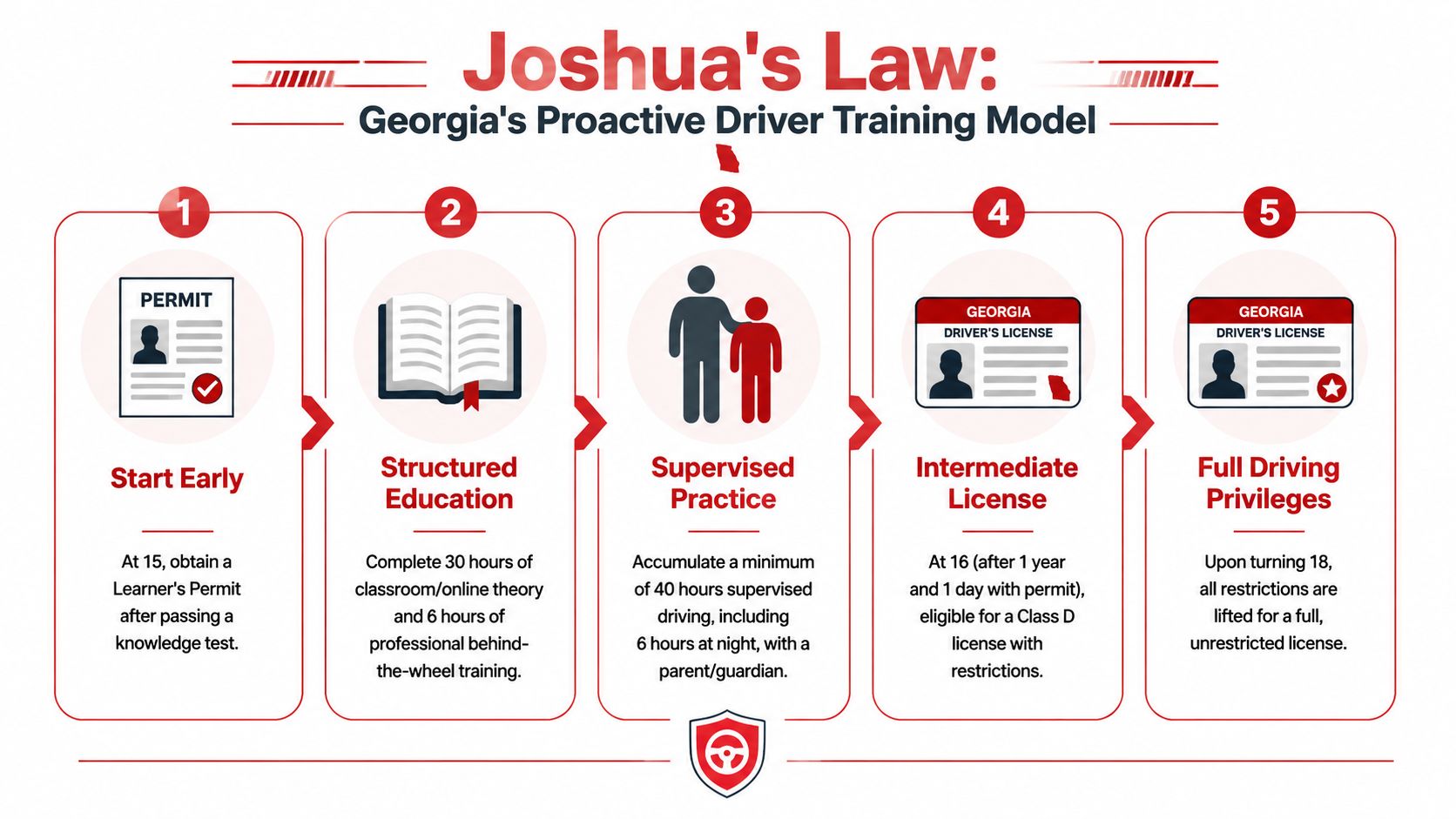
Joshua's Law is built around a layered training path for teen drivers. Instead of treating safety as a one-time lecture, it combines classroom knowledge, professional instruction, and supervised practice over time.
That approach solves a common problem in teen driving. Many new drivers understand rules on paper but struggle with timing, scanning, lane judgment, and decision-making in real traffic. Professional instruction closes that gap.
A-1 Driving School offers Joshua's Law driver education courses in formats that fit different schedules, including online and classroom options for families who need to meet Georgia's education requirement.
The structure families should understand
A Georgia parent usually needs to think in stages, not just in course enrollment.
- Permit first: A teen begins with a learner's permit.
- Formal education next: Joshua's Law requires 30 hours of classroom or online theory and 6 hours of professional behind-the-wheel instruction for qualifying young drivers seeking a Class D license at 16.
- Practice after that: Families then add supervised driving experience at home.
- Licensing comes later: The teen moves toward the intermediate stage only after meeting the state's conditions.
The smart question isn't “How fast can my teen finish a course?” It's “How many chances will they get to practice good decisions before driving alone?”
Why this model works so well for new drivers
This Georgia approach uses the same safety logic found in defensive driving, but earlier. Instead of waiting for a ticket, students learn to notice hazards, judge space, and react calmly from the start.
That's especially valuable for nervous teens, busy parents, and adult learners who didn't get much structured training the first time around. The classroom piece teaches the rules. The in-car piece teaches judgment.
The Power of Professional Behind-the-Wheel Lessons
A parent can help a new driver practice. A professional instructor can do something different. They can spot weak habits early, correct them clearly, and build skills in a structured order.
That matters because safe driving isn't just about remembering signs or staying under the speed limit. The National Safety Council explains that the technical core of defensive driving is hazard prediction and space management, and that professional instructors train drivers to keep asking “What if?” as they watch traffic unfold (NSC defensive driving training overview).

What an instructor sees that families often miss
A parent may notice obvious mistakes like hard braking or wide turns. An instructor is often watching for smaller patterns that become bigger problems later.
- Scanning habits: Is the student checking far enough ahead, or only looking at the bumper in front?
- Lane control: Are they drifting during turns or correcting too late?
- Decision timing: Do they hesitate too long at merges, or commit too early?
- Space judgment: Can they leave enough room without freezing up in traffic?
Those are the details that affect both road test performance and everyday safety.
Why lesson packages can help more than isolated sessions
One lesson can identify problems. A package gives a student time to fix them. That's usually the better setup for teens, anxious adult beginners, and drivers who haven't been behind the wheel in a long time.
A well-built package also lets instruction progress naturally. One session might focus on low-speed control. The next can add lane changes, busier traffic, parking, or test-route skills. By the end, the student isn't just “less nervous.” They're more consistent.
Good driving lessons don't just add seat time. They turn random practice into coached repetition.
That's why families often get more value from professional lesson packages than from trying to piece together training one ride at a time.
Financial Aid and Taking Your Georgia Road Test
Cost stops some families from starting driver's education on time. In Georgia, the Driver's Education Grant Scholarship Program can help qualifying students access training without placing the full burden on the family budget.
The first step is simple. Check the scholarship requirements early, before you lock in your schedule. Families who wait until the last minute often create avoidable delays with paperwork, course timing, or permit planning.
Two practical moves for students and parents
Look at funding and scheduling together
Don't treat the grant search and course search as separate tasks. The best plan is the one your student can attend.Plan the road test before the final rush
Road testing is easier when it's built into the training timeline, not treated as an afterthought.
Many students also want an easier path to the last step. Instead of waiting and guessing about test-day readiness, some families prefer to complete the road test through a driving school when that service is available. That can make the handoff from lessons to licensing much smoother.
If you need one place to compare classes, lessons, scholarship-related options, and Georgia road test services, it helps to choose a provider that supports the full process rather than only one piece of it.
If you're comparing California traffic school with Georgia driver training, the big takeaway is simple. Corrective courses help after a mistake, but structured education and professional driving lessons build safer habits earlier. For Georgia teens and adults who need driver's education, behind-the-wheel lessons, lesson packages, or road testing help, A-1 Driving School offers those services in one place so you can move from class to practice to license with a clearer plan.