A traffic ticket in Oklahoma usually creates the same chain of questions. Do I need to go to court? Will this hit my driving record? Can a class fix it?
That's where many drivers get tripped up. A defensive driving class oklahoma course can help, but only if you choose the right class for the right reason. Some people need it for a ticket. Some need it for point reduction. Others only care about an insurance-related benefit. Those are not the same thing, and treating them like they are is how drivers waste money and miss deadlines.
Your Guide to Oklahoma Defensive Driving
You pay the ticket, toss the paper on the passenger seat, and tell yourself you will deal with it tonight. Then the search results start sending you in three different directions. One course says it helps with a citation. Another talks about points. A third promises an insurance benefit.
Those are three different jobs.
In Oklahoma, a defensive driving class works a lot like using the right form at the tag agency. If you bring the wrong one, you may still stand in line, pay money, and leave without the result you needed. The same problem shows up with driving courses. A class that helps one driver with point reduction may do nothing for another driver who needs court approval or proof for an insurer.
Start with one question and answer it plainly. What outcome are you trying to get?
Here is the simple map:
- Ticket handling: You want to satisfy a court, prosecutor, or judge requirement tied to a citation.
- Point reduction: You want credit that can help your Oklahoma driving record.
- Insurance documentation: You want a certificate your insurer may accept for a discount or driver improvement review.
Many drivers get tripped up at this point because course ads often blur those goals together. “Defensive driving” sounds like one product. In practice, approval rules can differ depending on who needs to accept your certificate. A court may have its own expectations. The state has its own approval process for point-related credit. An insurance company may ask for something else entirely.
That is why the safest first step is not enrolling right away. First, confirm who must accept the certificate after you finish. If you skip that step, an unapproved online course can turn into a wasted fee, a missed deadline, and no benefit to your record.
A defensive driving class also has a real safety purpose. It teaches the habits that reduce close calls, lower stress, and help you spot trouble early. If you want a quick refresher before choosing a course, this guide to what defensive driving means in practice gives a clear overview.
Before you spend any money, keep these four rules in front of you:
- Match the course to your goal. Ticket, points, and insurance are separate uses.
- Verify approval with the right decision-maker. That may be the court, the state, or your insurer.
- Save every document. Keep your citation, deadlines, license information, and completion certificate together.
- Plan for the final step. Finishing class only helps if the right office receives your proof on time.
Who Qualifies and Why You Should Take a Class
You got a ticket, opened a few course websites, and now everything says “defensive driving.” That is where Oklahoma drivers often make the wrong choice. One class may help with points, another may satisfy a court, and another may only be useful for an insurance discount. The name sounds the same, but the goal changes what counts.
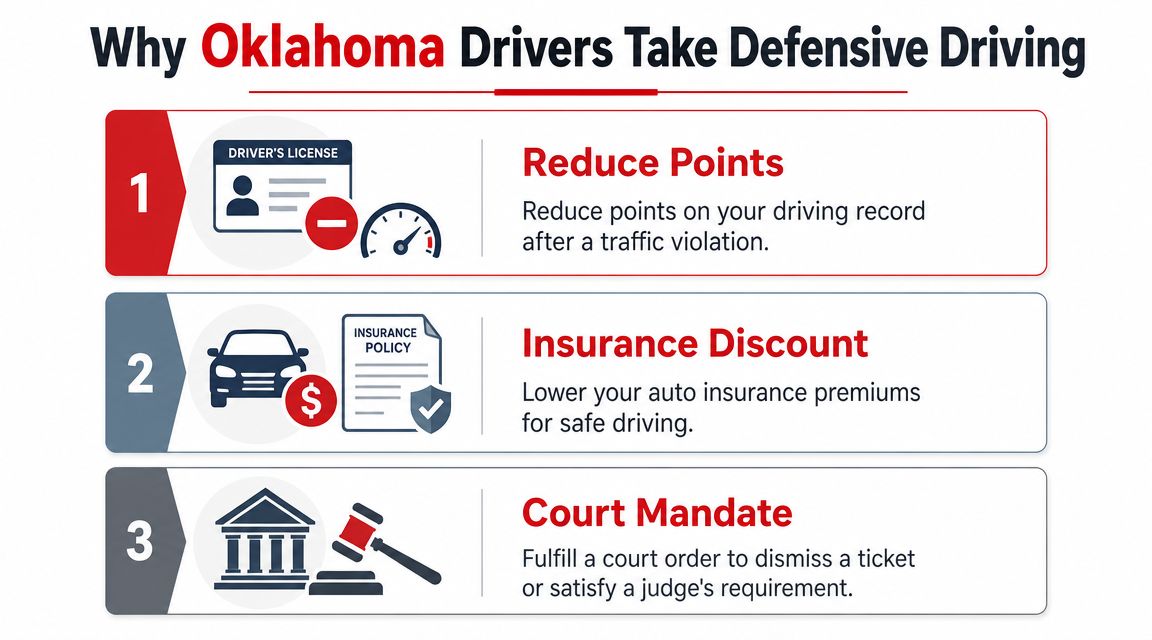
A good way to sort this out is to treat your class like the right key for the right lock. If you bring a point-reduction certificate to a court that wanted a specific driver improvement course, it may not help. If you take a generic online class for insurance, your carrier may say it does not meet its requirements. Before you enroll, decide which of these three outcomes you need.
Point reduction
If your goal is to remove points from your Oklahoma driving record, focus on state-approved point-reduction eligibility. Oklahoma rules are commonly summarized this way: eligible drivers can receive a 2-point reduction, and that credit is generally limited to once every 24 months. As noted earlier, that timing rule matters.
Drivers usually run into trouble here because they assume any online defensive driving class will count. It will not. For point reduction, the course must be the type the state accepts for that purpose, and your own record must fit the eligibility rules.
Check these items before you pay:
- You have an Oklahoma license that qualifies. Commercial and other special license situations can follow different rules.
- You currently have points to reduce. No points usually means no point-reduction benefit.
- You have not already used this option too recently. The waiting period can block credit.
- The course is approved for point reduction. A course title alone proves nothing.
One Oklahoma-based guide also explains that the state, not the course advertisement, decides whether a class counts for this use. See Aceable's Oklahoma defensive driving guide for a plain-language summary of that distinction.
Ticket dismissal or court compliance
A ticket case follows a different path. The question is not “Does Oklahoma approve this generally?” The question is “Will my court accept this for my citation?”
That difference trips people up all the time.
Some courts allow a class to keep the ticket from showing up as a conviction. Some limit that option by violation type, timing, or driving history. Some want a specific provider or a specific kind of certificate. In other words, court approval is local. A course that works for one town may do nothing for a ticket in another court.
For court-related use, verify these points first:
- Ask the court whether your violation qualifies
- Confirm the exact class type they want
- Find out whether you submit the certificate or the school sends it
- Get the deadline and keep a copy of it
If you want a flexible option after the court confirms online attendance is acceptable, you can take an online defensive driving class from home. Just make sure the court will accept that specific format before you register.
Insurance discounts
Insurance is the third bucket, and it has its own rules. Your insurer decides whether it offers a discount, what course it accepts, and what proof it wants.
This works a lot like rebates. Finishing the class is only part of the job. You also have to send the right paperwork to the right place in the right format.
Ask your insurer these questions:
| Question to ask | Why it matters |
|---|---|
| Do you accept this specific course? | Some insurers only recognize certain providers or certificate formats. |
| Does the class need state approval? | Your insurer may care about approval status even if your goal is not point reduction. |
| How should I submit proof? | Upload, email, and agent submission are handled differently. |
The short version is simple. Ticket help, point reduction, and insurance savings are three separate goals. Once you know which one applies to you, it becomes much easier to choose a class that counts and avoid paying for an unapproved course that solves the wrong problem.
Finding a State-Approved Course Online vs In-Person
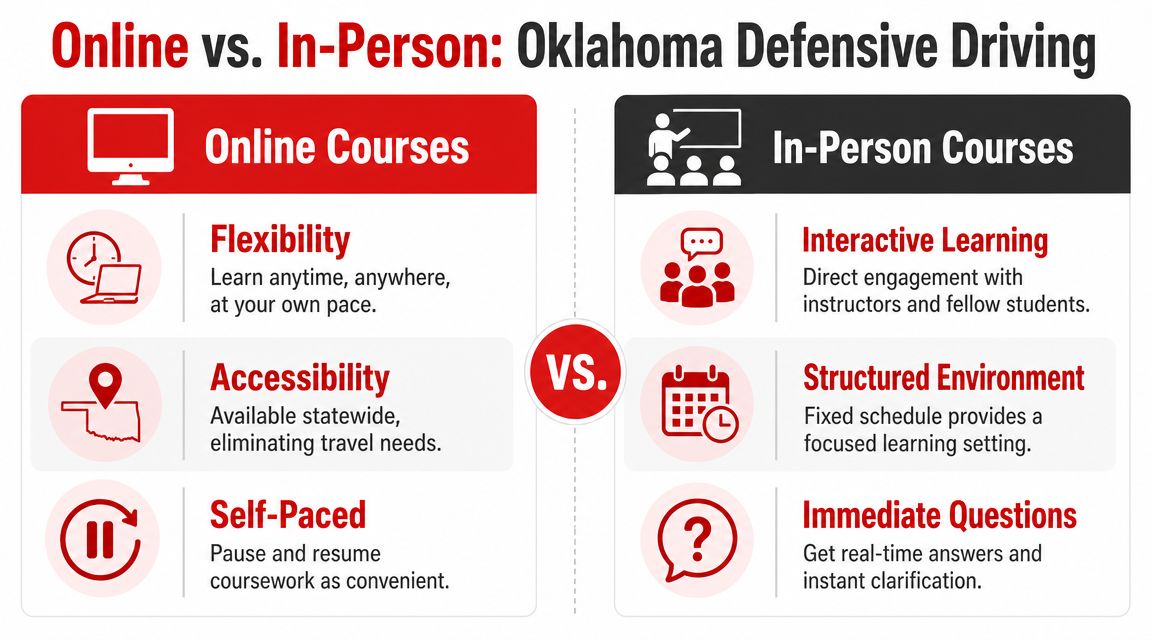
Online classes appeal to most drivers because they're flexible. In-person classes appeal to drivers who want structure and quick answers. Both can work. The key issue isn't convenience. It's approval.
What online gets right
Online defensive driving works well for people juggling work, family, or court deadlines. You can often start quickly, stop when needed, and complete the class from home. If flexibility is your priority, many drivers prefer to take a class virtually.
But convenience can hide a serious problem.
One Oklahoma driving school warns that some online defensive driving classes are not state-certified, which can make them invalid for official court or point-reduction use. That warning appears on Safer Driving School's defensive driving page.
What in-person still does better
An in-person class gives you a set schedule and a live instructor. That helps drivers who learn better by asking questions as they go. It also reduces the chance that you'll misunderstand a requirement and only discover the problem after the deadline.
That said, in-person doesn't automatically mean approved for your exact goal either. You still need to ask the same core question: approved by whom, and for what purpose?
Practical check: ask the provider to explain whether the class is intended for court use, point reduction, insurance use, or some combination.
A side-by-side way to choose
Use this if you're stuck between formats:
- Choose online if you need scheduling flexibility, you're comfortable learning independently, and you have already confirmed the course is accepted for your exact use.
- Choose in-person if you want a fixed routine, immediate clarification, or you're uneasy about sorting through court and approval details on your own.
- Avoid either format if the provider can't clearly tell you what the course is approved for.
A newer wrinkle in Oklahoma content is that some providers advertise shorter formats while others still describe the older six-hour model. That's another reason to stop comparing classes by speed alone. A shorter class that doesn't count for your purpose is no bargain.
The Enrollment and Course Completion Process
Once you've picked the right type of course, the process is usually less intimidating than people expect. Most drivers can handle it smoothly if they gather their information before they start.
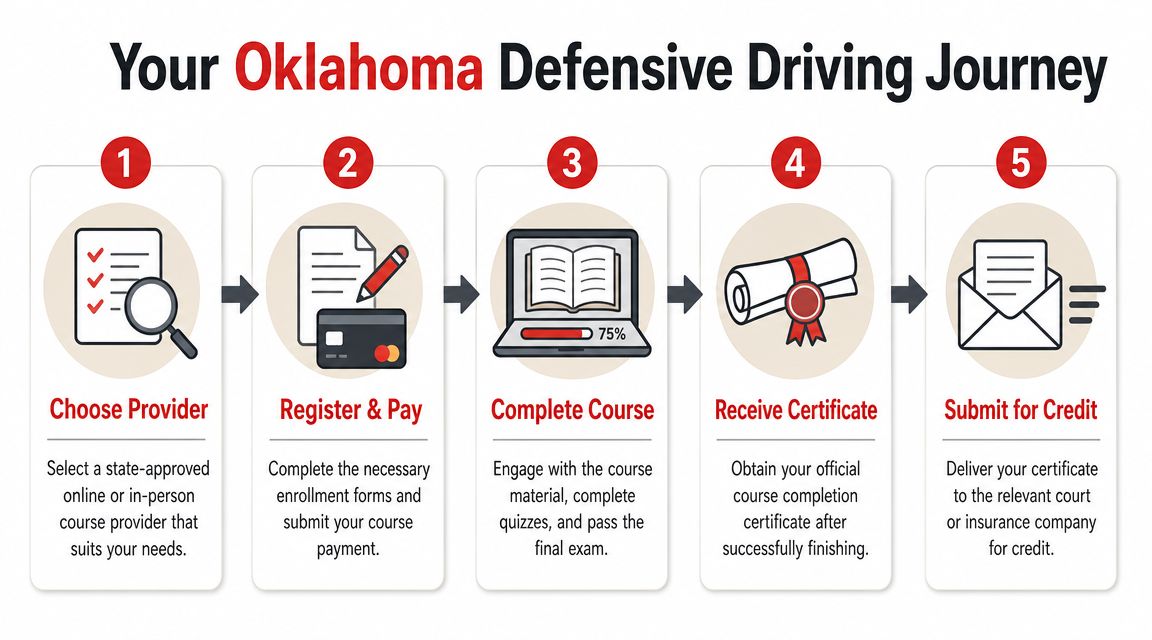
What you usually need to register
Providers commonly ask for basic identifying details and, if you're taking the class for a ticket, information tied to the citation or court.
Have these ready:
- Your license information: Make sure it matches your current record.
- Your citation details: Court name, case number, or ticket number if applicable.
- Your reason for taking the class: Point reduction, court, or insurance.
- Your contact information: You'll need certificate delivery updates.
If anything on your ticket looks unclear, call the court before enrolling instead of guessing.
How the course is typically structured
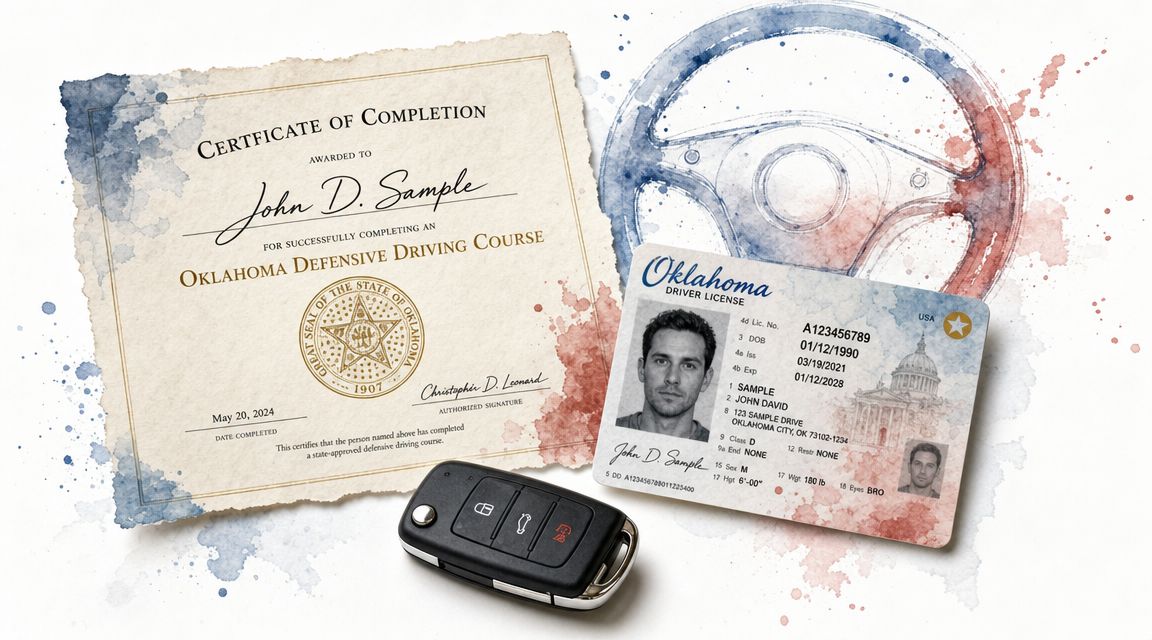
One provider describes a standard Oklahoma online course as a six-hour program broken into 14 modules, with a quiz after each module and a 25-question final exam. That provider also says drivers usually get unlimited retakes until they pass, as described on OklahomaDriver.com's course process page.
That structure matters because it tells you what your day will look like. You're not usually sitting through one long lecture. You're moving through sections, checking understanding as you go, and finishing with a final test.
Here's a practical rhythm that works for many students:
- Read one module carefully
- Take the quiz right away while the material is fresh
- Pause if needed, then resume later
- Save the final exam for a time when you won't be rushed
Don't wait until the last possible night. If the court or insurer needs the certificate by a deadline, leave time for processing and delivery.
What trips people up during the course
The content itself usually isn't the problem. These are.
- Rushing registration: A wrong court or citation entry can cause certificate problems later.
- Assuming all reporting is automatic: Some providers report to certain courts, others don't.
- Ignoring completion timing: Even a self-paced course still takes real time to finish.
Submitting Your Certificate for Credit
You finish the course, pass the final, and breathe out. Then a week later, you find out the court never got your certificate, or your insurer says the class you took does not qualify for a discount. That is the part many Oklahoma drivers do not see coming.
Your certificate only helps if it reaches the right place, in the right format, for the right reason. In Oklahoma, that reason usually falls into one of three buckets:
- Ticket handling through a court
- Point reduction for your driving record
- Insurance discount or insurer requirement
Those goals sound similar, but they do not always use the same process. A certificate works like a key. It has to match the lock you are trying to open.
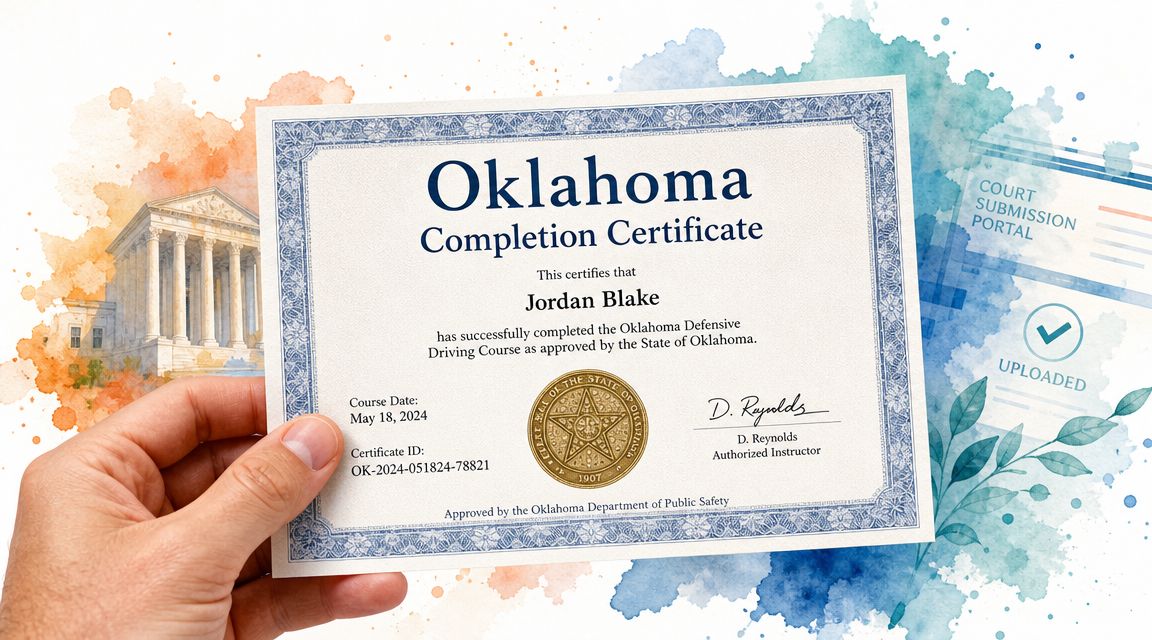
Court submission
If you took the class to deal with a ticket, do not assume completion ends the matter. The court decides whether your case is satisfied, dismissed, deferred, or kept off your record. That means your next step is simple but important:
Ask immediately: Who sends the certificate, and who confirms acceptance?
Some providers submit completion records to certain courts. Others give you the certificate and expect you to file it. If you guess wrong, the court may treat the ticket as unresolved.
Use this checklist:
- Verify the exact court name on your citation
- Check whether that court accepted this course before you enrolled
- Ask if the provider sends proof directly
- If you must submit it yourself, ask how the court wants it sent
- Get confirmation that the court received and accepted it
If your case is with a city court, municipal court, or traffic division, follow that court's instructions, not general advice from a course website. That one detail prevents a lot of trouble.
Point reduction and insurance submission
Point reduction and insurance credit are different goals, even though both use a completion certificate.
For point reduction, you are dealing with your driving record. For insurance, you are dealing with your carrier's rules. One office may accept a certificate that another office does not. That is why unapproved online courses cause problems. A course may be real, paid, and completed, yet still fail to count for the purpose you had in mind.
A careful follow-up routine helps:
- Save the certificate right away
- Keep a digital copy and a printed copy
- Write down the completion date
- Submit it using the agency's or insurer's stated method
- Keep any email receipt, upload confirmation, or fax record
If your main concern is points on your license, this guide on how to reduce points on your license can help you understand the record side of the process.
For insurance, call your carrier before you send anything and ask:
- Does this course qualify for a discount with your policy?
- Do you need the full certificate or a specific form?
- Is there a deadline for submission?
The safest habit
Treat certificate submission like mailing a payment. You do not want to assume it arrived.
Keep a small paper trail:
- What you sent
- When you sent it
- How you sent it
- Who confirmed receipt
Finished means accepted, not just completed.
That one habit separates a useful defensive driving class from a wasted one.
Making the Smartest Choice for Your Driving Record
The smartest move isn't picking the fastest course. It's picking the right approved course for your exact goal and then handling the paperwork all the way through.
For most Oklahoma drivers, the decision comes down to three questions:
- Are you trying to deal with a ticket, reduce points, or satisfy an insurance requirement?
- Has the court, DPS-related process, or insurer approved that specific course type?
- Do you know who must receive the certificate after you finish?
There are also driver-specific nuances that matter. One Oklahoma school notes that most Class D drivers can receive the 2-point reduction, but it also says CDL holders will no longer receive that same point credit after August 2025 under federal law, according to Oklahoma Driving School's course detail page. That kind of detail is easy to miss if you enroll based on a headline promise instead of the fine print.
Good driver education does more than satisfy a rule. It helps you drive with more awareness, make calmer decisions, and avoid repeating the same mistake.
While rules vary by state, from Oklahoma to Georgia, the principles of safe, defensive driving are universal. For a wide range of state-approved courses, from teen driver's education that satisfies Joshua's Law to flexible driving lessons and insurance discount programs, find your expert-led class today.
If you need professional driver training beyond Oklahoma, A-1 Driving School offers Georgia-focused options including Joshua's Law driver's education, online classes, road test preparation, road testing support, and flexible driving lesson packages for teens and adults. They also provide guidance on the Georgia Driver's Education Scholarship Grant Program, making it easier for families to find the right training path and get on the road with confidence.