
A lot of Georgia families hit the same moment at the same time. Their teen has a permit, everyone is excited, and then the practical questions start. Do we teach driving ourselves? Do we sign up for a school? Are the legal requirements the same? And most important, which path gives our teen the safest start once they're driving without us in the passenger seat?
That's where the usual driving school vs parent taught debate gets too simple. In real life, this isn't just a choice between paying for lessons or saving money. It's a choice about structure, coaching, consistency, and whether your teen will practice the situations families often put off until it's too late.
For most Georgia teens, the strongest plan isn't purely one or the other. It's a hybrid approach. Professional instruction builds the foundation and covers high-risk skills correctly. Parent-led practice adds repetition, comfort, and the hours needed to turn those skills into habits.
The Big Decision for Georgia's New Teen Drivers
A parent in Georgia usually starts with good intentions. You've been driving for years. You know the local roads. You know your teen better than anyone. It's reasonable to think, “I can teach this.”
That can work for some parts of the process. It often works well for parking lot starts, neighborhood turns, stop sign routines, and low-speed repetition. The problem shows up later, when your teen needs to merge with confidence, handle pressure from traffic behind them, judge speed in a busy corridor, or drive at night without freezing up.
In Georgia, both paths can fit into the licensing process. That's why families get stuck. If both are legally acceptable in some form, it's easy to assume they produce the same result. They don't always.
What parents are really deciding
The question isn't just who sits in the passenger seat. It's this:
- Who teaches the fundamentals correctly from the beginning
- Who catches bad habits before they become normal
- Who makes sure your teen practices more than easy roads
- Who keeps the process calm when parent and teen start frustrating each other
Practical rule: The best training plan is the one your family will actually complete, in enough variety, before solo driving starts.
A nervous teen may learn better from a neutral instructor. A confident teen may still need outside coaching because confidence and judgment aren't the same thing. A capable parent may still want professional help for highway driving, road test prep, or correcting habits that are hard to spot when you drive the same routes every day.
That's why this decision deserves more than a quick pros-and-cons list. Georgia law sets the minimum. Your family still has to decide how to build a driver who's ready for real roads.
Understanding Georgia's Joshua's Law Requirements
A lot of parents find out the hard way that Georgia does not treat driver education as a simple choice between driving school and home practice. A 16 or 17-year-old applying for a Class D license has to meet Joshua's Law first. That legal baseline shapes every training decision that follows.
What Georgia requires
For teens under 18, Georgia requires a DDS-approved driver education course and 40 hours of supervised driving, including 6 hours at night, according to the Georgia DDS driver education FAQs.
That point matters because many families assume professional lessons cover everything. They do not. The law still expects real supervised practice outside formal instruction, which is one reason a hybrid plan works well for many Georgia teens.
Here is what parents need to keep straight:
Driver education course
Your teen must complete a DDS-approved course. Families usually choose either classroom instruction or an approved online option based on schedule, learning style, and how much outside structure the teen needs.Practical training path
Georgia allows families to meet the practical portion under the state-approved options, which can include instruction with a certified driving instructor or work completed through the Parent/Teen Driving Guide, depending on the route your family uses. It is essential for parents to read the fine print and avoid guessing.Supervised driving hours
Your teen must complete 40 hours of supervised driving, and 6 of those hours must happen at night. Those hours are not paperwork only. They are where judgment, scanning habits, speed control, and consistency start to stick.
What this means for your family
Joshua's Law sets the minimum standard. It does not tell you the best way to prepare a teen for Atlanta traffic, suburban left turns, parking lots full of distractions, or first-time night driving in the rain.
That is why I often recommend a combined approach. Use professional instruction to build the foundation correctly and cover higher-risk situations with a trained eye in the passenger seat. Then use parent-led practice to add repetition over time, on different roads, in the family vehicle your teen will drive. If you are sorting out the licensing timeline, this guide on how to get a Georgia provisional license lays out the process clearly.
Joshua's Law sets the floor. Safe solo driving takes more than checking the boxes.
Where families usually get tripped up
Starting too late
Parents wait until the permit is issued, then realize coursework, practice hours, instructor availability, sports, school, and test timing all have to fit into the same window.Treating the course as the whole solution
Coursework teaches rules and concepts. It does not build smooth braking, lane position, gap judgment, or calm decisions under pressure.Misunderstanding what parents still need to do
Even with professional lessons, parents still need to supervise meaningful practice. The strongest results usually come when the instructor teaches the skill first and the family reinforces it until it becomes routine.Forgetting the night hours
Families remember the total requirement and miss the separate night-driving piece until late in the process.
The legal requirement is clear. The harder question is how to use those required hours well enough that your teen is not just eligible to drive alone, but ready.
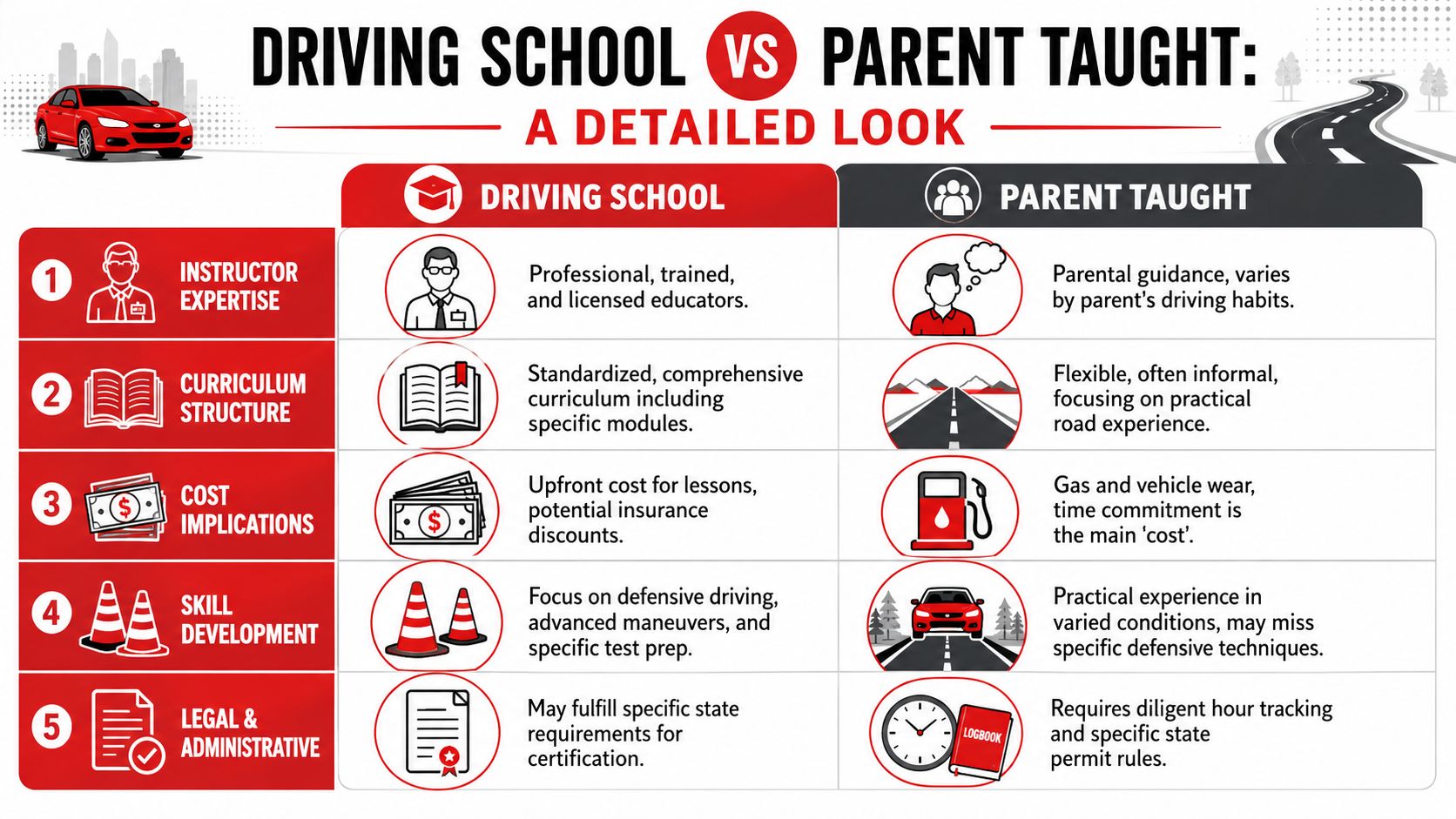
Driving School vs Parent Taught A Detailed Comparison
Most parents don't need a speech. They need a clear side-by-side comparison.
Here's the short version.
| Feature | Professional Driving School (e.g., A-1) | Parent-Taught Driver Education |
|---|---|---|
| Instructor | Trained, licensed instructor focused on teaching | Parent or guardian with real-world driving experience, but not necessarily teaching training |
| Lesson structure | Planned sequence of skills and scenarios | Flexible, often based on family schedule and comfort level |
| Vehicle setup | Often includes training vehicles designed for instruction | Usually the family car |
| Feedback | Objective correction from a neutral third party | Familiar guidance, but sometimes emotional or inconsistent |
| Road test prep | Usually includes test-focused coaching and evaluation habits | Often centered on basic maneuvers the parent remembers |
| Practice volume | Limited by lesson package and schedule | Easier to add frequent local practice |
| Scenario variety | More likely to include targeted higher-risk situations | Often stays in familiar, lower-stress areas |
| Compliance support | Helps families connect requirements, lessons, and readiness | Requires the family to manage logs, pacing, and skill progression |
Instructor skill matters more than parents expect
A parent may be a safe driver and still not be a strong teacher. Those are different skills. Teaching requires breaking maneuvers into steps, spotting patterns, correcting calmly, and knowing when a student is ready to progress.
A professional instructor usually sees the same beginner mistakes over and over. That repetition matters. They can often tell whether a teen is scanning too late, oversteering, braking at the wrong point, or relying on luck instead of process.
If you want a practical overview of what trained instruction is designed to add, this page on the benefits of taking driving lessons from an instructor lays out the mechanics clearly.
Structure is a big advantage
Parent-taught driving often starts well and then becomes random. One day it's parking. Another day it's errands. A week later there's no practice at all because everyone's schedule got crowded.
Driving schools tend to be stronger in sequence. They build from vehicle control to lane management, intersections, turns, backing, parking, traffic flow, and test-readiness. That doesn't make parents ineffective. It means schools are built for progression, while family practice often depends on convenience.
A short video can make that difference easier to visualize.
What each path does well
Driving school often works better for:
- Foundational habits that need to be taught correctly from day one
- Objective correction when your teen tunes out family feedback
- Road test preparation that matches current evaluation standards
- Stressful scenarios like multilane turns, lane changes, and busy intersections
Parent-led teaching often works better for:
- Frequent repetition on your own schedule
- Low-pressure confidence building in familiar areas
- Short practice drives that fit real family life
- Follow-up coaching between formal lessons
A family car and a willing parent can provide lots of practice. They don't automatically provide complete training.
The trade-off most families miss
Driving school vs parent taught isn't really about choosing which side is “good” and which side is “bad.” It's about recognizing what each method leaves out.
Professional instruction can be more structured, but it doesn't usually provide enough volume by itself. Parent-led practice provides volume, but it can leave major blind spots if nobody deliberately plans difficult scenarios.
That's why the strongest setup for many teens is simple. Use professional lessons to teach and correct. Use parent practice to repeat and reinforce.
The Hidden Gaps in Parent-Led Practice
A teen can look comfortable on the roads your family uses every week and still be unprepared for the drive that tests judgment. I see that all the time. The student does fine in the neighborhood, on the usual route to school, and on calm afternoon errands. Then traffic gets tight, visibility drops, or another driver does something reckless, and the skill gap shows up fast.
That gap usually comes from good intentions. Parents protect their teen from situations that feel like too much, too soon. Instructors do the opposite. We introduce pressure in a controlled way, because a new driver needs coached exposure before solo driving begins.
Why logged hours can still leave real holes
Georgia families hear the hour requirement and often treat it like the finish line. As noted earlier, the state still expects supervised practice outside the formal course. That matters, but the number of hours is only part of the job.
Forty hours can be useful practice, or it can be forty hours of the same easy driving.
A teen who spends nearly all of that time on familiar surface streets may build comfort without building range. They get used to starting, stopping, turning, and parking in low-pressure settings. They do not automatically learn how to judge closing speeds on a highway, manage glare at night, recover after missing a turn, or stay calm when a horn goes off behind them.
Where parents commonly leave gaps
The pattern is predictable:
Night driving
Families often complete the minimum night practice but rarely go beyond it. That leaves limited experience with glare, reduced depth perception, pedestrians who are harder to spot, and fatigue.Heavy traffic
Parents often avoid the exact roads that force a teen to make quicker decisions. Busy intersections, short merge lanes, and multi-lane left turns usually get postponed.Higher-speed driving
Speed changes everything. Following distance, mirror checks, lane changes, and merge timing all get harder once traffic is moving faster.Unfamiliar areas
A teen who knows every turn in one part of town can seem more capable than they are. Change the route, add signs they have not seen before, and decision-making slows down.Parent habits
This one matters more than families expect. Parents often teach the habits they personally use, including the weak ones. Rolling stops, one-hand turns, late signals, or casual speed creep can become the teen's normal.
Comfort is not the same as readiness. A teen needs practice in the situations that create mistakes, not just the situations that feel easy.
Why the hybrid approach works better
Parent practice is still valuable. It gives teens repetition, seat time, and real-life driving in the family car. But repetition only helps if the practice plan is broad enough.
Professional lessons fill in the parts families tend to delay. A good instructor can correct lane position, scanning habits, turn setup, gap judgment, and speed control before those mistakes harden into habits. Then parents can reinforce those same skills over the next several weeks.
That is usually the best mix for Georgia teens. Use professional instruction for foundation and higher-risk situations. Use parent-led practice for volume and consistency.
A stronger plan for home practice
Each week, pick one environment, one skill, and one stretch goal.
For example, one drive might focus on lane changes in moderate traffic. Another might focus on left turns with protected and unprotected signals. Another might be a short night drive with clear goals for speed control, scanning, and following distance. If you want a practical framework, this guide on how to teach a teenager to drive helps parents turn random errands into organized practice.
The families who get the best results do not treat driving school and parent teaching as competing options. They use both on purpose. That approach gives a teen more than enough hours. It gives them a better chance of becoming steady, alert, and safe when no one is in the passenger seat.
Analyzing Long-Term Costs and Safety Outcomes
Cost matters. Families have budgets, and professional instruction is an upfront expense. That's real. But if you stop the analysis there, you miss the part that matters most. The outcome isn't just whether your teen gets licensed. It's whether they're prepared when supervision drops.
Upfront cost versus training value
Parent-led instruction usually looks cheaper at first because you're already supplying the car and the time. Driving school adds course and lesson costs.
That's why scholarship and grant options matter for Georgia families looking at formal training. If cost is the main obstacle, it makes sense to check whether your teen may qualify for the Georgia Driver's Education Scholarship Grant Program through local school offerings or approved providers.
Insurance discounts sometimes come up in this conversation too. They can help, but they shouldn't drive the decision. Discount claims vary by carrier, and they aren't the same thing as proof of safer driving.
The safety question is the real one
A foundational U.S. study based on more than 1.4 million Texas driver records plus statewide surveys and focus groups found that parent-taught novice drivers were involved in more traffic convictions and crashes than commercial or public-school-trained drivers, both before and after graduated driver licensing. The report also found that the gaps narrowed during the permit phase and widened again once supervision dropped in later stages, according to the Texas driver education study from ROSA P.
That finding lines up with what many instructors see on the ground. A teen can look acceptable when an adult is present and still be underprepared for independent driving.
What parents should take from that
- Compliance is not the same as readiness
- The permit phase can hide weaknesses because supervision is constant
- The actual test begins after licensure, when the teen has to make decisions alone
The goal isn't to produce a teen who can pass a test. It's to produce a teen who can recover from mistakes, read traffic early, and stay calm without coaching.
If you're weighing driving school vs parent taught mainly on price, widen the frame. Ask what it costs if the training leaves major gaps. Ask whether your family can consistently provide varied practice in the conditions your teen will face. That's the decision that lasts longer than the receipt.
Your Family's Decision Checklist and Next Steps
The decision usually gets clearer after one honest week of practice. A parent takes a teen through neighborhood turns, a few busier intersections, maybe a parking lot. Then the hard parts show up. The parent is coaching too much, the teen gets flustered, and nobody is sure whether the problem is nerves, lack of repetition, or a missing skill.
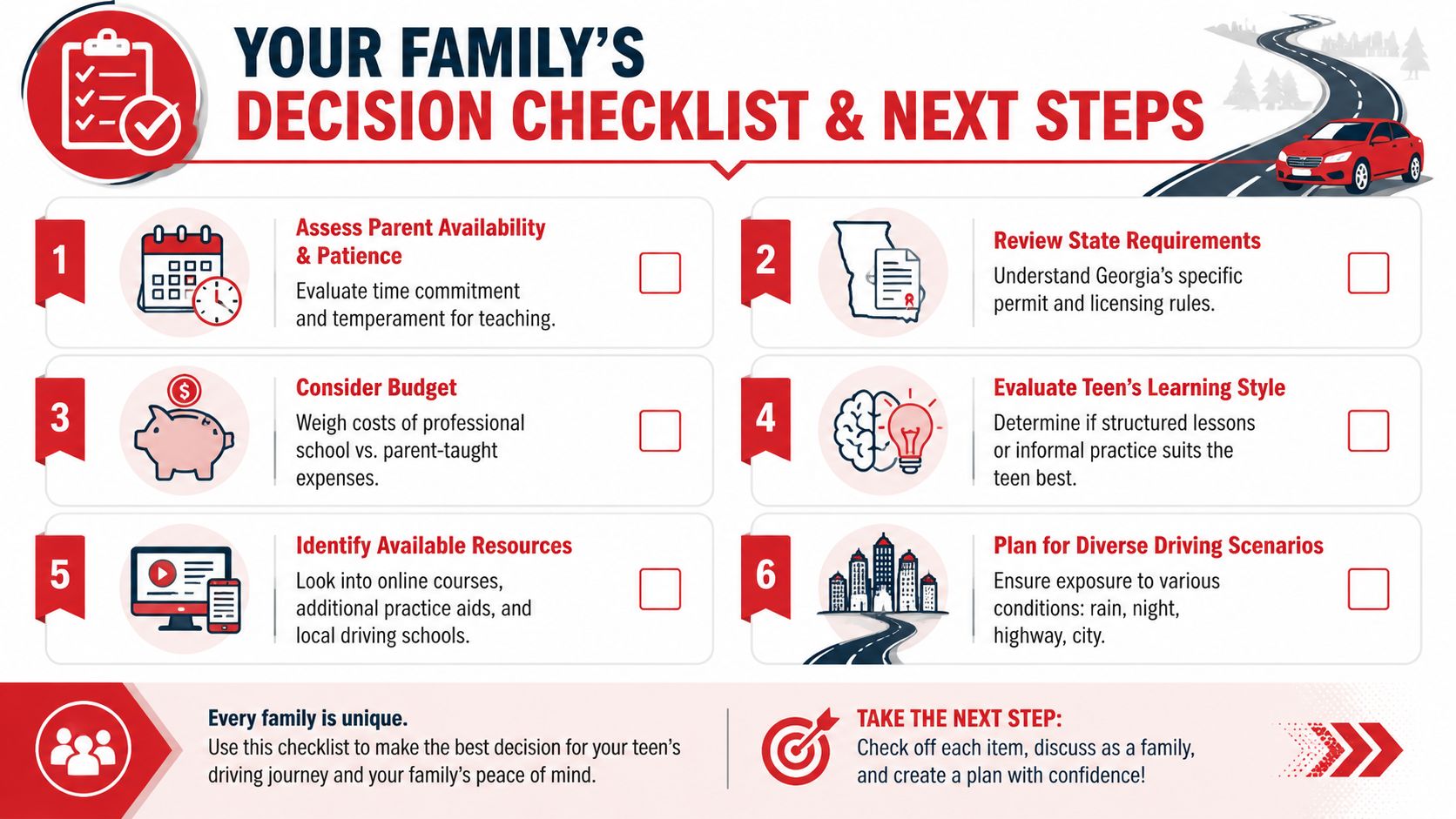
That is usually the point where the best answer stops looking like driving school or parent taught. For many Georgia families, the strongest plan is a hybrid one. Use professional instruction to build sound habits, correct mistakes early, and cover higher-risk situations. Use parent-led practice to add hours, repetition, and local-route experience.
Ask these questions honestly
Can we correct mistakes without the drive turning tense?
A calm car matters. Teens learn more when corrections are clear and specific, not emotional. If every lesson turns into an argument, bring in an instructor before the stress becomes part of the habit.
Can we teach advanced skills well enough to trust them later?
Left turns across traffic, lane changes in heavy flow, highway merging, backing, and parking expose weak training fast. If a parent is not fully comfortable teaching those skills, that is a strong case for professional lessons.
Can we provide steady practice for the next several months?
One long drive on Saturday is not the same as regular exposure. Safe drivers are built through repeated practice in different places, at different speeds, and under changing traffic conditions.
Are we practicing in the conditions our teen will face?
A teen who only drives in daylight on familiar roads is still undertrained. Build a plan that includes rain, night driving, parking lots, suburban traffic, and higher-speed roads when the teen is ready.
Does our teen respond better to a neutral coach?
Some do. Parents still play a major role, but many teens accept correction faster from someone outside the family. That is a practical issue, not a parenting failure.
Match the answer to the right next step
If your teen still needs the classroom requirement, start with a Joshua's Law course that fits your schedule. Then decide early how the behind-the-wheel portion will be handled, because the classroom piece alone does not build judgment on the road.
If your teen has the academic requirement covered but looks shaky in traffic, do not start over. Add focused driving lessons for the skills that tend to break down under pressure, such as merging, lane positioning, parking, and busy-intersection decisions.
If your teen is doing well with basics at home, keep the parent practice going and use a few professional lessons for the higher-risk parts. That combination often gives families the best return. Instructors tighten technique. Parents supply the repetition that makes those corrections stick.
If your teen is close to licensing, resist the urge to rush just because the permit hours are done. Road-ready means the teen can make safe choices without constant prompts.
A simple decision guide
Parent can handle routine practice but not advanced situations
Keep practicing at home and book targeted professional lessons for highway driving, multilane traffic, parking, and complex turns.Teen needs structure and accountability from the start
Use a full driver education program first, then continue with planned parent practice each week.Teen has enough hours but still makes inconsistent decisions
Add skill-specific lessons before scheduling the road test.Family schedule is tight but parent involvement is still possible
Use a program for the formal instruction, then protect time for short, regular practice drives at home.
A-1 Driving School is one example of a Georgia provider that offers Joshua's Law courses, online options, driving lessons, lesson packages, and road testing. For families trying to build a hybrid plan, that range of services can make it easier to get professional help where it matters most and keep parent practice where it helps most.
Frequently Asked Questions About Georgia Driver's Ed
How does the Georgia Driver's Education Scholarship Grant Program work
Georgia offers scholarship support for some students who need help paying for driver education through approved providers. Availability, eligibility, and award amounts can change, so parents should confirm current details with the program or school before building a plan around scholarship funding.
If my teen takes an online Joshua's Law course, how do they complete the driving part
The online course covers the classroom portion. It does not replace time behind the wheel.
Your teen still needs supervised driving practice, and many families add professional lessons for lane changes, traffic timing, highway entry, parking, and other situations that are harder to teach well from the passenger seat. That hybrid approach usually works well because the instructor sets the standard and the parent helps build consistency through repetition.
Is taking a road test at a driving school location the same as taking it at DDS
The goal is the same. Your teen must show they can control the vehicle, follow traffic rules, and make safe decisions under test conditions.
For some families, testing at a school location is simpler because the lessons, final preparation, and test stay in one workflow. Convenience helps, but readiness still matters more than location.
Is parent-taught training enough on its own
It can be enough to meet Georgia requirements, but meeting the rule and being road-ready are not always the same thing. Parent-led practice is valuable because it gives teens the repetition they need. The weak spot is consistency. Parents often teach from experience and instinct, while an instructor is watching for scanning habits, lane position, speed control, gap judgment, and other errors that teens may repeat without realizing it.
The strongest plan for many Georgia families is not choosing one side. It is combining both. Use professional instruction to build the foundation and handle the higher-risk situations, then use parent practice to add hours, confidence, and routine decision-making.
If you're deciding between driving school and parent-taught instruction, choose the setup that gives your teen structured teaching, enough supervised practice, and correction in the areas your family cannot coach confidently. A-1 Driving School is one Georgia provider families may consider for Joshua's Law courses, online classes, driving lessons, lesson packages, and road testing.