The first drive usually starts with a quiet moment. Your teen adjusts the seat, grips the wheel too tightly, and looks half excited, half terrified. You sit in the passenger seat trying to sound calm while mentally reviewing every stop sign in a five-mile radius.
That reaction is normal. Teaching your child to drive is one of the few parenting jobs that feels emotional, practical, and high-stakes all at once. You want them to gain independence, but you also know a car can punish inexperience fast.
There’s a reason parents feel that pressure. Novice teen drivers ages 15 to 18 are twice as likely as adult drivers to be involved in a fatal crash, and one in five teens experiences a crash in the first year of driving, with most occurring within the first six months of licensure, according to the National Highway Traffic Safety Administration’s teen driving guidance. Those numbers don’t mean your teen is doomed to struggle. They mean the learning process needs structure.
A good plan does two things at once. It lowers anxiety for the parent, and it gives the teen a clear path from permit to real competence. Along the way, it also helps to cover basic ownership skills, not just steering and braking. A simple guide to essential car care can help your teen understand tires, fluids, and warning signs before they start driving regularly. And because many Georgia parents are also thinking about cost, it’s smart to read up on whether adding your teen to your insurance can raise your rates.
Your Teen Has the Keys What Now

Most parents don’t need more motivation. They need a method.
The mistake I see most often is starting too big. A teen gets a permit, the family has one free afternoon, and suddenly the first lesson happens on busy roads with real traffic, real impatience, and too many decisions at once. That doesn’t build skill. It builds tension.
A better start looks quieter. You choose a car that’s in good working order. You pick a large empty lot. You spend the first session on setup, not speed. Seat position, mirrors, brake pressure, steering feel, turn signals, parking brake, headlights, wipers. If the teen leaves that first lesson knowing where everything is and how the car responds, that was a productive day.
Practical rule: The first job isn’t “driving on roads.” The first job is making the car feel familiar.
Parents also do better when they stop trying to teach everything in one session. New drivers can only absorb so much before their attention narrows. A short, focused practice with one or two goals works better than a long drive filled with corrections.
What a strong beginning actually looks like
A solid first week usually includes:
- Vehicle orientation: Show how to adjust mirrors, seat, and steering wheel position so the teen can see clearly and reach pedals comfortably.
- Basic movement: Practice smooth starts, gentle braking, backing up slowly, and stopping at a target point.
- Simple scanning habits: Get them used to looking far ahead, checking mirrors, and turning their head before moving.
- No extra audience: Don’t bring siblings or friends. The car should stay calm.
What doesn’t work
Some habits make learning harder than it needs to be:
- Constant talking: If you narrate every second, your teen won’t learn to process the road independently.
- Late instructions: “Turn here” said at the last second causes panic and bad steering.
- Teaching while upset: If either of you is frustrated, end the session and reset later.
- Jumping ahead: Highway driving before neighborhood mastery usually creates shaky habits that take longer to fix.
The goal isn’t to produce a brave teen driver in a weekend. The goal is to produce a predictable one. Predictable drivers check, pause, scan, signal, and make smooth choices. Confidence comes after those habits settle in.
Georgia's Licensing Roadmap and Joshua's Law
A lot of Georgia parents calm down once they see the licensing path in plain English. The process feels less stressful when you know which pieces are legal requirements, which pieces are skill building, and where parent practice fits.
The basic Georgia path
For most teens, the sequence is straightforward:
- Learner’s Permit
- Driver’s education and supervised practice
- Road skills preparation
- Class D provisional license
If you want the state sequence laid out step by step, this Georgia provisional license guide gives parents a clear reference for timing, paperwork, and next steps.
Where Joshua’s Law fits
For teens seeking a Georgia Class D license, Joshua’s Law shapes the whole timeline. Parents should treat it as part of the licensing process, not as an extra course to squeeze in later.
In day-to-day terms, a solid parent checklist includes:
- Classroom instruction: Georgia requires a driver’s education course that satisfies Joshua’s Law.
- Professional behind-the-wheel training: The standard Joshua’s Law route includes professional driving instruction hours.
- Supervised practice with a parent or guardian: Keep the log accurate, but pay attention to the quality of the drives too.
- Night practice: Start it early enough that your teen can build comfort before test week.
A teen can finish the required hours and still be shaky in traffic. I see that often with students who have logged time but have not built good habits in observation, speed control, or lane placement.
Online courses versus in-person training
Georgia families ask this all the time. Is online learning enough?
For the classroom portion, online study can work well. It gives families more scheduling flexibility and keeps the academic part of driver education from becoming a weekly transportation problem.
Hands-on coaching is different. A course can teach signs, laws, and hazard awareness. It cannot correct a rolling stop, late braking, poor mirror use, or a rushed gap choice at a left turn. Those mistakes need real-time feedback from someone in the car.
The best setup for many families is a blended one:
- Online classroom work for flexibility
- Professional driving lessons for technique and correction
- Parent-led practice for repetition on familiar Georgia roads
That mix gives the teen more than hours. It gives them consistency.
What to log during supervised driving
Parents often watch the clock. I tell them to watch the variety.
Track the kinds of driving your teen completes, not just the total time:
- Residential streets
- Intersections with turn decisions
- Lane changes on busier roads
- Parking lots and parking spaces
- Night driving
- Rainy conditions when safe
- Errand-style trips with real destination planning
A useful log shows a wider range of conditions, not just the same easy route repeated over and over.
This is significant because the first months after licensing are when inexperienced drivers are exposed to more judgment calls, more distractions, and more pressure to keep up with traffic. A varied practice record prepares them better than neighborhood loops alone.
Where professional lessons help most
Parents are the backbone of the process, but outside instruction can solve problems faster. Teens often accept coaching more readily from a neutral instructor, and parents can focus on support instead of correcting every small mistake.
That is where a Georgia-specific plan helps. Parent practice handles repetition. Professional lessons handle technique, legal requirements, and honest feedback. A-1 Driving School fits into that system with Joshua’s Law courses, online class options, behind-the-wheel lesson packages, road test support, and information about the Georgia Driver’s Education Scholarship Grant Program. For many families, that combination creates a steadier path from permit to provisional license without putting the full load on the parent.
Your Behind-the-Wheel Teaching Curriculum
Parents often ask how to teach a teenager to drive without turning every lesson into an argument. The answer is simple. Follow a sequence. Don’t improvise the whole process.
Expert-level teen driver instruction uses a hierarchical skill-building model where the teen should master one level before moving to the next. The sequence is parking lot vehicle familiarization, low-speed neighborhood roads, single-lane main streets with intersections, multi-lane roads and merging, and finally highway driving, and each skill set requires at least two hours of deliberate practice according to this teen driving progression model.
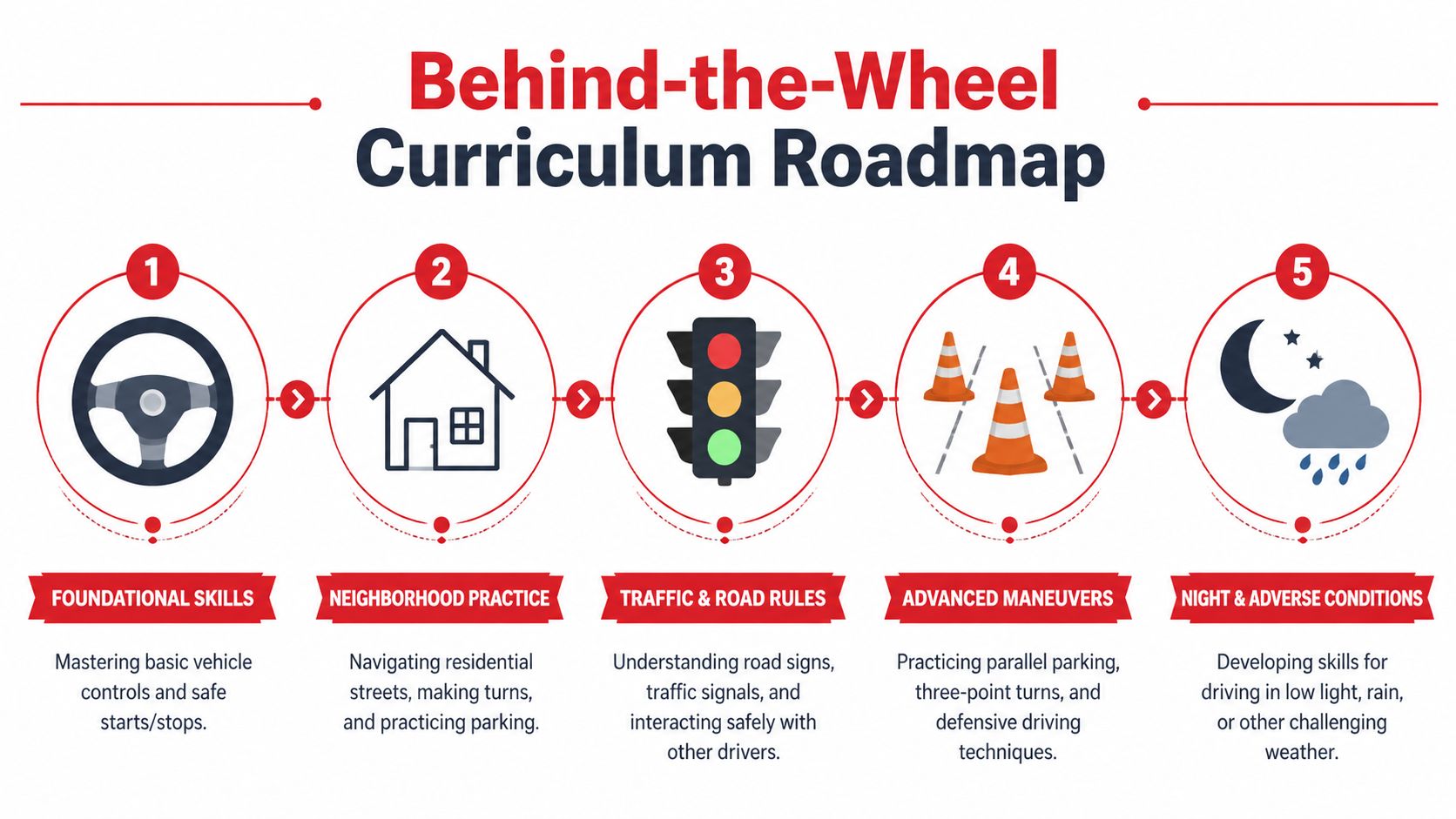
That sequence matters because each environment adds a new layer. In a parking lot, the teen learns control. In a neighborhood, they learn space and scanning. On larger roads, they learn timing. On highways, they learn speed management and commitment.
Start with the car before the road
The first teaching block should feel almost slow to the point of boredom. That’s good. It means the teen has room to think.
Use an empty lot for:
- Controls practice: Gear selection, pedals, steering input, blinkers, lights, wipers, parking brake
- Low-speed movement: Rolling straight, gentle stops, reversing, backing into a space
- Reference points: Where the hood ends, how wide the car feels, how much steering is enough
- Simple routines: Brake before shifting, look before moving, hands back to the wheel after signaling
A teen who can start, stop, and steer smoothly at low speed is much easier to coach once other traffic appears.
Move up only after habits look consistent
The next stage is low-speed neighborhood driving. During this stage, many parents often push their teens too quickly. If your teen still brakes late, forgets turn signals, or drifts wide in turns, they’re not ready for bigger roads yet.
Look for these signs before advancing:
- They scan intersections without being reminded every time
- Their stops are controlled, not abrupt
- They hold lane position without wandering
- They can handle right and left turns without cutting corners
- They recover from minor mistakes calmly
The safest progression is usually the one that feels a little slower than your teen wants.
A sample lesson sequence
Below is a simple parent-friendly structure that mirrors how professional programs often build skill.
| Lesson Focus | Location | Key Skills to Master |
|---|---|---|
| Vehicle setup and basic control | Empty parking lot | Seat and mirror adjustment, smooth starts and stops, steering control, backing up |
| Residential driving | Quiet neighborhood streets | Stop signs, right turns, left turns, lane position, speed control |
| Intersections and route planning | Single-lane main streets | Traffic light response, gap judgment, scanning, following directions calmly |
| Lane changes and traffic flow | Multi-lane roads | Mirror checks, blind spot checks, lane changes, maintaining safe space around the car |
| Higher-speed readiness | Highway entry areas and controlled higher-speed roads | Merging, speed matching, exit planning, staying calm at speed |
What to say during each lesson
Parents often over-instruct. Short cues work better than lectures.
Try language like:
- “Eyes up.” Good for reminding them to look farther ahead.
- “Set your speed early.” Useful before curves, lights, and turns.
- “Mirror, signal, shoulder.” A clean lane-change sequence.
- “Finish the stop.” Helpful for rolling stops.
- “Wait for the full gap.” Good when they’re tempted to force a turn.
Keep your tone even. The words matter, but the delivery matters more. If your voice spikes every time they hesitate, they’ll start driving to avoid your reaction instead of reading the road.
Build repetition without making practice stale
You don’t need a new route every day. You do need a purpose.
One of the best ways to teach is to assign each drive a theme:
- Today is all about smooth braking
- Today we’re focusing on left turns
- Tonight we’re doing parking and backing
- This drive is for lane changes and mirror timing
That keeps the teen from feeling overwhelmed. It also helps you notice improvement.
When to use lesson packages
Parent practice is important, but it has limits. Some teens perform differently with a professional in the car. Some parents know what feels wrong but can’t explain the correction clearly.
Lesson packages are useful when:
- Your teen is stuck at one stage
- Practice at home turns emotional
- You want third-party feedback before the road test
- You need a cleaner bridge from permit driving to test-level skill
The most effective families usually combine both. The parent provides frequency. The instructor provides precision.
Mastering Advanced Scenarios and Safe Habits
Basic vehicle control isn’t enough. A teen can drive around the neighborhood smoothly and still be unprepared for the situations that cause the most stress. The true question isn’t whether they can move the car. It’s whether they can make calm decisions when the environment changes.

Practice sessions should include “a variety of conditions, including at night and in inclement weather, as much as possible,” and that exposure should be paired with “gentle feedback” in a “calm and constructive” atmosphere, according to this scenario-based parent teaching guidance. That advice lines up with what works in the car. Teens learn better when the challenge rises gradually and the coaching stays steady.
Night driving needs its own practice
Night driving is not just daytime driving in the dark. Depth perception changes. Glare becomes a factor. Hazard detection gets slower for new drivers because they haven’t built a strong visual search pattern yet.
When teaching at night, keep the route simple at first:
- Choose familiar roads
- Limit extra passengers
- Focus on speed discipline
- Practice identifying pedestrians, cyclists, and poorly lit intersections
- Review high-beam and low-beam use before the car moves
Parents often wait too long to introduce night driving. Then the teen reaches the road test stage with little comfort after sunset. That’s avoidable if you build it in early and keep it controlled.
Rain, fog, and reduced visibility
Weather changes the lesson immediately. The teen has less traction, less visibility, and more pressure to respond smoothly.
Coach these habits directly:
- Increase following distance
- Slow down before the turn, not during it
- Use headlights properly
- Avoid sudden steering or braking inputs
- Keep eyes moving farther ahead than feels natural
This is also a good place to supplement your own coaching with broader safety materials. Some parents like structured classroom-style resources such as Kuraplan lesson plans for road safety because they help frame hazard awareness in a more organized way.
Highway driving is mostly about timing
Many teens fear highways because everything feels fast. In reality, highway driving becomes manageable when you break it into a few repeatable actions.
Teach these in order:
- Read the merge lane early
- Match speed before forcing entry
- Check mirrors and blind spot without drifting
- Commit once the gap is clear
- Keep a stable lane position after merging
If your teen hesitates during merge practice, don’t shame it. Slow judgment is safer than impulsive judgment. The fix is more controlled repetition, not pressure.
A short visual refresher can help some learners see how professionals think about road awareness and observation habits.
Safe passengers matter too
A teen doesn’t just need to be a safe driver. They also need to be a safe passenger and know how to respond when friends create pressure.
That conversation should be direct. Give them actual lines they can use:
- “Put the phone down or I’m getting out.”
- “I’m not riding if you’re driving like that.”
- “We can be late. I’m not rushing this.”
- “No, I’m not packing extra people in the car.”
These scripts feel awkward at home, but that’s why you practice them there first. A prepared response is easier to use than an improvised one.
Calm coaching produces better judgment than criticism. A tense teen may obey in the moment, but a calm teen learns how to decide well when you aren’t there.
Troubleshooting Common Teen Driving Hurdles
Some teens are cautious to a fault. Others act ready long before their skills say they are. Parents often assume one teaching style should work for both. It won’t.
Vanderbilt Health reports that 30% of teens delay getting their permit by 6+ months because of driving-related fear, which is a useful reminder that nervousness is not rare and shouldn’t be treated like stubbornness. You can read that finding in this Vanderbilt Health article on teaching teens to drive. A teen who is afraid needs coaching that lowers the emotional load, not just more instructions.
When your teen is anxious
An anxious teen usually isn’t refusing to learn. They’re trying to protect themselves from feeling overwhelmed.
That means you should shrink the task:
- Start parked: Let them sit in the driver’s seat, adjust everything, and talk through controls before moving.
- Use short sessions: A focused practice can be more productive than pushing until they’re drained.
- Repeat familiar routes: Confidence often grows from knowing what comes next.
- Praise specific actions: “Good mirror check” works better than “good job.”
- End on a success: Finish after a clean turn, smooth stop, or well-handled parking maneuver.
When your teen is overconfident
The overconfident teen is trickier because the danger can hide behind a calm face. They may steer one-handed, roll stops, or assume they’ve “got it” after a few decent drives.
That kind of student needs standards, not speeches.
Try this approach:
- Set clear rules: Full stops, no phone access, both hands ready, no rushing yellow lights.
- Use correction over argument: “That stop was incomplete. Let’s do it again.”
- Make them narrate: Ask what they saw, what they predicted, and why they chose that speed.
- Limit advancement: No multi-lane roads until current habits are consistent.
When the parent is the problem
This happens more than families admit. The parent means well, but their voice tightens, they grab the dash, or they fire off six instructions in five seconds. The teen then drives in a state of alertness that has more to do with the passenger than the road.
If that sounds familiar, use a reset routine:
- State one goal before the drive
- Use short coaching phrases only
- Pull over if emotions rise
- Debrief after the car is parked, not during a hard moment
If the lesson becomes a power struggle, nobody is learning. Stop, reset, and try again later.
A simple fix for repeated friction
When the same correction keeps causing conflict, change the teaching format. Instead of correcting during the moment, take notes discreetly and review two or three patterns afterward. Many teens respond better when they don’t feel publicly graded in real time.
A useful debrief format is:
- One thing that improved
- One habit to keep watching
- One focus for next time
That structure keeps the learning honest without making every drive feel like a test.
Prepping for the Georgia Road Test and Driving Beyond
The road test feels like the finish line, but it’s really the first independent checkpoint. The goal is not to sneak past the exam. The goal is to make the tested skills look routine because they’ve been practiced enough to become automatic.
A lot of parents wait until the test is scheduled before getting serious. That usually creates rushed practice and uneven confidence. A better approach is to treat the road test as a final review of habits your teen already uses every drive.
What examiners usually notice first
Road tests tend to reward the basics done cleanly and consistently. Examiners aren’t looking for fancy driving. They’re looking for safe, controlled, rule-following behavior.
Focus your final practice on:
- Complete stops
- Observation at intersections
- Smooth lane changes
- Proper signaling
- Backing and parking control
- Steady speed management
- Following directions without panic
If you want a practical checklist before test day, this Georgia driving test preparation guide helps parents and teens review what to expect.
Common reasons teens struggle on test day
Most road test mistakes aren’t caused by lack of intelligence. They come from rushed decisions and unfinished habits.
Watch for these patterns:
- Rolling through stop signs
- Failing to check blind spots
- Turning too fast
- Stopping too far into the intersection area
- Braking late
- Letting nerves speed up every action
The fix is not “try harder.” The fix is running a few clean rehearsal drives under test-like conditions. Minimal conversation. Clear route. Full compliance with every small rule.
Practice the social side of driving too
Licensing changes the social environment immediately. Once a teen can drive friends, the car becomes a moving group setting, and that changes behavior fast.
Given that 58% of teen fatal crashes involve multiple passengers, according to this safe passenger training discussion, parents should prepare for that before the first social trip, not after.
Role-play a few moments at home:
- A friend tells the driver to hurry
- Someone starts filming inside the car
- A passenger wants to add extra riders
- Another teen offers a ride with unsafe behavior already happening
The teen should already know what they’ll say and what they’ll do. A simple refusal script is often enough if it’s practiced ahead of time.
Road testing support and the next step after licensing
Families often underestimate how much stress comes from the testing process itself. Scheduling, waiting, paperwork, vehicle concerns, and the pressure of one official appointment can rattle even a capable teen.
That’s why many parents look for a smoother route that combines:
- Targeted driving lessons
- Lesson packages for weak areas
- Road test preparation
- A testing option outside the DDS bottleneck
- Information about the Georgia Driver’s Education Scholarship Grant Program for families who qualify
If your teen still looks uneven in parking, lane changes, or test-day composure, don’t push them through hoping nerves will disappear. A little extra guided practice is usually cheaper than repeating bad habits after they’re licensed.
If you want a complete path from Joshua’s Law coursework to driving lessons, lesson packages, road test prep, road testing, and scholarship program information, take a look at A-1 Driving School. For many Georgia families, the easiest way to teach a teenager to drive is to combine steady parent practice with professional instruction at the points where technique, confidence, and test readiness matter most.