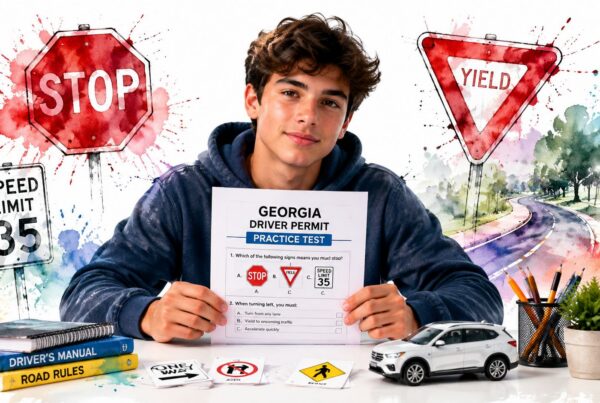

A lot of families start in the same place. A teen is excited. A parent is cautious. Both of them are typing the same driving school questions into Google late at night, trying to figure out what comes first, what's required in Georgia, and how to avoid wasting time on the wrong class.
That confusion makes sense. The licensing process has rules, course options, practice requirements, and a road test at the end. If nobody lays it out clearly, it can feel more complicated than it needs to be.
I've answered these questions for years as an instructor, and the pattern is always the same. Families don't just want a class. They want a clear path from permit to license, with fewer surprises along the way.
Starting Your Journey to a Georgia Driver's License
Most students don't come in asking one question. They come in with ten.
A parent wants to know if their teen needs Joshua's Law. The teen wants to know how soon they can start driving lessons. Someone asks whether online classes count. Then another question follows right behind it. Who signs the practice log? When should we schedule the road test? Should we do lessons before the test, or wait?
That's normal.
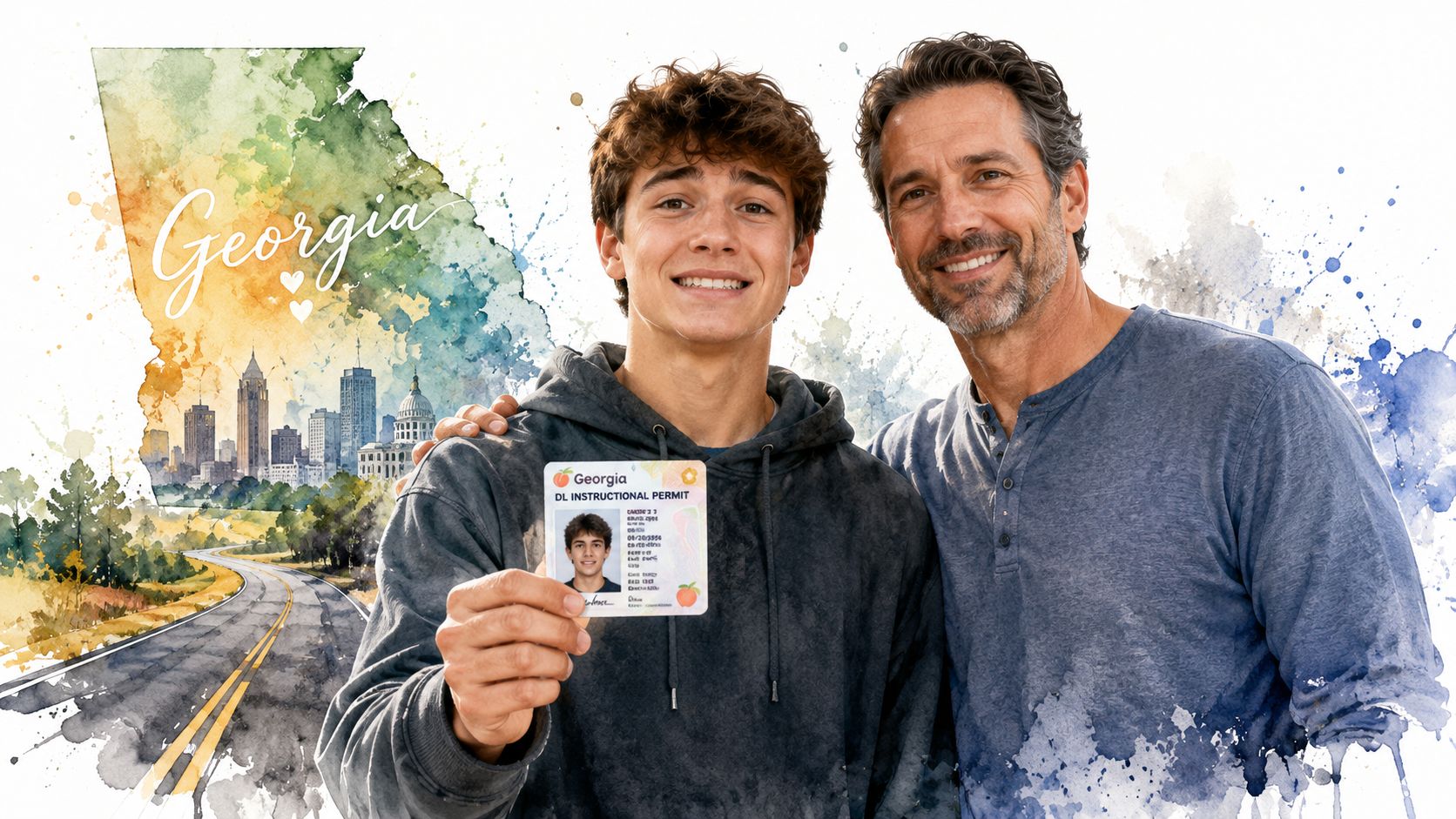
The easiest way to settle those driving school questions is to think of the process in stages, not as one giant task. First, understand the permit and license path. Then complete the required education. After that, build skill through driving lessons. Finally, take the road test when the student is ready.
If you're still sorting out the earliest step, this guide to getting a permit in Georgia helps families understand where the process begins.
What families usually need most
In practice, clarity is commonly needed on four things:
- State rules: What Georgia requires for teens under 18.
- Course choice: Whether online, virtual, or classroom instruction fits the student better.
- Driving lessons: How much behind-the-wheel training the student really needs.
- Road test planning: Where to test, what gets graded, and how to avoid common errors.
The students who feel calm on test day usually aren't the ones who memorized the most facts. They're the ones who followed a clear sequence and practiced the right habits.
Once you see the process in order, the stress drops fast.
Understanding Georgia's Core Driver's Ed Requirement
A parent usually asks this right after the permit question. “What does Georgia require before my teen can get a license?”
For teens under 18, the answer starts with Joshua's Law.
Georgia's driver education rules are built around Joshua's Law, passed in 2005 after the death of 16-year-old Joshua Brown. For a Class D license, Georgia requires an approved driver education course plus supervised driving practice totaling 40 hours, including 6 hours at night, according to the Georgia DDS practice test and training guidance.
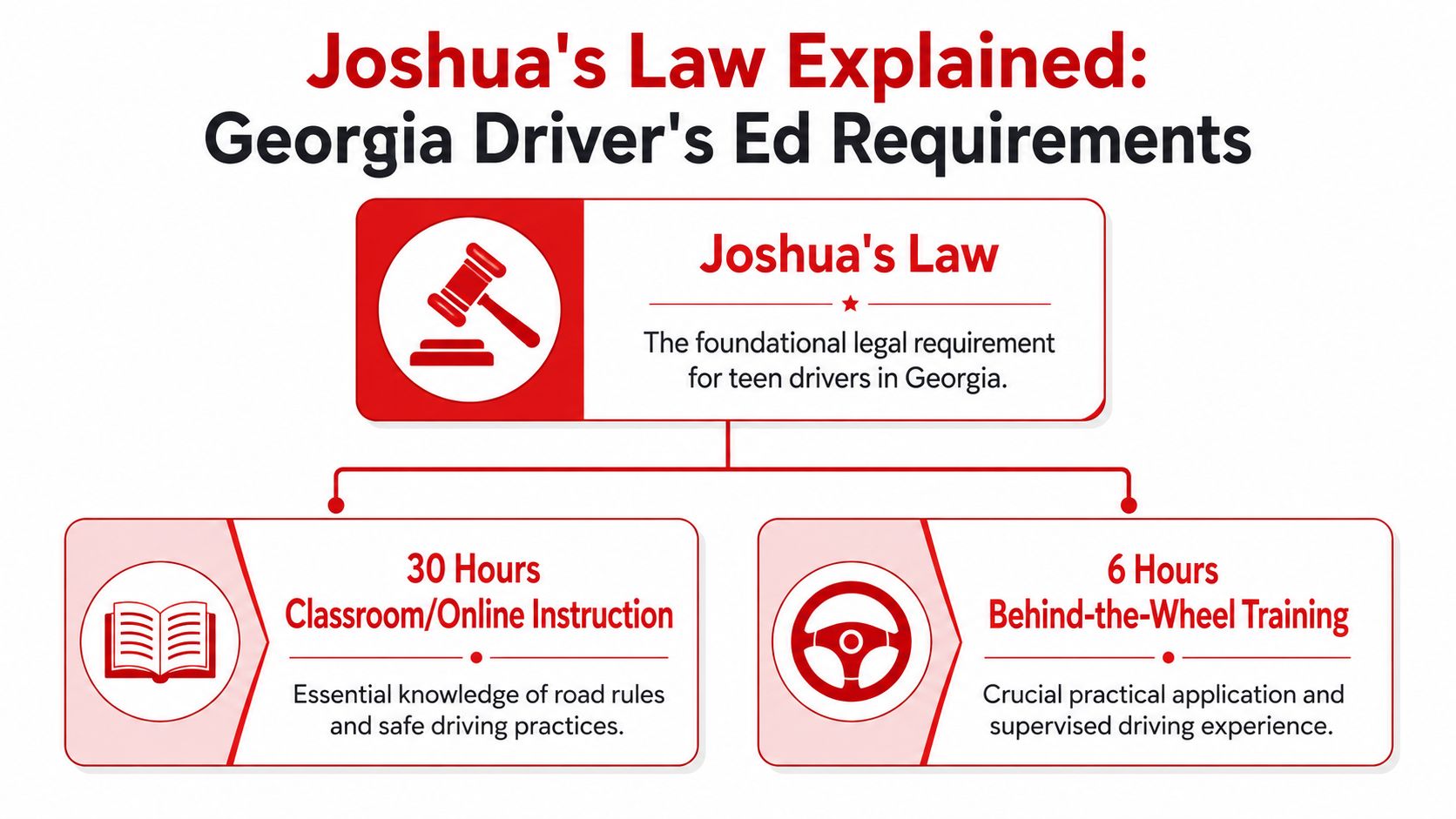
That matters because many families hear “driver's ed” and assume it means one class and they're done. In Georgia, the process works more like a two-part build. First the student learns the rules. Then the student proves those rules can be used calmly in real traffic.
The two parts families often mix up
The first part is the course itself.
That course can be completed in a classroom or online, as long as it is state approved. Students cover signs, right-of-way, Georgia traffic laws, risk awareness, and the kind of judgment that keeps small mistakes from turning into dangerous ones. If you want a clearer picture of how the online option works, A-1 explains it in this guide to online driver's education in Georgia.
The second part is supervised driving practice.
This is where the information starts to stick. A teen may answer a question about a four-way stop correctly on paper and still hesitate when two cars arrive together, a pedestrian steps forward, and someone waves them on out of turn. Practice turns that confusion into a routine.
A-1 Driving School helps families treat Joshua's Law as a sequence instead of a pile of tasks. Finish the approved course. Track the required practice hours carefully. Add professional lessons where the student needs more help. Then use that preparation to get ready for the road test through A-1's testing service, if that fits your plan.
A simple checklist helps:
- Complete an approved driver education course
- Record supervised driving hours
- Include the required night driving
- Keep the paperwork organized for licensing and testing
If you are comparing approved course options, the Joshua's Law course page is a practical place to review current formats and enrollment details.
Families also like knowing how schools communicate class updates, schedules, and reminders. For a behind-the-scenes look, this article on how driving schools manage social media gives useful context.
Before you choose a format, it helps to see how each option fits a student's schedule and learning style. This short video gives a quick overview.
Choosing Your Ideal Driver's Ed Course
Once families understand the legal requirement, the next question is simpler. What kind of course setup will this student finish and learn from?
Some teens do well with flexibility. Others need structure, a live instructor, and a set class time on the calendar. Neither choice is automatically better. The right fit depends on attention span, school schedule, transportation, and how much accountability the student needs.
A simple way to compare formats
If you're weighing options, start with the student's real habits, not the ideal version of them.
| Feature | Online Course | In-Person Classroom |
|---|---|---|
| Schedule | Flexible timing for students with packed calendars | Set meeting times that create routine |
| Learning pace | Self-paced for students who like working independently | Instructor-led pace for students who stay focused in group settings |
| Questions and feedback | Usually handled through course support or follow-up | Immediate live clarification during class |
| Best fit for | Independent learners who manage deadlines well | Students who benefit from structure and discussion |
| Home logistics | No commute for the class portion | Requires travel to class location |
Some schools also offer a virtual classroom model, which can be a useful middle ground. It gives students a live learning environment without the extra driving time to and from class.
What parents often overlook
The best format is the one the student will complete without dragging the process out. I've seen motivated students do very well online. I've also seen students who kept postponing online modules until a classroom schedule forced them to finish.
Practical rule: If your teen usually needs reminders to complete schoolwork, a scheduled class often works better than a fully self-paced option.
There's also a communication side to this that families don't always think about. Schools that keep students informed well tend to make the process feel less chaotic. If you're curious how education businesses organize updates and reminders, this look at how driving schools manage social media gives useful context about how schools stay visible and communicate with families.
If online learning is on your shortlist, this guide on what online driver's education is can help you decide whether that format matches your student's learning style.
Why Behind-the-Wheel Training is Essential
This is the part families underestimate most.
A student can pass quizzes, name road signs, and explain right-of-way rules, then still feel completely unsettled the first time traffic closes in around them. That's because knowledge and driving judgment are not the same thing. The classroom gives a student the rules. Driving lessons teach them how to use those rules under pressure.
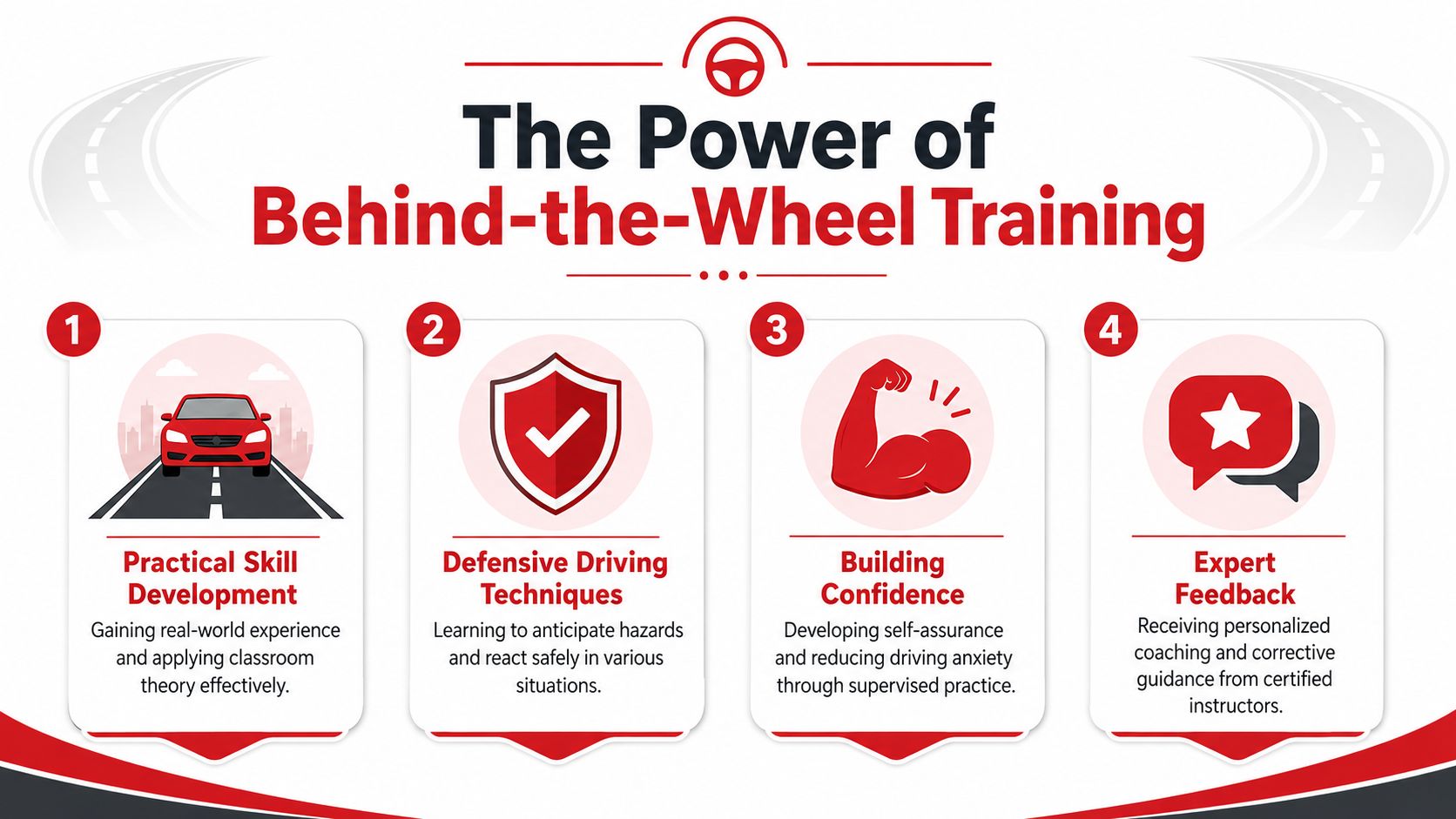
One of the biggest safety gaps for new drivers isn't simple sign recognition. It's attention management in real traffic. Most widely shared practice materials still focus on static right-of-way and sign-recognition quizzes, while U.S. safety data show the bigger gap is how drivers manage attention, speed, and space. NHTSA reported 3,308 traffic deaths in 2022 involving distracted driving, as summarized in this driver practice test reference.
What good lessons actually build
A strong lesson doesn't just tell a student what to do. It trains them to notice what matters early enough to act calmly.
Attention before action
Students need to learn how to scan ahead, check mirrors at the right time, manage following distance, and stay mentally present when passengers, phones, or traffic pressure start competing for attention.
Judgment in fast-moving situations
Merging, turning across traffic, changing lanes, and entering busy intersections all require timing. That timing improves with coached repetition.
Confidence that isn't fake
Real confidence comes from doing hard things correctly more than once. It doesn't come from being told “you're fine” after one easy drive in a quiet neighborhood.
Here are the lesson areas that usually make the biggest difference:
- City driving: Handling traffic lights, lane choices, and busy intersections.
- Parking skills: Backing, angle parking, and parallel parking without panic.
- Lane management: Knowing where to position the car and when to move.
- Speed control: Matching conditions instead of driving by guesswork.
- Highway exposure: Learning how to enter, merge, and exit smoothly.
Why more practice can matter
The required minimum is only the starting line. Some teens learn quickly and need just enough coaching to become consistent. Others need extra sessions to smooth out hesitation, wide turns, braking habits, or lane position.
That's why lesson packages can be useful. A shorter package may cover the basics and satisfy a requirement. A larger package gives more room to work on the skills that usually take longer, like highway driving, parallel parking, left turns in traffic, and route planning.
A school such as A-1 Driving School offers driving lessons and lesson packages that let families choose between the minimum required training and additional practice time based on the student's actual needs. You can review the current driving lesson packages to compare what's included.
Students rarely struggle because they never heard the rule. They struggle because they haven't repeated the skill enough for it to feel normal.
That's why behind-the-wheel training matters so much. It closes the gap between “I know” and “I can do it.”
Passing Your Georgia Road Test with Confidence
By the time a student reaches the road test, the goal isn't perfection. The goal is consistency.
Many students assume road-test failure comes from dramatic mistakes like hitting a curb or forgetting how to steer. Those things do happen, but a lot of test problems are smaller and more procedural. A high-value technical pattern in road-test preparation is that many failures come from procedural errors rather than vehicle control, especially rolling stops, late lane changes, and inadequate mirror or blind-spot checks. Evaluators often deduct points even when the maneuver is physically safe but the required observation sequence is not clearly demonstrated, according to this road-test preparation guide.
What examiners are really watching
The road test is about habits you can show clearly.
Stop completely
A slow roll is not a stop. Students need to bring the car to a full stop and pause long enough for the examiner to see that they did.
Show your observation sequence
For lane changes, students should make their actions visible and orderly. Signal first. Check mirrors. Then check the blind spot. If a student does those checks too subtly, the examiner may not credit them.
Stay ahead of the route
Late lane changes happen when students wait too long to prepare. Good road-test driving looks calm because the student starts early.
A helpful pre-test routine looks like this:
- Warm up with familiar skills
- Review complete stops and lane changes
- Keep instructions simple
- Drive a little slower in your mind, not slower than traffic
- Let one mistake go and keep driving
A road test is often lost on routine details, not on dramatic errors.
A lot of families also prefer taking the test through a certified school because the setting can feel more familiar and less rushed than a busy DDS environment. If you want to compare that option, the Georgia road test service page explains how school-based testing works and what students should bring.
How to Get Your Driver's Ed for Free in Georgia
Cost is one of the most common driving school questions parents ask, and for good reason. Driver training is important, but families still have to fit it into a real budget.
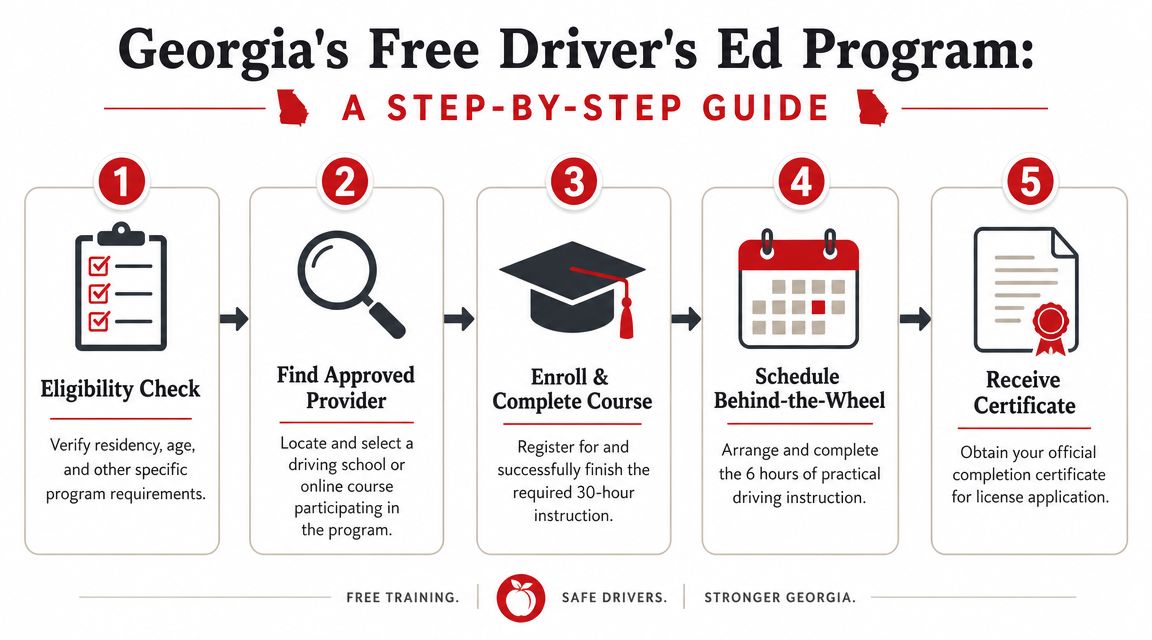
Georgia does offer a path that can make this much easier for eligible teens. Official driver education programs differ by state and purpose. In Georgia, Joshua's Law requires specific driver education for Class D licensing, while defensive driving is used for ticket dismissal under separate rules. For teens, the Georgia Driver's Education Grant Scholarship Program helps fund the compliant path to licensure, as described in this Georgia driver education reference.
What the scholarship changes
For eligible students, the grant can remove a major barrier. Instead of delaying driver education or trying to patch the process together, families can pursue the required training through the state-supported route designed for teen licensure.
That matters because the rules can feel fragmented if you're new to them. Teen driver's ed, adult lessons, road testing, and defensive driving do not all serve the same purpose. The scholarship helps teens focus on the right training for the license path they're on.
A practical application checklist
Families usually do best when they treat the scholarship like a process, not a last-minute add-on.
- Check eligibility first: Confirm that the student meets the current program requirements.
- Choose an approved provider: Make sure the course and training path fit the grant rules.
- Register promptly: Spots can be limited depending on schedule and location.
- Complete the class requirements: Finish the education portion and any required follow-through.
- Schedule driving instruction: Don't wait too long to line up the behind-the-wheel portion.
Some parents get stuck because they assume they need to figure everything out alone. You don't. If you want the school-specific steps, the Georgia Driver's Education Grant Scholarship Program page is the right place to review application details and enrollment guidance.
For many families, this is the difference between postponing driver's ed and getting started on time.
Your Final Driving School Questions Answered
By this point, most families are down to the practical questions. Not “What is Joshua's Law?” but “How do we make this work in real life?”
What should you ask any driving school
Use this checklist when you're comparing providers.
- Are instructors properly qualified? Ask whether instructors are state-certified and how the school handles safety and professionalism.
- How flexible is scheduling? Families need to know how lessons fit around school, sports, and work.
- What vehicles are used for training? Students should learn in safe, school-approved vehicles they can handle comfortably.
- How are parents kept informed? Clear communication matters when schedules shift or students need more practice.
- Can the school help with road-test planning? A smooth handoff from lessons to testing saves time and stress.
A lot of schools in every industry struggle with communication volume, especially when families call with repeat questions. If you're interested in the operational side of that, this article on effective small business phone support gives a good look at how service businesses keep responses organized and consistent.
Answers parents usually want right away
Can lessons work around a school schedule
Usually, yes. The key is to book early and treat lesson times like any other standing commitment.
Should a teen wait until they feel fully confident before testing
No. Most students never feel “fully ready” in a perfect sense. They should test when their skills are steady, their habits are visible, and their instructor or supervising adult sees consistent decision-making.
Is one lesson package enough for every student
No. Some students are ready close to the minimum. Others need more repetitions to become smooth and calm in traffic.
The right amount of training is the amount that produces reliable habits, not the amount that sounds good on paper.
What's the smartest next step
Pick the part of the process you haven't completed yet. If the student still needs the class, choose the course format. If the class is done, schedule lessons. If lessons are nearly complete, start road-test planning.
That's how you get through the process without feeling buried by driving school questions.
If you're ready to stop guessing and start the process clearly, A-1 Driving School offers course options, driving lessons, road testing support, and scholarship information for Georgia families who want a straightforward path from permit to license.