Your teen is ready to drive. You've got the excitement, the questions, and probably a folder full of papers that all sound alike. One school form. One course certificate. Maybe something called a drivers eligibility certificate. Then someone mentions Joshua's Law, the permit, ADAP, and the road test. That's when a simple next step starts to feel messy.
Most families don't get stuck on driving. They get stuck on paperwork.
That's why it helps to slow the process down and separate each document by purpose. One paper proves school attendance. Another proves driver education. A less common form applies only in limited situations. Once you know which one does what, the whole path gets easier to manage.
If your teen is just starting, this guide to getting a permit in Georgia is a helpful companion. It pairs well with what follows here, especially if you're trying to line up school documents, course completion, and the timing of a DDS visit.
The First Step to Your Georgia Driver's License
A common scene plays out like this. Your teen is ready to start driving, you head to DDS, and halfway there someone asks, “Wait, do we have the right certificate?” That one question can turn an exciting milestone into a stressful errand.
For most Georgia teens, the first real step is the Class CP Learner's Permit. This is the starting point, not the finish line. It gives a new driver the legal right to begin supervised practice, which is how skill and confidence are built before a road test ever enters the picture.
If your family is still sorting out the basics, this guide to getting a Georgia learner's permit can help you line up the DDS visit, the required documents, and the timing.
What makes this stage confusing is that several papers start showing up around the same time, even though they serve different jobs. A school document helps show attendance status. A driver education certificate comes later for the next license step. A less common eligibility form applies only in limited situations. The names sound close enough to blur together, especially if this is your first teen driver.
A good way to look at it is this. The permit is the entry ticket. It gets your teen onto the practice field. The other certificates belong to later checkpoints or special cases, so bringing the wrong one can slow down a DDS visit that should have been simple.
What families need to focus on first
At the permit stage, families should concentrate on the documents tied to starting supervised driving, not every certificate they have heard mentioned online or from friends.
That usually means keeping three questions straight:
- Is this document needed to apply for the permit now?
- Is this document for the Class D license later?
- Is this document only for a special exception?
That small sorting step saves a lot of frustration. It also helps parents avoid over-preparing in the wrong direction, which happens more often than you might expect.
The bigger picture matters too. Georgia's teen licensing process is set up in order. First, a teen qualifies to begin practicing. Then they gain experience behind the wheel. Then they finish the education and training needed for the next step. A-1 helps families handle that whole path with courses, lessons, and testing support, so the process feels organized instead of scattered.
Treat each document like a tool in the right toolbox. Once you know what the permit step requires, the stack of paperwork starts to look much less intimidating.
Decoding Georgia's Teen Driver Certificates
A lot of families hit the same snag. You show up at DDS with a folder full of papers, someone at the counter asks for a certificate, and suddenly every form name sounds the same.
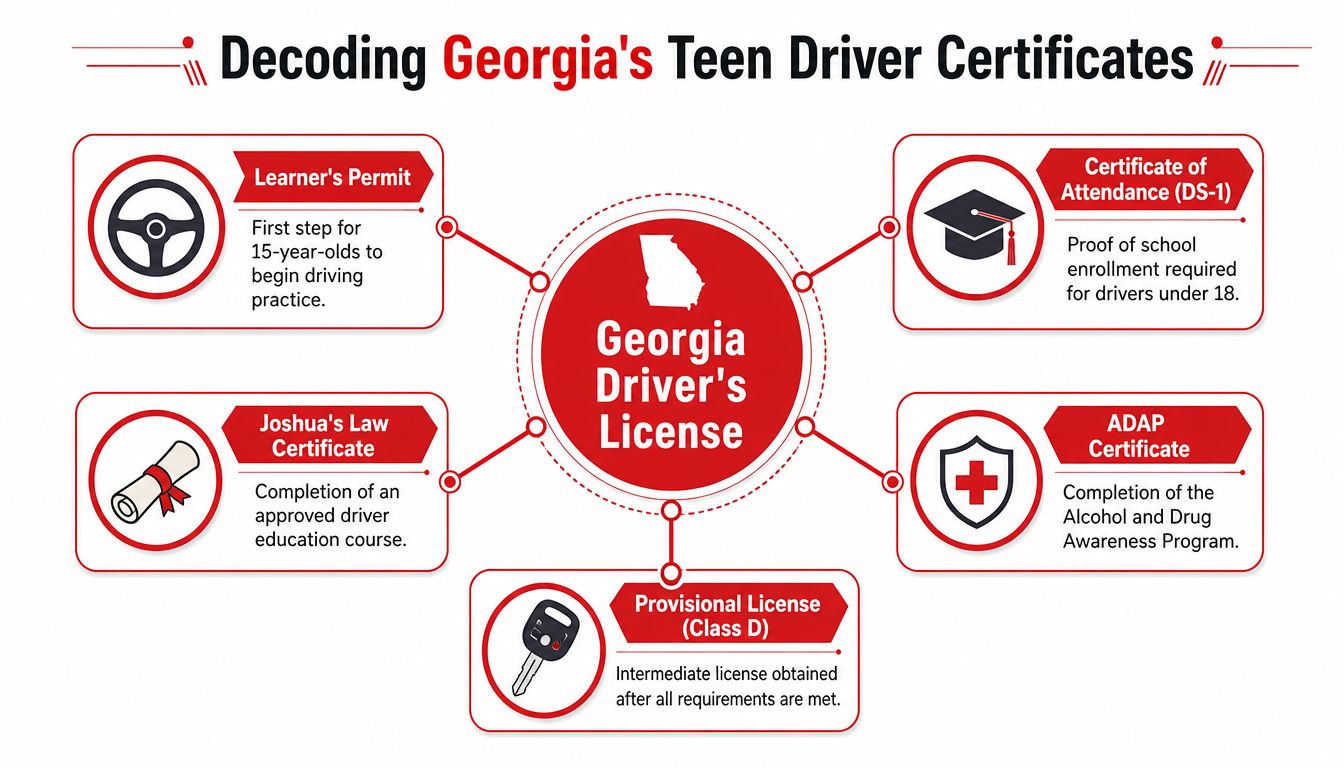
The fix is simpler than it looks. Georgia uses a few different certificates for teen drivers, and each one belongs to a different part of the process. Once you sort them by purpose, the paperwork starts to feel much more manageable.
The three documents families mix up most
Here's the clearest way to separate them.
| Document | What it proves | Who issues it | When it matters |
|---|---|---|---|
| Certificate of School Attendance (DS-1) | The teen is enrolled in school | The high school | Commonly needed when a minor applies at DDS |
| Joshua's Law Certificate of Completion | The teen finished driver education | A DDS-approved driving school | Needed when applying for a Class D license |
| DS-318 Certificate of Eligibility | The teen qualifies under a limited military-related exception | A local National Guard Commanding Officer | Only in specific cases |
For many parents, the school attendance form is the one causing the confusion. It is usually the document people mean when they say “drivers eligibility certificate,” even though that is not always the official name they have in mind. If your teen is heading to DDS for the permit stage, that school document is often the paper to double-check first.
The Joshua's Law certificate is different. It comes from driver education, not from the school office. If your family wants a direct path later on, A-1 can help you get that training done in one organized place through the A-1 Joshua's Law student login and course access page.
What the drivers eligibility certificate usually refers to
In everyday conversation, families often use one catch-all phrase for several documents. That is where mistakes start.
The phrase drivers eligibility certificate usually points to the school attendance paperwork, not the Joshua's Law completion certificate. Those two forms do completely different jobs. One confirms the teen is attending school. The other confirms the teen completed driver education.
The DS-318 is different again. It is a narrow exception document, not a standard paper most teens need to chase down. Georgia licensing guidance describes it as part of a limited path for certain military-affiliated applicants who have not completed the full Joshua's Law route, as explained in this Georgia licensing explanation.
A good rule for families is to match the form to the goal. Permit paperwork, driver education paperwork, and exception paperwork belong in different lanes.
Before any DDS visit, ask one simple question: “Are we applying for a permit, applying for a Class D license, or using a special exception?”
A quick reality check before your appointment
Bring the certificate that fits the step your teen is on. One document does not automatically replace another.
- For a permit, focus on school attendance paperwork and the rest of the required identification documents.
- For a Class D license, focus on driver education completion and the other licensing requirements tied to that stage.
- For DS-318, confirm first that your teen qualifies for that limited exception.
That small sorting step can save a wasted trip, a lot of second-guessing, and one more afternoon spent trying to decode DDS paperwork on your own. A-1 helps families handle the whole teen licensing path with classes, lessons, and testing support, so each certificate makes sense when it is time to use it.
The Best Path Forward The Joshua's Law Course
For most Georgia teens, the most important certificate they'll earn isn't the drivers eligibility certificate people talk about casually. It's the Joshua's Law Certificate of Completion.
Georgia requires a clear educational foundation before many teens can move forward. All 16- and 17-year-olds must complete a DDS-approved 30-hour Driver's Education course from a certified school before they can apply for a Class D license, according to this Joshua's Law guide for Georgia.
That requirement matters because it gives structure to the whole licensing process. Instead of piecing together advice from friends, social media, and random forums, a teen gets organized instruction on rules of the road, signs, decision-making, and basic risk awareness.
Why this course matters more than families expect
A lot of teens want to “just get the certificate.” Parents usually want more than that. They want a teen who understands what to do when traffic gets busy, when a left turn feels rushed, or when another driver behaves unpredictably.
That's why the course isn't just a checkbox. It creates the shared language that makes later practice more useful.
- It teaches the rules before practice starts getting serious.
- It gives parents a better framework for supervised driving.
- It turns vague advice into a step-by-step learning process.
Some families prefer classroom instruction. Others need flexibility because of sports, school, work, or commute time. Georgia teens can find DDS-approved options in both formats, including online programs offered through approved providers.
If you're comparing schedules and want a flexible course path, review the available Joshua's Law online course options.
Online or in person
The best format is the one your teen will complete carefully.
Online learning works well for students who do better at their own pace. They can log in around school and activities, review material again if needed, and work steadily without commuting to class.
In-person instruction can be helpful for students who learn best with live discussion and direct feedback. Some teens stay more focused in a classroom than they do on a screen.
Instructor's note: Don't choose the format based on what sounds easiest. Choose the one your teen is most likely to finish with real attention.
A short walkthrough can help families understand what quality instruction should look like before they enroll.
What this certificate is not
The Joshua's Law certificate does not replace school attendance paperwork. It also isn't the same as a rare exception form like DS-318. It has one job. It proves the teen completed the state-required driver education course from an approved provider.
That clarity helps families stop chasing the wrong paper and focus on the route that fits the vast majority of Georgia teen drivers.
From Course Completion to On-Road Confidence
A course certificate proves a teen completed instruction. It doesn't mean they're ready for every merge, every parking lot decision, or every lane change in heavy traffic. That's where real driving practice starts doing the heavy lifting.
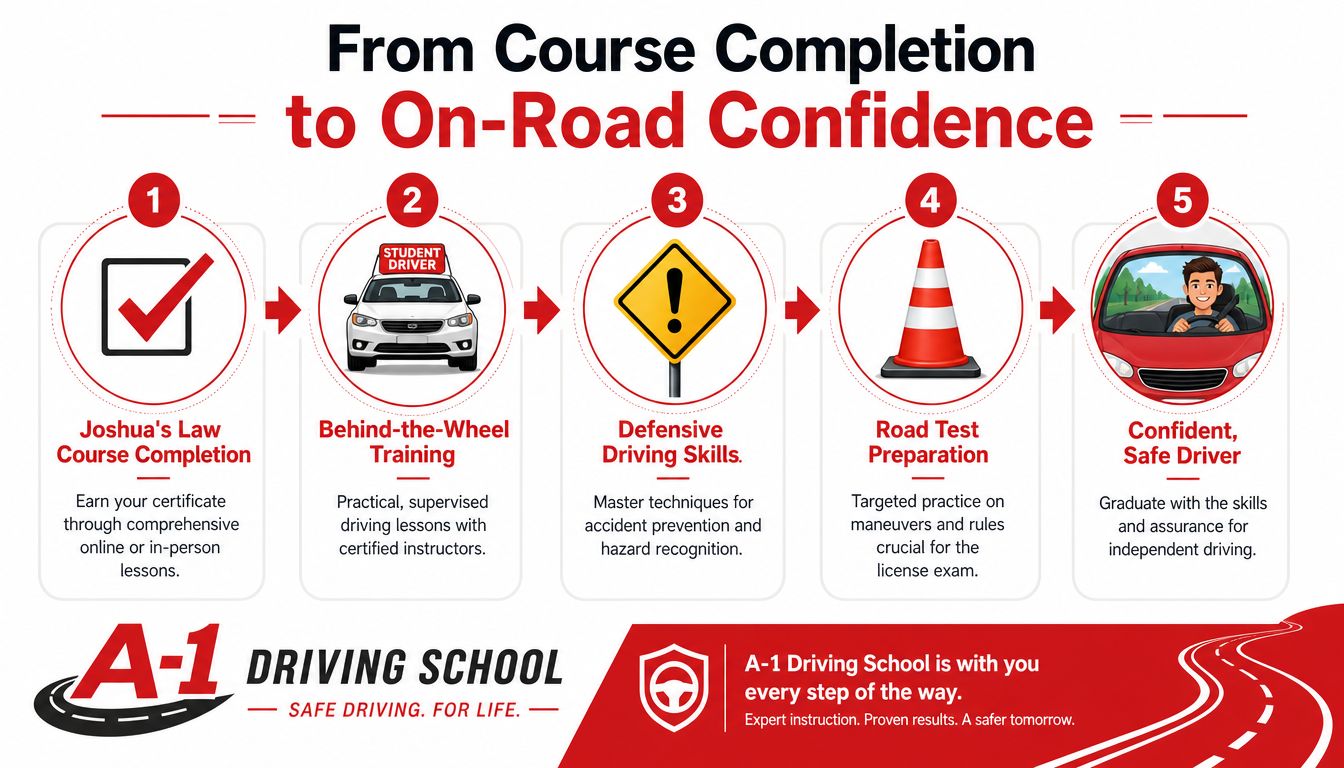
Georgia sets a practical standard here. Teen drivers under 18 must complete a 30-hour driver education course and 6 hours of behind-the-wheel training. If they don't complete professional training, they must log 40 hours of supervised driving, including 6 hours at night, and hold the learner's permit for 12 months and 1 day, according to Green Light Drivers' Georgia rules summary.
What the minimum really means
Families often read those requirements as finish lines. They're better understood as the floor, not the ceiling.
A teen might technically complete the required in-car instruction and still need more work in a few common areas:
- Parking skills, especially backing in and controlling speed in tight spaces
- Lane changes and merges, where timing and mirror checks need repetition
- Busy intersection judgment, where hesitation and overconfidence can both cause trouble
- Night driving habits, because visibility and glare change everything
The students who feel calm at the road test usually aren't the ones who rushed to the minimum. They're the ones who practiced enough that the basics started feeling ordinary.
Turning supervised hours into useful hours
Not all practice is equal. A teen can spend a lot of time in the car and still avoid the situations that build skill.
A better approach is to vary the practice on purpose:
- Start in low-pressure neighborhoods.
- Add traffic lights and moderate local roads.
- Practice parking repeatedly, not just once.
- Introduce multi-lane roads when the teen is ready.
- Add night driving with a calm, specific goal.
Many parents are relieved once they realize they don't have to “teach everything at once.” One skill-focused drive is usually better than one long, stressful drive.
Why road test prep deserves its own attention
Road tests create nerves even for teens who drive well in familiar places. The pressure comes from being watched, following directions exactly, and performing maneuvers on command.
That's why a good road test plan usually includes:
| Focus area | Why it matters |
|---|---|
| Vehicle control | Examiners watch for smooth braking, steering, and awareness |
| Observation habits | Mirror use, scanning, and checking surroundings matter throughout the drive |
| Parking and backing | These are common stress points and need repetition |
| Following instructions calmly | Good drivers can still make errors when they rush |
Some families also prefer to complete the road testing process through a driving school provider rather than adding another unfamiliar stop at the end of the journey. That can make the last step feel more manageable.
How to Get Your Certificate of School Attendance
The Certificate of School Attendance, often called DS-1, is one of the simplest forms in the process. It's also one of the easiest to mishandle if you get it too early.

This form usually comes from your teen's high school administrative office. The school confirms enrollment, and the document typically needs to be notarized before it's used for a DDS appointment.
The timing mistake families make all the time
The biggest problem isn't usually getting the form. It's timing it badly.
A related school-issued Driver Eligibility Certificate is often valid for only 30 days, which can create appointment problems if the DMV or licensing visit is scheduled farther out, according to Union County Public Schools' explanation of the 30-day certificate window. Even though families often use different names for these school documents, the practical lesson is the same. Don't request time-sensitive paperwork too early.
Get the school form close enough to the DDS visit that it's still valid, but not so late that you're scrambling on appointment day.
A simple checklist that works
Use this sequence to stay organized:
- Call the school first: Ask which office handles driver paperwork and whether the form needs an appointment.
- Ask about notarization: Some schools handle it on site. Others don't.
- Match the form date to the DDS date: Don't pull the document weeks ahead without checking the validity window.
- Store it safely: Keep it with permit and identity documents so it doesn't get bent, lost, or forgotten.
If your kitchen counter has become the family paperwork zone, these tips for organizing school forms can help you keep licensing documents separate from report cards, club forms, and everything else.
What to bring together
Families usually do best when they create one licensing folder with the school form, identity documents, and any course records that apply to the current step.
If you're preparing for the next stage and want a broader document checklist, this guide on what you need to get your license at 16 in Georgia can help you line up the practical details before your visit.
One last reminder matters here. Faxed copies aren't accepted by DDS for the original document set, and families should plan around original proof documents rather than assuming a copy will work, as noted earlier in this article.
A-1 Makes It Easy Your All-In-One Solution
The hardest part of teen licensing in Georgia usually isn't one test or one lesson. It's coordinating everything without missing a step. Families have to line up the permit, school paperwork, driver education, supervised practice, ADAP, and the final road test process in the right order.
Georgia also expects teens to show maturity over time before they move up. Teens under 17 must hold a learner's permit for at least one year and one day, complete ADAP, and have no major traffic violations to qualify for a Class D license, according to Certus' summary of Georgia Joshua's Law requirements.
What families usually need most
Most parents aren't looking for more complexity. They want one reliable place to handle the pieces that can be handled in one place.
That usually means looking for a provider that offers:
- Joshua's Law courses, including online options for busy schedules
- Driving lessons and lesson packages that go beyond the minimum and build real skill
- Road test preparation and testing support so the final step feels familiar
- Guidance on paperwork timing so school and DDS documents don't become the bottleneck
The strongest value for many families isn't the classroom piece alone. It's the ability to connect course completion with actual behind-the-wheel development.
Why lesson packages matter
Driving confidence doesn't always arrive on the same schedule as legal eligibility.
Some teens need targeted help with parking. Others are uneasy in traffic, overcorrect when turning, or freeze during lane changes. A structured lesson package gives them a chance to work on those weak spots directly instead of hoping they disappear by test day.
That's also why the Georgia Driver's Education Scholarship Grant Program matters. For eligible students, it can make professional training more accessible, which helps families who want quality instruction but are watching costs closely.
A smoother licensing journey usually comes from fewer handoffs, clearer scheduling, and more real driving practice.
When a school can support the education course, driving lessons, road test preparation, and testing assistance, families spend less time guessing and more time helping a teen become safe, calm, and ready for independent driving.
If you're ready for the simplest path from paperwork to practice, A-1 Driving School offers Joshua's Law courses, online options in Georgia, driving lessons, lesson packages, road test support, and information about the Georgia Driver's Education Scholarship Grant Program so teens and parents can move forward with confidence.