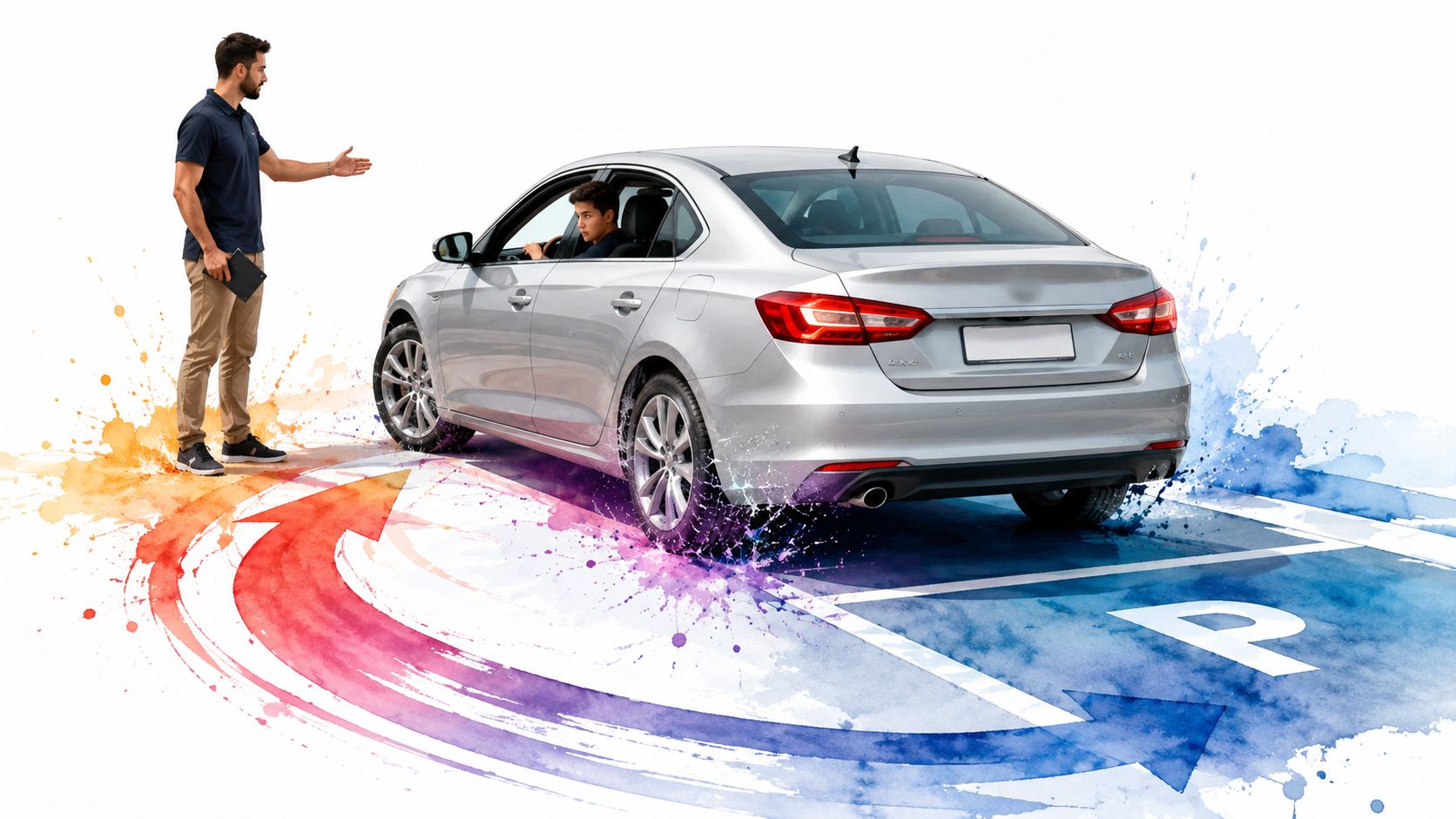
You're in a busy Atlanta shopping center lot. Cars are circling. Someone is waiting for your space. A pedestrian appears between two SUVs. You start turning in, stop, pull forward, and suddenly the whole parking job feels harder than the drive itself.
That's normal for a new driver.
Reverse parking feels awkward at first because it asks you to slow down, stay organized, and trust reference points instead of guesswork. The good news is that it's a skill, not a talent. Once you understand what the car is doing and what you should be looking for, reverse parking gets much more predictable.
Why Mastering Reverse Parking Is a Non-Negotiable Skill
A lot of teen drivers think reverse parking is mainly about looking polished on test day. It isn't. It's about making the exit safer.
Safety studies comparing forward-first versus reverse parking find that backing into a parking space reduces the risk of collisions when leaving the spot, particularly in crowded lots. Drivers can see traffic and pedestrians more clearly when pulling forward out of the space, so reverse parking is associated with lower rates of rear-end and backover collisions during exit maneuvers, especially in places like school lots, shopping centers, and work parking areas, as explained in this reverse parking safety overview.
That matters in Georgia because many teen drivers practice in exactly those environments. Think about a high school pickup line, a grocery store lot in Cobb County, or a packed weekend lot near an Atlanta movie theater. The hard part often isn't getting into the spot. It's leaving later when your view is blocked by larger vehicles.
Why the exit matters more than the entry
When you back into a space, you do the more difficult part while you still have a clearer view of the lane. You can pause, scan, and set up carefully. When you leave, you drive forward with a better view of cross traffic.
If you pull in nose-first, you save a few seconds on the way in but create a harder, riskier job on the way out. New drivers often don't realize that until they're stuck backing out blind between two tall vehicles.
Reverse parking is a safety habit. It's not just a parking trick.
Confidence comes from a repeatable method
Most parking anxiety comes from not having a plan. Drivers get stressed when they rely on instinct alone. A repeatable system fixes that.
Here's what changes once you build solid reverse parking techniques:
- Your steering gets calmer: You stop making big, rushed corrections.
- Your eyes get more organized: You know when to check mirrors, shoulders, and front corners.
- Your parking becomes more consistent: You can use the same setup in school lots, apartment complexes, and shopping centers.
A careful driver doesn't need to be fast. A careful driver needs to be clear, deliberate, and aware.
Your Pre-Reversing Safety Ritual
Before the car moves backward, you need a routine. Every time. No shortcuts.
I teach students a simple pattern: Signal, Mirrors, Over-the-shoulder, Go. You can think of it as a parking version of S.M.O.G. If you use the same safety ritual every time, your brain has less to juggle when the maneuver starts.
Signal first, then slow down
Your turn signal matters even in a parking lot. It tells the driver behind you that you're about to stop and maneuver. Without that signal, people may try to go around you just as you begin reversing.
After you signal, slow the car early. Don't rush past the space and slam the brakes. A smooth setup gives you more control and makes your intent obvious to everyone around you.
Set your mirrors before you need them
Your side mirrors should help you track parking lines and nearby cars. Your rearview mirror helps with a general rear view, but your side mirrors usually do the main work during reverse parking.
Use this quick check before practicing:
- Driver-side mirror: Tilt it so you can see the side of your vehicle and the ground area next to it.
- Passenger-side mirror: Adjust it to catch the line and curb area on that side.
- Rearview mirror: Keep it centered for a straight rear reference, but don't expect it to show every hazard.
If you need a refresher on spotting areas your mirrors still miss, review these blind spot checking habits for new drivers.
Use the camera as a helper, not a replacement
Backup cameras are useful. They help confirm where the rear of the car is heading. But they don't replace direct observation.
A camera can tempt new drivers to stare at one screen and forget everything else. That's how you miss a shopping cart rolling in from the side or a person walking behind the vehicle.
Practical rule: Look at the camera to confirm. Look around the car to decide.
Build a 360-degree scan you can repeat
Before shifting into reverse, pause and do a full scan. In a Georgia practice lot, that means checking for cars moving down the lane, people walking from store entrances, kids cutting between vehicles, and curbs or poles near your turning path.
A clean scan can look like this:
- Front area: Make sure your front end has room to swing.
- Both mirrors: Check for vehicles approaching from either side.
- Over your shoulder: Look through the rear and side windows.
- Camera glance: Confirm what's directly behind the bumper.
- Final decision: If anything is moving into your path, wait.
Don't let pressure from other drivers rush you
Teen drivers often feel pushed by the car behind them. Ignore that pressure. The person waiting can wait a few more seconds. Your job is to park safely, not impress strangers in a parking lot.
If the setup feels messy, stop. Pull forward and reset. Good reverse parking techniques always start with a good setup.
A Guide to Perpendicular Back-In Parking
This is the reverse parking maneuver most Georgia drivers use the most. You'll see it in shopping centers, school lots, office parks, churches, and apartment complexes. If you can back into a standard 90-degree space calmly, a lot of parking stress disappears.
Finding your starting point
The setup matters more than most beginners think. If your car starts crooked, too close, or too far away, the whole maneuver gets harder.
Technical guidance from driver training curricula says that aligning your vehicle at a near-perfect 90° to the bay rows before reversing improves first-attempt success by roughly 40% compared with an angled or skewed approach. The same guidance teaches a three-line reference. After signaling and driving 1 to 2 bays past the target, let the driver's side mirror clear the third painted bay line forward of the target while keeping the car parallel to the bay rows, as described in this reverse bay parking guide.
That sounds technical, so let's make it simple.
In plain language, drive past the space you want. Keep your car straight and parallel to the parked cars. Don't drift diagonally. Then use a consistent reference point, such as your driver-side mirror reaching a certain painted line, before you begin turning.
What the car should do next
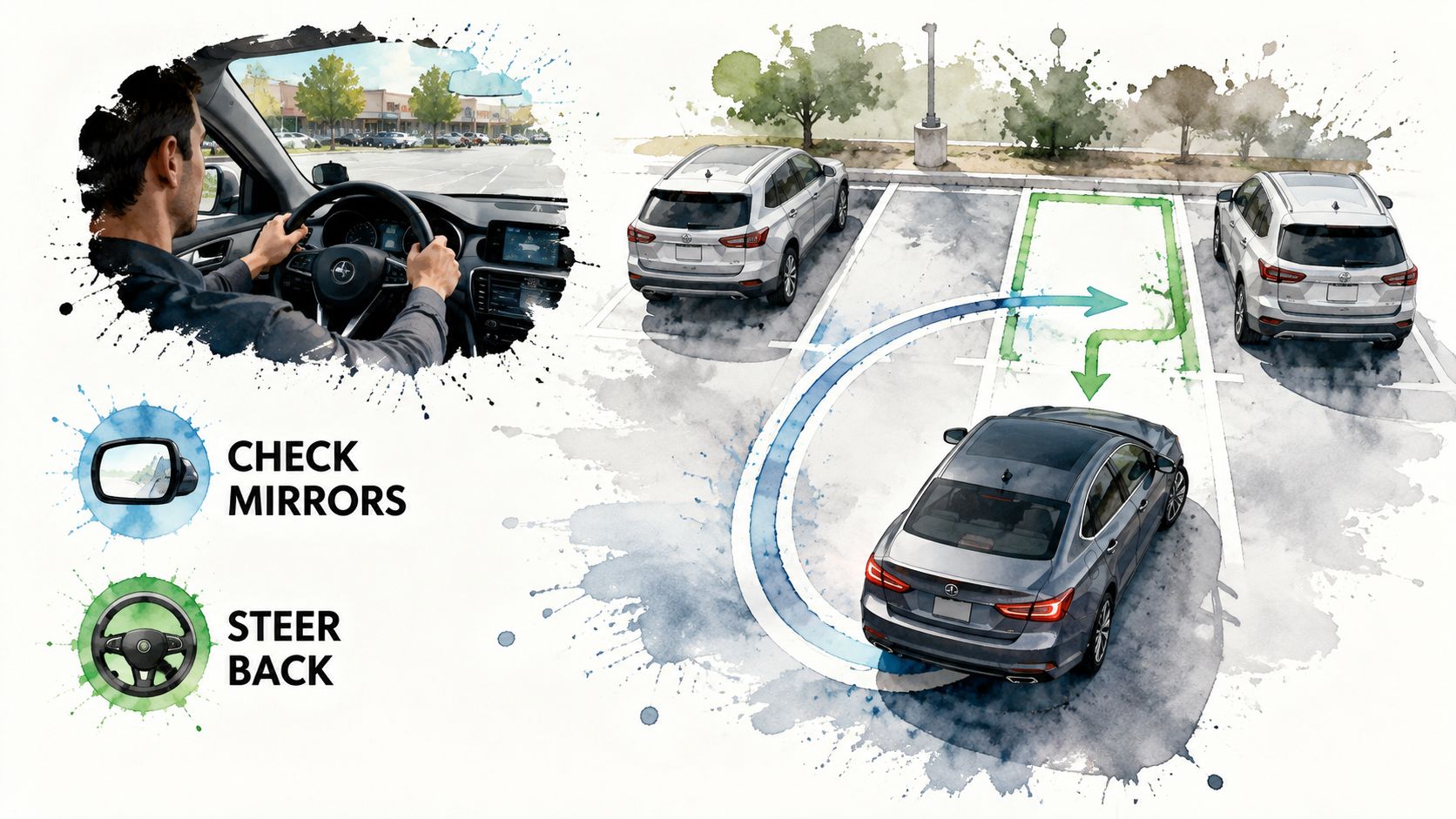
Once you've reached your starting point, shift into reverse and move very slowly. Turn the wheel in the direction of the space. The rear of the car will begin to arc into the spot while the front swings outward.
Many teens often panic and either stop checking around the vehicle or turn the wheel back too early.
Watch these three things:
- The inside parking line in your side mirror
- The front corner of your car as it swings outward
- The far side of the space to make sure you're centering the vehicle
If the front of your car is getting too close to the vehicle beside you, pause. Don't keep backing and hope it fixes itself.
Straightening without overcorrecting
As the car enters the space, the goal is to straighten the wheels when the vehicle body is lining up with the painted lines. If you leave the wheel turned too long, you'll cut too sharply and end up crooked. If you straighten too soon, the rear may not make it fully into the space.
A good visual cue is this: once both side mirrors suggest the car is entering evenly and the body is becoming parallel with the lines, unwind the steering wheel smoothly and continue backing straight.
This video shows the basic motion and timing in a way many students find easier to understand after they've practiced the setup once or twice.
A low-stress method for practice
Use an empty section of a large parking lot. Pick one row and practice the same space repeatedly from the same direction. That helps you connect the steering input to what the car does.
A simple practice pattern works well:
| What you do | What you look for |
|---|---|
| Pull past the space | Car stays parallel to the row |
| Pause before reverse | Full scan for people, cars, carts |
| Turn while backing slowly | Rear enters space, front swings safely |
| Straighten gradually | Car becomes parallel to the lines |
| Stop and assess | Centered vehicle with room on both sides |
The point isn't to memorize magic markers for every car. The point is to build a pattern you can trust. Your exact reference point may vary a little by vehicle, but the method stays the same.
Conquering Angled Spaces and Driveways
Not every reverse parking job happens in a standard 90-degree lot. In metro Atlanta, you'll also run into angled parking near shopping areas, school entrances, and mixed-use developments. Then there's the everyday challenge of backing into a driveway at home.
These situations use the same core reverse parking techniques, but the turning arc changes.
Handling angled spaces without cutting too sharply
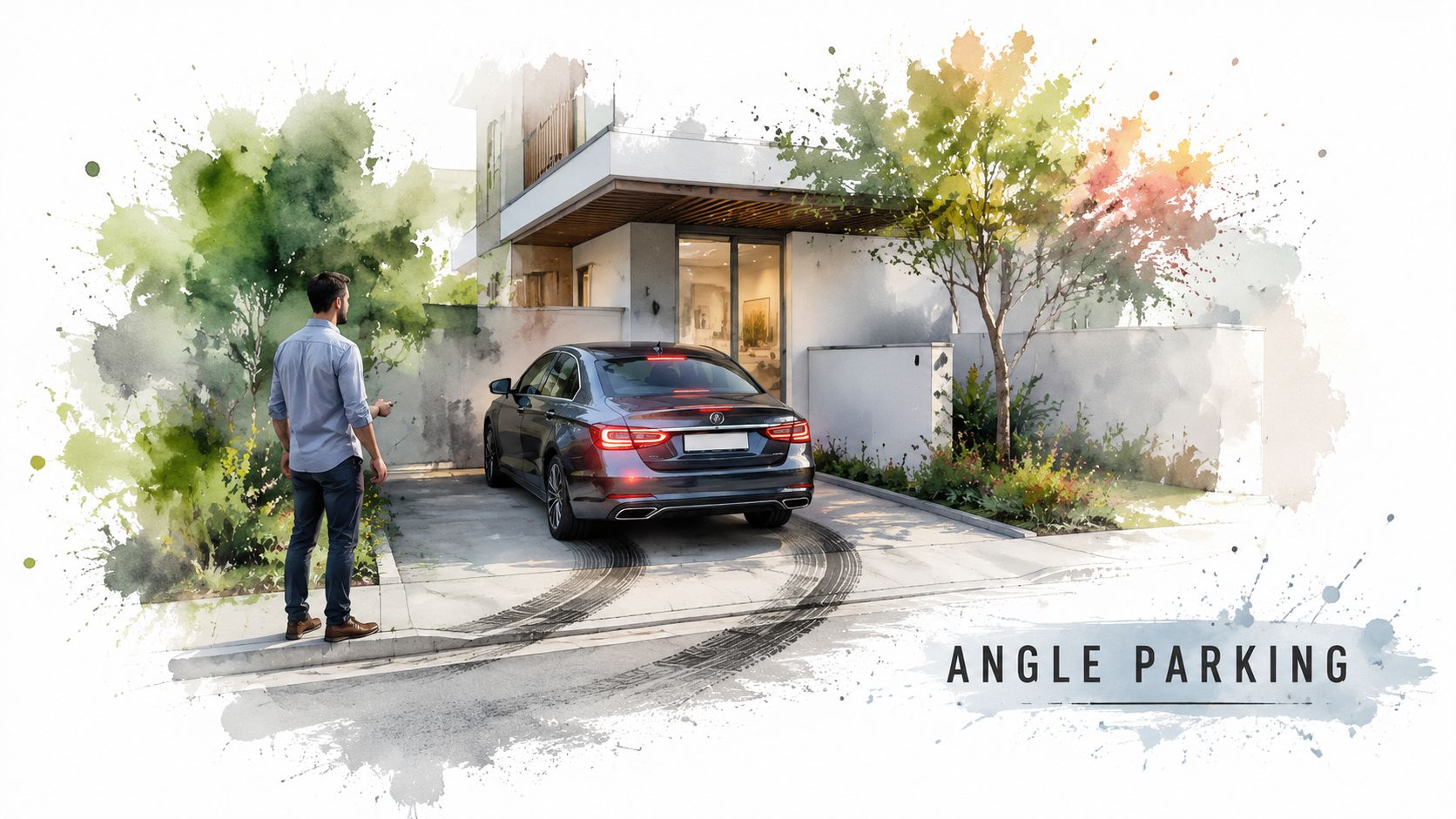
An angled space doesn't need the same deep turn as a 90-degree spot. The opening is already helping you. Your job is to match the angle of the bay and avoid swinging too late.
Driver-education guidance for perpendicular curb-side parking often recommends positioning the vehicle about one car width away from the space you're entering, then aligning your rear corners with the rear corners or brake lights of the adjacent parked vehicle before beginning the reverse maneuver. That setup helps the rear wheels track into the space instead of cutting too early or too late, as explained in this guide to angle parking and positioning.
For an angled reverse park, think of the movement as smoother and shallower:
- Stay a little wider on approach: This creates room for the rear to enter cleanly.
- Begin the turn earlier than you would for a square bay: But don't snap to full lock unless the space demands it.
- Match the painted angle: Let the space shape guide the car.
If you over-rotate, the vehicle may end up crooked across the lines. If you under-rotate, you'll sit too close to the outer line and need a correction.
Backing into a driveway at home
Driveways add different hazards. You may be dealing with a slope, a narrow entrance, a mailbox, a curb edge, or a sidewalk crossing behind you. In residential Georgia neighborhoods, you also need to expect children, pets, and walkers who may appear quickly.
A smart driveway routine looks like this:
- Pause before the turn: Let traffic behind you pass if needed.
- Check both sidewalk directions: A cyclist or jogger can appear fast.
- Back slowly enough to stop instantly: That's the right pace.
- Use your mirrors to track driveway edges: Especially if the entrance narrows near landscaping or a retaining wall.
In a driveway, slow is not a style choice. Slow is your safety margin.
What changes between lots and neighborhoods
A parking lot usually asks you to track painted lines. A driveway asks you to track edges, slope, and hidden movement.
This quick comparison helps:
| Location | Main concern | Best habit |
|---|---|---|
| Angled parking bay | Matching the bay angle | Use a smooth, shallow reverse arc |
| Home driveway | Sidewalks, curb edges, people | Stop early and scan longer |
| Sloped driveway | Roll and speed control | Cover the brake and creep backward |
If your home driveway feels tight, practice first in daylight. Night practice comes later. New drivers often rush driveway backing because it feels familiar, but familiar places can make people less alert. Treat each reverse entry like a fresh maneuver.
Common Reversing Mistakes and Quick Fixes
Most reverse parking problems come from a small group of mistakes. The good news is that each one has a clear fix.
Traffic-safety research has underscored that drivers who take more than 30 seconds to complete a reverse-bay maneuver are more likely to miss pedestrians or cyclists in blind spots because of information overload. That same gap in instruction shows up when drivers aren't taught a structured glance sequence, such as alternating between mirror, shoulder check, and front corner every 3 to 5 ft, or a clear rule like aborting and repositioning after two full-lock corrections.
The mistakes that cause the most trouble
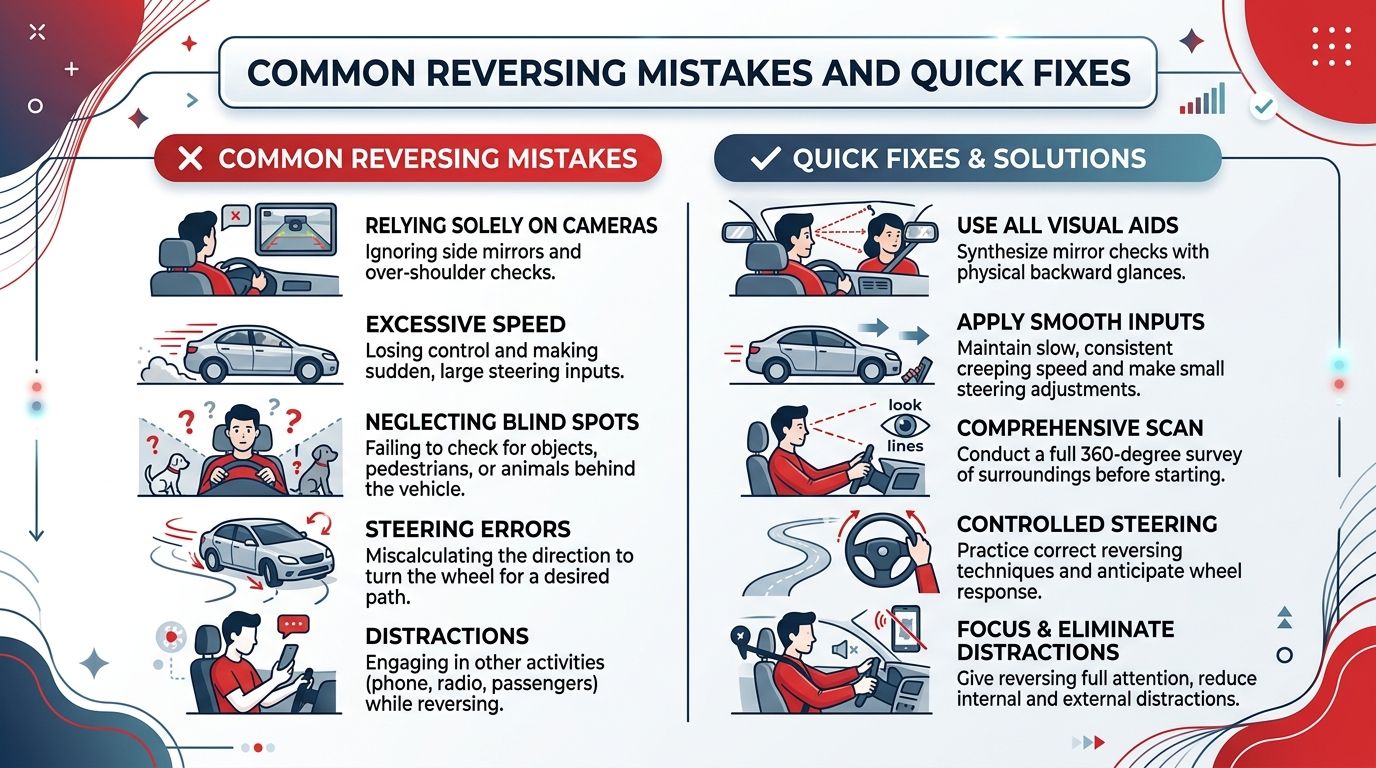
Here's the pattern I see most often with teen drivers:
- Turning too early: The rear enters awkwardly and the car drifts toward the wrong line.
- Turning too late: The car misses the space and forces a sharp rescue move.
- Watching only the camera: The driver loses awareness of side clearance and front swing.
- Backing too fast: Small steering errors turn into big position problems.
- Trying to save a bad setup: Instead of resetting, the driver keeps adding corrections.
Quick fixes that actually work
The best fix is often simpler than students expect.
| Mistake | What happens | Quick fix |
|---|---|---|
| Turn too early | Crooked entry or wide rear path | Pull forward, reset straighter |
| Turn too late | Rear misses space | Start again with a clearer marker |
| Stare at camera | Miss side hazards | Alternate mirrors, shoulder, camera |
| Move too fast | Jerky corrections | Idle speed or light brake control |
| Too many corrections | Stress goes up | Reposition after two full-lock fixes |
Don't wrestle a bad park into existence. Reset it.
A glance pattern that reduces overload
When drivers feel overwhelmed, their eyes often lock onto one place. Usually it's the backup camera or one mirror. That's when awareness shrinks.
Use a repeating scan:
- Driver-side mirror
- Rear view out the back
- Passenger-side mirror
- Front corner check
- Short camera confirmation
Keep cycling through that pattern as the vehicle moves. If the car stops, scan again before moving.
A clean reverse park usually looks calm from the outside because the driver is staying mentally organized on the inside.
Pass Your Georgia Road Test with Confidence
Reverse parking isn't just useful in daily driving. It also supports the broader vehicle control, observation habits, and composure that matter on a Georgia road test. Examiners pay attention to whether you check carefully, steer smoothly, and keep the vehicle under control in low-speed situations.
That's why parking practice should connect to your whole learning plan, not sit off to the side as an afterthought.
What helps most before test day
If you're working toward a Class D license in Georgia, build your preparation around real repetition. That usually means a mix of classroom or online learning, supervised practice, and focused road instruction in the exact kinds of places that make teens nervous.
For many students, that includes:
- Joshua's Law coursework: Helpful for understanding the full driver education path in Georgia.
- Online driver's education options: Useful if your family needs schedule flexibility.
- Road test preparation: Best when it includes hands-on coaching instead of general advice.
- Driving lessons packages: Strongest for building muscle memory through repeated practice.
- Scholarship support: Important for families exploring the Georgia Driver's Education Scholarship Grant Program.
One skill often connects closely with reverse control and slow-speed precision. If you're also preparing for test-day maneuvering, this parallel parking road test guide is a smart next read.
Why coached practice beats guessing
A parent can help a lot. So can empty-lot repetition. But many teens improve faster when an instructor catches the little things they don't notice, such as late steering, drifting setup, weak blind spot checks, or inconsistent brake control.
That kind of feedback matters because reverse parking mistakes are usually pattern mistakes. Once someone shows you the pattern clearly, the maneuver becomes easier to repeat.
Build the skill before the pressure shows up
The worst time to learn reverse parking is when you're already stressed, late, or being watched by other drivers. Learn it in practice first. Then use it in real life.
If you're a Georgia teen, your best preparation usually includes a full path:
- Driver's education to cover the rules and habits behind the wheel
- Joshua's Law training if you need it for licensing
- Online course options if in-person scheduling is tough
- Road test services if you want a smoother path to test day
- Driving lesson packages for repeated coaching on parking, turns, lane changes, and confidence
The Georgia Driver's Education Scholarship Grant Program can also help qualifying families access training, which can make structured instruction much more realistic.
A strong driver isn't the one who parks perfectly on the first day. It's the one who uses a safe process every time.
If you want hands-on help with reverse parking, road test prep, Joshua's Law, online driver's education, or driving lesson packages in Georgia, take a look at A-1 Driving School. Their programs include practical driving lessons, road testing support, online course options, and information on the Georgia Driver's Education Scholarship Grant Program so you can build real skill before test day.