Your test date is getting close, the Georgia Driver's Manual is open on your phone or desk, and every page feels like it could turn into a trick question. That's usually when students start searching for Georgia permit test answers, hoping there's a shortcut that will make the whole thing easier.
I understand the impulse. The permit test feels high stakes when you're eager to start driving, your friends already have permits, or your parents have started asking when you're scheduling your DDS visit.
The problem is that shortcut thinking usually makes the test harder, not easier. Students who chase random answer lists often memorize fragments, miss the logic behind the rule, and get rattled the moment a question is worded differently. Real preparation works better because it gives you something a cheat sheet never can. Confidence.
Stop Searching for Answers and Start Preparing to Pass
Most students don't fail because they're incapable. They fail because they study the wrong way.
They bounce between quizzes, screenshots, and social posts that claim to have the “real” Georgia permit test answers. That kind of studying feels productive because you're looking at questions. But if you don't understand why an answer is right, you're depending on memory under pressure. That's a weak plan for any state exam.
What students usually get wrong
The permit test doesn't reward shallow memorization. It checks whether you understand how to respond to real driving situations, recognize signs, and apply Georgia traffic laws correctly. That means one familiar-looking question can still trip you up if the wording changes or the answer choices are designed to test judgment.
A better goal is simple. Learn the rule, then practice applying it.
Practical rule: If you can explain an answer in your own words, you're learning it. If you can only recognize it when you see it, you're guessing.
That shift matters. Instead of asking, “What are the answers?” start asking:
- What is this rule trying to prevent
- How would this look on an actual road
- Why is one choice safer or more legal than the others
What confident preparation looks like
Strong preparation is not complicated. It's structured.
You need a study plan to cover the manual, separate road rules from road signs, and give you repeated practice on weak areas. You also need to stop treating the permit as a one-time hurdle. The knowledge you build now carries straight into your driving lessons, your road test, and the habits you'll use every time you get behind the wheel.
That's why I always tell students to prepare for two outcomes at once. First, pass the exam. Second, become the kind of driver who won't freeze when a real situation unfolds in traffic.
Here's the good news. Once the test is broken down clearly, it becomes manageable. It stops feeling like a giant wall of information and starts looking like a set of learnable categories with repeatable study steps.
Deconstructing the Georgia Permit Test
A lot of students walk into the DDS thinking the permit exam works like a single score test. Then they find out too late that Georgia grades it in two separate parts.
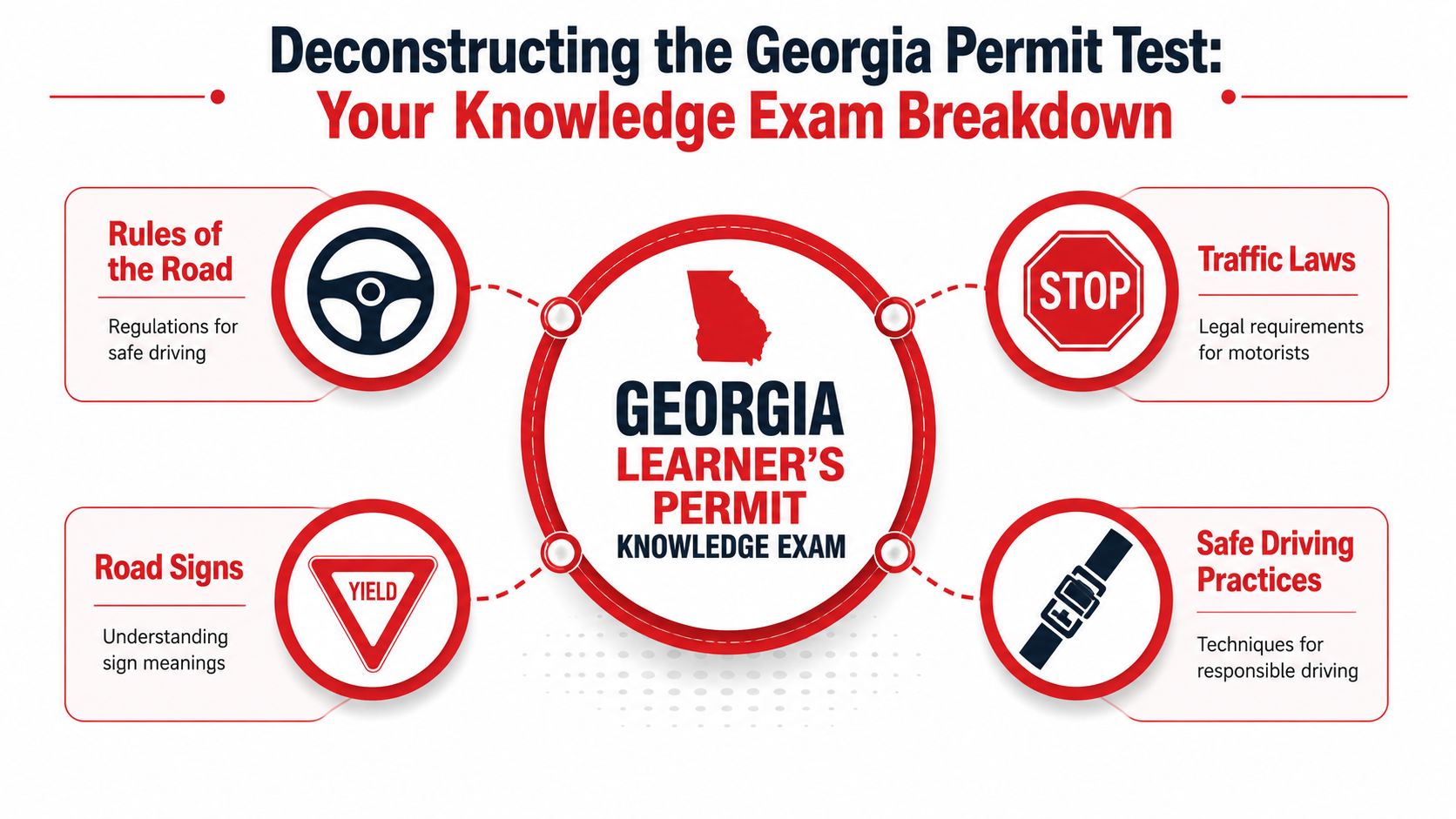
The Georgia learner's permit knowledge exam has 40 questions total, split into a 20-question Road Rules test and a 20-question Road Signs test. To pass, you must score at least 75% on each section, which means 15 correct answers on Road Rules and 15 correct answers on Road Signs. If you get 14 out of 20 on one section, you fail that section even if your other section is strong. You can see that structure in A-1's breakdown of the Georgia permit test format and in the Georgia DDS driver manual.
Why the two-part format matters
This scoring setup changes how smart students study.
If you spend three nights reviewing penalties, right-of-way rules, and lane markings but barely touch signs, you can still fail. I have seen that happen with students who felt confident walking in because they knew a lot of rules. Confidence built on half the test is shaky confidence.
Balanced preparation works better because the two sections test different skills. Road Rules asks whether you understand what the law requires and how to respond in a driving situation. Road Signs checks whether you can recognize visual information quickly and connect it to the right action.
| Section | What it tests | What you need to do |
|---|---|---|
| Road Rules | Georgia traffic laws, safe driving practices, penalties, right-of-way, and driving decisions | Know the rule and apply it to a real situation |
| Road Signs | Sign shapes, colors, symbols, and meanings | Recognize the sign quickly and know the correct driver response |
What happens if you don't pass
A failed attempt does not end the process. It usually means you lost time, added another fee, and put more pressure on the next try.
The DDS gives the exam digitally, so you get your result right away. If you fail, you can retake it after the required waiting period and payment of the testing fee. From a coaching standpoint, immediate results are useful. They tell you fast whether your study method prepared you or just made you feel busy.
That is why I tell students to treat the first attempt like it matters, because it does.
What the exam is really checking
The permit test is designed to measure understanding, not your ability to spot familiar answer choices. The DDS wants to know whether you can identify signs, follow Georgia traffic laws, and make safe decisions in common road situations.
That is also why chasing "Georgia permit test answers" usually wastes time. There is no official public answer key to memorize. Students make faster progress when they study the rule, connect it to a real driving situation, and practice until they can explain why the right answer is right.
That approach does more than help you pass. It gives you a stronger start once you begin actual driving lessons.
Your Four Week Permit Test Study Plan
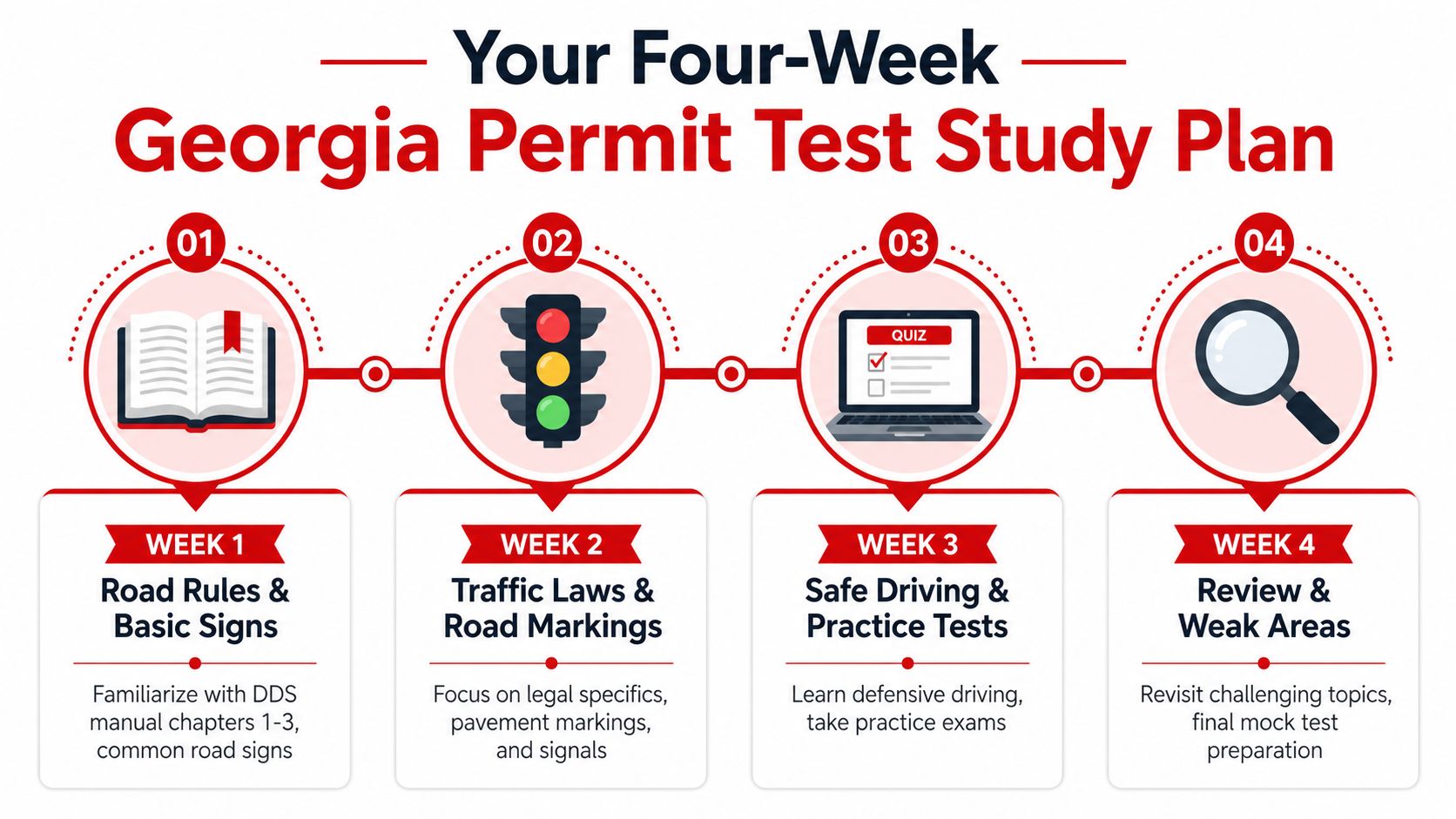
Students do much better when they stop trying to learn everything in one weekend. A four-week plan gives your brain time to absorb the manual, recognize patterns, and correct weak spots before test day.
Start with the timeline below, then adjust it to your schedule.
Week one builds your base
Week one is for reading, not testing yourself nonstop.
Read the sections of the Georgia Driver's Manual that cover core road rules first. Focus on right-of-way, lane usage, following distance, speed laws, school zones, and what different pavement markings mean. Don't rush to memorize every sentence. Your job in week one is to understand the language of the road.
Use a notebook or notes app and create two running lists:
- Rules that seem obvious until the answers get tricky
- Signs or terms you keep mixing up
That second list becomes valuable later because most students forget what confused them once they finally learn it.
Week two sharpens sign recognition
Road signs deserve their own week because students often underestimate them. Signs are visual, fast, and easy to blur together if you study them casually.
Flashcards work well for this. Put the sign image or description on one side and the meaning plus driver response on the other. Don't stop at naming the sign. Add what you should do when you see it. That extra step turns recognition into action.
Instructor note: A student who can identify a sign but can't explain the correct response is only halfway prepared.
If you want a more structured way to practice, A-1 Driving School offers a Georgia permit practice test that mirrors the split between road rules and road signs. That matters because it teaches you to prepare for the actual exam format instead of a random mixed quiz.
Week three is for pressure testing
By week three, you should be taking full practice tests and reviewing mistakes carefully.
Premium, structured study resources show a 97% pass rate, while unstructured self-study shows an average practice test pass rate of 52%, according to Zutobi's Georgia permit practice test data. The lesson isn't that you need something fancy. It's that organized study beats scattered studying.
Watch this walkthrough if you want a simple visual refresher while you review:
After each practice test, sort your misses into three buckets:
- Didn't know the rule at all
- Knew the topic but misread the question
- Changed the answer and talked yourself out of the right one
Those categories tell you what to fix. A knowledge gap needs manual review. A reading mistake means slow down. A confidence mistake means you need repetition under calmer conditions.
Week four is review, not panic
The final week is for tightening up weak areas, not trying to relearn the whole manual.
Use shorter daily sessions. Review missed questions, sign categories, and high-confusion laws. If a topic still feels fuzzy, explain it out loud to a parent, sibling, or friend. Teaching is one of the fastest ways to find out whether you understand something.
A strong final week routine looks like this:
- One short review block each day
- One mixed practice quiz
- One focused review of your worst category
- One light session the day before the exam
Don't cram late into the night. Tired students misread simple questions. Calm students usually score better than frantic ones with the same knowledge level.
Sample Questions with Expert Explanations
Students searching for Georgia permit test answers usually want certainty. The smartest way to get that certainty is to practice the kind of reasoning the test expects.
Here are sample-style questions based on concepts that regularly confuse new drivers.

Hands-Free law question
Question: If a driver violates Georgia's Hands-Free law, what penalty concept should you be ready to identify on a knowledge question?
- A single fine only
- Points only
- License suspension only
- All applicable penalties together
Correct answer: All applicable penalties together
The trap here is narrow thinking. The official DDS sample test presents the Hands-Free law as a cumulative-penalties concept, which means students need to recognize that the answer may require combining consequences rather than picking one isolated penalty, as noted in this review of the Georgia cheat sheet and DDS sample test behavior.
Why students miss it: they memorize one piece of the law and expect the question to ask for that exact piece.
Why the correct answer works: the exam may test whether you understand the full consequence pattern, not whether you spotted one familiar word.
Large vehicle right-turn question
Question: You're at an intersection and a large truck ahead starts a wide right turn. What should you do?
- Pull up quickly on the right to get past before it finishes
- Honk so the truck knows you are beside it
- Wait until the truck completes the turn
- Move closer so traffic behind you can pass
Correct answer: Wait until the truck completes the turn
This is a judgment question, not a speed question. Large vehicles often need extra room to complete right turns safely. If you try to squeeze by, you put yourself into a dangerous blind spot and create a conflict where the truck needs space.
A lot of students pick the faster option because they assume the test rewards efficiency. It usually rewards safety and patience.
If one answer sounds faster and another sounds safer, the safer choice is usually the one to study first.
Section-score logic question
Question: A student answers enough questions correctly to feel strong overall, but misses too many road signs. What matters most on the Georgia permit test?
- The combined total only
- The road rules section only
- Passing each section separately
- Finishing quickly
Correct answer: Passing each section separately
This kind of question checks whether you understand test logic, not driving content. If you don't know how the exam is scored, you can prepare the wrong way. Many students would benefit from creating their own mini review quizzes from notes or handbook pages. A practical tool for that is create quizzes from documents, which can help turn study material into question practice without relying on random answer dumps online.
How to use sample questions the right way
Don't just mark right or wrong and move on. After every question, ask yourself two things:
- Why is the correct answer correct
- Why are the other choices wrong
That second step is where your understanding gets stronger. It trains you to spot trap answers built from partial truths, rushed thinking, or familiar terms used in the wrong context.
A student who learns the reasoning can handle new wording. A student who only memorizes an answer list struggles the moment the test changes the scenario.
From Permit to License The A-1 Driving School Path
Passing the permit test is a milestone, but it's only the front end of the licensing process. Important growth happens after the permit, when students start turning rules from the manual into driving habits on actual roads.
For teens, Joshua's Law is a major part of that path. Under Georgia law, all 16- and 17-year-olds must complete a DDS-approved 30-hour Driver's Education course before applying for a Class D license, as explained in this overview of Joshua's Law requirements in Georgia.
What comes after the permit
Students and parents usually need a practical checklist more than they need another lecture. After the permit, the focus should shift to education, supervised practice, and road readiness.
Here's the sequence most families should think through:
| Stage | What matters | Good decision to make early |
|---|---|---|
| Driver's Education | Meeting Joshua's Law and learning core concepts in an organized format | Choose whether online or in-person fits the student's schedule better |
| Driving lessons | Building real skill, comfort, observation, and judgment | Book lessons before bad habits set in |
| Road test preparation | Practicing maneuvers, pacing, and test-day composure | Train on the exact skills that tend to break confidence |
| Licensing and ownership costs | Preparing for the responsibilities of driving | Review choices for vehicles and insurance before a teen starts driving regularly |
For families thinking beyond the permit stage, it also helps to compare Georgia auto insurance early so the cost side of teen driving doesn't become a surprise later.
Why driving lessons matter more than most families expect
A student can pass a knowledge exam and still be uneasy in traffic. That's normal. Reading about right-of-way and judging gaps at a busy intersection are not the same skill.
That's why driving lessons and lesson packages matter so much. They give students repetition in the places where anxiety usually shows up:
- Turns and lane position
- Parking and backing
- Speed control
- Mirror checks and scanning
- Decision-making around other vehicles
Private lessons also let an instructor correct habits early, before those habits become automatic. Some teens need a patient start. Others need more work on confidence than mechanics. Adults often need a reset after years away from driving or after moving from another country or state. Different drivers need different lesson pacing.
Online options, road testing, and financial help
A lot of families now prefer online course options because they're easier to fit around school, sports, and work schedules. That flexibility can make Joshua's Law compliance much smoother, especially when a student learns better in shorter, repeatable sessions.
If you want to see the full path from permit to license in one place, this guide on how to get a Georgia driver's license helps map the process clearly.
The other piece many families overlook is access. The Georgia Driver's Education Scholarship Grant Program can help qualifying students get training support. That matters because professional instruction shouldn't feel out of reach when a student needs it.
Road testing also becomes less stressful when students prepare with the same seriousness they used for the permit. A road test isn't just about maneuvers. It's about composure, observation, and following directions without rushing. Students who train with that standard usually feel steadier on test day.
Final Tips for a First-Time Pass
The last few days before your exam should feel controlled, not chaotic. At this point, your job is to protect the work you've already done.
Start with the basics. Confirm your documents early, know where you're going, and give yourself extra time on test day so nothing feels rushed. Eat something light, sleep well the night before, and avoid marathon studying the evening before the test. Tired brains miss easy questions.
What helps on test day
Keep your approach simple:
- Read every answer choice fully. Many mistakes happen because students recognize one familiar phrase and click too fast.
- Watch for section mindset. If you're in a sign question, think visual meaning and driver response. If you're in a rule question, think law and safe action.
- Don't panic over one hard question. A tough item early in the test doesn't mean the whole exam is going badly.
- Use common-sense safety judgment. When two answers seem possible, the safer legal choice is often the stronger one.
A calm student with a clear process usually performs better than a nervous student trying to remember a random answer sheet.
Why preparation matters beyond the permit
This matters for more than one exam. Georgia road test failures increased by 52.5% from 2021 to 2025, and the pass rate dropped to its lowest point in five years, according to Zutobi's review of Georgia driving test trends. That points to a bigger issue. Many new drivers aren't building strong fundamentals early enough.
The permit stage is where that can change.
If you prepare carefully now, you're not just trying to collect the right Georgia permit test answers. You're building the habits that carry into supervised driving, lessons, the road test, and everyday decisions behind the wheel. That's the true win.
If you're ready to move from test anxiety to a clear licensing plan, A-1 Driving School offers practical next steps that fit where you are now, including Joshua's Law driver's education, online course options in Georgia, road test support, scholarship information, and driving lessons and lesson packages that help turn permit knowledge into real road skills.