A lot of Georgia drivers meet fog the same way. The road looks normal, then one low stretch near trees, water, or an open field turns into a gray wall. Tail lights vanish. Lane lines soften. Your hands tighten on the wheel because you can still move the car, but you can't judge what's ahead with the same confidence.
That's why fog driving safety matters so much. Fog doesn't usually give you a dramatic warning. It removes depth, speed cues, and distance judgment a little at a time, and that's exactly why new drivers make simple mistakes that turn serious fast.
When the Mist Rolls In Understanding Fog Driving Dangers
A common Georgia scenario goes like this. A driver leaves before sunrise, gets onto a familiar highway, and thinks the trip is routine. Then the car drops into a patch of dense fog near a creek bed or low valley. The driver can still see a few car lengths, so they keep roughly the same speed. That decision is where trouble starts.
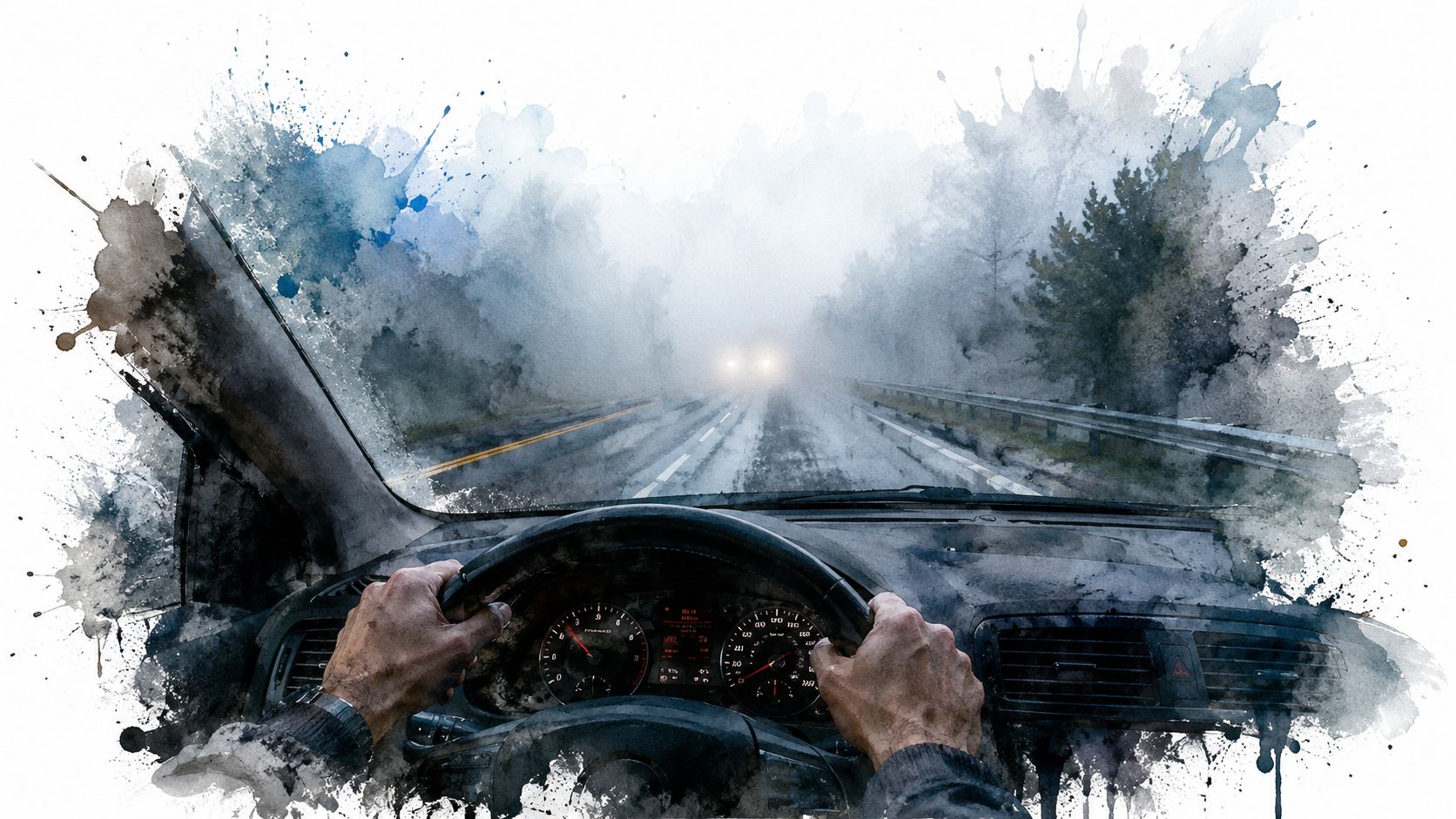
Fog strips away the visual references drivers use without realizing it. You lose clear horizon lines. You lose the easy sense of how fast you're closing on the next vehicle. You lose the comfort of seeing well beyond your stopping distance.
That's why fog isn't just annoying weather. According to the AAA Foundation's report Hidden Highways Fog and Traffic Crashes on America's Roads, fog is a critical factor in fatal multi-vehicle pileups involving 10 or more vehicles, contributing to nearly one-in-five, or about 20%, of these catastrophic crashes across the United States. The same report notes that these crashes peak during winter months and overnight hours.
Fog punishes ordinary mistakes more quickly than clear weather does.
What usually goes wrong
Most fog crashes don't begin with reckless intent. They begin with ordinary habits that stop working in low visibility.
- Speed stays too high: Drivers often slow a little, but not enough for what is visible.
- Following distance stays normal: A gap that feels safe in daylight can disappear in seconds in fog.
- Drivers chase the vehicle ahead: Instead of reading lane position and road edge, they lock onto tail lights and follow too closely.
There's another practical issue after a crash or near miss. Even careful drivers can end up dealing with vehicle damage from weather-related hazards, fallen debris, or secondary impacts. If you want a plain-English explanation of what coverage can apply outside collision claims, this comprehensive insurance guide for California drivers is a useful reference for understanding how this coverage type is generally discussed.
Before You Drive Preparing Your Vehicle for Fog
Fog driving safety starts before the key turns. Most drivers think of fog as an on-road problem, but the first mistakes happen in the driveway. Dirty glass, weak wipers, and the wrong light choice can cut visibility before the fog even gets thick.
Start with the glass
Your windshield has to do more than look “pretty clean.” In fog, even a thin film of dirt, road grime, or interior haze spreads light and makes glare worse.
Use a quick pre-drive check:
- Clean the windshield inside and out: Interior fogging and dashboard film can make low morning light harder to read.
- Wipe mirrors and side windows: You need side reference points when forward visibility shrinks.
- Check the defroster early: Don't wait until the inside of the glass fogs over to test it.
A lot of students are surprised by how often the inside of the windshield is the underlying problem. The outside looks damp, so they reach for the wipers, but the blur is coming from interior condensation.
Check the equipment that actually matters
Fog exposes small maintenance issues immediately. If your wiper blades chatter, streak, or skip, they're not “good enough.” If one headlight is dimmer than the other, fog will make that weakness obvious.
Focus on these items before a fog-prone drive:
- Low beams: Make sure both work and the lenses are clear.
- Fog lights if equipped: Use them only as a supplement, not a replacement for low beams.
- Wipers and washer fluid: Moisture film builds fast in fog.
- Defroster and climate controls: You need clear glass on demand, not eventually.
For more seasonal vehicle prep, A-1's guide to preparing for winter driving conditions in Georgia is a smart companion read.
Practical rule: If your windows are hazy in the driveway, they'll be worse on the road.
Why high beams make things worse
This is one of the most stubborn beginner mistakes. Drivers think more light means more visibility. In fog, it often means more glare.
According to AAA guidance on driving in fog, in Georgia's frequent valley fog, droplet size and density can render fog lights less effective than low beams, and 68% of drivers in the Southeast still incorrectly rely on high beams in fog, which creates a “white wall” effect and reduces visibility (AAA fog driving tips).
Here's the simple version. High beams throw more light higher into the moisture. That light bounces back at you. Instead of seeing farther, you see a bright curtain.
Low beams aim lower. They give you better usable vision on the pavement, lane markings, and immediate road edge, which is what you need most in fog.
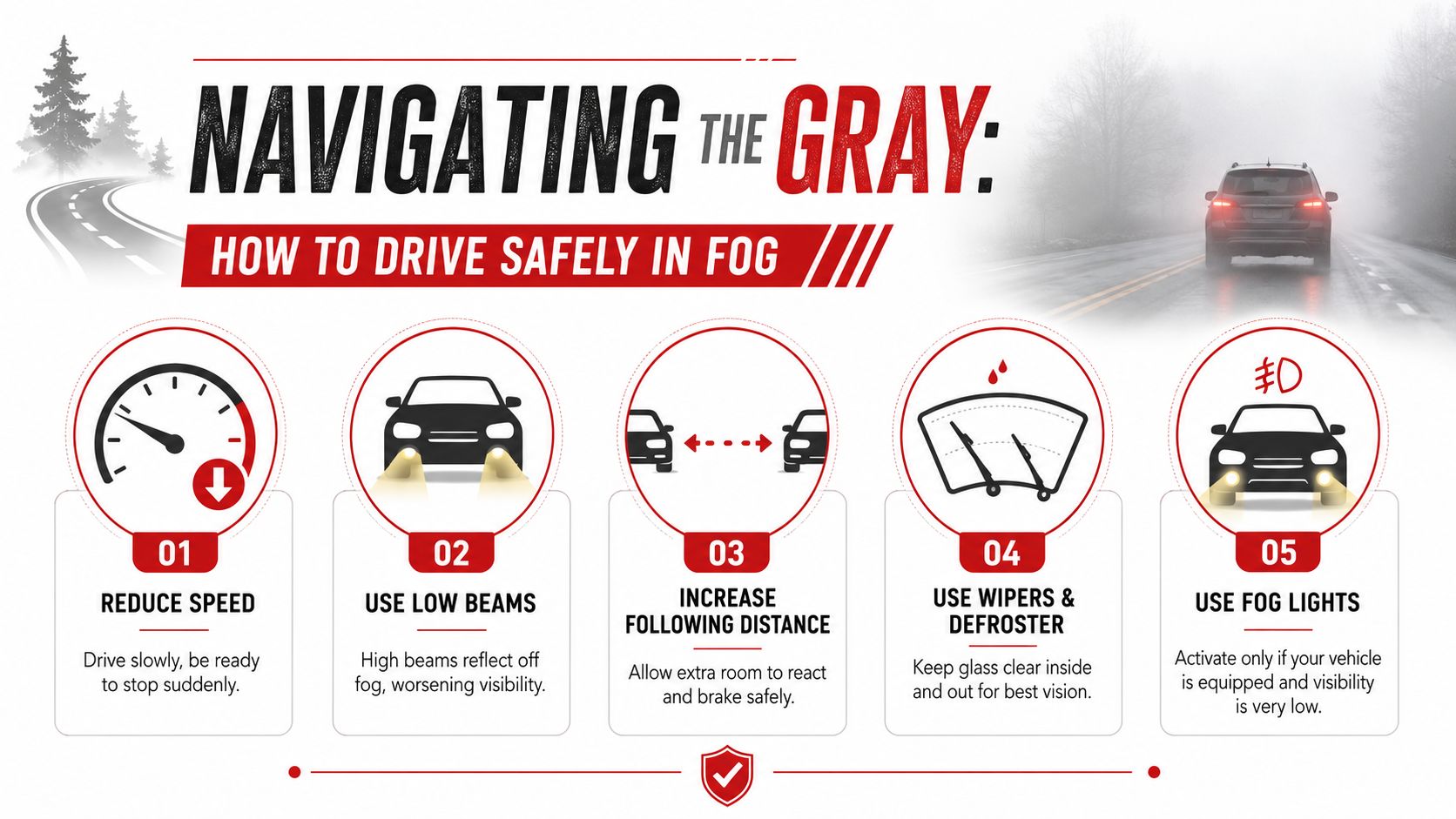
Navigating the Gray How to Drive Safely in Fog
Once you're in fog, your job changes. You're not trying to maintain normal travel. You're managing a moving visibility problem. That means speed, spacing, lane control, and attention all have to tighten up at the same time.
Manage speed by visibility, not by habit
The biggest trap in fog is feeling slower than you really are. Researchers describe this as a speed perception illusion. Under heavy fog, drivers often don't reduce speed enough, and the main technical pitfall is maintaining speeds 15 to 20 mph above the safe threshold for visibility under 100 meters. The same research notes that the way to mitigate that risk is to pair a slower speed with a minimum 4-second following interval (driving performance assessment research).
That matters because many drivers do half the job. They lift off the gas a little, but they don't build enough space.
A useful test is simple. Ask yourself whether you can stop within the distance you can see. If the answer is no, you're still going too fast.
Keep space in front of you
In clear weather, drivers often hear standard following-distance rules and treat them as fixed. Fog isn't a standard condition.
Use this approach:
- Count at least four seconds behind the car ahead: Pick a roadside marker and count after the lead vehicle passes it.
- Add more room if traffic is uneven: Brake lights appear late in fog.
- Don't let impatient drivers set your pace: Their bad choice doesn't improve your stopping distance.
For fleet operators and anyone interested in how speed control policies shape safer road behavior, this guide to Fleetalyse compliance solutions gives a practical view of why speed monitoring matters.
Use the road, not the car ahead, as your guide
A beginner mistake is locking onto the tail lights in front and treating that vehicle like a guide rope. That creates two problems. First, if they drift, you drift. Second, if they brake suddenly, you've given away your reaction time.
Look for stable references instead:
- The right edge line: It's often easier to track consistently than the center area in thick fog.
- Reflective markers and lane lines: These are more reliable than another driver's judgment.
- Road shape cues: Curves, ramps, and merges arrive faster than they seem in low visibility.
If you want a refresher on exactly when bright lights help and when they hurt, read when you should have your brights on. Fog is one of the clearest examples of why “brighter” isn't always “better.”
A short visual explanation can help lock these habits in:
Keep the cabin clear and your inputs smooth
Fog driving safety isn't only about what's outside the car. If your windshield is fogging inside, your visual field keeps shrinking. Run the defroster early. Use wipers as needed to clear moisture film. Keep both hands ready for small steering corrections.
Smooth driving wins in fog. Smooth speed changes, smooth steering, smooth lane position.
Abrupt braking creates panic behind you. Fast lane changes in limited visibility are even worse. In fog, every move needs to be earlier, gentler, and more deliberate than usual.
When Visibility Disappears Safely Pulling Over
Some fog gets bad enough that continuing is the wrong call. New drivers often hesitate because they think stopping is failure. It isn't. The mistake is pressing on after visibility has dropped below what you can safely manage.
Know when to quit driving for a while
If lane markings keep disappearing, if you can't tell where traffic is stopping, or if every few seconds feel like guesswork, it's time to get off the roadway. Don't wait for panic. Make the decision while you still have enough control to execute it cleanly.
The safest stop in fog is not a half-stop with your car partly exposed to traffic. It's a complete move off the roadway, away from active lanes.
The stopping procedure most drivers get wrong
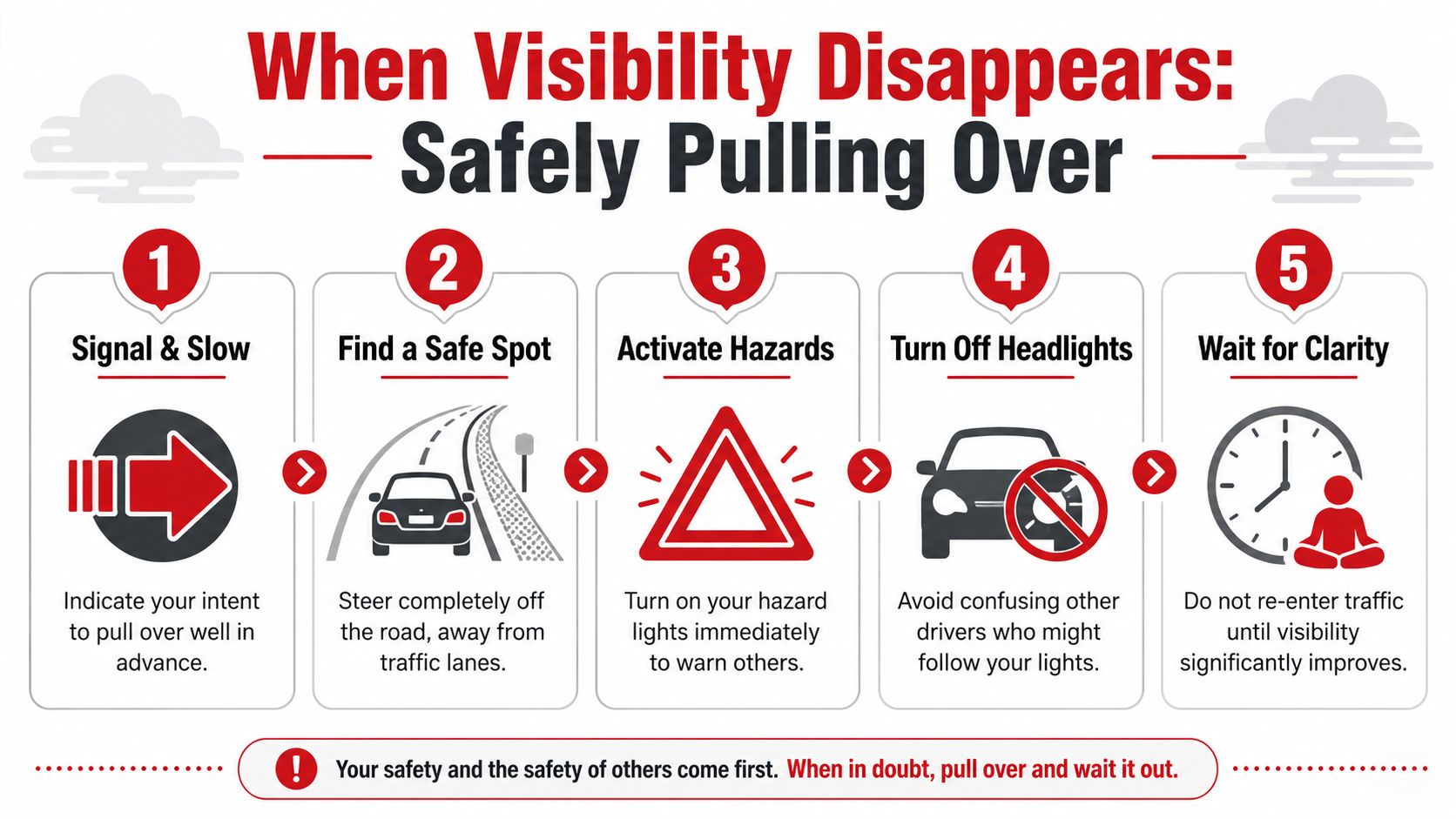
This is the step many people have never been taught correctly. According to National Weather Service guidance, drivers who pull over completely off the roadway and turn off all lights except hazard flashers experience a 98% avoidance rate for rear-end collisions. In contrast, those stopping on the shoulder with tail lights illuminated face a 40% rear-collision rate because other drivers mistake them for moving traffic (National Weather Service fog driving guidance).
Use this sequence:
- Signal early and slow gradually. Don't stab the brakes.
- Move completely off the road. Not partly in the lane, and not with the car angled back into traffic.
- Turn on hazard flashers.
- Turn off all other lights.
- Take your foot off the brake pedal. That keeps brake lights from glowing and making your stopped vehicle look like slow-moving traffic.
- Wait for visibility to improve before re-entering.
A stopped car with tail lights glowing can mislead another driver into following it.
What not to do
A short list is useful here because the dangerous mistakes are predictable.
- Don't stop in a travel lane: Even for a moment.
- Don't leave headlights or brake lights on after you're safely off the road: That's the exact visual confusion you're trying to avoid.
- Don't jump back into traffic just because the fog thins for a few seconds: Wait until you can make a calm, full re-entry.
Expert Training for Georgia's Roads Mastering Fog with A-1
Reading about fog helps. Doing the skills with an instructor is what makes them reliable under pressure. That matters in Georgia, where drivers can go from dry pavement to a low-visibility stretch in one bend of road.
Why classroom knowledge isn't enough by itself
Students can memorize “use low beams” and “slow down,” but fog doesn't test memory alone. It tests timing, lane discipline, judgment, and whether a driver can stay calm when the view narrows.
That's why behind-the-wheel instruction matters more than passive reading. An instructor can correct the exact habits fog exposes:
- Late braking
- Overdriving sight distance
- Fixating on the vehicle ahead
- Drifting within the lane
- Using the wrong lights
Those are skill problems, not just information problems.
Georgia teens need both education and practice
For teen drivers, there's also a legal foundation to build on. Joshua's Law in Georgia mandates that all 16- and 17-year-olds must complete a DDS-approved 30-hour Driver's Education course, available online or in-person, plus 6 hours of behind-the-wheel training before applying for a Class D license (Joshua's Law requirements in Georgia).
That combination matters. Online coursework can teach the rules, common hazards, and decision-making framework. Real progress happens when a student gets in the driver's seat and practices those decisions with coaching.
For some families, a class is the starting point and not the whole answer. A teen may understand the law perfectly and still need extra driving lessons to improve lane placement, hazard recognition, merging, or low-visibility judgment. Adult drivers often need the same thing, especially if they're preparing for a road test after years away from formal instruction.
The most practical route for nervous or inexperienced drivers
The drivers who improve fastest usually don't try to “tough it out” alone. They work in layers.
A smart progression looks like this:
| Training need | Best format |
|---|---|
| Joshua's Law requirement | DDS-approved online or in-person Driver's Education |
| Real-world confidence | Private driving lessons |
| Test-day readiness | Road test preparation and practice |
| Budget support | Georgia Driver's Education Scholarship Grant Program, if eligible |
If you're comparing programs, the key difference isn't just whether a school offers an online class. It's whether that school can carry a student from coursework to road practice to test preparation. For many Georgia families, that's the missing piece.
A-1 also offers a useful overview of why structured safety training still matters in everyday driving through its page on why a defensive driving class can help Georgia drivers. The larger point is simple. Knowledge builds awareness. Lessons build habits.
Your Fog Driving Safety Checklist
Fog driving safety gets much easier when the decisions are already made. You don't want to debate lighting, spacing, or stopping procedure while visibility is dropping. You want a routine.
Use this quick reference as a glove-box version of the article.
Fog Driving Quick Reference
| Phase | Action Item |
|---|---|
| Before You Go | Clean the windshield inside and out. |
| Before You Go | Check mirrors, side windows, and rear glass for haze or moisture. |
| Before You Go | Test low beams, wipers, washer fluid, and defroster. |
| Before You Go | Plan extra time so you won't feel pressure to maintain normal speed. |
| While Driving | Use low beams, not high beams. |
| While Driving | Reduce speed until you can stop within the distance you can see. |
| While Driving | Leave at least a 4-second following interval in heavy fog. |
| While Driving | Track lane lines and road edge, not just the vehicle ahead. |
| While Driving | Use smooth steering and gentle braking. |
| While Driving | Keep the windshield clear with wipers and defroster. |
| If You Must Stop | Signal early and slow gradually. |
| If You Must Stop | Pull completely off the roadway. |
| If You Must Stop | Turn on hazard flashers. |
| If You Must Stop | Turn off all other lights after you are safely off the road. |
| If You Must Stop | Take your foot off the brake pedal so brake lights don't stay illuminated. |
| If You Must Stop | Wait until visibility improves before re-entering traffic. |
The goal isn't to be fearless in fog. The goal is to be methodical. Drivers who prepare the car, adjust early, and know when to stop make better decisions because they're not improvising under stress.
If you want to turn these skills into real confidence, A-1 Driving School is the practical next step. A-1 offers Joshua's Law courses in Georgia, online Driver's Education options, road test preparation, and private driving lessons and driving lesson packages that help teens and adults build skill behind the wheel. Families can also explore the Georgia Driver's Education Scholarship Grant Program for eligible students. When fog, traffic, or test nerves are the problem, hands-on training is what makes the difference.