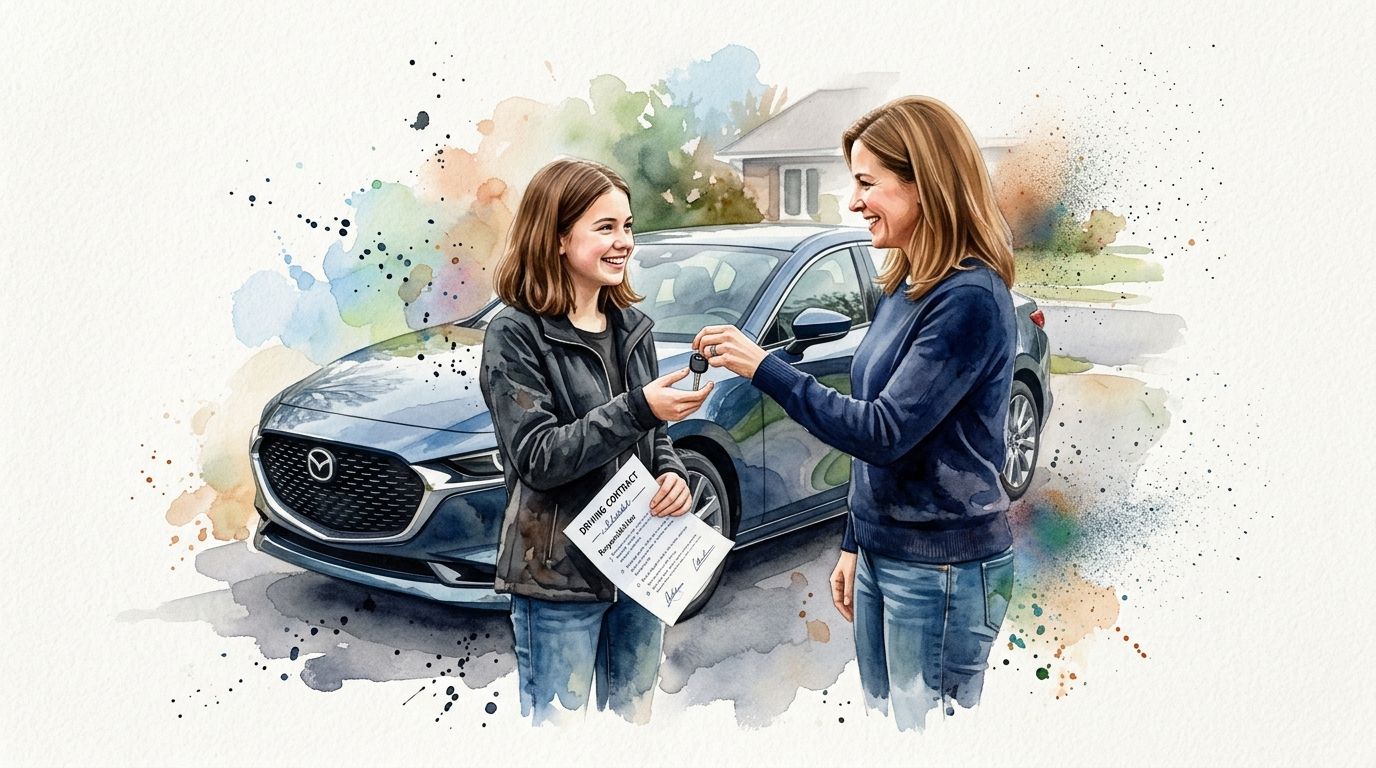
Your teen has finished the permit phase, logged practice time, and now wants the keys without a running commentary from the passenger seat. Most Georgia parents are split right down the middle at that moment. They're proud their child has reached a major milestone, and they're uneasy because they know a license doesn't create judgment overnight.
That tension is exactly why a written driving contract matters.
A good driving contract for teenagers isn't a threat sheet and it isn't a lecture in paragraph form. It's a practical bridge between supervised learning and independent driving. It turns vague family rules into something clear, repeatable, and easier to enforce when emotions are high and decisions have to be made fast.
The Keys to Freedom and Responsibility
A lot of parents have the same first week after licensure. Their teen wants to drive to school, then to work, then to meet friends, then to “just run one quick errand.” The parent starts answering every request case by case, and within days the house rule becomes whatever gets argued the hardest.
That approach usually fails because it leaves too much room for confusion.

Georgia families need a more structured starting point. Motor vehicle crashes are the leading cause of death for teenagers aged 15 to 18, and the risk multiplies when they carry teen passengers. The CDC explicitly recommends creating a written Parent-Teen Driving Agreement to establish clear rules on major hazards and improve overall safety, as summarized in this Georgia teen safety overview.
What the contract really does
A written agreement gives everyone the same reference point. The teen knows what's allowed. The parent knows what standard is being enforced. That sounds simple, but it changes the tone of the whole conversation.
Instead of saying, “Because I said so,” a parent can say, “This is the agreement we both signed.”
Practical rule: A contract works best when it reads like a training document, not a punishment form.
Why verbal rules fall apart
Verbal rules are easy to forget, easy to reinterpret, and easy to challenge. Teens hear, “Be careful.” Parents mean, “No passengers, no phone, home by curfew, call if plans change, and don't drive if you're upset or tired.”
Those are not the same message.
A strong driving contract for teenagers creates clarity around:
- Who can ride in the car and when
- Where the teen may drive during the early months
- What happens if plans change after departure
- Which behaviors end the trip immediately, such as phone use or reckless choices
A contract is not anti-freedom
Parents sometimes worry that a contract will make driving feel negative from day one. In practice, the opposite is usually true. Teens tend to handle limits better when they can see the path to more freedom.
That's the key idea. The contract is not there to stop independence. It's there to pace independence so the teen can grow into it without building bad habits first.
Laying the Groundwork with Georgia's Best Driver Training
Rules only work when the driver has the skill to follow them under pressure. A teen can agree to “be safe” all day long, but that won't help much in rain, traffic, lane changes, or tight decision windows at a busy intersection.
That's why the contract should come after real instruction, not instead of it.
Joshua's Law in Georgia mandates that all 16- and 17-year-olds complete a DDS-approved 30-hour Driver's Education course before applying for a Class D license, covering critical skills for handling adverse conditions, as outlined in this summary of Joshua's Law course requirements in Georgia.
The contract should reinforce training
The biggest mistake I see is families treating the contract as the main safety system. It isn't. The main safety system is instruction, guided repetition, and supervised correction. The contract is the capstone. It carries those lessons into the teen's first months of solo driving.
A strong foundation usually includes:
- Joshua's Law coursework meeting the legal education requirement
- Online course options in Georgia for families who need scheduling flexibility
- Behind-the-wheel driving lessons with a certified instructor who corrects habits early
- Driving lesson packages that give teens repeated exposure instead of one rushed session
- Road test preparation and road testing so the teen knows what is expected on test day
For parents comparing options, reviewing Georgia driver's education courses is a practical first step because it helps match the teen's schedule and readiness level to the right training path.
What works better than a one-and-done approach
Many teens pass a written requirement before they're polished enough for independent driving. That gap matters. Classroom learning teaches rules. Road experience teaches timing, scanning, speed control, space management, and calm decision-making.
A lesson package usually does more than a single drive because it gives the instructor time to spot patterns. One teen hesitates too long at left turns. Another rushes yellow lights. Another drives fine until passengers start talking. Those are the kinds of issues a family contract can later address by name, but only if someone has identified them first.
The best contract in the world won't compensate for weak lane control, poor mirror habits, or panic in traffic.
Keep access in mind
Cost can be a real concern for families. That's why it's smart to look into the Georgia Driver's Education Scholarship Grant Program early. If a teen qualifies, that support can make formal instruction much more reachable.
Parents should also think beyond the license card itself. Road testing matters, but what matters more is whether the teen can leave a parking lot, merge, manage a busy corridor, recover from a mistake, and get home without relying on luck. A contract has real value once those building blocks are already in place.
Drafting Your Contract Essential Clauses for Every Georgia Teen
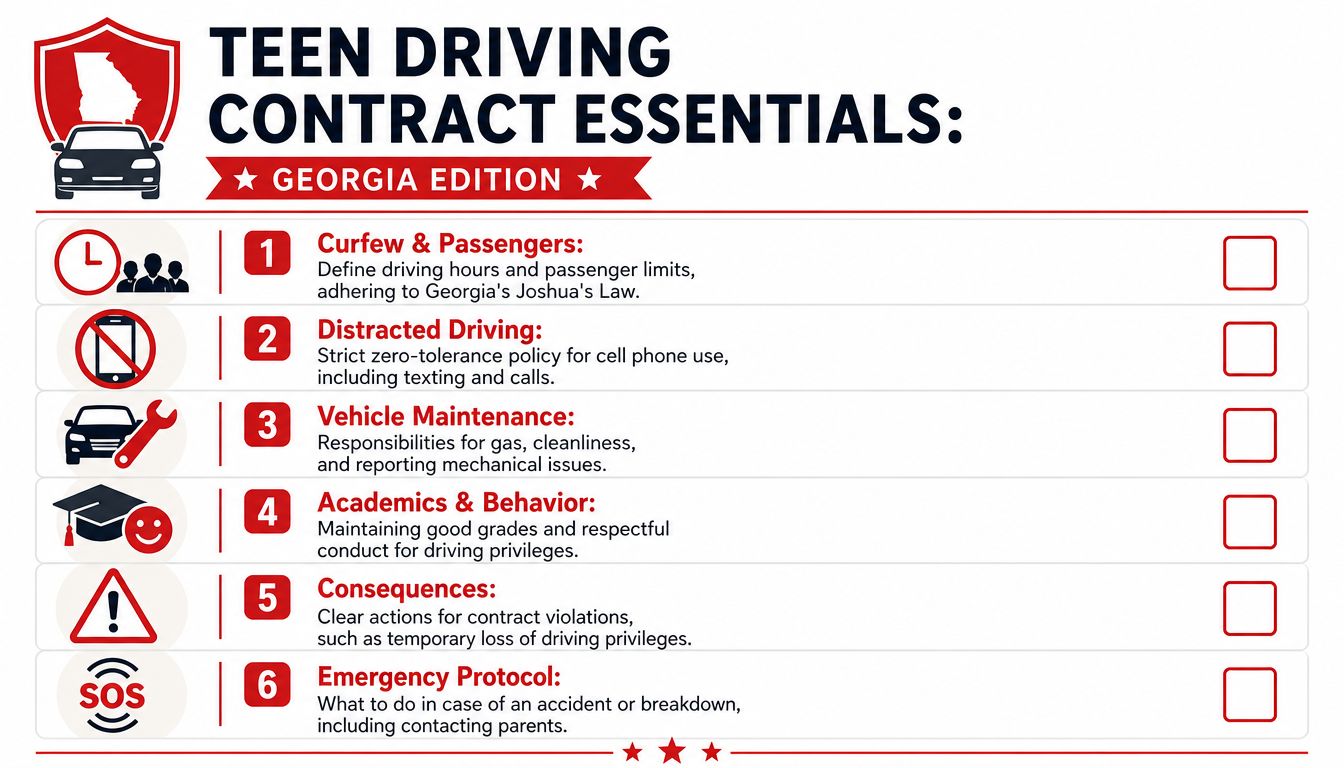
A useful contract is specific enough that nobody has to guess what a rule means. “Use common sense” is not a rule. “No phone use while the vehicle is moving or stopped in traffic” is a rule.
That level of detail matters because common contract pitfalls include vague rules. Be specific: teen drivers are 2.5 times more likely to engage in risky behaviors with one peer passenger, and 32.8% of teens admit to texting while driving, according to Children's Hospital of Philadelphia's guidance on parent-teen driving contracts.
Start with the Georgia rules that are not optional
In Georgia, a teen with an Intermediate Class D license has passenger restrictions that families should mirror in the contract. During the first six months, the teen may carry only immediate family members. During the next six months, the teen may carry only one passenger under 21 who is not an immediate family member, as explained in this overview of Georgia teen driving laws.
Those terms belong in the contract exactly as written, not in softened language.
Violating those passenger limits can lead to license consequences, points, and insurance problems under the rules described in the earlier Georgia safety source. Parents shouldn't treat this clause as flexible.
The clauses worth putting in writing
Some families do best with a one-page agreement. Others need two pages. Either way, these clauses are the ones that carry weight:
Passenger limits
Write the legal limit for the current stage of licensure. Then add any stricter house rule if needed.Phone policy
Don't write “limit distractions.” Write the exact rule. No texting, no calls, no scrolling, no handling the phone while driving.Night driving boundaries
Set clear times. If the teen may drive at night only for school, work, or family needs, say that plainly.Substance rule
Use zero-tolerance language. No alcohol. No drugs. No riding with an impaired driver. No exceptions.Seat belt requirement
Every occupant, every trip. If a passenger refuses, the car doesn't move.Trip communication
Require a text or call before departure if the destination changes. The issue is accountability, not surveillance.
Don't skip the boring parts
The strongest contracts usually include responsibilities that aren't dramatic but matter every week.
| Contract area | What to define |
|---|---|
| Vehicle care | Gas, cleanliness, reporting damage, dashboard warnings |
| Scheduling | Curfew, school-night use, work driving, recreational driving |
| Money | Fuel expectations, contribution to insurance if applicable, parking or ticket responsibility |
| Emergencies | Who to call after a crash, breakdown, or police stop |
Write consequences beside the rule
Parents often make the contract too moral and not operational enough. Put the consequence next to the violation. If the teen breaks the curfew rule, what happens next time. If the teen uses a phone while driving, what happens immediately. If the teen lies about destination or passengers, what privilege is reduced.
A contract becomes enforceable at home when each rule has a matching consequence that was agreed on ahead of time.
Keep the language plain
Don't draft this like a legal form. Use direct sentences, short clauses, and room for signatures. If a teen can read it once and repeat the main rules back to you, the contract is usable. If it reads like paperwork, it will end up in a drawer.
How to Negotiate the Contract for Teen Buy-In
Parents usually get better results when they present the contract at a calm time, not after a close call or an argument about plans. Start with the shared goal. The teen wants freedom. The parent wants safe, steady progress toward freedom.
That's not a conflict unless the conversation becomes one.

Contracts are most effective when parents actively communicate expectations and implement a graduated privilege system that expands driving access as experience and maturity increase. This collaborative process is proven to reduce risky driving behaviors, based on the step-by-step guidance in this parent-teen contract article.
Lead with the reason, not the restriction
Teens push back hardest when a rule feels random. They listen better when the parent explains the safety reason and then stays consistent.
A conversation might sound like this:
On passengers
“You're still building focus. We're keeping the car quieter while you get experience.”On curfew
“Late driving brings more variables. We'll expand hours as you show good judgment.”On check-ins
“I don't need a speech. I need to know where you are and when plans change.”
That style keeps the discussion grounded.
Build in earned freedom
A contract shouldn't read like permanent lockdown. It should include a visible path forward. Graduated privileges are what make the agreement feel fair.
A simple progression can work well:
- Initial phase with limited destinations and strict passenger control
- Expanded phase after consistent compliance with check-ins and curfew
- Broader access once the teen shows steady judgment across time and conditions
Let the teen see that every rule has a purpose and every privilege has a pathway.
A short video can help families hear how these conversations sound in real life:
Ask for input without surrendering the standard
Buy-in does not mean the teen gets veto power over safety rules. It means the teen gets to speak into logistics. Maybe they can suggest a weekend return time, a process for requesting exceptions, or a fair way to restore privileges after a minor violation.
That matters because teens are more likely to respect a document they helped shape.
Parents should still hold the line on essential rules. Passenger limits, substance rules, phone restrictions, and honesty about destination are not debate topics. The teen can help build the structure around those rules, but not erase them.
Enforcing the Rules When Your Teen Breaks the Contract
Most sample contracts get weak at the exact point families need help most. They list rules, ask for signatures, and then fade into fuzzy language when a teen breaks the agreement.
That's a real problem. A major gap in most contract templates is how to legally enforce them. They often fail to provide data-backed guidance on what parents can tangibly do beyond "taking the keys," treating the contract as a moral agreement rather than an enforceable safety mechanism, as noted in this teen driver agreement discussion.
Don't rely on improvised punishment
If parents invent consequences in the moment, teens usually experience that as anger, not accountability. The better approach is predictable enforcement.
Use a simple framework:
Minor breach
Late check-in, messy car, missed fuel agreement. Use a limited privilege reduction.Safety breach
Phone use, unauthorized passenger, speeding, dishonesty about destination. Remove driving privilege for a defined period and reset to a tighter level of access.Serious breach
Any behavior involving alcohol, drugs, racing, or deliberate defiance. End independent driving until the family reassesses readiness.
Know the boundary between house rules and legal rules
A parent-teen contract can control access to the family vehicle, but it doesn't replace state law. If a teen is driving in ways that create legal exposure, parents need to understand the actual consequences, including when a ticket may be more than a routine citation. For families trying to understand the difference, this guide to misdemeanor traffic offenses in Alpharetta gives useful context.
If the issue is unlicensed driving or a teen using a vehicle outside the lawful conditions, parents should also review practical information on teenage driving without a license. Sometimes the problem isn't just a broken family rule. It's conduct that can create bigger legal trouble.
Consequences work best when they are calm, specific, and already written into the agreement.
Match the response to the violation
Not every mistake should trigger the same penalty. A forgotten check-in and a hidden passenger are not equal. When parents treat every issue the same, teens stop taking the distinctions seriously.
The goal is not to “win” the argument. The goal is to connect choices to outcomes so the teen learns that driving freedom depends on judgment.
Your Partner in Creating Confident and Safe Drivers
A driving contract for teenagers works best when it closes the loop between training and independence. It gives parents a way to carry safe habits out of the classroom, through lessons, and into the first months of real-world driving.
That's why the smartest families don't treat the contract as a stand-alone form. They pair it with quality instruction, repeated practice, and a clear plan for gradual freedom.
What parents should focus on first
Before worrying about the perfect wording, get the sequence right:
- Start with driver education that meets Georgia requirements
- Add professional driving lessons so the teen gets coached on actual road behavior
- Use lesson packages when the teen needs repetition, confidence, or correction in specific areas
- Handle road test preparation seriously so test day doesn't become the only measure of readiness
- Use the contract as reinforcement once the teen has skills to protect
Parents also make better decisions when they think practically about the vehicle itself. If your family is still deciding what the teen will drive, VekTracer's first car advice is a useful resource for weighing beginner-friendly options without overcomplicating the decision.
A calm system beats constant reminders
The families who manage this stage best usually aren't the loudest or the strictest. They're the clearest. They give the teen instruction, put expectations in writing, revisit the agreement as experience grows, and stay steady when enforcement is necessary.
That approach builds something better than short-term compliance. It builds habits.
If your teen is about to move from supervised practice to independent driving, don't wait for the first mistake to set the rules. Put the contract in place while everyone is calm, and tie it directly to the skills your teen is learning on the road.
If you're ready to turn driver education into real-world readiness, A-1 Driving School offers Georgia Joshua's Law courses, online driver's education options, road testing support, the Georgia Driver's Education Scholarship Grant Program, and driving lessons packages that give teens the structured practice a contract can reinforce at home.