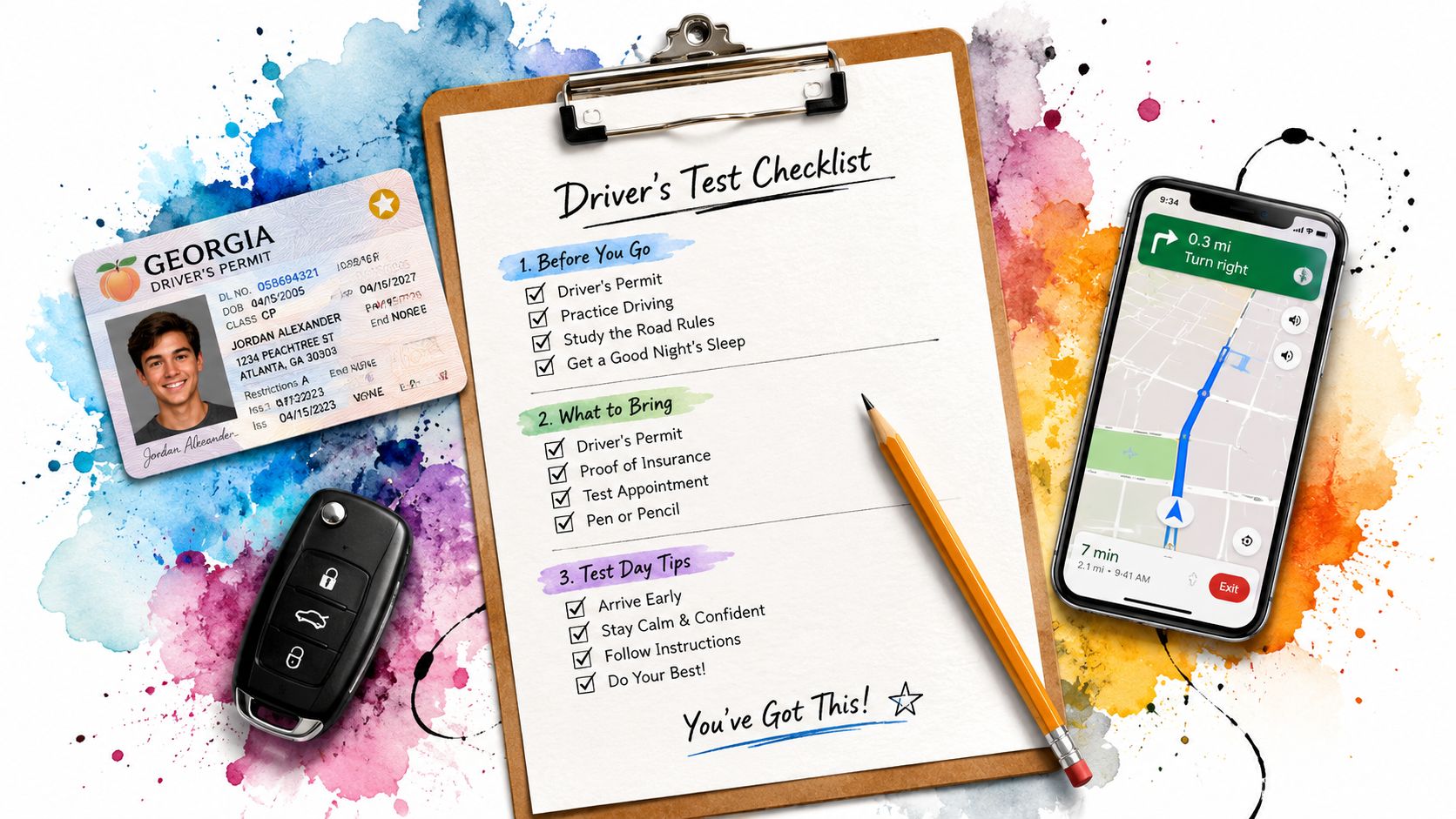
Your Ultimate Georgia Driver's Test Checklist
Getting ready to take your Georgia driver's test can feel overwhelming. You've practiced your three-point turns and parallel parking, but what do you need on test day? A common tendency is to focus on driving skills first and paperwork second, and that's exactly how people get stuck. A missing certificate, the wrong vehicle, or an incomplete driving log can stop your test before the examiner even gets in the car.
To take the drivers test in Georgia, you need more than a generic document list. You need a Georgia-specific plan that covers Joshua's Law, permit requirements, test-day vehicle rules, and the fastest way to get tested. That matters even more for teens, because Georgia has separate training and licensing rules for drivers under 18.
Georgia requires teen drivers to complete specific education and supervised practice before they can move forward, and the state also allows DDS-approved online coursework for the classroom portion of driver education through Georgia road test prep guidance from Kennesaw Driving School. That flexibility helps, but only if you choose the right course, finish the right steps, and keep the right records.
A-1 Driving School fits into that plan in a practical way. You can handle Joshua's Law training, book driving lessons, prepare for the road test, and schedule testing support through one provider instead of piecing everything together yourself. That's the easiest way to avoid last-minute surprises.
1. Required Documents & Identification
Most failed test-day check-ins happen before the car moves. The examiner or front desk staff asks for your documents, and one missing item sends you home. If you're asking what do I need to take drivers test, start with your paperwork first.
For teen applicants, Georgia expects a full packet, not just a permit and a smile. Bring original or accepted identity documents, your lawful presence documents, and proof that you've completed the required school and driver education steps if those apply to you.
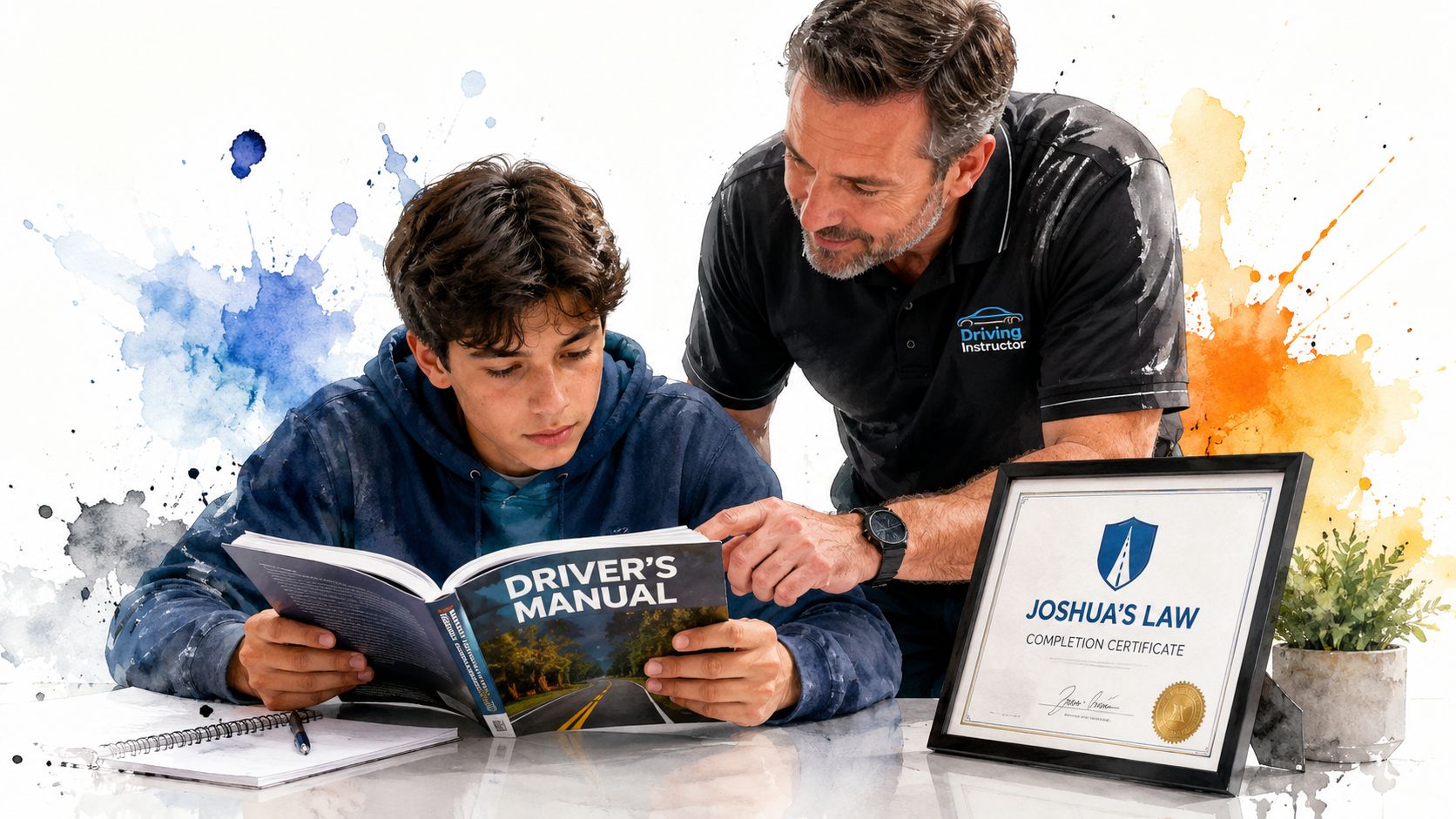
What to gather before test day
- Proof of identity: Bring an original birth certificate or a valid U.S. passport.
- Proof of Social Security number: Use your original Social Security card or a W-2.
- Two proofs of Georgia residency: Utility bills, bank statements, or a school report card can help show where you live.
- Proof of U.S. citizenship or lawful presence: Make sure the name matches your other records.
- School enrollment form if required: Teens commonly need the Georgia Certificate of School Enrollment, Form DS-1, dated within the last 30 days.
- ADAP or eADAP completion card: Teens need to complete the Alcohol and Drug Awareness Program before getting a Georgia license, and the card must be presented when applying according to Georgia ADAP and Joshua's Law course guidance from NHSA.
- Joshua's Law certificate: If you're 16 or 17, keep your completion certificate from a DDS-certified school such as A-1 Driving School's Georgia ID and licensing guide.
Practical rule: Put every document in one folder the night before your appointment. Don't rely on screenshots, old emails, or memory.
Adult drivers should pay close attention here too. Georgia's testing system often gets explained through teen rules, but adults follow a different path. Drivers 18 and older generally don't need the 40-hour driving log or DS-1 form, and the state's Georgia DDS testing and exams information highlights that adult applicants face a separate documentation path focused on identity and lawful status.
2. A Test-Ready Vehicle & Insurance
Your road test can end before you leave the parking lot. If the car fails a basic safety check or you cannot show proof of insurance and registration, the examiner can refuse the test on the spot. Check the car the day before, not after you arrive.

Georgia applicants bring their own vehicle for the road test. That means the responsibility is yours. If you are testing through DDS or booking with A-1 Driving School to avoid long state scheduling delays, the same rule applies. Bring a legal, safe, working car with current registration, a valid license plate, and active insurance.
Check these items before test day
- Registration and insurance card: Keep both current and easy to grab.
- Brake lights, headlights, and turn signals: Test every light.
- Horn and windshield wipers: Both must work.
- Driver-side window and defroster: The window should roll down fully, and the defroster should turn on.
- Tires and front seatbelts: Tires need safe tread, and both front seatbelts must latch.
- Warning lights: Do not use a car with dashboard warnings that suggest a safety problem.
- Front passenger area: Clean out the front seat and floor to give the examiner clear, unobstructed space.
Small problems can cancel the test. A blocked windshield, worn tires, a broken signal, or a seatbelt that will not click shut is enough. Without those basics, your test is over before it begins.
Use this Georgia road test vehicle inspection checklist from A-1 Driving School and go item by item. Do not guess. If the car was recently repaired after a crash and you are still sorting out paperwork, this step-by-step auto insurance claim guide can help you organize the insurance side.
Put the registration and insurance card in the glove box the night before. Then confirm you can reach them in seconds. That simple step cuts stress fast.
3. Your Learner's Permit & Driving Experience
A permit isn't just permission to practice. It's the clock that starts your path to the road test. If you haven't held it long enough or you haven't logged enough supervised driving, you aren't ready to apply.
For teens under Joshua's Law, Georgia requires a minimum of 40 hours of supervised driving, including at least 6 hours at night through Certus driver's education information. Keep that log current and signed. Don't wait until the last week and try to rebuild it from memory.
What your experience record should include
- Valid Georgia learner's permit: Bring your Class CP permit and make sure it's not expired.
- Supervised practice log: Record your driving consistently with dates, hours, and the supervising adult's signoff.
- Night driving entries: Make sure your night hours are clearly separated so you can prove you've completed them.
- Parent or guardian review: Ask them to check the log for missing dates, math errors, or blank signatures.
Some students meet the legal minimum and still aren't road-test ready. That's common. The legal requirement proves compliance. It doesn't guarantee skill under pressure.
Zutobi's Georgia road test guide notes that while Joshua's Law sets a minimum of 6 hours of behind-the-wheel instruction for teens under 18, many new drivers typically need more professional instruction to become fully road-test ready. That's why students who only check the legal boxes often struggle with backing, spacing, and smooth decision-making during the exam.
Don't confuse legal minimums with actual readiness
If your driving experience is mostly easy neighborhood trips, add more variety before the test. Practice lane changes, right-of-way decisions, parking, quick stops, backing, and left turns in traffic.
Professional driving lessons help most when you've already built basic comfort behind the wheel. That's when an instructor can fix habits, tighten observation, and prepare you for exactly what the examiner scores.
4. Joshua's Law Course Completion
If you're 16 or 17, handle Joshua's Law early. Waiting on this course is one of the easiest ways to delay your Georgia license, even if your permit, practice hours, and test skills are in good shape.
Georgia requires a DDS-approved driver education course before a teen can qualify for a Class D license. The official Georgia DDS Joshua's Law requirements page explains the rule clearly. The classroom portion can be completed in person or online. That gives families more flexibility around school, work, and sports.
What to finish before you book your test
- 30-hour driver education course: Complete it through a DDS-approved provider.
- Approved format: In-person and online classes can count if the provider has DDS approval.
- Course certificate: Save your completion record right away. Do not wait until test week to find it.
- Training records: Keep your course paperwork with your permit documents so nothing gets lost.
A lot of families make the same mistake. They treat Joshua's Law like a box to check at the end. That's backwards. Finish the course early, keep the certificate, and make sure your records are easy to pull when it's time to schedule the road test.
Another point matters here. Online coursework covers the classroom side, but it does not automatically cover every driving requirement. SafeMotorist explains that teens can meet part of the requirement by completing 6 hours of behind-the-wheel instruction with a DDS-certified instructor, instead of relying only on parent-supervised driving.
If your family wants a Georgia-specific plan that stays organized from start to finish, use A-1 Driving School's driver's education and Joshua's Law courses. Taking the course and handling your driving training through one school usually makes the paperwork simpler. It also sets you up for the next step, booking your actual road test with a certified provider like A-1 instead of getting stuck waiting on DDS availability.
5. An Appointment or a Spot with A-1
A lot of students prepare for the test and forget to prepare for the booking. That's backwards. Your appointment date controls your practice timeline, your document deadlines, and your stress level.
You have two practical options in Georgia. You can book through DDS, or you can schedule through a certified third-party testing provider such as A-1 Driving School. If your family wants a more direct path with lesson support and test prep in the same place, the school route is usually easier to manage.
Two ways to line up your road test
- DDS appointment: Book through the state system and keep your confirmation details.
- A-1 road test scheduling: Use A-1 Driving School's Georgia road test service if you want a more convenient school-based option.
- Location check: Confirm the exact address, arrival process, and parking instructions before test day.
- Timing plan: Schedule lessons close enough to the test date that your skills stay sharp.
A driving school appointment also makes sense if you want more structure. Students often feel calmer when they test in a familiar environment, especially if they've already practiced there or worked with the same team on lessons and pre-test preparation.
Instructor advice: Don't book your road test first and hope your skills catch up. Book lessons, identify weak spots, then lock in the test date.
A-1's driving lessons and lesson packages are especially critical. Instead of scrambling for separate online coursework, separate in-car training, and separate test preparation, you can build one connected plan. That saves time, reduces confusion, and makes your final week of practice much more focused.
6. The Skills to Pass the Test
Your paperwork can be perfect and your appointment can be booked. If your driving is sloppy, you still fail.
Georgia road tests reward safe, steady habits. The examiner wants to see control, awareness, and good judgment on every basic task. Small mistakes add up fast, so treat every stop, turn, mirror check, and parking move like it counts, because it does.
What the examiner is judging
- Car control: Smooth starts, smooth stops, steady steering, and backing without drifting.
- Core maneuvers: Quick stops, three-point turns, straight-line backing, and parking.
- Observation: Mirror checks, blind spot checks, signaling, and watching cross traffic.
- Lane discipline: Staying centered, turning into the correct lane, and keeping proper spacing.
- Rule obedience: Full stops, yielding correctly, and following signs and signals.
- Decision-making: Staying calm, fixing a small error safely, and not rushing the next move.
A lot of teens obsess over parallel parking. That is a mistake. Examiners also watch the habits between maneuvers, especially at intersections and during lane changes. If you roll a stop, skip a head check, or crowd a lane line, your score drops for things that were easy to prevent.
Practice like the test is graded from the moment the car moves. Use the same routine every time: adjust, buckle up, check mirrors, scan, signal, then move. That kind of consistency is what passes road tests.
If you have weak spots, fix them before test day. A-1 Driving School's driving lessons help because an instructor can catch habits your parent may miss, then drill the exact skills Georgia examiners score. For a final polish, review A-1's driving test preparation guide and run through your stops, backing, parking setup, and intersection scans until they feel automatic.
My advice is simple. Do not just practice until you get it right. Practice until you cannot do it wrong.
7. A Calm and Confident Mindset
What if you have every document, a legal car, and enough practice, then blow the test because your nerves take over? That happens all the time. Anxiety makes simple decisions sloppy. A normal stop feels rushed. A basic turn feels harder than it should.
Your goal on test day is control. Calm drivers make better decisions, follow instructions better, and recover faster from small mistakes.
Build a test-day routine that keeps you steady
- Sleep enough: Go in rested. A tired brain misses signs, speed changes, and instructions.
- Eat first: Have a simple meal or snack before you leave.
- Arrive early: Get there 15 to 20 minutes ahead so you do not feel rushed.
- Ask if needed: If the examiner gives an instruction you do not understand, ask them to repeat it.
- Recover quickly: One small mistake will not automatically end the test, so stay focused on the next decision.
Handle the basics before the examiner ever opens the car door. Use the bathroom. Silence your phone. Adjust your seat and mirrors. Take one slow breath before you put the car in gear.
If you wear glasses or contacts, bring them and use them. Georgia includes a vision screening before the road test, so do not create a preventable problem for yourself.
"Drive the car you're in, not the mistake you just made."
That is the right attitude for a Georgia road test. Examiners are looking for safe judgment, not perfect performance. If you make a minor error, correct it safely and keep driving. Do not let one shaky moment ruin the next three decisions.
This matters even more if you booked through A-1 Driving School to avoid DDS scheduling delays. A faster appointment helps, but only if you show up settled, alert, and ready to drive like you already belong on the road.
8. Knowledge of Financial Assistance (Scholarship Program)
Worried that driver education costs will slow you down? Check for financial help before you cut lessons, delay Joshua's Law, or try to piece everything together on your own.
A practical option is the Georgia Driver's Education Scholarship Grant Program through A-1 Driving School. If your family qualifies, it can reduce the cost of the training Georgia teens often need most, including the classroom course and in-car instruction tied to Joshua's Law.
That matters because cheaper is not the same as prepared. A teen who gets the required training, then keeps going with guided practice and test prep, usually shows up far more ready for the road test.
Why the scholarship matters
- It helps families pay for the classroom course requirement.
- It can reduce the cost of in-car driving lessons.
- It gives students a clearer path from Joshua's Law completion to road-test prep.
- It helps families train properly instead of stopping at the bare minimum.
- A-1 can explain the application process and what training the grant may cover.
This is one of the smartest Georgia-specific steps in your plan. Handle the funding question early. Then you can complete Joshua's Law with a flexible course option, schedule the driving you still need, and put yourself in a better position to book the actual road test through A-1 instead of waiting around on the DDS calendar.
If cost is part of your decision, ask about scholarship options first. Do that before you assume professional training is out of reach.
8-Point Comparison: Drivers Test Requirements
| Item | Implementation complexity | Resource requirements | Expected outcomes | Ideal use cases | Key advantages |
|---|---|---|---|---|---|
| Required Documents & Identification | Low–Moderate, collect and verify originals | IDs, SSN proof, residency docs, school/enrollment & certificates | Eligibility to take the test; avoid being turned away | All applicants, especially teens obtaining first license | Prevents last-minute denial; ensures compliance with DDS rules |
| A Test-Ready Vehicle & Insurance | Moderate, pre-test inspection and paperwork check | Registered vehicle, current insurance, working lights/horn, safe tires | Pass vehicle inspection; test proceeds as scheduled | Applicants using personal vehicles; those without school vehicles | Ensures safety compliance; avoids instant cancellation |
| Your Learner's Permit & Driving Experience | High, long-term requirement and logged hours | Valid Georgia permit, 40 supervised hours (6 night) logged & signed | Meets legal eligibility for road test | New teen drivers building supervised experience | Builds practical driving skill and legal readiness |
| Joshua's Law Course Completion | Moderate, complete classroom + in-car hours | 30 hours theory (class/online), 6 hours certified behind-the-wheel, completion certificate | Certificate required for licensing for 16–17 year olds | Teens mandated by Joshua's Law | State-approved curriculum; standardized safety training |
| An Appointment or a Spot with A-1 | Low, scheduling and confirmation required | Online DDS slot or A-1 booking; appointment confirmation | Secured test time; possible faster access than DDS | Candidates who want faster testing or third-party testing | Faster scheduling; familiar testing environment with instructor |
| The Skills to Pass the Test | High, skill mastery and targeted practice | Practice time, instructor lessons, practice setups (cones, routes) | Competence to perform maneuvers and pass road test | All test-takers preparing for exam day | Reduces failure risk; develops essential safe-driving behaviors |
| A Calm and Confident Mindset | Low, mental preparation and routine | Adequate sleep, nutrition, arrival buffer, relaxation techniques | Lower anxiety; clearer focus during test | Nervous or first-time test-takers | Improves performance; mitigates simple mistakes under pressure |
| Knowledge of Financial Assistance (Scholarship Program) | Moderate, application and eligibility verification | Proof of need, application forms, coordination with A-1 | Reduced or covered cost of Joshua's Law course and lessons | Low-income families seeking affordable driver education | Increases access to professional training; removes cost barrier |
Ready to Ace Your Georgia Road Test?
Passing your Georgia driver's test comes down to preparation, not guesswork. If you're asking what do I need to take drivers test, the answer is bigger than a short document checklist. You need the right identification, a valid permit, the required training, a safe vehicle, enough practice, and a clear plan for the actual appointment.
Teen drivers need to pay special attention to Joshua's Law. That means finishing the required driver education steps, keeping the correct certificates, and making sure supervised driving records are complete before test day. Adult drivers need a different kind of clarity. They should focus on identity and lawful presence documents and avoid getting distracted by teen-only requirements that don't apply to them.
Your vehicle matters just as much as your paperwork. If the car isn't registered, insured, and mechanically ready, the test can be canceled on the spot. Your driving matters even more. Basic maneuvers, parking, mirror checks, lane position, and calm decision-making are what carry you across the finish line.
A connected training plan makes this much easier. Instead of trying to patch together an online course, parent practice, random lessons, and a last-minute test date, use one path that keeps everything organized. That's where driving lessons and lesson packages are most useful. They help you turn legal eligibility into actual road-test readiness.
If you need Joshua's Law coursework, online course options in Georgia, road test preparation, or a practical place to line up lessons before your exam, A-1 Driving School is one relevant option. The school offers driver's education, Joshua's Law training, driving lessons, and Georgia road test support in one system, which can simplify the entire process for both teens and adults.
Start early. Check your documents early. Inspect your vehicle early. Book lessons before you think you need them. That approach gives you the best chance to walk into your appointment calm, prepared, and ready to pass on the first try.
If you're ready to move from planning to action, A-1 Driving School can help you handle the steps in one place, from Joshua's Law and online driver's education to driving lessons, lesson packages, road test preparation, and Georgia road testing support.