The accident is over, but your hands may still be shaking. You're standing by the shoulder, traffic is moving again, and your phone suddenly feels like the most important tool you own.
That's the moment many Georgia drivers lose control of the process. Not because they did anything wrong behind the wheel, but because they didn't know what to document, what to save, or what to ask for before the scene changed.
Good insurance claim documentation turns a confusing event into a clear record. It helps you show what happened, what was damaged, what treatment you needed, and what costs followed. When your notes, photos, records, and repair paperwork line up, you give the insurance company less room to question basic facts.
After the Accident What Matters Most
A new driver gets rear-ended at a red light in metro Atlanta. Nobody appears badly hurt at first. The other driver says, “Let's keep this simple.” Cars get moved. A few quick phone photos get taken. By that evening, neck pain starts. Two days later, the bumper damage looks worse in daylight. A week later, the driver realizes they never got a witness name, never confirmed the report number, and never saved the exact time of the crash.
That's how small gaps become big problems.
In insurance work, documentation isn't busywork. It's your proof. It tells the story when memories fade, when people disagree, and when an adjuster reviewing your file wasn't anywhere near the scene. If your records are thin, your claim can slow down or become harder to support.
The financial side of poor documentation is serious. Documentation gaps are the leading contributing factor in 67% of errors and omissions claims filed against independent insurance agencies, with each incident costing the average agency between $35,000 and $75,000 according to this insurance compliance analysis. That same source explains that inadequate claim documentation is a primary driver of financial liability.
Practical rule: The accident scene won't stay frozen for you. Skid marks fade, vehicles get moved, witnesses leave, and memories start changing within hours.
For Georgia drivers, the first goal is simple. Stay calm enough to build a clean record. You don't need perfect legal language. You need accurate details, stored in one place, in the right order.
That starts with knowing the basic accident steps before you ever need them. A quick review of these Georgia accident response procedures can make the first few minutes feel far less chaotic.
What documentation really does for you
Insurance claim documentation helps you do three things at once:
- Show what happened: Photos, police details, and witness information anchor the event in facts.
- Show what changed after the crash: Medical visits, repair estimates, and receipts connect the accident to real losses.
- Show that you acted responsibly: Prompt reporting, organized files, and a communication log make your claim easier to review.
When drivers understand that, they stop treating paperwork like an afterthought. They start treating it like protection.
Your Immediate Post-Accident Documentation Checklist
Right after a crash, your job isn't to build the whole claim. Your job is to capture what only exists at the scene.
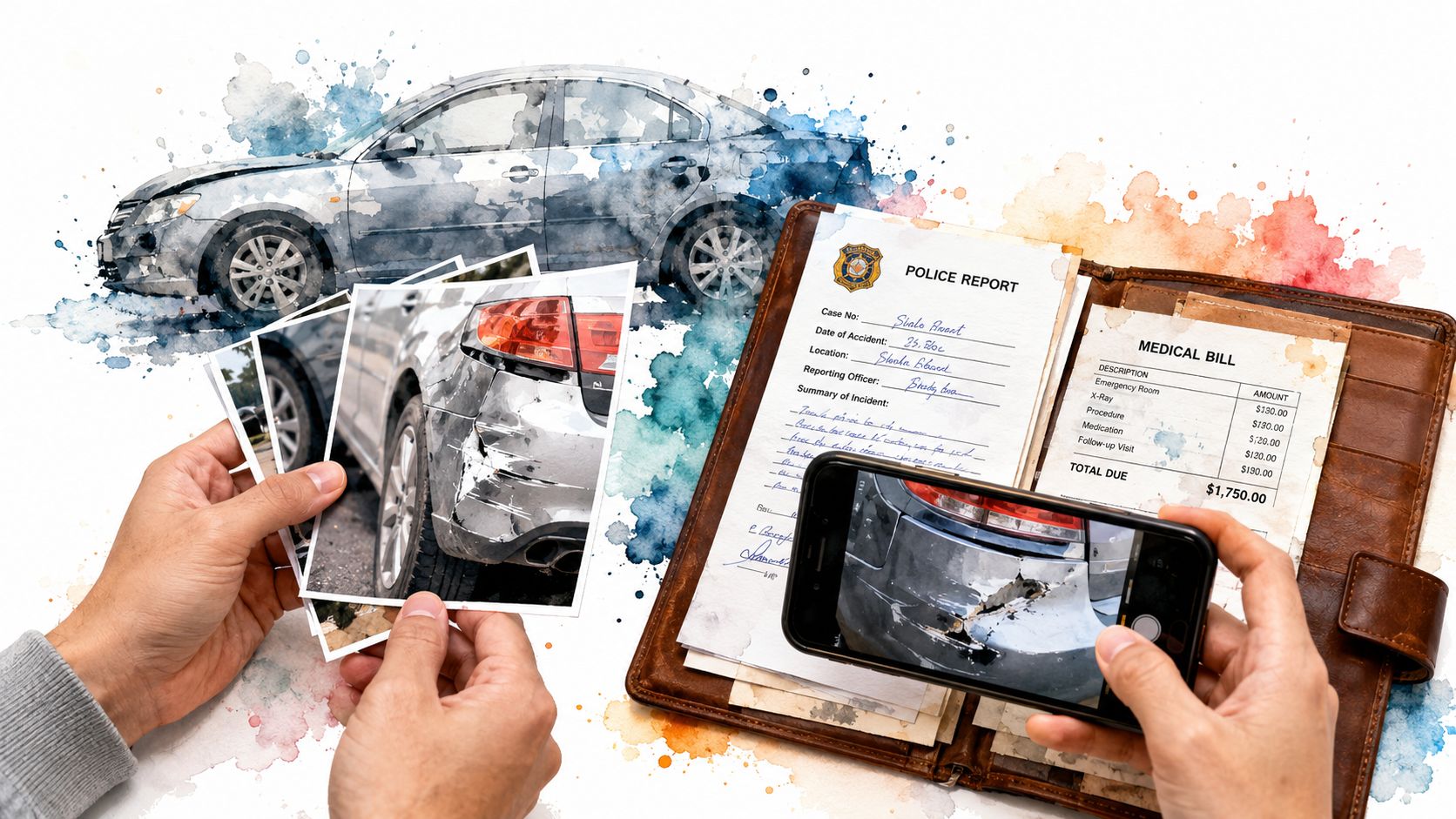
Full auto accident claims require four primary evidence categories: incident documentation, medical documentation, financial documentation, and policy or legal documentation. The core document set mandates the police report, photos of all vehicles and the scene, and the other driver's information according to this accident claim documentation guide.
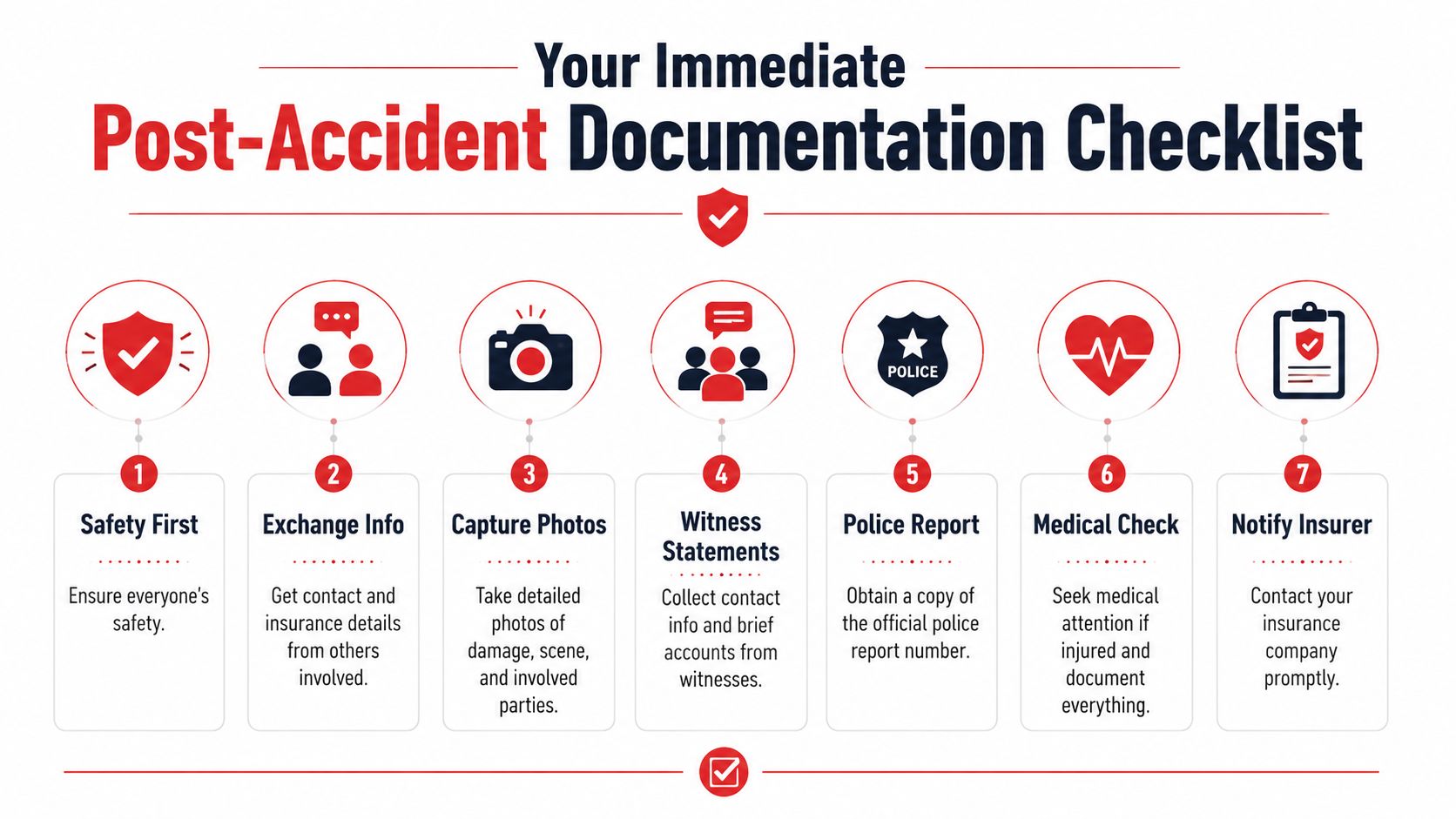
If you're rattled, use this as your mental checklist.
Start with safety and location control
Before you document anything, make sure people are safe and traffic danger is reduced as much as possible.
- Check for injuries: If anyone may be hurt, call for help and don't minimize symptoms.
- Move only when appropriate: If the vehicles can be moved safely and local instructions allow it, get out of active traffic.
- Mark your location: Save the street name, nearby intersection, direction of travel, and visible landmarks in your phone notes.
Take photos in a sequence that makes sense
Random pictures are better than none, but a planned sequence is stronger.
Wide shots first
Take photos that show the entire scene before focusing on damage. Include lane positions, intersections, traffic signs, debris, and road conditions.
Then move closer
Photograph each vehicle from multiple angles. Capture all visible damage, including areas that seem minor. Damage often looks different later.
Don't miss context
Road surface, weather, standing water, broken glass, skid marks, and traffic signals matter. They can help explain how the collision happened.
Take enough photos that a stranger could understand the scene without you standing there to explain it.
Exchange the right information
Drivers often leave with only a first name and an insurance card photo. That's not enough.
Collect:
- Driver identity: Full name and driver's license information.
- Insurance details: Company name, policy information, and phone number.
- Vehicle details: Make, model, color, tag number.
- Contact details: Current phone number and address if available.
If the other driver seems rushed, stay polite and focused. Verify that the photo you took is readable before they leave.
Get the police report details
If law enforcement responds, ask how to get the report number and where to request a copy. Don't assume you'll remember later.
Write down:
- Officer name
- Badge number if provided
- Agency name
- Report or incident number
- Date and time
That official report becomes one of the anchors of your insurance claim documentation.
Talk to witnesses briefly
Witnesses don't need to give a full statement to help you. You mainly need a way to reach them later.
Ask for:
- Name
- Phone number
- Email if they're willing
- Short note on what they saw
A simple note such as “saw silver SUV enter intersection after light changed” is useful. Keep it factual.
Document your own condition
Even if you think you're okay, note how you feel. Symptoms can show up later.
Use your phone to record:
- Pain areas
- Dizziness or headache
- Whether you hit your head
- Whether airbags deployed
- Whether you were able to drive away
If you want a quick refresher focused on drivers in this exact situation, this guide on what to do after a car wreck is worth saving to your phone.
Building Your Claim File in the Following Days
Once the scene is over, the claim shifts from evidence capture to evidence building. At this stage, many drivers relax too early. They reported the crash, maybe uploaded a few photos, and assume the rest will sort itself out.
It usually won't.
Your claim file needs documents that explain treatment, repair costs, time away from work, and out-of-pocket expenses. Think of it as building a folder that answers questions before the adjuster asks them.
Medical records matter more than memory
If you went to the ER, urgent care, your primary doctor, physical therapy, or a specialist, save every record from each visit. Don't rely on a portal alone. Download or request copies.
The most helpful records usually include:
- Visit summaries: These show date, symptoms, and treatment.
- Diagnostic reports: Imaging and test results support injury claims.
- Physician notes: These connect your complaints to the crash.
- Itemized bills: These are more useful than broad summary statements.
One common point of confusion is billing. A summary may show a total balance, but it often doesn't show what services were provided. Itemized bills give the insurer a clearer record.
Vehicle damage needs its own paper trail
Your photos show visible damage. Repair records show what it will cost to fix it.
Gather and save:
- Repair estimates from licensed facilities
- Supplemental estimates if hidden damage is found
- Tow invoices
- Storage fees if any
- Final repair invoice
- Rental car receipts
If the shop finds additional damage after teardown, save that update as a separate document. It helps explain why the original estimate changed.
Financial losses aren't just repair costs
A crash can create a string of smaller expenses that drivers forget to track. Those costs are easy to lose if you don't collect them right away.
A simple system works well. Create one folder called “Expenses” and drop everything into it as you go.
| Document type | Why it helps |
|---|---|
| Pay stubs | Shows normal earnings before missed work |
| Employer letter | Confirms missed days or reduced hours |
| Medication receipts | Ties out-of-pocket treatment costs to recovery |
| Transportation receipts | Supports travel costs related to treatment or vehicle loss |
| Car seat or personal item replacement receipts | Shows other crash-related losses if applicable |
Save documents in the form they arrive. Don't wait until later to “organize them better.” Later is when papers disappear.
Keep a short daily timeline
You don't need a formal legal memo. You need a clean timeline.
Write down key events in date order:
- Accident date and time
- Claim reported
- Medical visits
- Repair inspections
- Adjuster calls
- Work missed
- Payments or reimbursements received
That timeline helps you spot missing records early. It also makes later conversations easier because you're not guessing.
How to Organize and Submit Your Claim Documentation
A strong claim file isn't just complete. It's easy to follow.
That matters because the person reviewing your documents didn't live through your week. They're looking at uploads, emails, PDFs, photos, and notes. If your file is clean, your story is easier to verify. If it's scattered, simple questions take longer to answer.
A useful framework comes from this evidence collection protocol for insurance claims, which recommends a four-phase process: review the insurer's checklist, capture timestamped photos, obtain certified copies of official reports, secure professional assessments, and archive everything in cloud storage.
Build one master file
Use either a cloud folder, a physical binder, or both. Most drivers do best with a digital master folder and a smaller paper backup for critical items.
A practical folder structure might look like this:
- Accident scene
- Police report
- Medical records
- Medical bills
- Repair estimates
- Repair invoices
- Rental and transport
- Lost wages
- Communication log
- Claim submission proof
Keep file names simple and readable. “2026-03-14 ER visit summary” is much better than “IMG_4821” or “scan final maybe.”
Keep a communication log
A communication log is one of the most underrated parts of insurance claim documentation. It doesn't need special software. A notebook, spreadsheet, or notes app works fine.
Track these details every time you speak with the insurer, repair shop, or medical office:
| What to record | Example |
|---|---|
| Date and time | Tuesday afternoon |
| Who you spoke with | Adjuster, office clerk, estimator |
| Direct contact info | Phone or email used |
| What they asked for | Itemized bill, report copy, estimate revision |
| What you sent | PDF upload, email attachment, portal submission |
| What happens next | Waiting for review, follow-up call, inspection |
Drivers often assume they'll remember a phone call. They usually don't.
Match your insurer's submission method
Some insurers want uploads through an app or portal. Others accept email. In some situations, mailed copies still make sense, especially when you want a paper trail for key records.
Keep this habit: Every time you submit something, save proof that you submitted it. That can be a portal confirmation, email sent folder screenshot, or mailing receipt.
A good parallel exists outside auto claims. If you've ever looked at a medically detailed approval process like Georgia Plastic's panniculectomy guide, you'll notice the same pattern: the stronger the records and the clearer the submission package, the easier it is to support the request.
This short video gives a helpful overview of organizing claim materials before submission.
Use both digital and physical backups
Digital files are easier to upload and search. Physical copies are useful when portals fail, emails get buried, or you need to bring documents to an appointment.
For Georgia drivers trying to understand the policy side of the process, this car insurance guide for Georgia motorists helps clarify the terms and expectations behind claim handling.
Common Documentation Mistakes That Weaken Your Claim
Most weak claims don't fall apart because of one dramatic mistake. They weaken because of several small ones.
A major trap is assuming the insurer will “figure it out” from whatever you send. That approach puts the burden on the reviewer to connect dots you should've connected yourself.
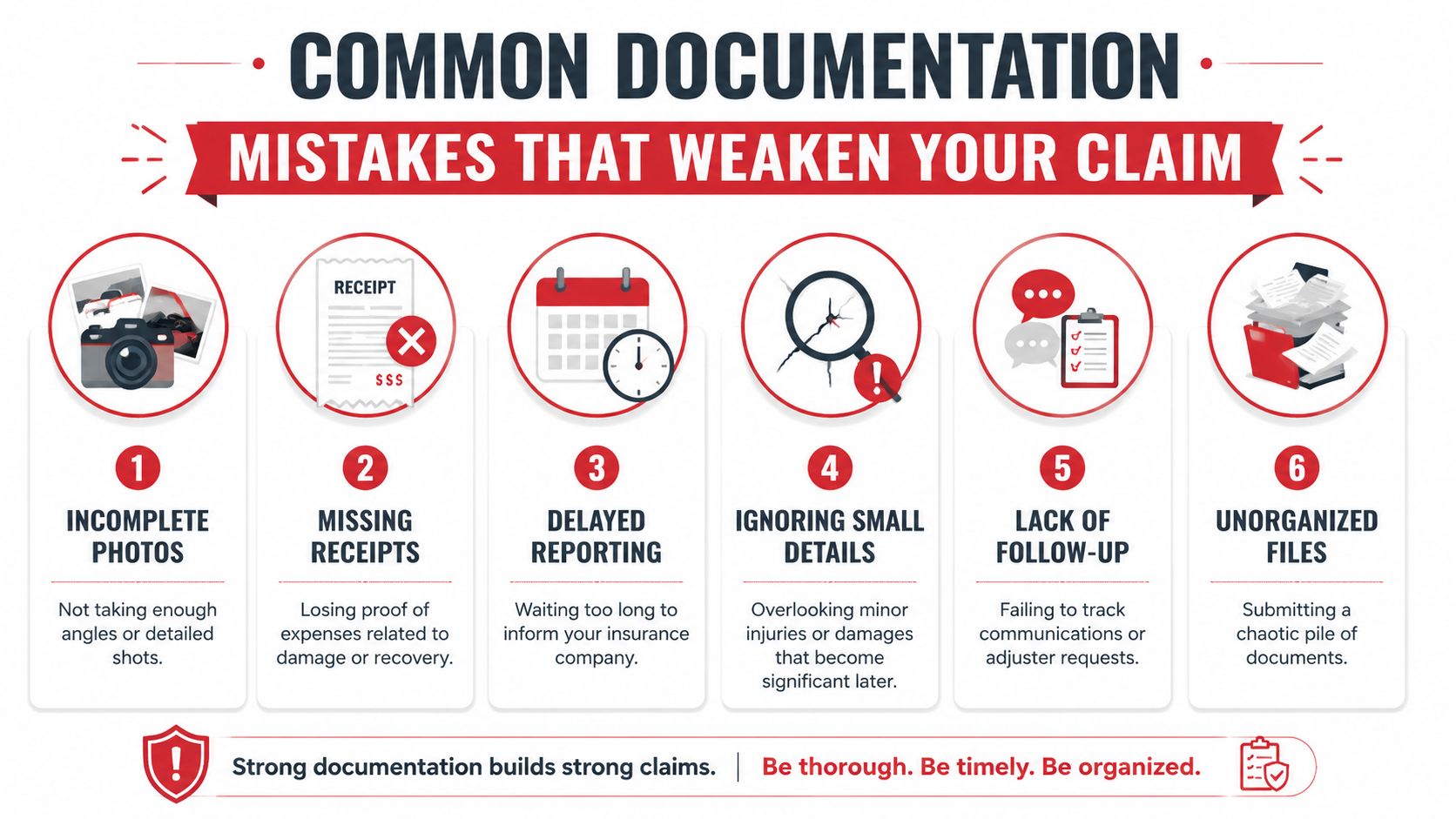
According to this review of claim documentation pitfalls, common problems include failing to document pre-existing damage separately, neglecting to create a chronological claims diary, and submitting summary bills instead of itemized hospital bills. The same source notes that claims with complete diaries and multiple written estimates from certified shops have significantly higher success rates.
Mistake one: mixing old damage with new damage
Say your car already had a scrape on the rear bumper, and now a new crash damages the same area. If you don't separate what existed before from what happened in this accident, you create doubt.
A better approach is simple. Label prior photos if you have them. Tell the repair shop what was pre-existing. Keep the description factual.
Mistake two: treating calls like they don't count
Drivers are careful with forms but casual with phone calls. That's backwards.
If an adjuster asks for something by phone and you don't write it down, you may miss deadlines, send the wrong document, or forget what was discussed. Your claims diary protects you from that drift.
Mistake three: sending vague billing records
Hospitals and clinics often produce broad account summaries. Those may not show enough detail to support treatment-related reimbursement.
Use this quick check:
- If it only shows a balance due, ask for more detail
- If it doesn't list services, ask for itemization
- If dates are missing, request a corrected copy
Small documentation errors create big credibility problems. The insurer may not deny the whole claim, but they may question parts of it.
Mistake four: forgetting that your file should tell a story
A pile of photos, receipts, and emails isn't the same as a claim package. When records arrive out of order, unlabeled, or incomplete, the insurer has to slow down and ask basic questions.
That's avoidable. Your file should answer these, without extra explanation:
- What happened?
- What damage followed?
- What treatment followed?
- What costs followed?
- What proof supports each step?
When your records do that, your claim stands on firmer ground.
From Reactive to Proactive A Prepared Driver's Advantage
The best time to think about insurance claim documentation is before you need it. Not because you expect a crash, but because preparation changes how you respond under pressure.
Drivers who've had solid training usually handle the aftermath better. They tend to notice road position, traffic signals, lane relationships, and sequence of events more clearly. Those observations become useful records later. Calm habits behind the wheel often lead to calm habits after the crash.
That's one reason formal driver education matters beyond the road test. In Georgia, to qualify for a Class D driver's license at age 16, a student must be at least 16 years old, have held a learner's permit for at least 12 months and 1 day, and fully complete Joshua's Law requirements including the 30-hour course, 6 hours of professional instruction, and 40 hours of supervised driving according to Georgia driver education requirements for Class D licensing.
Why this matters for Georgia families
A Joshua's Law course helps teens build structure. Online course options can make the classroom requirement easier to fit into a busy family schedule. Professional driving lessons add something even more valuable. Live coaching in traffic, at intersections, during lane changes, and in parking situations where many new drivers freeze.
Road testing matters too. Not just for passing, but for getting used to performing under pressure while following procedure.
Georgia families should also pay attention to access. The Georgia Driver's Education Scholarship Grant Program can help eligible students pursue required training, and that can make the difference between delaying instruction and getting started now.
Skill beats panic
After an accident, the driver who does best usually isn't the loudest or most confident. It's the one who knows how to slow down, observe, document, and follow steps.
That mindset can be taught.
If you want help building those habits before a stressful moment happens, A-1 Driving School offers Georgia-focused driver's education, Joshua's Law courses, online class options, road testing support, and driving lessons built for teens and adults who want more than the minimum. Their driving lesson packages are especially useful for families who want guided practice, stronger road awareness, and a clearer path from permit to confident daily driving.